I’m seventy years old, and I’ve buried two wives.
I’ve outlived almost every man I once drank coffee with, argued baseball with, or stood beside at church funerals pretending we still had endless years ahead of us.
You’d think after a life like that, grief would eventually run out of ways to hurt you.
It doesn’t.
It just changes shape.
For years, I thought I had learned how to survive it. Turns out I had only learned how to carry it quietly until the truth finally decided it was ready to surface.
And when it did, it knocked the breath clean out of me.
It started during a snowstorm.
A few days before Christmas.
Twenty years ago.
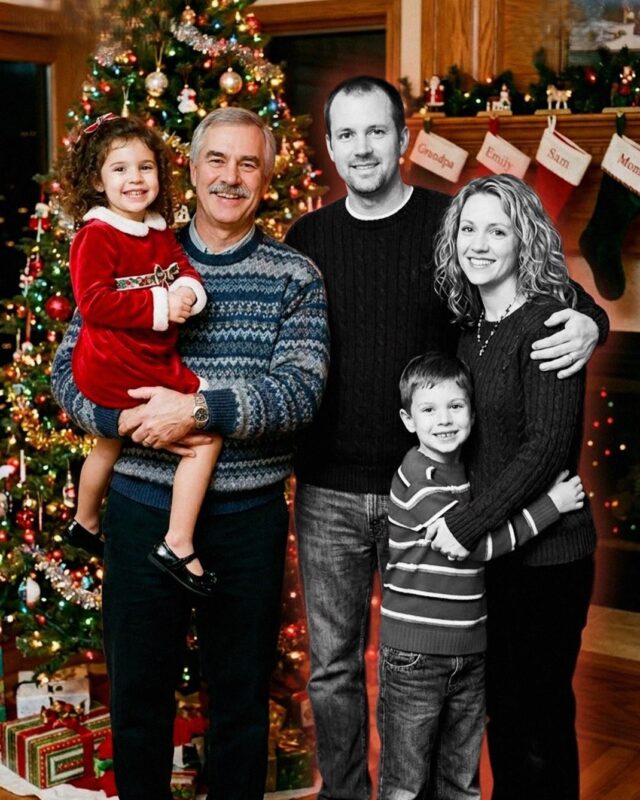
My son Michael and his wife Rachel came to my house with their two children for an early holiday dinner. I still remember the smell of cinnamon and roasted ham filling the kitchen while little Emily sat on the floor coloring reindeer with broken crayons.
Back then, life still felt ordinary.
Fragile maybe.
But ordinary.
I lived in one of those small towns where everybody waves whether they like you or not, where people trust the weather forecast even though it lies half the time.
That night the meteorologist promised light snow.
An inch or two.
Nothing dangerous.
He was wrong.
Michael left around seven in the evening. I remember standing in the doorway while he adjusted Emily’s pink hat over her curls. Sam, his older boy, was already buckled into the car complaining about being tired.
“Dad, we’ll be okay,” Michael told me with that calm smile sons use when they think their fathers worry too much. “I just want to get the kids home before the roads get ugly.”
The wind howled the second I shut the front door behind them.
And something inside me twisted.
Not fear exactly.
Something deeper.
Like an old instinct trying to scream through my bones.
Three hours later, somebody knocked at my door.
Not politely.
Not casually.
The kind of knock that makes your stomach drop before you even reach the handle.
Officer Reynolds stood outside with snow melting off his shoulders and grief already sitting heavily across his face.
There had been an accident.
Michael’s car lost control on an icy rural road and slammed into a stand of trees.
Michael died instantly.
Rachel died instantly.
Sam died instantly.
Only Emily survived.
She was five years old.
I still remember the hospital hallway. The fluorescent lights. The smell of disinfectant. The way my hands shook so badly I could barely sign paperwork.
Emily had broken ribs, a concussion, bruises from the seatbelt dark enough to look painted onto her skin.
The doctors said trauma had clouded her memory.
Fragments only.
Confusion.
Nightmares.
“Don’t force her to remember,
one doctor warned gently.
“Sometimes the mind protects itself.”
So I didn’t push.
Overnight, I stopped being just a grieving father and became a parent again at fifty years old.
Everybody called Emily’s survival a miracle.
The pastor called it a miracle at the funeral while three closed caskets sat beneath church lights and snow piled silently outside.
But miracles are complicated things.
Because surviving also meant remembering how to live afterward.
And that part nearly destroyed both of us.
Life became a long series of exhausting little lessons.
I learned how to braid a little girl’s hair badly enough to make her laugh.
I learned how to pack lunches.
How to survive school recitals without breaking down when she searched crowds for parents who weren’t coming.
Emily almost never complained.
That somehow hurt the most.
She became quiet in a careful sort of way, like she learned too young how fragile adults could be.
When she asked about the crash years later, I always gave the same answer.
“It was an accident, sweetheart. A terrible storm. Nobody’s fault.”
She accepted it.
Or at least I thought she did.
Years passed.
Emily grew into the kind of young woman people described as “wise beyond her years,” though there’s nothing beautiful about the pain that creates that kind of wisdom.
She loved mystery novels. Puzzles. Legal dramas. Anything involving hidden truths and patterns buried beneath ordinary things.
At twenty-five, she moved back home temporarily after college and started working as a paralegal for a legal research firm downtown.
And for a while, it felt almost peaceful again.
Dinner around six.
Quiet evenings.
Her explaining strange court cases while I pretended to understand half the legal terminology.
I loved those nights more than I admitted.
Then, a few weeks before the twentieth anniversary of the crash, something changed.
Emily became quieter.
Not sad.
Focused.
Like she was carrying something heavy she hadn’t decided how to set down yet.
Then the questions started.
“Grandpa, what time exactly did they leave that night?”
“Did police ever follow up with you after the crash?”
“Was that road supposed to stay open during storms?”
The way she asked unsettled me.
Not curious.
Careful.
Measured.
Like she already suspected the answers.
Last Sunday, she came home early from work carrying a folded piece of paper so tightly her knuckles looked white.
“Grandpa,” she said quietly, “can we sit down?”
We sat at the kitchen table where our whole life together had unfolded over twenty years.
Birthdays.
Homework.
Pancakes.
Grief.
She slid the paper toward me.
“I need you to read this before I explain.”
I unfolded it slowly.
Four words.
IT WASN’T AN ACCIDENT.
My chest tightened so hard I honestly thought my heart might stop.
I looked up at her and forced out a nervous laugh.
“Emily… what is this? Have you been reading too many crime stories?”
She didn’t smile.
Instead, she reached into her bag and pulled out an old silver flip phone scratched nearly beyond recognition.
“I found this in county archives,” she whispered. “Sealed in a courthouse evidence box.”
I stared at it blankly.
“There were deleted voicemails on it,” she said. “One of them was partially recoverable.”
My mouth went dry.
“What message?”
Emily swallowed hard.
“They weren’t alone on that road.”
The room seemed to tilt around me.
She pressed play.
Static filled the kitchen.
Wind.
Engine noise.
Then voices.
A frightened man saying:
“You said nobody would get hurt.”
Another voice answered coldly:
“Just drive. You missed the turn.”
Then silence.
I shook my head immediately.
“That doesn’t prove anything.”
“I know,” Emily said softly. “That’s why I kept digging.”
Then she told me everything.
Officer Reynolds — the same man who delivered the news that night — had quietly been under Internal Affairs investigation around the time of the crash.
Bribery.
Falsified reports.
Covering for a trucking company that paid officers to ignore safety violations and misreport accident conditions.
That road should have been closed the night Michael drove down it.
A semi-truck had jackknifed there hours earlier.
Barricades were supposed to block access.
But they disappeared.
Emily looked at me with tears filling her eyes.
“Dad swerved trying to avoid the truck,”
she whispered.
“That’s why the tire marks never matched a normal skid.”
Everything I believed for twenty years shattered at once.
It wasn’t weather alone.
It wasn’t fate.
Someone’s greed had left that road open.
Someone made a decision that killed my family.
I could barely breathe.
Then I asked the question that haunted me most.
“How did you survive?”
Emily wiped her face angrily.
“I was asleep,” she whispered. “The seatbelt caught differently. I didn’t brace. I didn’t see it happen.”
I reached across the table and grabbed her hand.
“You never remembered any of this?”
“Not fully. Not until recently. Little pieces kept coming back. Dreams. Sounds. Then I found the phone.”
She pulled another envelope from her bag.
“This came from Reynolds’ wife.”
Inside was a handwritten confession.
Reynolds had been drowning in debt. The trucking company paid him to bury reports and keep roads unofficially open to avoid delays and lawsuits.
He never expected anyone to die.
Never expected a family to drive through during the storm.
And at the bottom, written shakily, were the words that broke me completely:
“I hope knowing the truth gives your family peace.”
Peace.
I don’t know if peace is the right word.
Nothing gives back a son.
Or a daughter-in-law.
Or an eight-year-old boy who used to draw dinosaurs on napkins during dinner.
But truth changes grief.
It gives shape to the weight.
That night, Emily and I lit candles by the kitchen window while snow drifted softly outside.
But for the first time in twenty years, we talked openly about them.
Michael.
Rachel.
Sam.
Emily admitted she still woke up some nights feeling the seatbelt against her chest.
I admitted I carried one of Sam’s crayon drawings in my wallet for two decades because I couldn’t bear letting it go.
And for the first time since she was a little girl, Emily reached across the table and held my hand.
Not because she needed comfort.
Because she was giving it.
“You weren’t wrong for feeling something was off,”
she whispered.
“You were right.”
My throat closed completely.
I pulled her into my arms and held her tighter than I had in years.
“You saved us both, Emily,” I whispered.
And somehow, after all those years, it was finally true.
Outside, snow covered the world in white silence.
But for the first time in decades, it no longer felt cruel.
It felt still.
And strangely enough… safe.