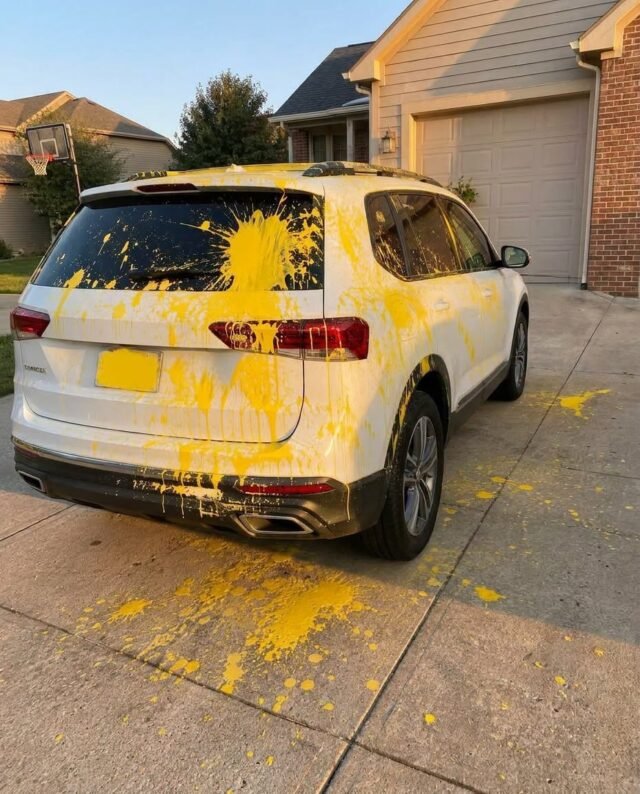
The first thing I saw was yellow—bright, ridiculous yellow running down the white hood of my SUV like wet paint from a child’s prank. At 2:13 that morning, a metallic clang had pulled me out of bed, and when I looked through the upstairs window I saw my neighbor Linda running across my lawn toward her house. By the time I reached the driveway, an empty bucket lay on its side beside my car and paint covered the hood, windshield, driver’s door, and rear quarter panel. Six days earlier I had finally had Linda’s SUV towed after months of her parking on a strip of driveway that sat entirely on my property despite repeated requests and a PRIVATE DRIVEWAY sign. She had stood in her yard afterward, furious, and told me I would regret it. I photographed every angle of the damage and planned to make a police report in daylight. At 7:20 the next morning, someone pounded on my front door—and when I opened it, three police cars were already parked outside Linda’s house.
The officers were not there because of my SUV. Linda’s adult son, Tyler, had been arrested in an investigation involving stolen construction materials, and police were searching her garage under a warrant after he reportedly told investigators where some of the property had been stored. During that search, officers found a half-used can of yellow paint that appeared to match the paint dripping from my vehicle. Then one detective studying the damage on my SUV noticed something stranger. The yellow coating had softened part of an older repair and exposed faint letters beneath the newer white finish near the rear quarter panel. Detective Harris asked when I had bought the vehicle, whether I had ever repainted it, and whether I still had the dealership paperwork. When I told him I had purchased it used three years earlier and had never done body work, his entire manner changed. The markings looked similar to a partial commercial fleet decal visible in grainy footage from a fatal hit-and-run six years earlier.
The old case involved a nine-year-old boy named Caleb who had been struck and killed while crossing a residential street. Investigators had long believed the vehicle was a white SUV of the same general make and model as mine, with damage on the rear side and part of a company marking visible in distant traffic-camera footage. The vehicle had disappeared before police could identify it. Now the newly exposed lettering and the location of an older structural repair gave investigators a reason to examine my SUV as possible evidence. I was not accused of anything; my purchase documents showed I had bought the car years later through a dealership. The SUV was impounded for forensic examination, and detectives traced its history backward through sales records. They discovered that it had entered the dealership shortly after the hit-and-run with rear body damage that had been described merely as “cosmetic,” followed by repainting in the exact area where the hidden fleet markings were later uncovered.
Investigators eventually identified a prior owner named Darren who had ties to a contracting company that used matching fleet decals. The evidence from the vehicle, repair history, prior ownership, and original crash investigation was reviewed together, and authorities questioned him. According to the later case record, he ultimately admitted he had been driving the night Caleb was struck, panicked, failed to stop, concealed the SUV for a period, and later disposed of it after repairs and repainting. Any criminal outcome depended on prosecutors, admissible evidence, and court proceedings rather than the paint discovery alone, but the vehicle provided investigators with the physical lead they had lacked for years. The dealership’s handling of the SUV became a separate matter involving its sales and repair documentation. Linda’s vandalism case remained separate too; the paint from her garage was tested against the substance on my SUV, and she later faced consequences related to the damage she caused.
Months afterward, I bought another car—a plain gray sedan with nothing memorable about it—and discovered I was grateful for ordinary. Linda and I barely speak now, and the driveway that started all of this has never been an issue again. What stays with me is not the parking dispute or even the ruined SUV, but the impossible chain of events that followed. Linda meant to damage my property because she was angry about being towed. Instead, the paint exposed a layer of history buried beneath the finish and gave investigators a lead they had been searching for since a child died six years earlier. When I later asked Detective Harris whether knowing the truth had helped Caleb’s family, he told me it could never be enough—but his mother had finally stopped watching every white SUV on the road and wondering whether it was the one. That was the part I understood.