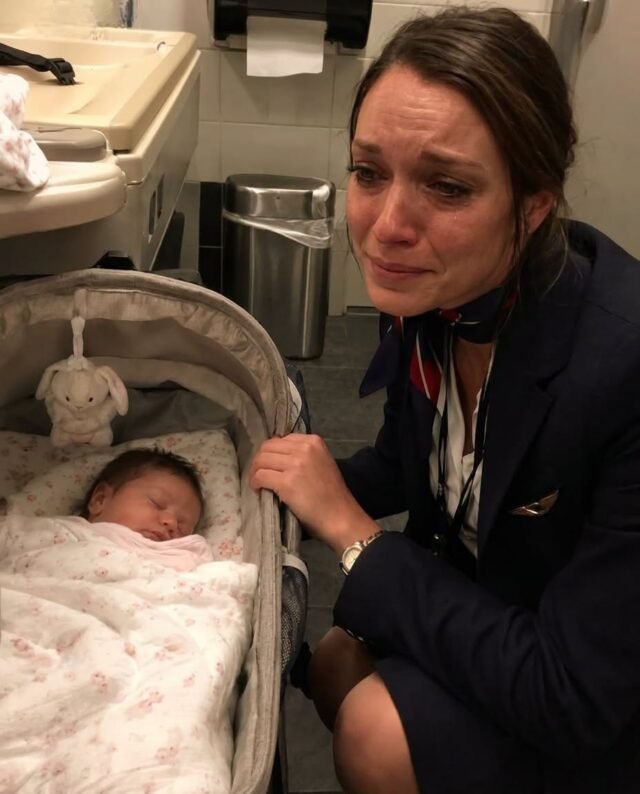
“Your daughter has been lying to you her whole life.” The sentence was written in black marker on an unstamped envelope tucked between my electric bill and a grocery flyer on Hope’s eighteenth birthday. I actually laughed at first because the accusation made no sense; Hope had been a newborn when I found her crying on an airport changing table eighteen years earlier, wrapped in a yellow blanket with a note asking someone to care for her. Then a woman across the street called my name. She had Hope’s dark curls, familiar brown eyes, and a face that made recognition arrive before reason. In one hand she held Bunny, the battered gray stuffed rabbit Hope had slept with since childhood and recently claimed she had thrown away. “My name is Rachel,” the woman said. “I’m Hope’s mother.”
Rachel told me she and Hope had been secretly communicating since Hope was fifteen. She said Hope wanted to spend time with her now that she was legally an adult and had even discussed staying with her for a while. Before I could process the betrayal of three years of hidden messages, Hope came out of the house, saw Rachel standing there, and went white. “I told you not to come,” she said. That sentence changed the entire morning. Hope admitted she had answered Rachel because she was curious about the woman who had given birth to her, but she had hidden the relationship from me because she feared it would hurt me. Rachel had exaggerated the story deliberately, writing the alarming note and arriving uninvited because she wanted to force the next step before Hope was ready. Hope had wanted answers. Rachel had mistaken that for permission.
Then another inconsistency surfaced. Eighteen years earlier, airport investigators had told me that surveillance appeared to show two women near the restroom where Hope was abandoned. Rachel had always described herself as completely alone, so Hope asked who the older woman had been. Rachel finally admitted it was her own mother. At nineteen, pregnant and financially dependent, Rachel had been pressured to choose between keeping her baby and retaining family support. Her mother drove her to the airport and told her she could come home only if she left the newborn behind. It was coercive and cruel, but Hope refused to let Rachel turn that painful history into a story that erased every choice afterward. “You were controlled,” Hope told her. “And now you’re trying to control me.” Rachel had been wronged as a young mother, but that did not give her the right to ignore Hope’s boundaries eighteen years later.
Rachel turned to me and asked whether I was going to fight for my daughter. I looked at Hope instead. She was eighteen, not property, and there was no custody battle to win. I told her that if she wanted Rachel in her life, I would manage my own feelings, and if she did not, no one had the right to force the relationship. Hope told Rachel she was not leaving with her and that any future meeting would happen only when Hope chose the time and place. She also insisted Rachel never contact me behind her back again. Then she held out her hand and asked for Bunny back. Rachel returned the rabbit and left alone. There were no dramatic legal threats, no attempt to rewrite the adoption, and no instant reconciliation. What remained was exactly what should have remained: Hope’s right to decide what kind of relationship, if any, she wanted with the woman who gave birth to her.
After Rachel drove away, Hope and I sat together on the front steps. She asked if I was angry, and I told her the truth: I was hurt, and I wished she had trusted me sooner. She told me she had never called Rachel “Mom,” because in her mind that word had always belonged to me. Then she looked at the filthy old rabbit tucked under her arm and joked that Bunny needed a bath, which made both of us laugh despite everything. For years, I had told Hope that God sent her somewhere I could hear her crying. On her eighteenth birthday, I finally understood the harder part of that story. Finding her had once meant protecting a helpless baby. Loving the adult she was becoming meant something different: standing beside her while she made choices that belonged to her, even when those choices frightened or hurt me.