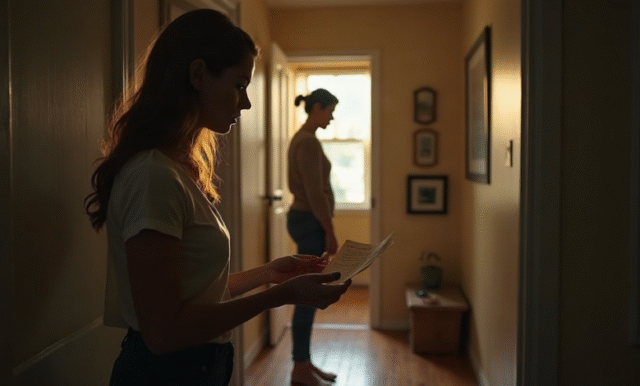
My sister moved Mom into a care home and sold her house in 19 days, for cash, to a young couple. She told me the money “went to Mom’s care.” Four months later, the couple found an envelope nailed to a rafter in the attic. It was addressed, “To whoever buys this house.” They read it, then drove forty miles to find me instead of my sister.
Mom was 84. She had lucid days and cloudy days, and my sister, Karen, had controlled her power of attorney since 2022.
I lived two states away and called Mom every Sunday. Karen was the one who handled things on the ground. I had let that arrangement become a kind of answer to every question I didn’t know how to ask from a distance.
In February, Karen called to tell me Mom had fallen and “could not be alone anymore.” The care home was already selected. When I asked how Mom felt about moving, Karen said she was frightened and that they needed to act. I knew Mom had fallen. I did not know then that she had written anything about what was happening.
“And the property?” I asked.
“We are selling it,” Karen said. “We need the liquid capital for her care facility.”
“Did Mom agree to that?”
“She knows it has to happen, Beth. We can’t leave her alone in that house.”
I asked what the sale would bring. Karen said she didn’t have a final number yet.
She spoke as though the decision had already been made and my questions were a delay she couldn’t afford. Mom was officially moved into the care home, and I tried to hold on to the part that seemed most urgent: she was safe from another fall.
The house sold in a rapid 19 days. The buyers were a young married couple with a baby, and the transaction was for cash. I asked Karen for the final number.
“Enough,” she said. “Do not worry about it, Beth. I have it completely handled.”
“I’m not asking you to hand me the money. I want the closing settlement statement.”
“I’ll forward it.”
She didn’t. I asked again, and got no statement. At the time, I told myself that care arrangements were taking all her attention. It was easier to call her disorganized than to consider that she might be keeping something from me.
Four months later, my phone rang with an unknown number.
“Is this Beth Carlson? Your mother is Dorothy Carlson?”
“Yes. Who is this?”
“My name is Tyler Reed. My wife and I bought your mother’s house on Oakwood. We… uncovered something. We would like to bring it to you directly in person, if that is acceptable. We would rather not trust the mail system with this.”
I asked what they had found. Tyler paused before answering.
“It’s a letter from your mother. We think you should read it.”
“Does Karen know you have it?”
“No,” he said. “We wanted to speak to you first.”
They drove forty miles on a Saturday. Tyler came with his wife, Hannah, and their baby, who was asleep in a car seat. Hannah held a manila envelope close against herself. She looked tired in the way people look when they have carried a decision longer than they intended.
“We were insulating the attic space,” Tyler explained. “It was nailed into a wooden rafter, right above the pull-down attic stairs. You would have to be looking straight up to notice it.”
Hannah glanced at me. “We read the contents. I am so sorry. We did not know what it was. And then once we started reading it, we could not stop. And then we knew we could not possibly take it to your sister.”
“You brought it here,” I said.
“We thought you should have it,” she replied. “It’s your mother’s letter.”
I sat on the porch step and opened the flap. The envelope was addressed in Mom’s handwriting. Inside were three pages, also in her handwriting, shaky but completely clear. The letter was dated February 3, six days before Karen forced her out of the house.
The first lines said, “If you are reading this document, then my daughter Karen has successfully sold my house. I want you to know that I did not consent to this. I am writing this on a highly clear day so there is a documented record of what I know.”
I had to stop there. I read the sentence again, then lowered the page. Tyler and Hannah waited without trying to hurry me. I had spent months telling myself that Karen had made a hard decision because Mom was no longer safe alone. Mom had written that she had not consented.
The letter went on: “I know that Karen has been stealing money from my checking account since 2023. I know this because I have maintained a written ledger in the blue tin stored under the third wooden stair, exactly where my husband kept his heavy lockbox before he died. The stair tread lifts up. Karen does not know this fact.”
Tyler cleared his throat. “We checked the staircase. The tin is still there. We did not attempt to open it.”
I looked down at the page. “You found it?”
“We saw it under the tread,” he said. “We thought it was yours to open.”
The next part was about the house. Mom wrote that she and my father had placed it in a trust for my daughter, Emily, in 2019. Karen had not been informed. The legal documents, Mom wrote, were with Mr. Fenwick, our attorney, on the main street.
I could no longer take in the page all at once. Hannah wiped a tear. Tyler rested a hand against her back. They had paid $290,000 in cash for the house, and they had come to me without knowing whether the sale was valid.
“Mrs. Carlson,” Tyler said evenly, “we paid two hundred and ninety thousand dollars in cash for that house. We do not know if it was ever your sister’s legal right to sell. We do not know if we even truly own it. But we know that whatever happens in court, that letter belongs to your side of the family and not to her.”
I turned to the final page. The last paragraph was addressed to me by my first name. Mom wrote that she knew I had called every Sunday, and that she did not blame me for living far away. She asked me to take the letter, the tin and the trust papers to Mr. Fenwick. She wanted me to protect Emily’s interest and make sure her care was paid for with her money, not with a story that could not be checked.
The next morning, I was in Mr. Fenwick’s office at nine, with the blue tin on my lap. Tyler and Hannah had let me remove it from the house the day before. I hadn’t opened it until then. I was afraid of what it would prove, and also afraid it wouldn’t prove enough.
Mr. Fenwick read the letter first. He looked through his files for the trust papers Mom had mentioned, then compared them with the records related to the house. He didn’t promise that a letter would settle a property dispute. He said the documents mattered, and that the sale and the money needed to be examined together.
“Did Karen have authority to sell the house?” I asked.
“Based on what I’m looking at, the house was held for Emily in the trust,” he said. “We need to establish what happened at closing and where the proceeds went. I can’t tell you the full outcome before we do that.”
The answer was not the clean certainty I wanted. It was still more than Karen had given me.
Mr. Fenwick opened the tin after I agreed. Inside was Mom’s ledger, kept in her handwriting. It listed withdrawals from her checking account, dates, amounts and notes about what the money had not paid for. I did not need to calculate every line to understand why she had hidden it under a stair Karen didn’t know about.
Tyler and Hannah had brought their own closing papers. Their documents showed the amount they had paid and the details of their purchase. They had not held anything back from me. Their worry was plain: they had bought a home for their family and had no idea that the seller might not have had the right to sell it.
“Are we supposed to leave?” Hannah asked.
“No,” Mr. Fenwick said. “You should not make any decisions based on guesses. We’ll speak with the people involved and work out what can be agreed.”
I looked at the ledger again. “And the money Karen said went to Mom’s care?”
“That needs an accounting,” he replied. “The ledger gives us a reason to ask for one.”
He advised me to put the letter and ledger in his care while he contacted Karen. I wanted to call her immediately and read the letter aloud. Instead, I agreed to let him arrange a meeting with her, with Tyler and Hannah present. I had spent enough time asking for records privately. This time, the documents would be on the table.
Karen arrived at Mr. Fenwick’s office with a folder of her own. She looked first at me, then at Tyler and Hannah.
“Why are they here?” she asked.
“They bought the house,” I said. “They found Mom’s letter.”
Karen’s gaze moved to the papers. “You went through Mom’s things?”
“We found an envelope nailed to a rafter,” Tyler said. “We brought it to Beth.”
Karen looked at me. “You should have called me.”
“I asked you for the closing statement. You said you would send it.”
“I’ve had a lot to manage.”
“You also said the sale money was for Mom’s care.”
“It is,” she replied. “That’s what I told you.”
Mr. Fenwick set the trust papers beside the letter. He explained that the house had been placed in trust for Emily and that the documents raised serious questions about the sale. He did not declare the buyers’ purchase void or tell them they had to leave. He said the people in the room needed to address the trust, the transaction and the account records before anyone could claim the matter was settled.
Karen’s folder stayed closed.
I took the ledger from the table and opened it to the first marked entries. “Mom wrote down the withdrawals. She wrote what they were for, and what they weren’t for.”
Karen leaned back. “That ledger is not a bank statement.”
“No,” I said. “It’s Mom’s record. The bank records can confirm the withdrawals.”
“I was paying for things. You weren’t here.”
“What things?”
She looked at the ledger instead of answering. “I was the one taking her to appointments. I was handling the house. I was doing what had to be done.”
“That doesn’t explain the money,” I said.
“You called once a week,” Karen said. “You didn’t see what it was like every day.”
“I know I wasn’t there. That doesn’t make Mom’s money yours.”
Her mouth tightened. “I never said it was mine.”
Tyler placed the buyers’ closing papers next to the trust documents. He didn’t raise his voice. “We paid the amount on these papers. Beth asked you for the settlement statement. You never sent it.”
Karen looked at him. “This is a family matter.”
“It became our matter when we bought the house,” Hannah said. “We have a baby. We need to know where we stand.”
Karen turned back to me. “I sold it because Mom needed care. That’s what mattered.”
“You said the money went to her care,” I replied. “Now we have a ledger, a trust, and no statement from you. Tell us what happened to the money.”
For a few seconds, she said nothing. Then she looked at Mr. Fenwick.
“I took some of the withdrawals,” she said. “I was covering things. I meant to put them back.”
“Were they Mom’s care expenses?” I asked.
“Not all of them,” she said. “I thought I could make it right.”
The office went quiet. No one needed to explain what she had just admitted. It did not make the ledger the whole story, and it did not tell us where every dollar had gone. But Karen had stopped saying that every withdrawal was for Mom.
Mr. Fenwick asked her to provide the records and account for both the withdrawals and the house proceeds. He made clear that the buyers should not be pressured to solve a dispute between the family and the trust. Karen started to argue that she had acted under the power of attorney, then stopped when he asked her to show the documents supporting that claim.
“I was trying to keep things moving,” she said.
“Then show us the records,” I replied.
She opened her folder. It contained some care-related papers, but not the closing statement I had requested. She agreed to provide the remaining records through Mr. Fenwick. For the first time, her answer was something we could check.
The next conversation I needed to have was with Mom. I called her at the care home after the meeting. She was having a clear day, though I did not know how long it would last. I told her about the letter, the ledger and the trust papers.
“You found it,” she said.
“Yes. I read it.”
“Did Karen see it?”
“She saw it at Mr. Fenwick’s office.”
Mom paused. “And the house?”
“The buyers are still there. Their purchase is being reviewed. Mr. Fenwick is working through it with them.”
“I didn’t want them hurt,” she said.
“I know. They came to me because they didn’t want to hurt us.”
Mom was quiet for a moment. Then she said, “I didn’t agree to sell.”
“I believe you.”
“I wanted you to know that.”
“I know,” I said. “I have your letter.”
I did not ask her to repeat what she had written or to defend it. She had already done that in the clearest way she could. Before we hung up, I told her that her care expenses would be checked against the records, and that I would keep her informed. She asked me to make sure Emily knew the house had been intended for her. I said I would.
The discussions did not finish in one office visit. Mr. Fenwick reviewed the trust documents, the buyers’ closing papers and the account records Karen provided. The outcome was an agreement rather than a dramatic court ruling. The couple would keep the house, and the sale proceeds would be accounted for as trust money for Emily. Karen agreed to return the money she had taken from Mom’s account and to repay what could not be returned from the remaining proceeds.
The arrangement took time to put in place. Karen did not get to dismiss the ledger as a misunderstanding or insist that her word should settle the numbers. The account records were checked against Mom’s entries, and the proceeds were addressed separately from the money she had taken before the sale. The buyers did not have to choose between abandoning their home and taking sides in a family argument.
Karen also stopped handling Mom’s finances. Mom made clear that she did not want her sister controlling the money. Mr. Fenwick helped us put that decision into effect in the ordinary way, with Mom involved when she was able to speak for herself. I took on the practical responsibility of keeping track of the care costs and making sure the records were available to Mom and to the trust.
I had spent months asking Karen to send one statement. In the end, it took Mom’s letter, her ledger and the buyers’ papers for the answer to stop being something Karen could summarize for me. The buyers kept the house. Emily’s interest was protected, and the money Karen had taken was no longer treated as a private matter between sisters.
I still call Mom every Sunday. Now I know what I’m asking to see.