**A Mom Gave Her 11-Year-Old Son $50 for His School Fair – Hours Later, His Teacher Called in Tears, Saying, “You Need to See What He Did with the Money”**
I thought I was sending my son off for a fun afternoon of games, treats, and laughter. But when I arrived at his school, the scene before me left me questioning what had happened.
“Ms. Khloe, please don’t panic.”
Those were Morgan’s teacher’s first words.
“That’s a terrible way to start.”
Mrs. Coleman wiped her eyes. “Your son hasn’t done anything wrong.”
“Please don’t panic.”
“Then why are you crying?”
She looked toward the gym doors. “Because I’ve never seen anything like this!”
I pushed past her.
Children crowded around a folding table. Someone shouted, “That’s not fair!”
Then I spotted my 11-year-old son. Morgan was wearing a paper crown. Several prize shelves behind him were empty. A handwritten sign hung above his head: FREE PRIZES.
My stomach dropped.
“What exactly did he do?” I whispered.
Mrs. Coleman smiled through her tears. “Something I think you’ll remember forever.”
—
Morgan was 11, and it had been just the two of us for years. My son was the kind of kid who still hugged me goodbye every morning. Then he’d immediately check whether his friends had noticed.
Every night, we ate dinner together. And during that bonding time, we shared the best and worst moments of our day.
Morgan usually cheated.
“Today, I got to play on the swings, and I passed the quiz.”
“Hey! That’s against the rules! Those are two best parts!”
“You’re the mom. Change the rules!”
I laughed. “Nice try.”
For two weeks, all Morgan had talked about was his school fair.
“There’s pizza, games, prizes, and giant cookies, Mom! Actual giant cookies!”
“Sounds like a very serious educational event.”
“Extremely educational!”
The night before, I found him counting money. He sat on his bedroom floor. Twelve dollars lay in front of him.
“Planning something expensive?” I asked.
“I’m calculating my budget.”
“Very professional.”
“I can afford pizza and two games.”
“What about those giant cookies?”
He sighed. “Budget cuts.”
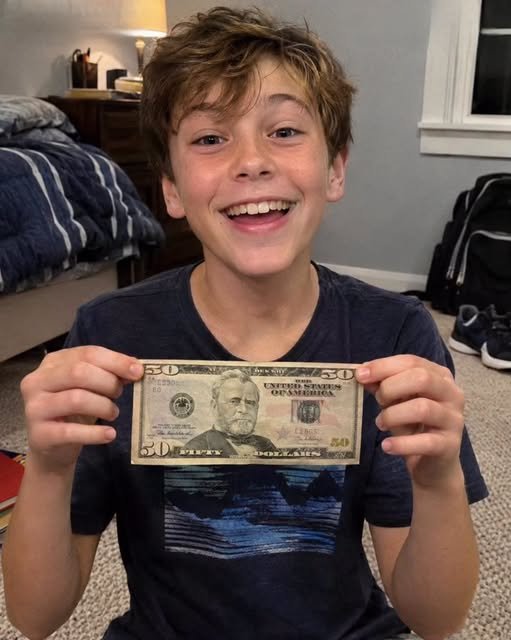
I laughed and opened my wallet. Then I handed him $50.
My son’s eyes widened. “No way!”
“It’s yours.”
“All 50?!”
“All 50. Buy whatever makes you happy.”
He examined the bill. “What if I spend it on something stupid?”
“Then you’ll learn a $50 lesson.”
He hugged me. “You’re my favorite mom!”
“I’m your only mom.”
“Still counts.”
The following morning, Morgan tucked the bill carefully into his backpack. As he got out of the car, I called, “Don’t spend it all on cookies!”
He grinned. “No promises!”
I watched him run toward school. Then I drove to work.
By lunchtime, I’d forgotten about the money. Until 2:18 that afternoon. My phone rang. It was Morgan’s teacher.
“Ms. Khloe?”
Something in her voice made me sit up. “Yes. Is Morgan okay?”
“He’s fine.”
Then her voice broke. She was crying.
My heart started racing. “What happened?”
“I’m sorry. I just… I wasn’t expecting this. Your son had $50 with him today, right?”
“Yes.”
Another pause.
“Please get here as fast as you can. You should see what he did with the money.”
Twenty minutes later, I rushed into the school. Mrs. Coleman waited outside the gym, wiping her eyes.
“Where’s Morgan?”
She pointed toward the doors. “Inside.”
And the moment I entered, my stomach dropped.
Now I stood watching my son. Children waited in a long, crooked line. Morgan raised both hands. “Everybody relax! I’m only one person!”
I looked at Mrs. Coleman. “Please tell me he hasn’t started a business?”
She laughed. “No. Nothing like that.”
“Then why are 30 children surrounding him?”
“He’s been organizing something.”
“What kind of something?”
Before she answered, Morgan spotted me. “Mom?”
My son looked at his teacher. “You called her?”
She nodded.
Morgan groaned. “I was going to explain at dinner.”
I folded my arms. “Explain why you’re running a toy store?”
“It’s not a store.”
“Then why does it have merchandise?”
He sighed. “Can you give me five minutes?”
“Five minutes?”
“Please. Hannah’s been waiting.”
I looked toward a little girl nearby. Mrs. Coleman touched my arm. “Watch him. You’ll understand.”
So I stepped aside.
Hannah stood beside the table. She wore a yellow sweater. Her hands were clasped together.
“Okay, Hannah,” Morgan said. “Your turn.”
She glanced at the other children. “I don’t know.”
“Remember what we practiced?”
Hannah nodded.
“Then you’ve got this.”
Someone behind her sighed. Morgan immediately raised his hand. “Nobody rushes anybody! That’s the rule!”
The children quieted.
Hannah took a breath. “Why did the cookie visit the doctor?”
Morgan leaned forward. “Why?”
“Because it felt crummy.”
There was silence. Then Morgan slapped the table. “That was incredible!”
The children burst out laughing. Hannah covered her mouth. She was smiling!
My son picked up a stuffed rabbit. “Congratulations! You’ve won!”
Her eyes widened. “Really?!”
“Really.”
“Can I keep it?”
“That’s generally how prizes work.”
She hugged the rabbit. Then little Hannah hugged Morgan!
My son froze. “Okay. That’s enough hugging.”
I almost laughed.
Mrs. Coleman wiped her eyes again. “That’s the first joke she’s told publicly.”
I looked at her. “Why?”
“Hannah’s struggled since transferring here. She gets nervous speaking around other children.”
Across the gym, Hannah approached two girls. They admired her rabbit. Then they invited her to play.
Mrs. Coleman smiled. “She’s been working hard to make friends.”
I watched Morgan greet another child. My throat tightened. Where had my $50 gone?
Mrs. Coleman led me toward the bleachers.
“The fair opened after lunch,” she explained. “Some children brought spending money. Others didn’t.”
I nodded. “The school said money was optional.”
“It was. We had free activities too.” She glanced toward the prize stall. “But the toys were popular.”
“What happened?”
“Hannah wanted that stuffed rabbit.”
I looked toward the girl. “She couldn’t afford it?”
“She’d already spent her $3 on games.”
Morgan had apparently noticed her disappointment.
“So he bought it?” I asked.
“That was his original idea.”
“Original?”
Mrs. Coleman smiled. “Your son had other plans.”
Before she continued, Principal Harris approached. “Khloe! I’m glad you’re here.”
Principal Harris laughed. “Morgan’s made quite an impression today.”
“Could someone explain why?”
The principal glanced toward Morgan. “I think he should tell you.”
I stared at him. “Does this school teach advanced secrecy?”
Mrs. Coleman laughed. “Give him time.”
By three o’clock, the fair was winding down. Morgan finally left his table. He approached, carrying a paper bag. “Hi, Mom.”
“Hello, Your Majesty.”
He touched his crown. “It’s an official position.”
“Who appointed you?”
“Me. Nobody else applied.”
I tried not to smile. “Morgan, where’s your $50?”
His grin disappeared. “Well…”
“Well?”
“I spent it.”
“All of it?”
He nodded.
I held out my hand. “Show me what you bought.”
My son opened the paper bag. Inside were two toy cars and a dinosaur.
I stared. “Fifty dollars for three toys?!”
“No! Those are leftovers!”
“Leftovers from what?”
He sheepishly pulled out a receipt. It listed stuffed animals and smaller prizes. The total was exactly $50.
“Morgan!”
“I know how it looks!”
“Then explain.”
He glanced toward Mrs. Coleman. “Can we sit down?”
Something in his voice stopped me. I followed him to the bleachers. He removed his crown.
For once, my son looked completely serious. “Remember what you told me yesterday?”
“That you shouldn’t eat $50 worth of cookies?”
He smiled. “No. The other thing.”
I thought for a moment. “Buy whatever makes you happy?” I asked.
“Yeah.”
He folded his hands. “I was going to buy pizza. And cookies. And a giant pencil.”
“An essential purchase.”
My son laughed. “Then I saw Hannah.” His expression changed. “She was holding that rabbit at the prize stall.”
A volunteer had let her examine it. But she couldn’t take it home.
“She looked really disappointed, Mom.”
I nodded. “So you bought it for her?”
“That was the plan.”
“What changed?”
Morgan glanced around the gym. “Oliver wanted a toy car. And Ben wanted a dinosaur.” He paused. “Then I noticed other kids just watching.”
Some had run out of game tickets. Others hadn’t brought spending money.
Morgan stared at his shoes. “I didn’t want anybody feeling left out.”
“So what did you do?”
“I asked Mrs. Coleman for help.”
His teacher nodded. “He wanted to buy several prizes.”
Morgan continued. “I used your $50 at the stall.”
I raised an eyebrow. “Your accountant is going to be furious.”
My son grinned. “Good thing I don’t have one.”
Mrs. Coleman explained what happened next. Morgan had asked permission to distribute the toys. The fair volunteers agreed to help him. But they needed an orderly system.
So Morgan suggested a game.
“A joke competition,” he announced proudly.
I looked at him, quite impressed.
“Everybody got one turn,” he explained.
“And if their joke wasn’t funny?”
“They still got a prize.”
I smiled. “Then why tell jokes?”
“Because laughing is fun.” My son said it like the answer was obvious.
Children could also make funny faces. Or answer silly questions. Nobody had to perform if they felt uncomfortable.
“And what happened when the prizes ran out?”
“We kept telling jokes,” Morgan explained. “The prizes weren’t the best part.”
Mrs. Coleman smiled. “Some children stayed just to participate.”
I looked at my son. “You organized all this?”
He shrugged. “With help from Mrs. Coleman and the volunteers.”
But his teacher wasn’t finished. “There’s something else you should know.”
Morgan groaned. “Mrs. Coleman, please.”
She smiled. “Your mother deserves to hear this.”
I looked at him. “Hear what?”
Mrs. Coleman glanced toward Hannah. “Earlier, some children laughed when she couldn’t speak.”
Morgan stopped smiling. “She got nervous.”
His teacher nodded. “One boy told her to hurry.”
I looked at Morgan.
“I stopped the game. Then I told everyone they had to wait.” He shrugged. “She was trying.”
Mrs. Coleman’s voice shook. “Hannah wanted to leave.”
Morgan looked down. “So I asked if she’d practice with me.”
They’d whispered the joke together. Then practiced again. And again.
“She got it on the third try,” he said.
I looked toward Hannah’s rabbit. “That’s when I arrived?”
“Yeah.”
Mrs. Coleman wiped her cheek. “Afterward, three children asked Hannah to play!” Her voice softened. “She’s been working toward moments like that all semester.”
I swallowed.
Morgan looked alarmed. “Mom, please don’t start crying too.”
“I’m not crying.”
He groaned again. “Your eyes are leaking.”
I laughed. “That’s a medical condition called motherhood.”
He shook his head. “Sounds exhausting.”
“Very.”
Then I hugged him. This time, he returned the hug and didn’t check whether anyone was watching.
Principal Harris approached before we left. “Khloe, may I ask you something?”
“Of course.”
“We’re considering making this activity permanent.”
I glanced at Morgan. His eyes widened. “Really?”
The principal nodded. “We could organize a free prize table.”
Harris turned toward me. “Would you consider joining our parent committee?”
I hesitated. “I work during most school events.”
“We usually meet after school or online.”
I thought about Hannah. And the children around Morgan’s table. “I’d be happy to help plan.”
Morgan grinned. “Can I join the committee?”
“You’re 11,” I reminded him.
“This is age discrimination.”
Principal Harris laughed. “You can be our student adviser.”
My son straightened. “Do I get an office?”
“No,” I said.
“A badge?”
“Maybe.”
“A parking space?”
“You don’t have a car!”
“Not yet.”
I shook my head. My son was impossible. And I loved him for it.
On the drive home, Morgan was unusually quiet. I checked the mirror. “Everything okay?”
“Yeah.”
“Then why so quiet?”
He hesitated. “Are you mad about the money?”
I glanced back. “Why would I be mad?”
“Because I didn’t buy anything for myself.”
I smiled. “Did you enjoy your day?”
My son nodded. “A lot!”
“Then you followed my instructions.”
He looked relieved.
“But next time, remember lunch.”
“I ate the sandwich you packed.”
“Good.”
“And Oliver shared his pizza.”
“That’s nice.”
“And Hannah’s mom bought me a cookie.”
I laughed. “Of course she did.”
He grinned. “It was enormous!”
I shook my head. “That’s my boy!”
That evening, we ate spaghetti together. Morgan insisted on wearing his crown. Apparently, royalty didn’t take evenings off.
“Best part of your day?” I asked.
He thought for a moment. “When Hannah made everyone laugh.”
I smiled. “And the worst?”
“When I realized $50 wasn’t enough.”
“I’m sorry,” I said, patting his hand.
“Thanks, Mom.”
I put down my fork. “Want to know my best part?”
“What?”
“Seeing how kind you’re becoming.”
My son groaned for the millionth time that day. “Mom. That’s embarrassing.”
“I’m putting it on a T-shirt.”
“Please don’t.”
“With your picture.”
“Mom!”
I laughed.
Then he looked thoughtful. “Can I have two best parts today?”
“That’s against the rules.”
“You’re the mom. Change the rules.”
I pretended to consider it. “Fine. What’s your second?”
He grinned, pretending to drool. “The giant cookie!”
I burst out laughing. Some things never changed!
The following Monday, Mrs. Coleman emailed me. She’d attached a photo from the fair. Morgan stood behind his table. His paper crown leaned sideways. Hannah stood beside him, holding her rabbit.
Underneath, Mrs. Coleman had written: “Thank you for raising a child who notices when others feel left out.”
I printed the picture. It went straight to our refrigerator.
Morgan spotted it after school. “Mom. Seriously?”
“What?”
“That’s embarrassing!”
“Would you prefer I frame it, Your Highness?”
He stared at me. “You wouldn’t?”
I smiled. “Try me.”
He shook his head. But as he walked away, he looked back. And smiled.
Over the following weeks, I attended committee meetings. We discussed the following year’s fair. A parent offered to collect donated toys for the free prize table. Someone volunteered to organize free games. Principal Harris approved the plan. We called it the “Second Chance Table.”
When I told Morgan, he nearly dropped his cereal.
“Wait! My idea’s becoming a real thing?”
“Apparently.”
“Do I get royalties?”
“Again, you’re 11!”
“That’s not an answer.”
I laughed. “No royalties.”
“Fine. Can I help run it?”
“Absolutely.”
He thought for a moment. “Then I have one condition.”
“What’s that?”
“Nobody has to tell a joke.”
I nodded. “That’s fair.”
“But terrible jokes should still be encouraged.”
“Naturally.”
At the next school fair, the table returned. This time, it didn’t depend on one child’s money. Families had donated toys and games. The school had provided extra supplies.
Hannah helped Morgan organize everything. She’d even written jokes on cards.
Mrs. Coleman sent me a photo. Both children were laughing behind the table.
That evening, Morgan came home holding a giant cookie. He placed it between us.
“For you,” he announced.
I stared. “Me?”
“Yep.”
“With your own money?”
“Yep.”
“What’s the occasion?”
He shrugged. “You’re my favorite mom.”
“I’m your only mom.”
He broke the cookie in half. “Still counts.”
I laughed and took my piece.
I’d given Morgan $50 for one afternoon. He’d used it to make others happy. And somehow, he’d brought that happiness home.