## PART 3
I stared at the envelope.
For years, I had trusted Melissa.
She had helped me organize my prescriptions after Marilyn died. She had driven me to appointments when I didn’t feel like driving. She had brought groceries and reminded me about birthdays.
I had called her a blessing more than once.
Now I was sitting in a doctor’s office wondering whether the person I had trusted with my medicine had been using it to change how I thought and behaved.
“Dr. Carter,” I said quietly, “could someone make an older person appear to have memory problems by giving them the wrong medication?”
She didn’t answer immediately.
“Certain medications can cause confusion, excessive sleepiness, slowed thinking, and other cognitive symptoms, particularly in older adults. But we cannot assume that’s what happened here. We need the exact substance, the amount, the timing, and your medical history.”
I nodded.
Then she asked something that made my stomach tighten.
“Ken, have you noticed any unusual changes in your behavior over the past few months?”
I thought about it.
There had been mornings when I woke up feeling as if I had spent the night underwater.
Sometimes I couldn’t remember whether I had eaten breakfast.
A few times, I had found myself standing in the hallway without remembering why I had gone there.
I had blamed grief.
I had blamed age.
Most importantly, I had believed Melissa when she told me these things were normal.
“There have been days,” I admitted.
“What kind of days?”
“Days when I felt unusually tired. Days when conversations seemed to disappear from my mind. Sometimes I would hear someone speaking, understand the words, and then struggle to remember what they had said five minutes later.”
Dr. Carter wrote something down.
“Did these symptoms begin before or after Melissa started organizing your medication?”
I looked at the ceiling.
Then I remembered.
“After.”
She stopped writing.
“How long after?”
“Maybe six months.”
She put her pen down.
“Ken, I want to be very clear. We are not going to assume anyone has harmed you. But we are also not going to dismiss your concerns.”
For the first time since Noah had whispered those words in my kitchen, I felt someone was taking me seriously.
Before leaving, Dr. Carter arranged for the tablet to be professionally identified and reviewed my medication plan. She instructed me not to take any unidentified medication and told me not to make changes to my prescribed treatment without consulting her.
She also recommended a proper cognitive assessment, one that would establish whether I actually had any underlying memory problems.
I agreed.
But there was one thing I hadn’t told her.
I was beginning to suspect that Melissa hadn’t simply been trying to help me.
She might have been preparing people to believe something about me.
And if that was true, Derek might have known more than he was admitting.
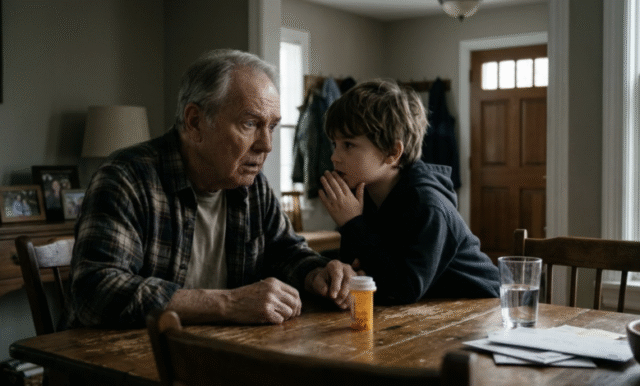
When I returned home, Noah was sitting at the dining table.
He had arranged his colored pencils in a perfect row.
Red.
Blue.
Green.
Yellow.
He looked up when I entered.
I placed my keys on the counter.
“Hey, buddy.”
He smiled faintly.
I sat across from him.
“The doctor listened.”
His pencil stopped moving.
“She wants to find out what’s in that pill. Nobody is angry with you.”
He stared at the paper.
Then he wrote something.
*Did you tell them about Mom?*
I read it twice.
“I told the doctor what you told me. I didn’t accuse your mother of anything. I just asked her to help us understand.”
Noah nodded.
Then he wrote another sentence.
*Mom says you forget things.*
I felt something uncomfortable move through my chest.
“What does she say?”
He erased something and wrote again.
*She says Grandpa is getting confused. She says soon he won’t remember what happened.*
I didn’t respond immediately.
There are moments when an adult must choose between speaking and listening.
This was one of them.
“Did she say that to you?”
He nodded.
“When?”
He wrote:
*At home. When Dad was working.*
I leaned back.
“Did your father hear her?”
Noah shook his head.
Then he wrote something that made my hands go cold.
*She said nobody believes children who don’t talk.*
I looked at him.
He was staring at the table, his eyes filled with tears.
“Oh, Noah.”
I reached across the table, but I didn’t grab him.
He slowly placed his small hand over mine.
For two years, people had treated his silence as if it meant he had nothing to say.
But perhaps he had been listening to everything.
Perhaps he had been carrying things he didn’t know how to explain.
And perhaps the adults around him had mistaken his silence for helplessness.
I took a breath.
“You can tell me anything, buddy. You don’t have to protect me.”
He looked directly into my eyes.
Then, very slowly, he spoke again.
“Grandpa… she did it before.”
I felt my heartbeat change.
“Did what?”
He swallowed.
“Medicine.”
I kept my voice gentle.
“What happened before?”
Noah looked toward the living room, where his backpack was sitting beside the couch.
He got up, walked over, and opened the front pocket.
He pulled out a small notebook.
It was the kind children used for school assignments.
The cover had a picture of a dinosaur.
He brought it to me.
“What’s this?”
He pointed to the pages.
I opened the notebook.
The first few pages contained drawings of dinosaurs, cars, and our old dog, Charlie.
But farther back, I noticed something unusual.
There were dates.
And underneath the dates were little drawings.
A bottle.
A pill organizer.
A clock.
And a person lying on a couch.
I turned another page.
There was a drawing of Melissa holding a small white bottle.
Beside her was a drawing of me sleeping in my recliner.
I looked at Noah.
“How long have you been drawing these?”
He held up three fingers.
“Three months?”
He nodded.
I turned to the next page.
There was a drawing of Derek standing in the doorway.
Melissa was pointing toward me.
Above my head, Noah had drawn a thought bubble.
Inside it were three question marks.
Then I noticed something written in small handwriting.
*Mom said Grandpa is getting worse.*
I closed the notebook.
“Why didn’t you show me this earlier?”
Noah’s eyes filled again.
He pointed to his mouth.
Then he shook his head.
I understood.
He had been afraid.
I pulled my chair closer.
“You don’t have to explain everything today.”
He nodded.
Then he reached for my hand and whispered:
“Grandpa, she wants your house.”
For several seconds, I couldn’t move.
My house.
The same house where Marilyn and I had raised Derek.
The same house where Noah had learned to ride a bicycle in the driveway.
The same house where I had spent forty years paying off the mortgage.
“What makes you think that?”
Noah opened his notebook again.
He turned to a page near the back.
There was a drawing of our house.
Underneath it, he had copied a few words from a document.
I recognized the words immediately.
**POWER OF ATTORNEY.**
I stared at the page.
“Where did you see this?”
He pointed toward the upstairs office.
Then he whispered something else.
“Mom took pictures.”
My mouth went dry.
“Pictures of what?”
He drew a rectangle with his finger on the table.
Then he wrote:
*Your papers.*
That afternoon, I waited until Noah was occupied with a puzzle before going upstairs.
My home office had not changed much since Marilyn died.
There was an oak desk near the window, a filing cabinet beside the bookshelf, and a small framed photograph of our wedding on the wall.
I had always kept important documents in the bottom drawer of the filing cabinet.
Property deed.
Insurance papers.
Retirement accounts.
Tax records.
Marilyn’s will.
My own estate documents.
I unlocked the drawer.
Everything looked normal.
But when I checked the folder containing my estate planning documents, I noticed that the papers weren’t in the order I remembered.
I removed them one by one.
There was the original deed.
There was the insurance policy.
There was Marilyn’s will.
And there was a document I had never seen before.
It was a draft power of attorney.
My name appeared at the top.
Derek’s name appeared as the proposed agent.
But the signature line was blank.
I read the document twice.
Then I checked the date.
It had been prepared approximately four months earlier.
Four months.
Around the same time Melissa had started telling me that I was becoming forgetful.
Around the same time Noah’s notebook began filling with drawings.
I turned the page.
There was a cover letter from a law office in Columbus.
The letter stated that the document had been prepared following a request from a family member.
It did not say I had requested it.
I checked the contact information.
Melissa’s email address was listed.
I sat down.
For a long time, I simply stared at the paper.
Then I heard a small voice behind me.
“Grandpa?”
I turned.
Noah was standing in the doorway.
“Hey, buddy. You okay?”
He pointed at the document.
Then he whispered:
“That’s the one.”
I looked at him.
“You saw this before?”
He nodded.
“Where?”
He pointed toward the filing cabinet.
“Mom put it there?”
One tap.
Yes.
I slowly folded the document and placed it back in the folder.
I wasn’t going to confront Melissa based on a child’s drawings and a suspicious document.
I needed facts.
And I needed to understand why my daughter-in-law had been so interested in my medical records, my memory, and my property.
My phone rang.
Derek.
I answered.
“Hello?”
“Hey, Dad. How’s everything?”
“Fine.”
“Is Noah behaving?”
I looked at my grandson.
He was standing silently beside the desk.
“Better than I am.”
Derek laughed.
“Good. Listen, Melissa wanted me to remind you about your medication. She said you might forget.”
I felt my jaw tighten.
“That’s thoughtful.”
“Just making sure.”
“Derek, I found something interesting today.”
There was a pause.
“What?”
“A document in my office.”
“What kind of document?”
“A draft power of attorney.”
The silence lasted several seconds.
Then he said:
“Oh. That.”
I looked down at the paper.
“That?”
“Yeah. Mom—Melissa—mentioned it a while ago. We thought it would be good to have something prepared in case you ever needed help.”
“Did I ask for it?”
“Dad, it’s just paperwork.”
“Did I ask for it?”
His voice became sharper.
“Why are you making this into a big deal?”
I leaned back in my chair.
“Because my name is on it, and I don’t remember asking anyone to prepare it.”
“It’s not signed, is it?”
That question stopped me.
I hadn’t told him the signature line was blank.
“No,” I said slowly.
“Then there’s nothing to worry about.”
I looked at Noah.
He was watching me.
“Derek, who paid the lawyer?”
Another pause.
“I don’t know. Ask Melissa.”
“I might.”
“Dad, please don’t turn this into another family argument. We’re supposed to be enjoying our vacation.”
There it was again.
The vacation.
The sudden urgency to keep me quiet.
I changed the subject.
“How’s the beach?”
“Great. Weather’s perfect.”
“Enjoy it.”
“I will. And remember, take your medicine tonight.”
He hung up.
I sat motionless.
Then I opened the notebook again.
Noah had drawn a little calendar on one of the pages.
Several dates were circled.
I recognized the first date.
It was the day Melissa had taken me to a medical appointment.
The second was the day she had asked me to sign some insurance forms.
The third was the day Derek had come over and suggested I should stop driving at night.
And the fourth was the day Noah had stopped speaking completely.
I looked at that final date for a long time.
Then I noticed a small sentence written beneath it.
*I heard Mom say Grandpa needs to be confused.*
I read it again.
My grandson wasn’t simply warning me about a pill.
He had been trying to tell me something much bigger.
And suddenly, I understood why he had chosen that Saturday morning to speak.
Because Derek and Melissa had left town.
Because they thought I would be alone.
Because they believed Noah couldn’t tell me what he knew.
But there was something else.
Something Noah hadn’t shown me yet.
He reached into his backpack again.
This time, he pulled out a small folded piece of paper.
He placed it in front of me.
“What’s this?”
He whispered:
“Mom’s plan.”
I unfolded it.
It was a printed email.
The sender was Melissa.
The recipient was someone whose name I recognized from the law office letter.
I read the first paragraph.
Then the second.
And by the time I reached the final sentence, I had to put my hand against the desk to steady myself.
The email said:
*Once the medical assessment confirms that he can no longer manage his affairs independently, we can move forward with the property arrangements. Derek will handle the paperwork. We just need to make sure he doesn’t change his mind before everything is finalized.*
I read it again.
Then I looked at the date.
It had been sent three weeks earlier.
My hands began to shake.
But it was the final line that frightened me most.
*The boy must not interfere. He still doesn’t speak, so there’s no reason to worry about what he sees.*
I slowly lowered the paper.
Noah was watching me.
His eyes were full of fear.
I knelt in front of him.
“Buddy, where did you get this?”
He pointed toward his backpack.
Then he whispered something I will never forget.
“Grandpa, I didn’t want them to take you away.”
I pulled him into my arms.
And for the first time in two years, my grandson began to cry while speaking.
“I’m sorry,” he said.
“I’m sorry I didn’t tell you before.”
I held him tightly.
“You have nothing to apologize for.”
Then he pulled away, wiped his eyes, and looked directly at me.
“Grandpa, there’s one more thing.”
I waited.
He took a deep breath.
“Dad knows.”
I felt the room become very quiet.
“Knows what?”
Noah looked down.
Then he said:
“Dad knows about the medicine.”
I didn’t ask another question.
Not yet.
Because suddenly, I wasn’t just dealing with a daughter-in-law who might have been manipulating my medication.
I was dealing with the possibility that my own son had been involved.
And I still didn’t know how much of the truth my grandson had been carrying alone.
That evening, I made three phone calls.
The first was to Dr. Carter.
The second was to my pharmacist.
The third was to an attorney who had handled my estate planning for years.
I told each of them what I had discovered.
I asked them to preserve records, document everything, and help me protect myself without alerting Derek or Melissa prematurely.
Then I did something I hadn’t done in months.
I checked my own email.
And there, buried beneath grocery receipts and retirement account updates, was a message from an unfamiliar medical records service.
The subject line read:
**Authorization Request — Patient Records and Capacity Assessment.**
The request had been submitted using my personal information.
But I had never authorized it.
I opened the attachment.
And my heart sank.
Someone had already started building a medical file about me.
A file that described me as increasingly confused, forgetful, and unable to manage important financial decisions.
At the bottom was a section titled:
**Primary Family Contact.**
The name listed there was Derek Walker.
And beside his name was a phone number I knew by heart.
My son’s.
I closed the laptop.
Then I looked toward the living room.
Noah was sitting on the carpet, quietly arranging his dinosaur figures.
I walked over and sat beside him.
“Buddy?”
He looked up.
“Can I ask you something?”
He nodded.
“Did your mother ever tell you why she wanted me to take those extra pills?”
Noah looked at his dinosaurs.
Then he whispered:
“She said you would sleep more.”
I felt my stomach tighten.
“What else?”
He hesitated.
Then he leaned close enough that I could barely hear him.
“She said when Grandpa sleeps, nobody asks questions.”
I stared at him.
And in that moment, I realized that the next seven days were going to reveal far more than what was inside that little white pill bottle.
Because Derek and Melissa believed they had left behind an old man who could be easily managed.
They had no idea that I had started keeping records.
And they certainly had no idea that Noah, the little boy they believed would never speak again, had finally decided to tell the truth.
But the most frightening discovery was still waiting for me.
The following morning, my attorney called.
He had checked the law office mentioned in Melissa’s email.
And he had found something.
Something involving a property transaction that was scheduled to take place just two days after Derek and Melissa returned from vacation.
## PART 4
My attorney’s name was Robert Hayes.
He had been Marilyn’s attorney for nearly twenty years. He had helped us prepare our wills, review our insurance policies, and organize our retirement plans.
He was not a man who enjoyed unnecessary drama.
So when he called me at 8:15 the following morning and asked me to come to his office immediately, I knew something serious had happened.
“Ken, I reviewed the documents you sent me last night,” he said.
“And?”
“There’s a property transaction scheduled for Wednesday.”
I glanced at the calendar.
Wednesday was two days after Derek and Melissa were supposed to return from their vacation.
“What kind of transaction?”
“A proposed transfer involving your house.”
I stood up.
“That’s impossible. I haven’t agreed to sell my house.”
“I know.”
“Then how is there a transaction?”
Robert took a breath.
“Someone has been preparing documents to transfer ownership into a trust. The proposed beneficiaries include Derek and Noah.”
I closed my eyes.
For a moment, I couldn’t speak.
My house was worth approximately $620,000. Marilyn and I had purchased it decades ago, when the neighborhood was still developing.
We had paid off the mortgage years earlier.
It wasn’t just an investment.
It was where my wife had spent her final days.
It was where our son had grown up.
It was where Noah had learned to walk.
And someone had apparently decided that I no longer needed to own it.
“Who prepared the documents?”
“The same law office mentioned in Melissa’s email.”
“Did they have my authorization?”
“That’s what we’re investigating. They have a draft authorization, but I don’t see a properly executed transfer document. There are several irregularities.”
I rubbed my forehead.
“Robert, what do I do?”
“First, don’t sign anything. Second, don’t confront anyone until we have secured the relevant records. Third, I recommend an independent medical assessment so nobody can later claim that you were incapable of making your own decisions.”
I agreed.
Then Robert said something that made me sit down again.
“Ken, there’s another issue.”
“What?”
“The proposed trust documents contain a statement that you have been experiencing progressive cognitive decline and are unable to manage your property independently.”
I looked toward the kitchen.
That was exactly what Melissa had been telling people.
“Who wrote that?”
“The draft references information supplied by a family member. We need to establish whether anyone submitted inaccurate medical information.”
I thanked him.
Before hanging up, I asked him to make sure no one could transfer or sell my property without my knowledge.
He assured me that he would take the necessary legal steps.
Then I went downstairs.
Noah was eating cereal.
“Morning, buddy.”
He looked up.
I sat beside him.
“Remember when you told me your dad knew about the medicine?”
He stopped chewing.
I didn’t push him.
After a moment, he nodded.
“Can you tell me what you saw?”
He placed his spoon down.
Then he spoke quietly.
“Dad gave Mom the bottle.”
I felt my chest tighten.
“When?”
“Before Grandma’s birthday.”
I thought back.
Marilyn’s birthday had been in May.
“What happened?”
Noah looked at the table.
“Mom said you were asking too many questions.”
I waited.
“She said you needed to sleep more.”
“And your dad?”
Noah’s eyes filled with tears.
“He said it was better if you didn’t drive or go to the bank alone.”
I swallowed.
“Did you hear anything else?”
He nodded.
“Dad said when the papers were ready, everything would be easier.”
I sat silently.
It was one thing to suspect Melissa.
It was another to hear that Derek might have known about it.
But I needed to be careful.
Noah was eight years old. He had been frightened for months. I wasn’t going to turn him into a witness by questioning him until he gave me the answers I wanted.
I simply held his hand.
“Thank you for telling me.”
Then he asked something that broke my heart.
“Are you going to send me away?”
I turned toward him.
“What?”
“Mom said if I told anyone, I couldn’t stay with you anymore.”
I pulled him close.
“Listen to me. You are not in trouble. You don’t have to keep secrets to make adults happy. Your safety is important, and I will make sure the right people help us.”
He rested his head against my shoulder.
For the first time in two years, I understood that his silence might not have been a simple mystery.
It might have been his way of surviving an environment where speaking felt dangerous.
And I promised myself that no one would make him feel that way again.
The medication results arrived that afternoon.
Dr. Carter called me personally.
“Ken, we have an identification.”
I sat at the kitchen table.
“What is it?”
“The tablet contains an ingredient consistent with the prescription sleep medication you discontinued several months ago.”
I closed my eyes.
“So it was the old medication.”
“Yes. The identification is consistent with that medication. However, we still cannot determine exactly who placed it there or how often you may have received it.”
“Could it explain the confusion?”
“It could contribute to symptoms such as excessive drowsiness, slowed thinking, and memory difficulties. Especially given your age and the fact that you previously reported side effects.”
I looked at the empty place where Melissa usually arranged my pills.
“Doctor, I need to know something. If someone gave me this medication without my knowledge, could it have affected my ability to make decisions?”
“It could have affected your alertness and judgment while it was active. But we need a proper assessment to understand your current cognitive condition. I have scheduled you for an independent evaluation.”
I thanked her.
Then she added:
“Ken, please keep all medication containers and records. Don’t discard anything. And if you believe someone is administering medication without your consent, we should document that and involve the appropriate authorities.”
After the call, I sat quietly.
I wasn’t a medical professional.
I wasn’t a detective.
But I had spent most of my adult life working as a building inspector.
I understood something about evidence.
A crack in a wall might be harmless.
A loose electrical connection might be accidental.
But when several unrelated problems appeared in the same place, you stopped calling them coincidences.
And now I had a suspicious medication, an unauthorized medical records request, a property transfer draft, and a child who had been afraid to speak.
There was a pattern.
And I was finally looking at it.
That evening, Robert called again.
“Ken, I contacted the law office. They agreed to provide copies of the documents they prepared.”
“Did they explain why they were working on this?”
“They said they received instructions from Melissa. They believed she was helping you organize your estate.”
“Did they speak to me?”
“According to their records, they attempted to contact you once. They were told you were unavailable and that Melissa would coordinate everything.”
I laughed bitterly.
“I was available. I was sitting in my own house.”
Robert didn’t laugh.
“There’s another detail. The proposed trust included a clause allowing the appointed trustee to manage the property if you were declared unable to manage your affairs.”
“Who was the proposed trustee?”
“Derek.”
I looked at the family photograph on my desk.
Derek was smiling in it.
He was about twelve years old, holding a baseball glove Marilyn had bought him.
I remembered teaching him how to ride a bicycle.
I remembered sitting beside him in hospital when he broke his arm.
I remembered working overtime so he could attend college.
And now I was reading legal documents that suggested he wanted control over everything I had spent my life building.
“Robert,” I said, “I want the truth. Whatever it is.”
“So do I.”
On Tuesday morning, I received a call from an unfamiliar number.
A woman introduced herself as Sarah Mitchell.
She was a patient advocate from the medical practice that had received the records authorization request.
“Mr. Walker, I’m calling because there appears to be an issue with a request submitted on your behalf.”
“What issue?”
“The request included an authorization form. However, the signature doesn’t appear to match the signature on your previous records.”
My fingers tightened around the phone.
“Are you saying someone forged my signature?”
“I’m saying the document has been flagged for verification. We have not accepted it as valid.”
“Who submitted it?”
“The contact listed on the request was Melissa Walker.”
I thanked her and ended the call.
Then I contacted Robert.
He asked me to forward the information.
Within an hour, he had arranged for the disputed authorization to be preserved as evidence.
But there was another surprise.
The same signature appeared on a document requesting information from my retirement account.
Someone had been trying to collect information about my finances, too.
Robert advised me to contact the financial institution directly, secure my accounts, update access credentials, and make sure no unauthorized person had access.
I followed his instructions.
By lunchtime, my accounts were protected.
My property documents were secured.
And every relevant record was being preserved.
For the first time in months, I felt that I was doing something instead of simply reacting to what other people told me.
That afternoon, Noah came downstairs carrying his school backpack.
“Grandpa?”
“What’s up?”
He placed it beside my chair.
Then he removed a small blue envelope.
I recognized the envelope immediately.
It belonged to Marilyn.
She had used the same kind for birthday cards.
I opened it carefully.
Inside was a photograph of Noah sitting beside his grandmother in the garden.
On the back, Marilyn had written:
*My sweet Noah. Never let anyone convince you that your voice doesn’t matter.*
I stared at the words.
Marilyn had died before Noah stopped speaking.
She had always understood him.
She never demanded that he perform happiness.
She never asked him to speak when he wasn’t ready.
Instead, she would sit beside him and let him draw.
I turned the photograph over again.
“Where did you find this?”
Noah pointed toward the storage box beneath his bed.
Then he whispered:
“Grandma gave it to me.”
“When?”
“Before she died.”
I looked at him.
“Did you remember her?”
He nodded.
“Did you talk to her?”
His eyes filled.
Then he whispered:
“Sometimes.”
I felt tears gathering in my own eyes.
For two years, I had believed Noah had completely lost his voice.
But apparently, there had been moments when he had spoken.
Moments he had kept to himself.
I held the photograph against my chest.
“Your grandmother would be so proud of you.”
Noah smiled.
Then he said something else.
“Grandpa, I want to go to school again.”
I looked at him.
“Of course. We’ll talk to your teacher and make a plan.”
He hesitated.
“Can you come with me?”
“Every day if you want.”
He nodded.
Then he returned to his room.
I sat alone for a few minutes.
Marilyn had always told me that children needed adults who made them feel safe enough to tell the truth.
I finally understood how badly Noah needed that.
Wednesday arrived.
Derek and Melissa were scheduled to return that evening.
At 10:30 that morning, Robert called.
“Ken, I have an update.”
“What happened?”
“The law office has withdrawn from preparing the proposed property transfer. They have also confirmed that no completed transfer was recorded.”
I exhaled.
“So my house is still mine?”
“Yes. The title remains in your name. We’ve also taken steps to protect your interests while the disputed documents are reviewed.”
“Good.”
“There’s something else. I recommend that you make a formal report concerning the suspected unauthorized administration of medication and the disputed signatures. We should also make sure Noah has appropriate support.”
I agreed.
We arranged for the relevant authorities to receive the documentation.
I didn’t want revenge.
I wanted an investigation.
I wanted the truth.
And most importantly, I wanted Noah protected.
At approximately 6:20 p.m., I heard a car pull into the driveway.
I looked through the window.
Derek’s SUV.
Melissa stepped out first.
She looked tanned, relaxed, and happy.
Derek opened the trunk.
They were laughing.
For a moment, I wondered whether they knew anything had happened.
Then Melissa entered the house carrying a shopping bag.
“Dad! We’re back!”
She kissed my cheek.
“How was everything?”
“Fine.”
“Did you take your medicine?”
I looked directly at her.
“Yes.”
She smiled.
“Good. I knew you would be okay.”
Derek walked into the kitchen.
“Hey, Dad.”
“Welcome home.”
He looked at the dining table.
There were no pills waiting beside the sugar bowl.
His eyes moved toward the kitchen counter.
Then toward the small envelope containing the disputed tablet.
His expression changed.
Only slightly.
But I saw it.
“What’s that?” he asked.
“Something from the doctor.”
Melissa stopped moving.
“What doctor?”
“Dr. Carter.”
She looked at Derek.
Then back at me.
“Why were you seeing Dr. Carter?”
“Because I wanted to.”
Her smile disappeared.
“Dad, you should have told us.”
I leaned back.
“Why?”
“Because we’re your family.”
I nodded.
“Exactly.”
Nobody spoke.
Then Noah entered the kitchen.
Melissa immediately smiled.
“There’s my boy!”
She opened her arms.
Noah stepped backward.
Her smile faded.
“What’s wrong?”
Noah looked at me.
I gave him a small nod.
Then he walked toward the table and said clearly:
“I don’t want you touching Grandpa’s medicine anymore.”
Melissa froze.
Derek’s face went pale.
For several seconds, neither of them moved.
Then Melissa laughed nervously.
“Noah, sweetheart, what are you talking about?”
He looked at her.
“The white pills.”
Derek took one step forward.
“Noah, go upstairs.”
“No.”
The word was small.
But it was firm.
It was the first time I had ever heard him directly refuse his father.
Melissa looked at me.
“Dad, what’s going on?”
I stood.
“I think you should sit down.”
She didn’t.
Instead, she looked at Derek.
He avoided her eyes.
That told me more than any explanation could have.
The conversation lasted nearly two hours.
I didn’t shout.
I didn’t insult anyone.
I placed the documents on the dining table one at a time.
First, the tablet identification report.
Then the medication records.
Then the disputed medical authorization.
Then the power of attorney draft.
Finally, I placed Melissa’s email on top.
She stared at it.
Her face became completely white.
“Where did you get that?”
I didn’t answer.
Derek picked it up.
His eyes moved across the page.
Then he looked at Melissa.
“You told me this was just estate planning.”
She snapped her head toward him.
“Don’t do this.”
He looked confused.
“What?”
“Don’t pretend you didn’t know.”
I watched them carefully.
There it was.
The moment when two people who had been presenting themselves as a united family began pointing fingers at each other.
Derek turned toward me.
“Dad, I can explain.”
“Then explain.”
He rubbed his face.
“Melissa was worried about you. She thought you were becoming forgetful. We thought it would be better if someone could help with the finances.”
“Did I ask for help?”
He didn’t answer.
“Did I ask you to prepare a power of attorney?”
“No.”
“Did I ask you to request my medical records?”
He looked down.
“No.”
“Did I ask you to put medication into my organizer that wasn’t part of my current prescription list?”
He looked toward Melissa.
She immediately interrupted.
“It was an old prescription! It wasn’t some dangerous substance!”
I looked at her.
“You knew I had stopped taking it.”
“I thought it would help you sleep.”
“Then why didn’t you ask my doctor?”
She said nothing.
I continued.
“Why did you tell the lawyer I was becoming incapable of managing my affairs?”
“Because you were forgetting things!”
“Then why did you tell the doctor I had canceled my cognitive assessment?”
She blinked.
“What?”
“The appointment. The one that was never completed because someone told the office I couldn’t attend.”
She looked at Derek.
He was silent.
I continued.
“Why did you tell Noah that nobody would believe him because he didn’t speak?”
Melissa’s mouth opened.
Then closed.
Derek turned toward her.
“You said Noah was imagining things.”
She looked furious.
“Because he was drawing pictures! He’s a child!”
Noah was sitting beside me.
His hands were shaking.
I placed my hand over his.
Then he spoke.
“I’m not imagining it.”
Everyone turned.
He swallowed.
“I saw you.”
Melissa stared at him.
Noah continued.
“You told Dad Grandpa was getting confused. You told him Grandpa needed to sleep more. You said the house would belong to Dad.”
Derek covered his face.
“Stop, Noah.”
But Noah wasn’t finished.
“You told me not to tell Grandpa.”
Melissa suddenly stood.
“This is ridiculous! He’s eight years old! He doesn’t understand what he saw!”
I looked at her.
“Then you should have no trouble explaining it.”
She looked toward the door.
At that moment, the doorbell rang.
I opened it.
Robert was standing outside with another professional who had accompanied him to help document the disputed records and advise me on the next steps.
I had informed them that Derek and Melissa had returned, and I wanted the matter handled properly.
Melissa stared at them.
“What is this?”
Robert stepped inside.
“Mrs. Walker, we need to discuss the documents submitted in Mr. Walker’s name.”
Her face changed.
Derek sat down.
And for the first time since they had returned, neither of them seemed to know what to say.
The following weeks were difficult.
The authorities reviewed the medication evidence, the disputed authorization forms, the email correspondence, and the proposed property transfer.
The medical evaluation was completed independently.
My results were reassuring.
I had some ordinary age-related changes that needed monitoring, but the assessment did not support the claim that I was incapable of managing my affairs.
Dr. Carter also reviewed my earlier symptoms.
After the suspected medication exposure was addressed, my daytime alertness improved.
I began sleeping normally again.
The difference was noticeable.
I could read a newspaper without losing my place.
I could follow conversations.
I could remember what I had planned to do that afternoon.
For months, I had been told that I was getting old and confused.
But the truth was more complicated.
I had been experiencing symptoms that deserved medical attention, and I had trusted people who had not handled my medication and personal information responsibly.
The legal investigation continued.
The proposed property transfer was canceled.
The disputed authorizations were formally challenged.
My attorney updated my estate documents and made sure that any future decisions would require my direct participation and independent legal advice.
I also made a report about the medication concerns.
I refused to let the matter disappear simply because the people involved were family.
Derek and Melissa eventually separated.
Derek told me that Melissa had convinced him that I was becoming incapable of managing my affairs.
He admitted that he had agreed to the estate planning arrangements because he believed he was protecting the family’s future.
He also admitted that he had known she was using an old prescription medication, although he claimed he hadn’t understood the full extent of what she was doing.
I listened.
Then I asked him one question.
“Did you ever consider asking me what I wanted?”
He looked at the floor.
“No, Dad.”
That was the answer I had expected.
And somehow, hearing it hurt more than anything else.
Melissa eventually contacted me.
She sent a long message explaining that she had been under financial pressure.
Derek’s business had been struggling.
They had debts.
They had been worried about their future.
She said she had believed that placing my house into a family trust would protect everyone.
She said she had never intended to hurt me.
She apologized for making decisions without my permission.
I read the message twice.
Then I put my phone down.
I could understand financial pressure.
I could understand fear.
I could even understand someone making a terrible decision.
But I could not accept the idea that desperation gave someone the right to secretly interfere with another person’s medication, misrepresent their medical condition, or frighten a child into silence.
I didn’t respond immediately.
There would be no quick return to normal.
Trust was not a switch.
It was something that had to be rebuilt through actions, honesty, and time.
The most important changes happened with Noah.
We found a child therapist who understood selective mutism, childhood anxiety, and the effects of frightening family experiences.
The therapist never forced him to speak.
She allowed him to communicate through drawings, writing, games, and eventually short conversations.
His school was informed, and his teacher helped create a comfortable environment where he could participate without feeling pressured.
I began taking him to school every morning.
At first, he held my hand tightly.
He rarely spoke to anyone outside the house.
But slowly, things changed.
He started answering his teacher with short words.
Then he began speaking to one classmate.
Then another.
One afternoon, I picked him up and found him talking excitedly about a science project.
He stopped when he saw me.
“Grandpa! We made a volcano!”
I smiled.
“Did it erupt?”
He nodded enthusiastically.
“Really big!”
I laughed.
“Sounds dangerous.”
He giggled.
It was such a small moment.
But I sat in the driver’s seat for several seconds after he climbed into the car.
I remembered all the mornings when I had asked him questions and received nothing but a nod.
I remembered the drawings.
The notebook.
The frightened little voice saying, “Don’t take the medicine.”
And I realized that his first words to me hadn’t simply been a warning.
They had been an act of courage.
Three months later, on a cool November afternoon, Noah and I visited Marilyn’s grave.
We brought flowers.
Yellow roses.
Her favorite.
Noah placed them carefully beside the headstone.
Then he stood quietly.
I put my hands in my coat pockets.
“Your grandmother would be proud of you,” I said.
Noah nodded.
“I miss her.”
“Me too, buddy.”
He looked at the headstone.
Then he said something that made me smile through my tears.
“Grandma always listened.”
I nodded.
“She did.”
Noah took my hand.
“I’m glad you listened too.”
I couldn’t answer immediately.
I bent down and hugged him.
“I will always listen.”
We stood there for a while.
Then Noah looked at the flowers.
“Can we come again next week?”
“Of course.”
He smiled.
And as we walked back toward the car, he began telling me about his science project, his favorite book, and a new friend he had made at school.
His voice was still quiet.
Sometimes he needed time to find the right words.
But he no longer seemed afraid of using them.
Derek eventually began attending family counseling.
At first, I refused to participate.
I needed time.
But after several months, I agreed to meet him with a counselor present.
He looked older.
Tired.
The confidence he once carried had disappeared.
“Dad,” he said, “I know I hurt you.”
I waited.
“I thought I was helping. I thought you were getting older and that I needed to take responsibility.”
I looked at him.
“Taking responsibility for someone doesn’t mean taking control of them.”
He nodded.
“I know that now.”
“Do you?”
He looked up.
I continued.
“You could have asked me to attend a financial planning meeting. You could have asked me to see a doctor. You could have talked to me about your business problems. I might have helped you. I might not have. But I deserved the choice.”
He wiped his eyes.
“I was afraid.”
“Of what?”
“Losing everything.”
I looked at him for a long moment.
“Derek, I lost your mother. I know what losing something important feels like. But I never tried to take away your freedom because I was afraid.”
He lowered his head.
For a while, neither of us spoke.
Then he asked:
“Do you think you can forgive me?”
I took a breath.
“Forgiveness isn’t the same as trust. I may eventually forgive you completely. But trust will take longer.”
He nodded.
“I understand.”
“And Noah comes first. Whatever happens between the adults, he must never feel responsible for protecting us or keeping our secrets.”
Derek began to cry.
“I know.”
I reached across the table.
He took my hand.
It wasn’t a perfect reconciliation.
There were still unanswered questions.
There were still consequences.
And there were boundaries that would remain in place.
But it was a beginning.
A year later, my house looked different.
Not because anyone had taken it.
Because Noah and I had made it ours again.
His drawings covered the refrigerator.
His school photographs sat beside Marilyn’s wedding picture.
The little dinosaur notebook was on a bookshelf in his bedroom.
I never threw it away.
One Sunday morning, I was making pancakes when Noah came running downstairs.
“Grandpa!”
“What?”
“Can I help?”
I handed him a bowl.
“Of course.”
He began mixing the batter.
Then he looked at the kitchen counter.
The pill organizer was sitting beside my coffee.
He pointed toward it.
“Are you taking your medicine?”
I smiled.
“Yes. Exactly what Dr. Carter prescribed.”
He nodded.
Then he said something that made me laugh.
“Good. Because I don’t want you getting sick.”
I put an arm around his shoulders.
“I’m planning to stick around for a long time.”
He smiled.
“Promise?”
I looked at him.
“I promise to take care of myself.”
He returned to mixing the batter.
Then, after a moment, he said:
“Grandpa?”
“Yes?”
“I’m glad I told you.”
I stopped moving.
I looked at that little boy.
The same boy who had once communicated through drawings.
The same boy who had been afraid that nobody would believe him.
The same boy who had finally found the courage to speak when the person he loved was in danger.
I bent down and kissed the top of his head.
“I’m glad you did too, Noah.”
He smiled.
Then he turned back to the pancakes.
And for the first time in a very long time, our kitchen was filled with something I had almost forgotten how to recognize.
A child’s laughter.
That evening, I sat in Marilyn’s old rocking chair.
Noah was asleep upstairs.
The house was quiet.
I looked at our wedding photograph on the mantel.
For years, I had believed that growing older meant slowly giving up control.
First, you stopped driving at night.
Then you needed help with groceries.
Then someone else organized your medicine.
And before you knew it, people began speaking about your future as if you weren’t sitting in the room.
But I had learned something important.
Needing help does not mean surrendering your independence.
Growing older does not mean losing your right to make decisions.
And being family does not give someone permission to control another person’s life.
Melissa and Derek had believed my age made me easy to manage.
They had mistaken my kindness for weakness.
They had mistaken my grief for confusion.
And they had mistaken Noah’s silence for an inability to understand what was happening around him.
They were wrong.
My grandson had been listening all along.
He had noticed the small things.
The pills.
The conversations.
The documents.
The fear.
And when he finally found the courage to speak, he gave me something far more valuable than a warning.
He gave me the chance to protect both of us.
I stood up, walked toward the kitchen, and turned off the light.
On the refrigerator was a drawing Noah had made that afternoon.
It showed two people holding hands beneath a bright yellow sun.
One was tall.
One was small.
Above them, he had written:
**GRANDPA AND ME. WE TELL THE TRUTH.**
I smiled.
Then I switched off the remaining light.
For the first time in two years, I wasn’t wondering when my grandson would speak again.
I was simply grateful that he felt safe enough to do so.
And that was worth more than any house, bank account, or inheritance I could ever leave behind.
Because sometimes the bravest voice in a family belongs to the smallest person in the room.
**THE END**