Since the assassination of Charlie Kirk, public attention has not only focused on the circumstances surrounding his death but also on the leadership transition at Turning Point USA.
His widow, Erika Kirk, stepped into a more visible role within the organization, a move that has generated both support and scrutiny online. In highly polarized political spaces, personal grief and public leadership often intersect in complicated ways.
One of the most vocal critics has been Candace Owens, a former colleague of Charlie Kirk who previously served as communications director at Turning Point USA until 2019.
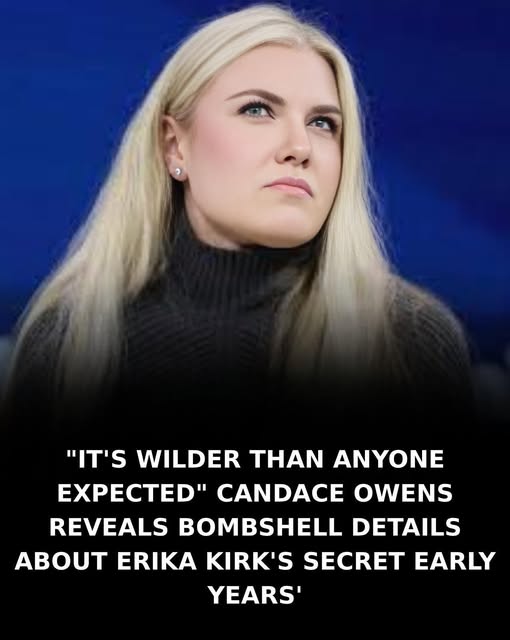
Owens has released a docuseries titled Bride of Charlie, in which she raises questions about Erika Kirk’s public narrative and motivations. In the first episode, A Wrinkle in Time, Owens alleges inconsistencies in how Erika has described her upbringing.
Erika has publicly stated that she was raised by a “strong, independent, entrepreneurial single mother,” Lori Frantzve, after her parents divorced in 1998. Owens disputes that framing, arguing that Erika’s father, Kent Frantzve, was significantly involved in her life and at one point served as a stay-at-home parent.
To support her claim, Owens referenced a September 2025 profile in The New York Times in which Erika described being raised by a single mother. Owens also played a clip from The Charlie Kirk Show podcast where Erika mentioned that her father had been a stay-at-home dad during part of her childhood — something Erika described as meaningful to her.
Owens contends that these accounts are contradictory. She further stated that she spoke with former classmates and acquaintances who questioned how Erika characterized her family background. In the docuseries, Owens also shared an image of a family tree and suggested alternative interpretations of Erika’s family relationships.
These allegations have circulated widely on social media, where supporters and critics of both women have weighed in. Some argue that family dynamics can be complex and that phrases like “raised by a single mother” may reflect emotional or custodial realities after divorce rather than the complete absence of another parent. Others believe public figures should be precise when describing their backgrounds.
Tensions between Owens and Erika appear to extend beyond biographical details. Owens has also criticized how Erika has handled public messaging following her husband’s death, including remarks about the scale of his memorial service and merchandise sales connected to the organization.
In December 2025, the two women reportedly met in person and described the meeting as “productive” on social media. However, public disagreements resurfaced weeks later, indicating that their differences were not fully resolved.
It is important to note that many of Owens’ claims are presented from her perspective within the docuseries and have not been independently adjudicated in a legal or formal investigative setting. As with many high-profile disputes, narratives can differ depending on interpretation and context.
At the center of the situation is a broader question: how should public figures navigate personal tragedy while managing political organizations under intense scrutiny?
Grief unfolds differently for everyone. Leadership transitions following sudden loss can be complex, especially when they occur within organizations that already operate in highly charged political environments. Public commentary, particularly from former allies, can amplify that complexity.
For observers, separating verified facts from personal interpretations is essential. Political disagreements, personal histories, and emotional responses often blend together in ways that make online discourse more heated than clarifying.
Ultimately, the situation highlights how quickly private family history and personal grief can become subjects of national debate when tied to prominent political movements.
As discussions continue, the focus for many remains on accountability, transparency, and respectful discourse — particularly when conversations involve loss, family, and leadership.