The world at 3:00 a.m. is a different dimension altogether, a landscape of long shadows and a silence so profound it feels heavy against the eardrums. I was driving along the winding stretch of Highway 42, the only illumination coming from the rhythmic sweep of my headlights against the asphalt. The air was thick with the scent of pine and impending rain, and the dashboard glow was the only company I had on that desolate trek home. It was the kind of night where the mind wanders to places it usually avoids—regrets, old faces, and the ghosts of a life left behind. I was lost in a fog of exhaustion when a sudden movement on the shoulder of the road forced my foot toward the brake.
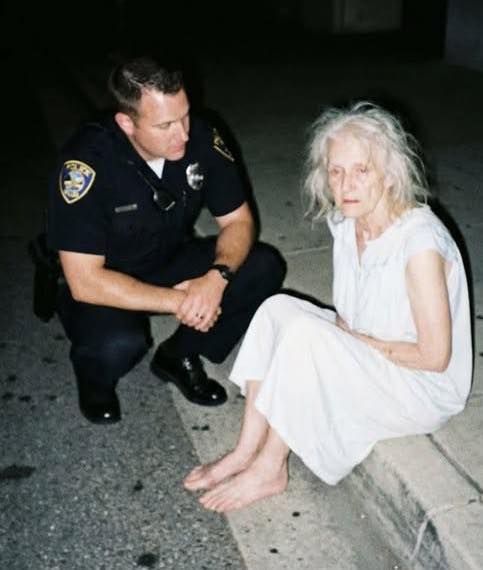
Standing at the edge of the tree line was a figure that seemed to manifest out of the mist. An elderly woman, frail and dressed in a nightgown that fluttered like a tattered flag in the cooling breeze, stood perfectly still. She looked dangerously out of place, a silver-haired specter in a world of darkness. My heart hammered against my ribs as I pulled my car to a slow stop, the gravel crunching beneath the tires with a sound that felt violently loud in the stillness. I didn’t know if I was witnessing a medical emergency or something more tragic, but I couldn’t drive away.
I stepped out of the vehicle, the cold night air biting through my jacket. “Are you okay?” I asked, my voice barely more than a whisper. I didn’t want to startle her, but the woman didn’t flinch. She remained focused on something gripped tightly in her hand. As I approached with measured, cautious steps, I could see the confusion etched into the deep lines of her face. Her eyes were distant, clouded by a disorientation that suggested she was miles away from the present moment. She seemed to be searching for a landmark that no longer existed, or perhaps a person who had long since departed.
It was when she shifted her weight that the moonlight caught a glint of metal in her palm. My breath hitched. She was clutching a worn, silver bracelet adorned with unique, hand-stamped charms—a tiny anchor, a weathered oak leaf, and a distinctively notched heart. My vision blurred for a second as a memory I hadn’t touched in twenty years surged to the surface with the force of a tidal wave. I knew that bracelet. I knew the weight of it, the way the clasp clicked, and the specific story behind every single charm. It was a one-of-a-kind piece, commissioned by my father for my mother just months before she disappeared from our lives.
The implications of that discovery hit me with a physical force. For two decades, our family had lived in the shadow of an unsolved mystery. My mother had walked out of our front door one Tuesday afternoon and vanished into the ether, leaving behind a grieving husband, a confused son, and a void that no amount of time could fill. We had searched every hospital, every shelter, and every corner of the state, eventually being forced to accept the cold finality of a cold case. And yet, here on a forgotten stretch of road at three in the morning, stood a woman holding the only piece of jewelry my mother never took off.
“Where did you get that?” I asked, my voice trembling with a mixture of hope and terror. The woman finally looked at me, and for a fleeting second, the fog in her eyes seemed to lift. She held the bracelet out toward me, her fingers gnarled and shaking. She didn’t speak, but her expression pleaded for help, for recognition, for a way back to whatever reality she had slipped out of. I looked at the woman’s features—older, weathered by time and perhaps by a life of hardship I couldn’t imagine—and searched for the mother I remembered. The high cheekbones were there, hidden beneath the sagging skin, and the shape of her brow was hauntingly familiar.
I realized then that this woman wasn’t just a stranger wandering the roadside; she was a living testament to a history that had been stolen from us. As I helped her into the warmth of the passenger seat, the bracelet fell into my hand. The notched heart was still there, the edge slightly sharp just as I remembered. This wasn’t a coincidence. This was the intersection of a tragedy and a miracle occurring in the dead of night.
As we drove toward the nearest hospital, the woman began to hum a melody—a low, rhythmic tune that my mother used to sing to me to ward off nightmares. The sound sent chills down my spine, bridging the twenty-year gap in an instant. I looked at her in the dim light of the cabin and saw the truth that the police and the private investigators had missed. She hadn’t left us by choice; she had been lost in the labyrinth of her own mind, a victim of an early and aggressive onset of memory loss that had likely stripped her of her identity before she could even find her way home.
The 3:00 a.m. silence was no longer heavy; it was sacred. The roadside encounter had turned a night of routine into a journey of reclamation. As the lights of the city began to flicker in the distance, I realized that the bracelet wasn’t just a piece of jewelry—it was the compass that had finally led her back to me. The truth was far more complex than any tabloid headline could capture, involving years of life spent in state-run facilities under an “unknown” status, but all of that could be untangled later. For now, the only thing that mattered was the warmth of her presence in the seat next to me and the silver weight in my hand.
When we arrived at the emergency room, I didn’t identify her as a Jane Doe. I leaned down, kissed her weathered forehead, and told the nurses her name. I held the bracelet up, the charms jingling softly, a sound that had once been the soundtrack to my childhood. The mystery that had defined my life was over, replaced by a new, more important task: caring for the woman who had finally found her way back from the darkness. The 3:00 a.m. bracelet truth was a reminder that some bonds are forged in material far stronger than silver—they are etched into the very soul, waiting for the right moment of silence to be revealed once again.