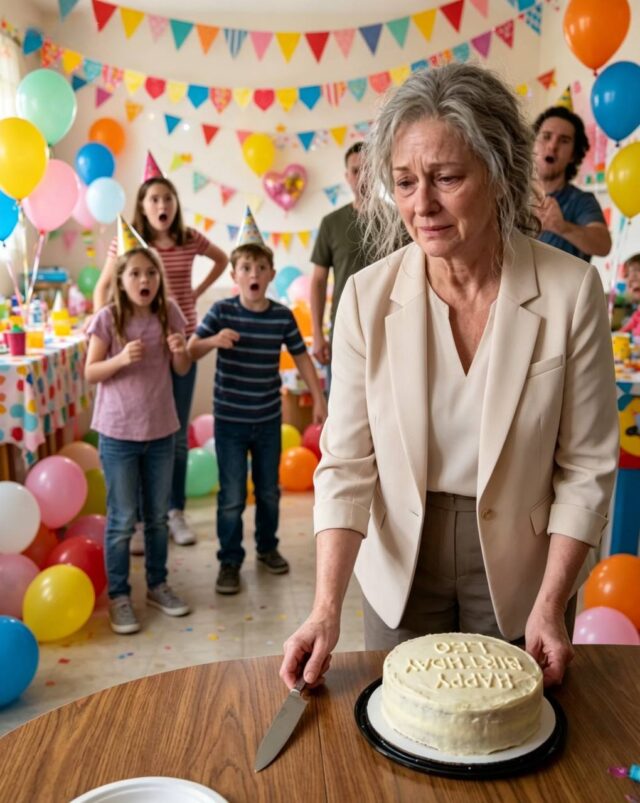
I left my grandson’s birthday party with the cake still uncut, because after seven years of raising my daughter’s children, I learned I was useful—but never truly valued.
“Mom, can you bring out the plates?”
That was the moment I understood exactly who I was in that house.
Not a guest. Not even family, really.
Staff.
My name is Evelyn. I’m sixty-six, a retired public school teacher in Ohio, living on a pension that makes every grocery trip feel like a math problem.
For seven years, I have spent more waking hours in my daughter’s home than in my own.
I got there before sunrise.
I packed lunches, cleaned spills, found missing shoes, signed school papers, drove to practices, sat through fevers, folded tiny socks, wiped bathroom counters, and made dinner before my daughter and son-in-law came home tired enough to say, “I don’t know how we’d survive without you.”
I used to think that meant something.
I thought love counted.
I thought sacrifice was seen.
When my older grandson, Mason, was born, my daughter Rachel cried in my kitchen and held both my hands.
“We can’t afford full-time help,” she said. “And I don’t want strangers raising my boys. Please, Mom. Just until we get on our feet.”
That was seven years ago.
They got on their feet.
Then they kept climbing.
Better jobs. Bigger house. New furniture every season. Travel sports. Fancy birthday themes. A backyard firepit nobody ever used.
Somewhere along the way, I became part of the house too.
Like the dishwasher.
Always running. Never thanked unless broken.
Then there was Linda, my son-in-law’s mother.
Linda lived in Florida half the year and treated grandparenting like a vacation package.
She blew in wearing bright lipstick and expensive sunglasses, carrying giant gift bags and zero responsibility.
She didn’t know Mason’s teacher’s name.
She didn’t know the younger one, Eli, still woke up crying after thunderstorms.
She had never cleaned vomit out of car upholstery, never sat in urgent care for four hours, never spent her own gas money driving to a school because someone forgot a trumpet or a permission slip.
But she was the fun grandma.
The glamorous one.
The one the boys ran to.
Yesterday was Mason’s eleventh birthday.
I had been working on his gift since January.
A quilt.
Hand-stitched. Navy, forest green, and soft gray. Heavy enough to calm him at night because ever since his father started yelling more and listening less, that child had become a restless sleeper.
I also baked the cake myself.
Three layers. Vanilla with strawberry filling. The kind of cake my own mother used to make when money was tight but love wasn’t.
I got to the house at eight in the morning.
I swept, wiped counters, stuffed goodie bags, blew up balloons until my head hurt, and cooked enough food to feed a church basement.
By four, the guests were there.
By five, Linda arrived like she was making an entrance in a movie.
The boys screamed when they saw her.
She laughed, kissed the air near their cheeks, and handed Mason a giant box from an electronics store.
“Open Grandma’s gift first,” she said.
Inside was the newest gaming system, extra controllers, and gift cards.
Mason let out a sound I had never once heard over anything I had given him.
Rachel clapped.
Her husband slapped his mother on the back and called her “unbelievable.”
Someone poured Linda a glass of wine.
I was still standing by the kitchen island holding a knife and a stack of paper plates.
I waited for a pause. Just one.
Then I held out the quilt.
“Mason,” I said. “I made you something too.”
He glanced at it for less than a second.
“Oh. Thanks, Grandma.”
Then he turned back to the screen.
His little brother laughed and said, “It’s a blanket.”
Not cruel.
Just careless.
The kind of careless children learn from watching adults.
I looked at Rachel.
I thought she would step in.
I thought she would say, “That blanket took months,” or “Your grandmother does everything for this family,” or even “Say thank you properly.”
Instead, she gave me that tight little smile adult daughters use when they want their mothers to stop embarrassing them.
“Mom,” she said softly, “don’t do this today. Linda’s the exciting grandma. You’re more the dependable one. The boys love you differently.”
Dependable one.
I stood there with buttercream on my wrist and her words in my chest.
Dependable.
Like a furnace.
Like a mop.
Like something you only notice when it stops working.
Then Linda laughed and said, “Well, every family needs somebody practical.”
Everybody smiled the way people smile when they’re relieved the insult didn’t land on them.
Something in me went still.
Not loud. Not dramatic.
Just finished.
I set the quilt down on the counter.
I placed the cake knife beside it.
Rachel blinked at me. “Mom? Can you start cutting the cake?”
“No,” I said.
The room got quiet.
She frowned. “What do you mean, no?”
“I mean I’m done.”
I untied my apron and folded it over the back of a chair.
“I am done being the unpaid engine of this house while everybody else gets to be adored. I am done being called dependable when what you really mean is convenient.”
Rachel’s face changed.
Not to guilt.
To panic.
“Mom, please. Not now.”
“Yes,” I said. “Exactly now.”
Her husband stepped forward. “You’re overreacting.”
I looked at him for a long moment.
“Am I?” I asked. “Then tomorrow morning you can pack lunches, find Eli’s sneakers, wash the uniforms, take Mason to school, get groceries, and stay home when somebody spikes a fever.”
Linda suddenly became very interested in her wineglass.
Rachel followed me to the front porch.
Her voice dropped low and sharp.
“You can’t just leave. I have a meeting tomorrow.”
And there it was.
Not Are you hurt?
Not I’m sorry.
Not Mom, please don’t go like this.
Just scheduling.
Just logistics.
I opened my car door.
“I am not quitting the boys,” I told her. “I am quitting this job you dressed up as love.”
She stared at me like I had slapped her.
My phone rang all night.
Rachel. Her husband. Then Rachel again.
Texts came in one after another.
You’re being unfair.
The boys are upset.
We need to talk.
Can you at least come in the morning?
Need.
Not miss.
Need.
This morning, for the first time in years, I woke up without an alarm.
I made coffee and sat on my porch wrapped in the quilt I had made for Mason.
It fit me perfectly.
Around ten, a woman from down the street stopped by and asked whether I still wanted to join the beginner pickleball group at the community center.
Three weeks ago, I had laughed and told her I was too busy raising children I did not give birth to.
Today, I said yes.
Because I love my grandsons.
I always will.
But I will not spend whatever years I have left teaching my own daughter that a mother’s devotion is an endless natural resource.
If they want me in their lives, they can welcome me as a person.
Not a backup plan.
Not free labor.
Not the dependable one.