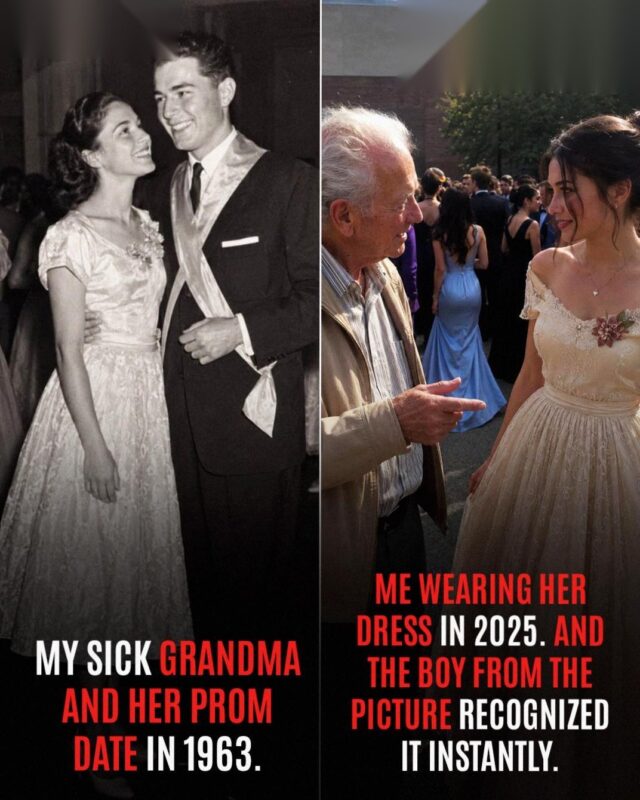
Linda thought wearing her dying grandmother’s old prom dress would be a quiet way to honor her one last time. Instead, one shocked look from a stranger at the dance unraveled a love story that had been buried for nearly 50 years.
While everyone else at school was talking about prom, I was counting the days I had left with my grandmother.
Grandma Mary was 79, and the doctors had already told us there was nothing more they could do. Hospice had been coming to the house for three weeks, and every afternoon I sat beside her bed, wondering how many conversations we still had left.
I spent most afternoons in Grandma’s room after school, sitting beside her bed while she drifted in and out of sleep. Sometimes she knew exactly who I was. Sometimes she thought I was my mother.
So no, I was not in the mood to care about prom.
I only even had a date because my best friend, Dane, had asked me in the least romantic way possible.
“You are not spending prom night in sweatpants watching crime documentaries,” he told me in the cafeteria.
“I absolutely am.”
He dropped into the seat across from me. “Then I am taking you against your will.”
“That is not how dates work.”
He stabbed a fry into his mouth and shrugged. “You know what I mean.”
Dane had been my best friend since eighth grade. “I don’t even have a dress,” I told him.
“Find one, because we are going.”
“I mean it, Dane. I don’t want to go.”
His expression changed then. Softer. “I know.”
That night, I heard my mom in the attic, dragging boxes around. A few minutes later, Grandma called weakly from her room, and my mom came down carrying an old white storage box with a cracked lid.
Grandma was propped up against her pillows.
“Open it,” she told me.
Inside was tissue paper yellowed with age. Under that was the dress.
It was pale blue once, I think, though time had faded it into a soft grayish color that almost looked silver in the lamplight. The waist was tiny.
The sleeves were puffed and ridiculous. Half the beadwork on the bodice was missing, and the hem looked like it had survived a small war.
“What is this?” I asked.
“My prom dress,” Grandma whispered.
Mom laughed a little through tired eyes. “She made me wear it once when I was 12 and thought I was going to a school dance.”
Grandma ignored her and looked at me. “You should wear it.”
I gave my mom a look that clearly said, “Help me here,” and she just smiled in that helpless way people do when they know they can’t win.
Grandma’s thin hand reached for mine. “Please, Linda.”
That was the thing about people who are dying. Sometimes one little request carries the weight of a whole lifetime.
So I nodded. “Okay.”
Her eyes lit up. For one second, she did not look sick at all.
That was how I ended up spending the next two weeks rebuilding a dress from another century.
I watched tutorials. I bought beads from the craft store with money I had been saving for shoes. I removed the sleeves, reshaped the neckline, tightened the waist, and added a soft layer of fabric over the skirt so it moved better when I walked.
Every night after homework, I locked myself in my room and worked until my fingers cramped.
The day of prom, I brought the dress into Grandma’s room before I got ready. Her breathing was shallow, but when I held it up, she smiled in this faraway, aching way.
“You repaired it,” she said.
“I had to. Now it looks closer to its original color and design.”
I sat beside her on the bed. “Did you have a good prom?”
Her smile faded, not completely, but enough for me to notice.
“It was beautiful,” she said softly.
Then she turned her face toward the window, and that should have told me something right there. But I did not know enough yet to ask the right questions.
By seven, I was dressed and standing in front of the hallway mirror.
“You look gorgeous,” Mom said.
Dane showed up in a dark suit and tie, holding a corsage and trying way too hard not to look stunned when he saw me.
“Okay,” he said. “Wow,” and handed me the corsage. “You look amazing, Linda.”
“You’re cleaning up okay, too.”
Mom took pictures on the porch. Grandma was too weak to come downstairs, so before we left, I ran back up to her room to show her one more time.
She was awake, barely.
I stood in the doorway and said, “What do you think?”
Her eyes filled immediately. “Oh.”
That was all she said. Just oh. But the way she looked at me made my throat tighten.
I crossed the room and kissed her forehead. “I’ll be back before midnight.”
She touched the skirt with trembling fingers. “Have a beautiful night.”
Prom was being held at a ballroom inside an old hotel downtown.
Everything glowed gold. Music was already thumping when Dane and I walked in.
People complimented the dress. Girls I barely knew asked where I bought it. One teacher said, “Very vintage, Linda,” like she was trying not to admit she loved it.
Then, maybe 20 minutes after we got there, I noticed an elderly man standing near the entrance to the ballroom.
He looked out of place in a way I could not explain. Not sloppy. Just… separate. He wore a dark suit that had probably fit him better 20 years earlier.
He had a shock of white hair, a face lined so deeply it almost looked carved, and this strange stillness about him, like everyone else was moving too fast for the world he came from.
At first, I thought he must be somebody’s grandfather there for photos.
Then I realized he was staring at me.
He looked like he had seen a ghost.
I glanced behind me to make sure he was not staring at someone else. He wasn’t.
Dane noticed too. “Do you know him?”
“No.”
The man started walking toward us.
By the time he reached me, his eyes were wet.
“Excuse me,” he said. His voice shook. “Where did you get that dress?”
I laughed nervously. “Um. It belonged to my grandmother.”
The color left his face.
“…Mary?” he whispered.
My heart kicked hard against my ribs.
“That’s my grandmother,” I said. “How do you know her?”
For a second, he truly could not speak. He just stared at me, blinking fast.
Then he whispered, “Can you take me to her?”
Every instinct in me went on alert.
Dane stepped slightly closer to my side. “Linda—”
“She’s very sick,” I said quickly. “She can’t even leave her bed anymore.”
The man’s mouth trembled. “Then I need to see her even more.”
Dane pulled me aside. “This is insane.”
“I know.”
“You don’t know this guy.”
“He knows Grandma.”
“That does not make this less insane.”
I looked back at the man. He had not moved. He was standing exactly where I left him, hands shaking at his sides.
“I just…” I lowered my voice. “What if this matters? You know Grandma is dying.”
Dane rubbed a hand over his face. “It’s hard to argue with that.”
“Will you come with me?”
He let out a breath. “Obviously.”
I called my mom and said, “Please don’t freak out,” which of course guaranteed the exact opposite.
Fifteen minutes later, she pulled up outside the hotel.
The old man got into the backseat beside me.
Dane sat on my other side. The whole drive home, the man twisted a handkerchief in his hands until I thought the fabric might tear.
Finally, my mom turned around and asked him, “Do you mind telling us who you are?”
The man looked up. “My name is Griffin.”
Mom’s eyes met mine in the rearview mirror. “Linda said you knew Grandma.”
“I did.” His voice broke on the last word. “A long time ago.”
“How?” I asked.
Griffin closed his eyes briefly. “I loved her.”
The car went silent.
When we got home, Mom told us all to stay calm.
Grandma’s room was dim except for the bedside lamp. The hospice nurse had just left. The oxygen machine hummed softly in the corner. Grandma was half asleep, turned toward the wall.
Mom went in first. “Mom? There’s someone here to see you.”
Grandma stirred faintly. “At this hour?”
Griffin stepped into the doorway before any of us could overthink it.
She turned her head.
I watched recognition hit her in waves.
First confusion, then disbelief, and then something so deep and raw that I felt like I should not be seeing it.
Her whole face changed.
Griffin took one step closer. Then another.
By then, he was crying openly, not even trying to hide it.
He stopped beside her bed.
And very quietly, he said, “I came back.”
My grandmother made a sound that felt like something had torn straight out of her.
She reached for him with both hands.
“Griffin?” she whispered.
He dropped to his knees beside the bed so fast that Dane had to grab the doorframe like he had been physically hit by it.
“It’s me,” Griffin said. “Mary, it’s me.”
She began to cry then. I had seen my grandmother in pain. I had seen her tired, confused, angry, and fading. I had never seen her like that.
“I waited,” she said. “I waited and waited.”
“I know.” He pressed his forehead to her hand. “I know. I am so sorry.”
Mom had one hand over her mouth. Dane reached for my fingers and held on tight.
After a minute, Grandma looked at me through tears and said, “Close the door.”
So we did. Sort of.
We left it cracked. Enough to hear without being noticed. Enough that what happened next changed the way I understood my grandmother forever.
They talked in broken pieces at first.
He told her his family had moved to Ohio three days after graduation because his father had lost his job and his uncle promised work in Cleveland.
He said it had happened fast, with no warning, and his mother had refused to let him go back for her because they did not have the money.
“I wrote to you,” he said.
“I wrote to you too.”
“I never got them.”
“Neither did I.”
His voice shook. “I came back that fall, Mary. I came back, and your house was empty.”
Grandma closed her eyes. “My father sold it after he got sick. We moved in with my aunt in another county.”
“I looked for you.”
“So did I.”
There was a silence then, full and terrible.
Finally, Grandma whispered, “I thought you changed your mind about us.”
Griffin made this wounded sound. “Never.”
Apparently, they had been inseparable as teenagers. First kiss behind the football bleachers. First dance at prom. Plans to get married after he finds work. My grandmother, my sweet dying grandmother who had spent 48 years married to my grandfather Rob, had once belonged heart and soul to someone else.
That part hurt weirdly. Just because it made her feel suddenly larger than I had known. As if there had been a whole country inside her I had never visited.
Grandpa had been dead for six years.
He and Grandma loved each other; I know they did. But listening from that hallway, I realized loving one person deeply does not erase the loss of another.
At one point, Griffin laughed softly through tears and said, “You wore blue to prom because you said every other girl would be in pink.”
Grandma gave this tiny, watery smile. “And you told me I looked like moonlight.”
“I meant it.”
“So did I.”
I started crying right there in the hallway.
Dane put an arm around my shoulders and whispered, “Okay, yeah, this is brutal.”
After a while, Mom went in with water and tissues, but Grandma barely noticed. She and Griffin were staring at each other like everything else in the room was smoke.
Then Grandma said something that broke me.
“I kept the prom dress. I gifted it to my granddaughter to wear it tonight.”
His face folded in on itself. “I knew it the second I saw her.”
She nodded. “I could never throw it away.”
He looked toward the doorway then, toward me. He then explained that he had just moved back to town after losing his wife of 30 years.
They never had children, and he felt nostalgic, wanting to spend the rest of his life in the first place he had ever called home and fallen in love.
He had arrived the previous day and was taking in the town at night when he noticed the prom happening at the hotel.
He said he found himself walking in as memories of dancing with my grandmother came rushing back.
He was about to leave when he spotted me and recognized the dress.
At first, he thought he was hallucinating, but then he realized I was real.
“Your granddaughter looked exactly like you,” he said. “For one second, I thought time had done something impossible.”
I stepped into the room because, by then, pretending I wasn’t listening felt ridiculous.
Grandma reached for my hand and squeezed it weakly. “You brought him back to me.”
I was crying too hard to answer properly.
Griffin stayed for three hours.
He told stories about sneaking pebbles at her window, about the diner where they split milkshakes, about the silver ring he bought with lawn-mowing money and never got to give her.
Grandma remembered everything. Every place. Every song. Every promise.
At some point, she fell asleep holding his hand.
Griffin did not let go.
When the hospice nurse came back early the next morning, she found him still sitting there.
Grandma died two days later.
On her last day, she looked straight at Griffin and said, “You came back.”
And he answered, “I always meant to.”
That is still the saddest and most beautiful thing I have ever seen.
Sometimes I think about how different life was back then. No phones in their pockets, no social media, and no way to search one name and bridge 50 years in five seconds.
Just two kids in love, then gone from each other overnight, and a silence so long it became part of who they were.
And yet, somehow, she kept the dress.
Somehow, he walked into that ballroom.
Somehow, he looked at me and saw her.
People keep telling me how tragic it all is, and it is. It really is. They lost almost 50 years they should have had. There is no pretty way around that.
It is heartbreaking, unfair, and to some, even beautiful.
Still, I wish I had never taken him to her.
Did she die better for knowing what her life could have been, or would she have been gentler, leaving the world never knowing at all? I think I prefer that she had left without knowing.
But the question at the heart of it all is: When your grandmother spends half a century holding onto one dress and one memory, and the man tied to both suddenly finds his way back to her bedside, was that destiny, or a miracle that arrived painfully late?
If you enjoyed reading this story, here’s another one for you: For 65 years, Daniel believed the girl he loved at 17 existed only in a fading photograph and in the quiet corners of his memory. He had made peace with that, or at least he told himself he had. He did not expect to see proof that he had been wrong while sitting in a nursing home dining hall.