“If you mention my name again, I promise you’ll be going straight back to prison.”
My sister said it calmly, the way you’d tell someone their shoe was untied.
Then she tossed a thick white envelope onto the grass in front of my feet. It landed with a soft thump. One corner had torn open, and I could see the edges of hundred-dollar bills inside, wrapped in a rubber band.
I was standing in Opal Hargrove’s backyard in Worthington with a wet bedsheet in my hands and two clothespins in my mouth. I took the clothespins out slowly.
It had been six weeks since my release from prison.
Six weeks, and the sound of a slamming door still made me sit straight up in bed at night with my heart pounding. Six weeks, and I still asked permission before I opened the refrigerator.
Now Monica was standing in front of me, outside a house that wasn’t mine, threatening to send me back.
And on her wrist was our father’s watch.
The gold one, with the scratched face and the brown leather band. The one he’d pressed into my hand in the hospital, two days before he died, and said, “You keep this, Becky. You’re the one who’ll keep time for everybody.”
The one I’d left in the top drawer of my nightstand the morning the police came to my house.
Monica saw me looking at it. She didn’t cover it up. She turned her wrist a little so the sun caught the glass.
“Pick up your money,” I told her. My voice was shaking, but I kept going. “You already took four years of my life. You’re not buying the ones I have left.”
Monica smiled. It was a cold, small smile. I’d seen it before, when we were kids, right before she told our mother that I was the one who broke the lamp.
“You still think you can win,” she said.
To explain how my sister and I ended up facing each other across a clothesline that day, I have to start six weeks earlier, at the front gate of the Ohio Reformatory for Women in Marysville.
My name is Rebecca Hale. I’m thirty-six years old.
I spent almost four years behind bars, serving a five-year sentence for fraud I didn’t commit.
Before all of that, I owned a company called Buckeye Medical Supply. We distributed medical equipment to private clinics around central Ohio. Wheelchairs, blood pressure monitors, exam tables, hospital beds for home care. I started it from nothing, in a tiny rented storefront between a nail salon and a tax office. I had a comfortable house in Dublin, a suburb outside Columbus, with a red front door and a backyard with a maple tree.
And I was married to Trevor Mallory, a man I’d thought of as my closest friend.
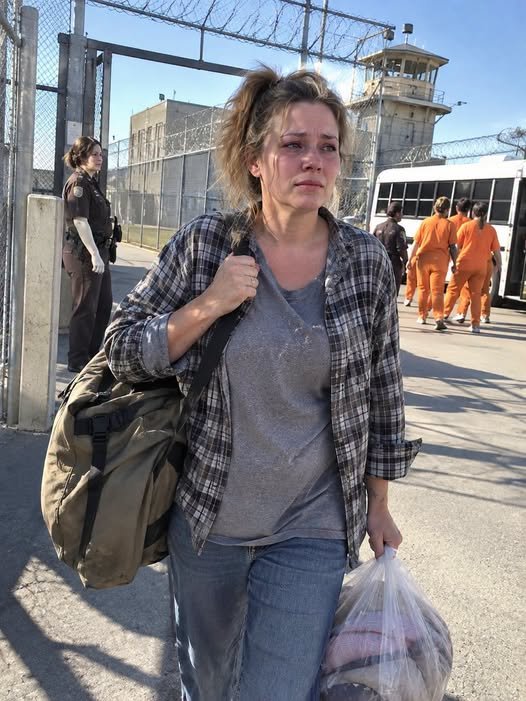
When I walked out of that prison gate, everything I owned fit inside a clear plastic bag. Two pairs of jeans. Three shirts. Some underwear. A hairbrush. A paperback book with the cover torn off.
And seventy-five dollars in release money, in an envelope with my name typed on it.
That was it. That was what was left of my whole life.
Nobody came to pick me up.
I’d called Trevor from the prison phone two weeks before my release date. Then again one week before. Then again three days before. It rang and rang. The last time, it went straight to voicemail, and the message said the mailbox was full.
I’d called Monica too. Her number had been changed.
So I took the bus.
I sat in the back row, by the window, with my plastic bag in my lap. A woman across the aisle was eating a bag of chips, and the crinkling sound was so loud and so normal that I started crying, very quietly, so nobody would notice.
I hadn’t heard anybody eat chips in almost four years.
Here’s what I knew when I got out.
Trevor had taken control of my company after my arrest. Monica was still running its finances, the way she had for six years before everything happened.
And my house, my house with the red door, had a mortgage on it that I had never signed. I’d found out from a letter my lawyer forwarded to me in prison, eight months before my release. A bank I’d never heard of. A loan I’d never asked for. My signature, supposedly, at the bottom.
I’d written to Trevor about it. Three times.
He never wrote back.
For nine days, I looked for work.
I stayed at a women’s shelter on the east side of Columbus. They let you stay two weeks if you were looking for a job. The bed was narrow, and the woman in the bunk above me talked in her sleep, but it was clean, and nobody counted me at night.
Every morning, I put on my one good shirt, a blue button-down that was a little too big for me now, and went out.
The first place was a dental office looking for a receptionist. The office manager was a friendly woman with a lot of bracelets. She liked me. She said so. She said, “You’re exactly what we need.” Then she said they just needed to run a quick background check.
She called me the next afternoon.
“I’m so sorry, Rebecca,” she said. “It’s just… with patient information, and billing… I’m sure you understand.”
I said I understood.
The second place was a warehouse. The third was a hardware store. Both times, it went the same way. A nice interview. A handshake. A background check. A phone call.
I’m sure you understand.
The fourth place offered me something. Overnight office cleaning in a business park twenty miles north of the city, eleven at night to seven in the morning. Nine dollars an hour.
“When can you start?” the man asked.
“What’s the address?” I said.
He told me.
There was no bus that went there at night. I didn’t have a car. I didn’t have the money for a car. I didn’t even have a permanent address to put on the paperwork, because the shelter only let you use theirs for two weeks.
I thanked him and hung up.
Then I sat on a bench outside the shelter and counted my money. Forty-one dollars left.
I did the math three times. It didn’t get any better.
On the ninth day, I took a bus up to Worthington because a coffee shop there had a HELP WANTED sign in the window. When I got there, the sign was gone.
I was so tired and hungry that I walked into the little grocery store next door to buy a banana and a carton of milk. Two dollars and eighteen cents.
On my way out, I passed the community bulletin board by the door. Lost cats. Guitar lessons. A church rummage sale.
And an index card, handwritten in careful blue ink, in old-fashioned cursive.
*Live-in woman wanted to cook and keep house. Room, board, and $600 a week. Must be honest and able to work. Inquire: Mrs. O. Hargrove.*
There was a phone number at the bottom.
I read it twice.
Then I took the card off the board, put it in my pocket, and walked to the pay phone outside, because I didn’t have a cell phone.
The woman looking for help was Opal Hargrove. She was seventy-four years old and a widow, and she lived alone in a white two-story house on a quiet street lined with oak trees.
She opened the door before I even knocked.
She was wearing a navy blue dress with a white collar, and her white hair was pinned up in a neat twist at the back of her head. She was small and straight-backed, with a cane she didn’t seem to need much. But it was her eyes I noticed. Sharp gray eyes, like a schoolteacher’s. Eyes that seemed to see things I was working very hard not to show.
She looked me up and down. My too-big blue shirt. My worn-out sneakers. The plastic grocery bag with a banana in it.
“Come in,” she said. “Wipe your feet.”
We sat in her kitchen. It smelled like coffee and lemon dish soap. There was a stack of newspapers on one chair and a shoebox full of crumpled receipts on the counter.
“Can you cook real home-cooked food?” she asked. “Not out of a box. I mean real food.”
“Yes, ma’am.”
“What can you make?”
“Pot roast. Chicken and dumplings. Meatloaf. My mother’s chili. I can bake bread, if you have a decent oven.”
She nodded slowly. “Can you keep books?”
I almost laughed.
“Better than I cook,” I said.
One of her white eyebrows went up.
She looked at me for a long moment.
“Then you start tomorrow,” she said.
I almost said yes. I almost just took it and ran.
But I’d spent nine days watching people’s faces change on the phone. I didn’t want to see hers change after I’d already unpacked.
“Mrs. Hargrove,” I said. “Before you decide, there’s something you should know. I just got out of prison. Nine days ago. I served almost four years for fraud.” I took a breath. “I didn’t do it. But I know everybody says that.”
She didn’t say anything right away.
She picked up her coffee cup and took a sip. She put it down again. She looked at me over the rim of it.
“I asked if you knew how to work,” she said. “Not whether your life has been perfect.”
I just sat there.
“Tomorrow,” she said. “Seven o’clock. I like my eggs scrambled soft, and I like my coffee strong enough to stand a spoon in. Can you manage that?”
“Yes, ma’am,” I said. My voice cracked a little.
“Good. Now eat that banana before it goes brown. You look like you haven’t had a real meal in a week.”
That evening, I moved into a small bedroom on the second floor, at the back of the house. It had a single bed with a white chenille bedspread, a wooden dresser, a lamp with a fringed shade, and a window that looked out over Opal’s backyard. There was a clothesline out there, strung between two metal poles. A vegetable garden with tomato cages. A bird feeder.
I set my plastic bag on the dresser.
Then I closed the bedroom door.
I just stood there with my hand on the doorknob.
For almost four years, I hadn’t been allowed to close a door. Other people decided when doors opened and when they shut. A guard with keys. A buzzer. A loudspeaker. Count time, six times a day.
I turned the doorknob and opened the door again. Then I closed it. Then I opened it.
I did it four times.
Nobody yelled. Nobody came.
I sat down on the edge of the bed and put my face in my hands. I didn’t cry. I just sat there and listened to the quiet of a room that was, for now, mine.
For the first few days, Opal and I kept things completely professional.
I made breakfast at seven. Soft scrambled eggs and coffee strong enough to stand a spoon in. I made lunch at noon and supper at six. I washed her clothes and ironed her dresses and dusted the china cabinet in the dining room, which was full of little porcelain birds.
She ate alone at the dining table. I ate alone in the kitchen. That was how she wanted it, and I didn’t mind. I was used to eating fast and alone.
On the third day, I started on the shoebox.
It was full of receipts. Grocery receipts. Pharmacy receipts. Utility bills. Bank statements she’d stuffed in there without opening. Some of them went back two years.
I sat at the kitchen table after supper with a pencil and a legal pad and sorted them into piles. By category. By month. I made a little ledger in neat columns. Income on one side, expenses on the other.
When I was done, I found two problems. Her cable company had been charging her twice a month for eleven months. And the man who mowed her lawn had been billing her for weekly service in the winter, when nothing grows.
I wrote it all down and left the legal pad on the dining table next to her coffee cup in the morning.
She read it while she ate her eggs. She didn’t say anything for a long time.
Then she looked up at me over her glasses.
“You weren’t always a housekeeper, were you?”
“No, ma’am,” I said. “I used to run a company.”
I waited for the questions. What kind of company? What happened? Who were you before?
She just nodded and picked up her phone and called the cable company and gave them a piece of her mind for twenty minutes straight.
That was the first time I really liked her.
But something outside that house started to bother me.
On my fifth day, I was out sweeping the front porch in the morning when I noticed a gray sedan parked across the street. A plain car. Four doors. Tinted windows. The kind of car nobody looks at twice.
It was just sitting there with the engine running.
I kept sweeping. When I looked up again, it pulled away from the curb and drove off down the street.
I told myself it was nothing. A neighbor. A delivery driver checking his phone.
Four days later, it was back.
Same car. Same spot across the street. I was sweeping the porch again, and this time, the driver’s window was down a few inches. I could see a man inside. Middle-aged, with a baseball cap.
He was holding up his phone. Pointed at the house.
Taking pictures.
When he saw me looking, the window went up, and the car drove away fast.
I had a feeling I knew who’d sent him.
Trevor. Trevor, who never answered my calls. Trevor, who had my company and my house.
But I didn’t have any proof. Just a feeling. And I’d learned in a courtroom in Franklin County that feelings don’t count for anything.
So I did what I’d learned to do in prison. I wrote it down.
I bought a small spiral notebook at the grocery store for a dollar ninety-nine. On the first page, I wrote the dates and times of both sightings. A description of the car. A description of the man. And the license plate. Or at least the first four characters, which was all I could catch before it drove away. HKD 4…
I hid the notebook under the mattress in my room.
Some habits you don’t lose.
On my twelfth day, Opal came into the kitchen at a quarter to six, while I was setting out her supper tray.
“Leave that,” she said. “I made soup.”
I looked over at the stove. There was a big pot on the back burner I hadn’t noticed. It smelled like chicken and celery and thyme.
“You cooked?”
“I cooked for fifty-one years before you came along, young lady,” she said. “I can still do it once in a while. Sit down. You’re eating with me tonight.”
I didn’t know what to say. So I sat down.
She ladled out two bowls of chicken soup. Real chicken soup, with thick noodles and big chunks of carrot. She put a basket of bread rolls on the table between us and a dish of butter.
As she set down the rolls, she said, very casually, like she was asking me to pass the salt:
“Rebecca, why were you in prison?”
My fingers tightened around my spoon.
I looked down at the soup. The steam was rising off it in little curls.
I’d been asked that question a hundred times. By lawyers. By guards. By other women in my unit. By a parole officer with a mustache who never once looked up from his clipboard.
But nobody had ever asked me like she asked it. Like she actually wanted to know the answer.
“Because my husband and my sister stole money using my name,” I said. “And then they convinced everyone I was the one who did it.”
Opal didn’t react. She just buttered a roll.
“Tell me,” she said.
So I told her.
I told her how I’d started Buckeye Medical Supply eleven years ago, when I was twenty-five, with fourteen thousand dollars I’d saved from waitressing and a small business loan my father co-signed. How I rented that tiny storefront between the nail salon and the tax office. How I spent every Sunday for three years driving around central Ohio in my old Honda, with a trunk full of brochures, knocking on the doors of private clinics, trying to get them to buy from me instead of the big national companies.
How the first contract I ever got was from a family doctor in Delaware, Ohio, named Dr. Ferris, who bought six exam tables and said, “You’re the first salesperson who’s ever asked me what I actually need.”
How it grew. Slowly. Then faster. Forty clients. Then eighty. Then a real warehouse, and eleven employees, and a delivery van with our name painted on the side.
How I met Trevor at a medical supply trade show in Cincinnati, when I was twenty-eight. He was a sales rep for a wheelchair company. He was funny and easy to talk to, and he bought me a terrible hotel coffee and made me laugh about how terrible it was. We were married a year and a half later.
“He came to work at Buckeye after the wedding,” I said. “He handled sales. He was very good at it. People liked him. Everybody likes Trevor.”
“And your sister?”
“Monica ran the administrative side. Payroll. Billing. Vendor payments. She’s three years younger than me. She was working at a bank when I started the company. I hired her when we got big enough to need someone full-time on the books.” I stirred my soup. “I trusted them both. Completely. I never once thought I needed to check.”
Then I told her about Loretta.
Loretta was Trevor’s mother. She was a retired school librarian, kind and funny, with a laugh that sounded like a hiccup. She’d never had a daughter, and she treated me like one from the very first day.
In the spring of 2021, she got sick. Ovarian cancer. Trevor’s father had been dead for years, and Trevor said he couldn’t handle hospitals. They made him panic. So I went. I drove her to every appointment. Every scan. Every chemotherapy session. I slept in the chair next to her bed when she had surgery.
For almost three months, I was barely at the office.
“I’d check my email at night,” I said. “I’d sign things when Monica sent them over. But I wasn’t really watching. I couldn’t. I was holding Loretta’s hand while she threw up into a plastic tub.”
And during those three months, unauthorized money transfers started going out of Buckeye’s accounts. Under my login. With my approval code.
The money went to a supplier called Halston Ridge Supply. A company I’d never ordered from. Never even heard of.
By the time our bank flagged it, more than three hundred thousand dollars was gone.
“Once the investigators got involved,” I said, “Trevor testified that I’d told him to make those payments. He said I’d been under a lot of stress with his mother, and I’d made some bad decisions. He said I’d asked him to cover for me.” I set the spoon down. “And Monica brought in paperwork. Emails. Approval forms. All of it looked like it backed up what he said.”
“Your own sister,” Opal said.
“My own sister.”
“And your lawyer?”
“He was a nice man,” I said. “He tried. But he couldn’t prove their evidence was false. It was my word against theirs. And there were two of them, and they had papers, and I just had my word.”
The jury was out for four hours.
When the foreman read the verdict, Trevor was sitting in the second row behind the prosecutor’s table. He looked down at his shoes.
Monica was sitting next to him.
She looked straight at me.
Opal listened to all of it without interrupting. Not once. She just sat there with her soup going cold and her hands folded on the table.
When I finished, she was quiet for a long time.
“Do you have any documents?” she said. “From those years?”
I hesitated.
“I kept a few copies,” I said. “When things started to go wrong, before I was arrested, I printed some things out. A few emails. A bank statement. I didn’t really know what I was looking for. I just knew something was wrong. I hid them in a safe deposit box in my maiden name, at a bank Trevor didn’t use. My lawyer never even used them. He said they didn’t prove anything.”
Opal nodded slowly.
Then she pushed back her chair and stood up, holding on to the edge of the table. She walked out of the kitchen with her cane. I heard her open a drawer in the front hall.
When she came back, she was holding a small piece of paper, folded in half. She put it down on the table in front of me.
I unfolded it.
There was a name and a phone number, written in that same careful blue cursive.
Russell Keane.
“He’s a forensic financial investigator,” Opal said. “He helped me once. When I had trouble with my ex-husband.”
“Your ex-husband? I thought you were a widow.”
“I’m both,” she said. “I divorced the first one and buried the second one. The first one was named Leonard, and he hid sixty thousand dollars from me in our divorce. Russell found every penny of it. In about two weeks.” She sat back down. “He doesn’t work miracles, Rebecca. But he knows how to find lies that are hidden in numbers.”
I stared at the name on that piece of paper.
For the first time since that jury foreman stood up, I felt something I’d almost forgotten about.
It wasn’t hope. Not exactly. It was smaller than hope. It was more like the idea of hope. Like seeing a light on in a house far away when you’re lost in the dark.
“I can’t pay him,” I said. “I have six hundred dollars a week, and I owe you for the soup.”
“Talk to him first,” Opal said. “Then worry about paying him.”
Then she reached into the pocket of her navy dress and took out her cell phone.
“There’s something else you need to know,” she said. “I was going to wait and see what you told me before I showed you.”
She put the phone face up on the table and slid it across to me.
It was a text message. It had come in the night before, at 10:47 p.m.
*Mrs. Hargrove, I understand you have recently hired a woman named Rebecca Hale. You should know she is a convicted felon and is considered dangerous. She has a history of stealing from people who trust her. I am prepared to offer you $3,000 to dismiss her immediately. No questions asked. Please reply to this number.*
I read it twice.
I didn’t need to read it a third time. I recognized the phone number.
It was Monica’s.
Her personal cell. The number I’d been calling from prison for the first year, before she changed it. The one I’d memorized when she got her first cell phone in high school.
She hadn’t changed it after all. She’d just blocked mine.
“That’s my sister,” I said.
My voice sounded very far away.
“I thought it might be,” Opal said. “Scroll down.”
I scrolled down.
There was a photograph attached to the message.
It was my house. My house in Dublin, with the red front door and the maple tree in the backyard. The red door had faded to a dull pink. The grass was long and brown. There were dead leaves piled against the foundation.
Under the photo was another line of text:
*This is what happens when you hire a thief. She ruined her own home. Don’t let her ruin yours.*
I put the phone down carefully.
“She wants me gone,” I said.
“Yes,” Opal said. “And she is willing to pay three thousand dollars to make it happen.”
I looked at her.
“Why are you telling me this?”
“Because I want you to know that I already answered her.”
Opal picked up the phone, opened the message, and showed me her reply.
*No. And if you contact me again, I will call the police.*
I stared at the screen.
“You could have taken the money,” I said.
“I could have,” Opal said. “But I asked you if you knew how to work. You do. That is all I needed to know.”
She put the phone away.
“Call Russell tomorrow,” she said. “Tell him Opal Hargrove sent you. And tell him everything you just told me.”
I did.
Russell Keane was a thin man in his fifties with a soft voice and a cardigan that looked like it had been through a war. He listened to my story for nearly two hours without interrupting. Then he asked for every document I still had.
I went to the bank the next morning, showed my identification, and opened the safe-deposit box I had kept in my maiden name. Inside were the printouts I had made years earlier: bank statements, emails, internal transfer records, and a few pages of login activity I had saved without fully understanding why.
Russell took them.
Over the next several weeks, he began reconstructing what had happened while I was caring for Loretta.
He found that the company listed as Halston Ridge Supply had no real warehouse and no employees. Its registered address was a rented mailbox. Its bank account had been opened three weeks after Loretta’s diagnosis. The signatures on the account-opening documents were almost identical to mine, but not quite.
He also found that the login used for the transfers had come from Monica’s office computer, not from my laptop at the hospital.
And he found something else.
During the same period, Trevor had used a limited power of attorney I had once given him for a specific real-estate transaction years earlier. The document had never been revoked. He used it to place a mortgage on my house.
Monica had signed the internal company documents that made it look as though I had authorized the transfers.
Russell’s report was long, careful, and dense with numbers.
I took it to a lawyer named Helen Vargas, a woman who specialized in post-conviction cases. She read the report twice, then looked at me over her glasses.
“This is not a miracle,” she said. “But it is enough to file a petition.”
The petition to vacate my conviction took months.
Helen kept reminding me, over and over, that new evidence didn’t guarantee anything. “Courts don’t like to admit mistakes,” she said. “Be ready for anything.”
I had to testify again.
I sat in a courtroom in the same county building where I’d been convicted. Different courtroom. Different judge. The same smell of floor wax and old paper. My hands were shaking under the table. Opal sat in the second row in her navy dress, with her cane across her knees.
I described my old job. My responsibilities. Loretta’s surgery. The phone. The two hours.
And I answered questions that brought back every bad memory of my first trial.
One question stung the most. The lawyer for the state asked it very politely.
“Ms. Hale, why did you give your sister access to sensitive banking information? Your login. Your phone. Your verification codes?”
I took a breath before I answered.
“Because she’d worked with me for years,” I said. “I trusted her ability. I trusted her as my sister. I let her have access I shouldn’t have let anyone have, without controls. That was a mistake. I know it was.” I looked at the judge. “But trusting someone isn’t the same as telling them to commit fraud.”
I didn’t try to pretend I’d been a perfect business owner.
I hadn’t been.
I’d made mistakes. When Loretta got sick, I stopped watching the company. I signed things Monica sent me without reading them. I’d set up our internal finance system so that the same few people had too much power, with nobody checking anybody. Any good accountant would have told me to separate those permissions. Gordon actually had told me, once, years earlier. I’d said I’d get to it.
Those mistakes were mine. I said so, out loud, in that courtroom.
But I never approved stealing from my own company.
The judge’s decision came in April.
Helen called me at six in the morning and said, “Come to my office. Now. Don’t stop for coffee.”
I took two buses. I ran the last three blocks.
She was standing in her doorway when I got there. She didn’t say anything. She just handed me a document.
My petition had been granted. The court found that the new evidence undermined the foundation of my conviction. The conviction was vacated.
And the court had declared me actually innocent.
“Rebecca,” Helen said. “You now have a court decision that says you’re innocent. Not just that they couldn’t prove it. Innocent.”
I read my name on that piece of paper.
Then I read it again. And again. Rebecca Ann Hale. Actually innocent.
I’d imagined that moment so many times. In my bunk at night. In the shower. In the yard. I’d imagined jumping up and down. Screaming. Crying with joy. Calling everyone I knew.
That’s not what happened.
What happened was a sadness so big and so heavy that I couldn’t talk. I just stood there in Helen’s office, holding the paper, and I couldn’t make a single word come out.
My legal status had changed. On paper, I wasn’t a criminal anymore.
But no piece of paper could give me back what I’d lost. My father’s grave, which I’d never visited because he died while I was awaiting trial and I couldn’t go to the funeral. Loretta, who’d died while I was in Marysville, who’d sent me a card every month until she was too sick to hold a pen. Four birthdays in a cell. Four Christmases eating cold turkey off a plastic tray.
All the nights I’d lain awake knowing that not one single person in the world believed me.
“Is it over?” I asked finally.
“This part is,” Helen said. “The investigation into Trevor and Monica, and the fight for your property, those are on their own track. That’ll take longer.”
I went outside and stood on the sidewalk in front of Helen’s building.
I called Opal.
She picked up on the first ring. She’d been waiting by the phone.
“I’m not guilty anymore, ma’am,” I said.
There was a little pause.
Then she said something that made me start crying right there on the sidewalk, with people walking around me.
“To me,” Opal said, “you never were.”
The rest of it took a lot longer.
Prosecutors kept tracing the money and examining the forged documents. Gordon testified formally and turned over everything in his battered accordion folder. Forensic accountants spent months going through bank records.
About five months after my exoneration, prosecutors got indictments against Trevor and Monica. Fraud. Forgery. Theft.
They both kept fighting it. They were released while their cases went forward, under conditions set by the court. Monica’s lawyer gave a statement to a local newspaper saying she was “confident she would be vindicated.”
I read that article at Opal’s kitchen table and felt something strange.
I understood that an indictment didn’t mean they were guilty. Not yet.
After everything that had happened to me, after watching what an accusation can do when there isn’t enough evidence behind it, I wasn’t going to treat a charge like a conviction. Not even for them.
I just waited.
Nearly two years after my release, both cases began to come to an end.
Trevor took a plea agreement first. His lawyers had seen the bank records. He admitted to specific fraudulent transactions and was sentenced to prison time and ordered to pay restitution.
Monica went to trial. It lasted eight days. I didn’t go. Helen told me about it afterward. The jury was out for three hours.
She was convicted on most of the charges.
In separate civil proceedings, the court threw out the fake transfer of my company shares. The March 14, 2022, meeting minutes were declared void. The mortgage lien on my house, the one Trevor signed with my old limited power of attorney, was ruled invalid and removed.
I got back controlling ownership of Buckeye Medical Supply.
I got back my house.
Neither of them had survived in one piece.
Buckeye was buried in debt. We’d lost most of our customers. The delivery van had been sold. The warehouse lease had lapsed, and the landlord was suing for back rent.
My house had water damage from a burst pipe that nobody had fixed for months. Half the furniture was gone. Sold, Russell guessed. The yard was a jungle.
Getting the house back didn’t give me back the money I’d lost. And signing the papers that said Buckeye was mine again didn’t make it a real company.
For months, I sat in an empty office with an accountant named Mae, a sharp young woman Gordon recommended. We went through every debt. Every creditor. Every unpaid bill. We called the creditors one by one and negotiated. We figured out which parts of the business could actually survive and which couldn’t.
We sold equipment we didn’t need. We gave up projects I’d once thought were the most important things in the world.
I called my old employees.
Four of them came back. Tonya, the receptionist, was one of them. She hugged me in the parking lot for a full minute and said, “I always knew it wasn’t you, Becky. I always knew.”
Others had moved on. They had new jobs, new lives. They didn’t want to come back.
I respected that. I told them so.
After everything I’d been through, I wasn’t the same woman who’d run Buckeye before, either.
One afternoon in late spring, I finally went to my house.
I opened the red front door with a brand new key. The locksmith had changed all the locks that morning.
The door was still faded to pink. The paint was peeling off in strips.
I’d imagined that moment a thousand times. Walking back into my house. In prison, I used to close my eyes and walk through it in my head. Room by room. The kitchen with the blue tile. The living room with the big window. The bedroom with the quilt my mother made.
Now I walked through it for real.
The kitchen tile was cracked and stained. The living room smelled like mildew. In the bedroom, the bed frame was still there, but the mattress was gone, and so was my mother’s quilt.
I went to the fireplace in the living room.
The mantel was empty.
I stood there for a long time.
Then I went to the hall closet and opened it. There were some cardboard boxes stacked on the floor, things nobody had wanted to sell. Old tax files. Christmas ornaments. A box of my books.
At the very bottom of the third box, wrapped in a dish towel, I found it.
My father’s photograph. On his fishing boat. Laughing, with that fish the size of a loaf of bread.
The glass in the frame was cracked straight across his chest. But his face was fine.
I sat down on the floor of the hallway with my back against the wall and held it in my lap for a long time.
I’d thought I would move back in. That was always the plan. Fix it up, paint the door red again, and live there.
But sitting on that hallway floor, I realized I didn’t want to live there by myself.
Too many memories were stuck to those walls. Trevor making coffee in the kitchen in his boxer shorts. Trevor and me dancing in the living room on our first anniversary. Monica sitting at the dining table every Sunday night, eating my pot roast, laughing at Trevor’s jokes.
The police knocking on that red door at six in the morning.
I locked up and drove back to Worthington. I’d bought a used car by then, a little blue Ford, with money from Buckeye’s first profitable month.
Opal was in the front room, knitting, in the armchair by the lamp.
I sat down across from her.
“I want you to live with me,” I said.
Opal stopped knitting. She lowered the needles into her lap.
“Rebecca,” she said slowly, “you don’t need to take care of me out of gratitude. I hired you. I paid you. You worked very hard. We don’t owe each other anything.”
“It’s not gratitude,” I said. “It’s that with you, I learned how to feel like I had a family again. I don’t want to go back to that house and be alone. And I don’t want you to be alone in this one, either.”
Opal looked down at her knitting.
She was quiet for a long time.
“And what happens,” she said, “if someday you get married again? Or start a family of your own? You’re thirty-eight years old. You have your whole life. You don’t want some old woman rattling around your house, telling you how to scramble eggs.”
“I’m already building a family,” I said.
She didn’t say anything.
Then, very slowly, she reached across the space between our chairs and took my hand.
“Then I’ll accept,” she said. “But I want my own room. With my own bathroom. And I’m not giving up my walks.”
I laughed.
“Deal,” I said.
We spent the summer fixing up the house. Well, I fixed it up. Opal sat in a lawn chair in the front yard and supervised.
A crew replaced the water-damaged floors. I painted every room myself. I painted the front door red again. Bright red. Two coats.
We moved in that September.
Opal chose the bedroom at the back of the house, overlooking the garden. She said she wanted to watch the birds at the feeder in the morning. I bought her a bird feeder for her window.
I turned Trevor’s old home office into my own workspace. I took down his framed sales awards and his signed baseball and his leather desk chair. I put in a plain wooden desk and a good lamp and a bookshelf.
I hung my father’s photograph on the wall above the desk, in a new frame, with new glass.
On our first Sunday in the house, Opal and I made chicken pot pie together.
She made the filling. I made the crust. We argued about whether to put peas in it. She won.
As I set two plates on the dining table, I thought about something I’d never said out loud.
During those first weeks at Opal’s house, back when we ate in separate rooms and kept everything professional, I’d come back from Helen’s office or Russell’s office late in the evening, exhausted, and there would be a plate on the stove. Covered with foil. Still warm.
Opal never mentioned it. Not once. She never said, “I saved you supper.” She’d just be upstairs, already in bed, with the light off.
I’d eat standing up in her kitchen in the dark, and it was the best food I’d ever had.
I set the pot pie down in the middle of the table.
“Can I call you Mama Opal?” I asked.
Opal put one hand over her mouth.
She didn’t say anything for a while. Her eyes filled up.
“I thought you’d never ask,” she said finally.
I came around the table and hugged her, and we stood there in my dining room for a long time, while the pot pie got cold.
We didn’t care.
I stayed in touch with Russell after the case was over.
At first, it was just coffee. Once a month or so, at a little place near his office. He’d ask how Buckeye was doing, and I’d ask about his cases, and we’d talk about Opal. Russell and Opal had a running argument going about whether he needed a new cardigan. She said yes. He said his cardigan was fine.
Then the coffees turned into walks. Long walks along the river in Columbus, on Saturday afternoons. We talked about things that had nothing to do with money or courtrooms or forged signatures. His divorce, years ago. His daughter in college. My father. The books I’d read in prison. The dying plant on his windowsill, which, it turned out, had been dying for six years and refused to give up.
“Like you,” he said once.
“Like me,” I agreed.
Russell wasn’t some kind of hero who rode in and saved me and rebuilt my life. I want to be clear about that, because that’s not what happened.
He met me after I’d already started rebuilding it myself.
Slowly, over about a year, our friendship turned into something more.
Opal complained constantly that Russell was too serious.
“That man needs dancing lessons,” she told me at breakfast. “He walks like he’s carrying a filing cabinet on his back.”
“I’ll tell him.”
“Tell him I said so. Tell him Opal Hargrove said he needs to loosen up.”
I told him.
He promised he’d make an effort.
I wasn’t sure he meant it until one Friday evening in December. He showed up at our red front door carrying a stack of old vinyl records under his arm. Frank Sinatra. Six of them. He’d found them at an estate sale.
He walked into our living room, put one on the old record player Opal had brought from her house, and held out his hand to her.
“Mrs. Hargrove,” he said. “May I have this dance?”
Opal looked at his hand. She looked at me. Then she put down her knitting, picked up her cane, and stood up.
“About time,” she said.
They danced slowly to “The Way You Look Tonight,” in the middle of my living room, under the lamp. Russell was stiff and awkward and stepped on her foot twice. Opal laughed at him and told him to stop counting out loud.
I sat on the couch and watched them.
And I realized that this, this simple, ordinary thing, an old woman and a rumpled man dancing badly in my living room on a Friday night, mattered more to me than almost everything I used to think was important.
As for Monica, I never tried to contact her again.
During her trial, she sent me a letter. Through her lawyer. Three handwritten pages on yellow legal paper.
There was no real apology in it.
She wrote that Trevor had made all the big decisions. That he’d pushed her into it. That she’d only been trying to protect Buckeye when things started to fall apart. That she’d been scared of him.
And near the end, she wrote that I was partly responsible. That if I’d just accepted the settlement, none of this would have happened to her. That I’d “chosen” to let things get this bad.
I read it once.
I didn’t write back.
I put it in a folder with all my case documents, and I put the folder in a filing cabinet in my office, and I closed the drawer.
But I still remember when we were girls.
We shared a bedroom in our parents’ little house in Grove City. A narrow room with one window and one bed, because we couldn’t afford two. Whenever there was a thunderstorm, Monica would get scared. She’d scoot over until she was pressed up against my back, and she’d whisper, “Becky, tell me a story.”
So I would. I’d make up stories about a princess who lived on a fishing boat, like our dad’s. About a dragon who was afraid of thunder too. I’d keep talking until I heard her breathing slow down and I knew she’d fallen asleep.
Those memories haven’t gone anywhere. I don’t think they ever will.
But neither has the knowledge that she used my time in prison to make herself rich. That she wore our father’s watch on her wrist while she threatened to send me back.
The watch came back to me, in the end. It was listed in the restitution order, along with the other personal property taken from my house. Helen brought it to me in a small plastic evidence bag.
I wear it now. Every day. The scratched face. The brown leather band.
I’m the one who keeps time for everybody.
Our father used to say that families should stick together, no matter what.
He said it all the time. At dinner. On the boat. When Monica and I fought as teenagers, he’d sit us both down at the kitchen table and say, “You two are all you’ve got. Someday I’ll be gone, and you’ll be all you’ve got.”
For years, I thought that meant I had to forgive every betrayal. That being a good sister meant letting her back in, no matter what she did.
I don’t see it that way anymore.
You can treasure your memories of someone and still decide that they can never be part of your daily life again.
I don’t feel any joy when I think about Trevor and Monica’s sentences.
People expect me to. People say, “You must feel so vindicated.” I don’t. I just feel tired, mostly.
What matters to me is that the evidence was finally seen. That the truth was put on paper, with official seals, where no one can take it away again. That responsibility landed where it belonged.
Justice couldn’t give me back my four years.
But it gave me something else. It gave me the chance to live the rest of my life without carrying the blame for something someone else did.
A few weeks ago, I was cleaning out an old canvas bag from the back of my closet. The one I’d used when I first moved into Opal’s house. I hadn’t opened it in two years.
In the little zippered pocket on the inside, I found a piece of paper.
It was folded in half. It was soft and worn at the edges.
I unfolded it.
Russell Keane. And a phone number. In careful blue cursive.
I carried it into the kitchen. Mama Opal was standing at the counter in her blue bathrobe, making coffee strong enough to stand a spoon in.
“Look what I found,” I said.
She put on her glasses and looked at it. Then she smiled.
“An old scrap of paper,” she said.
“The scrap of paper that changed my life,” I said.
Opal took it from me and set it down on the kitchen table. She smoothed it flat with her palm.
“No, honey,” she said. “Your life changed because you had the courage to make that phone call. And to keep going. Even when nobody could promise you anything.”
That evening, I put that little piece of paper in a small wooden picture frame.
I didn’t hang it in my office next to the court ruling that says I’m innocent. I didn’t put it in the filing cabinet with the deed to the house or the papers that say Buckeye is mine again.
I put it on the mantel in the living room. Above the fireplace. Right where my father’s photograph used to be.
Next to a new photograph. One Russell took on the day we moved in. Opal and me, standing on the front steps in front of the bright red door, with our arms around each other, squinting into the sun.
I lost my freedom. I lost my marriage. I lost my sister. I lost almost everything I’d spent my whole adult life building.
But a woman I’d never met, a woman who wasn’t related to me at all, gave me a room and a job when nobody else in Ohio would take a chance on me. She asked if I knew how to work, not whether my life had been perfect.
And she became the mother I needed.
Trevor betrayed me for money. Monica helped destroy my name. But Opal Hargrove opened her door when I had nothing left but seventy-five dollars and a banana.
Someday, Monica will get out of prison. And maybe she’ll come find me. Maybe she’ll knock on my red door and ask me to forgive her.
If she does, I know I’ll need to listen to what she has to say. I owe that much to the little girl who used to press against my back during thunderstorms.
But listening doesn’t mean I have to let her back into my home.
Forgiveness is something I can choose for my own peace. For me.
Trust is something else entirely. Trust is a different choice.
And after everything I’ve been through, I’ve learned that sharing blood with someone never gives them the right to demand both.
**THE END.**