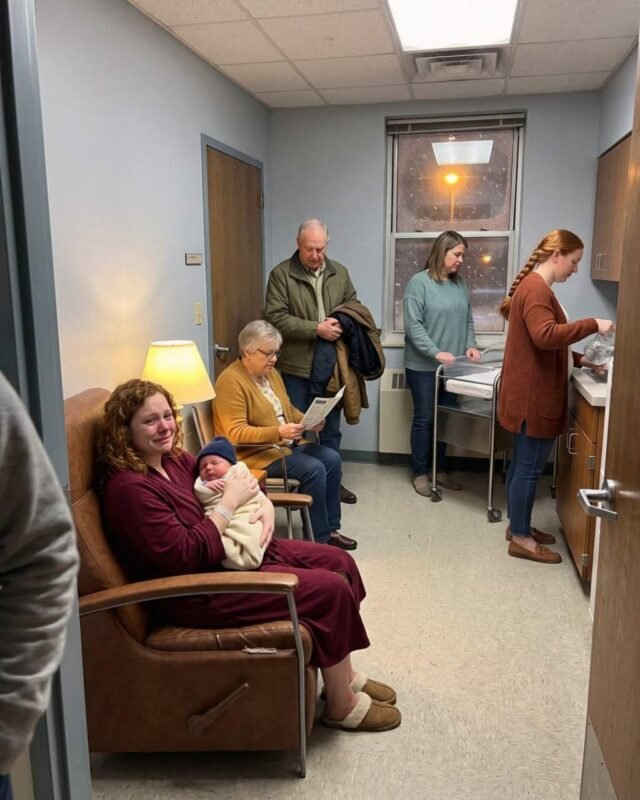
Mom asked me to let my sister adopt my newborn before I had even figured out how to stand without holding onto the hospital bedrail.
“She can offer her a better life,” Mom said, gently adjusting the blanket around my daughter as though she already belonged with somebody else.
Dad set a thick envelope beside my water cup. “The attorney prepared everything. We’ve already told everyone.”
I looked at him. “Told everyone what?”
“That Claire is adopting the baby.”
My older sister stood beside the window, dressed in a cream sweater and wearing the sympathetic smile she always used whenever she wanted something without seeming unkind.
“You can still visit,” Claire said. “I would never keep her away from you.”
My daughter, Lily, was thirty-six hours old.
I was twenty-four, unmarried, and had spent nearly my entire pregnancy hearing every mistake I had ever made repeated to me. Claire was thirty-three, married to a dentist, living in a five-bedroom home outside Columbus, Ohio. After years of fertility treatments, she had finally stopped trying to become pregnant.
Apparently, my baby had become our family’s solution.
“I haven’t agreed to anything,” I said.
Mom’s expression tightened. “Emily, be realistic.”
“I am.”
“You work reception at a physical therapy clinic.”
“I have savings.”
“You rent an apartment.”
“So do millions of parents.”
Dad slid the documents closer. “Don’t turn this into something emotional.”
That almost made me laugh.
My daughter whimpered softly from the bassinet.
I lifted her up.
Claire’s eyes followed her.
“Just give me one day,” I said.
Mom glanced at Dad.
“One day for what?” Claire asked.
“To think.”
Dad exhaled heavily, but eventually nodded. “Tomorrow afternoon. Then we settle this.”
They left believing I would surrender.
I spent that night making three phone calls.
The following afternoon, Claire arrived carrying an expensive infant car seat. Mom brought a diaper bag embroidered with Lily’s name. Dad carried the adoption documents.
They walked into my hospital room speaking quietly.
Then they stopped.
A woman was sitting beside my bed.
She was sixty-one, with dark hair streaked with silver, a navy coat folded across her lap, and a narrow scar extending from her left temple toward her ear.
Mom grabbed Dad’s arm so tightly the papers bent.
Her face turned pale.
“You said she was dead.”
Dad said nothing.
Claire glanced between them and the stranger. “Who is that?”
The woman stood.
Her eyes met mine first.
Then she looked directly toward my mother.
“My name is Rebecca Hale,” she said.
Mom stepped backward toward the door.
I held Lily closer.
Rebecca’s voice stayed calm.
“And apparently, thirty years ago, your parents decided it was easier to tell everyone I was de:ad than explain what they had done to me.”
Dad murmured, “Rebecca—”
“No,” she said. “You’ve said enough.”
Then she reached inside her handbag and set a yellowed document beside the adoption papers.
I had seen it for the first time that morning.
It was another adoption consent form.
And the mother listed on it was Rebecca Hale.
The baby named beneath her was me.
Nobody said anything for several seconds.
Claire finally laughed, although there was no humor behind it.
“That’s impossible.”
I watched my father.
If Rebecca was lying, I expected him to become angry. Dad had always been quick to challenge anything he believed was disrespectful or incorrect.
Instead, he sat down.
Mom stayed standing.
Claire turned toward me. “Emily, who is this woman?”
“My biological mother.”
The words felt unexpectedly solid.
I had discovered the truth less than six hours earlier.
Rebecca had not found me through some extraordinary coincidence. She found me because my name appeared in a public engagement announcement two years earlier, when my former fiancé and I were still planning our wedding. She recognized Dad’s surname and eventually discovered where I worked.
She had written twice.
I never received either letter.
Three days before Lily’s birth, Rebecca came to my apartment.
Dad happened to be there repairing a leaking faucet.
When he spotted her through the peephole, he told me she was a confused former patient of Mom’s.
Then he threatened to contact the police.
Rebecca left.
But before leaving, she slipped her phone number underneath my doormat.
I discovered it after briefly returning home the morning before my scheduled induction.
“You intercepted her letters,” I said to Dad.
He stared down at the floor.
Claire turned toward him. “What letters?”
Mom answered for him.
“We were protecting Emily.”
Rebecca gave a brief, bitter smile.
“That’s what you called it last time too.”
Claire looked genuinely unsettled now. “Last time?”
Rebecca sat down again.
Thirty years earlier, she explained, she had been nineteen, pregnant, and staying with Mom—her older cousin—after Rebecca’s parents passed away in a car accident.
Mom and Dad had already been married for four years.
They had also been trying unsuccessfully to have a baby.
Rebecca intended to raise me.
But following a complicated delivery, she developed an infection and remained in the hospital for more than two weeks.
During that time, Mom and Dad persuaded her that she was unstable, financially unprepared, and unable to properly care for a newborn.
They arranged a private adoption.
The adoptive parents were themselves.
“They told me I could reconsider later,” Rebecca said. “That I could remain close.”
My throat tightened.
Mom snapped, “You were sick.”
“I was grieving.”
“You didn’t have a job.”
“I had an inheritance.”
Dad finally raised his head.
Rebecca turned to face him.
“You remember the inheritance, don’t you, Michael?”
Claire’s expression shifted.
“What inheritance?”
Rebecca explained that shortly after the adoption, her guardianship account—which contained money from her parents’ estate—was almost completely depleted.
Dad stood suddenly. “That isn’t relevant.”
“It became relevant when Emily told me you were pressuring her to surrender her own daughter.”
I looked toward Claire.
The expensive car seat suddenly seemed disturbing.
“Did you know?” I asked her.
“About you? No.”
“About Mom and Dad pressuring me?”
Claire swallowed hard.
“I believed you wanted this.”
“You brought a car seat before I signed anything.”
Her gaze lowered.
Mom stepped closer. “Enough. Rebecca has always been difficult. She v@nished for decades and suddenly shows up when Emily is vulnerable.”
Rebecca reached into her handbag again.
This time, she pulled out a folder.
“I never vanished.”
She placed twelve photocopied envelopes across the table.
One for nearly every year of my childhood.
Everyone addressed Mom and Dad.
Some stamped RETURN TO SENDER.
Others had clearly been opened.
“I kept writing until Emily turned eighteen.”
Dad shut his eyes.
Rebecca looked toward me.
“They always knew where I was.”
I stared at the two people who had spent my entire life teaching me that loyalty to family meant never challenging them.
Then I looked at the adoption papers beside Lily’s bassinet.
Same wording. Same pressure. Same promise that giving up a child was an act of love.
Except this time, I had discovered the truth before signing.
I picked up Dad’s documents.
And ripped them in half.
Claire flinched at the sound.
Dad stepped forward instinctively.
“What are you doing?”
I ripped them again.
Four pieces became eight.
Then I dropped them into the hospital trash bin.
“I’m raising my daughter.”
Mom stared at me.
For almost my entire life, that expression had been enough to make me question any decision.
College choices. Boyfriends. Jobs. Apartments. Even hairstyles.
Disapproval was Mom’s strongest weapon because she never had to raise her voice. She simply looked at you as though you had deliberately chosen to disappoint her.
But Lily was sleeping against my chest.
For the first time, disappointing my mother felt like a very small price.
Mom’s voice dropped.
“You have no idea how much raising a child alone costs.”
“I’ll learn.”
“You could lose your job.”
“My manager already approved twelve weeks.”
“You’ll use up your savings.”
“Maybe.”
“You’ll eventually come asking us for help.”
I met her eyes.
“Then I won’t ask you.”
That affected her more deeply than shouting could have.
Claire slowly lowered the car seat onto the floor.
“Emily,” she said, “I honestly believed this was what you wanted.”
“No, you believed it was something I could be persuaded into.”
“I would have loved her.”
“I know.”
That was the most difficult part.
Claire was not a monster.
She had wanted a child for years. I had watched her go through unsuccessful fertility treatments, hormone injections, two miscarriages, and one adoption match that ended after the birth mother reconsidered.
I understood why Lily represented hope.
But understanding someone else’s pain did not mean giving them my daughter.
“You brought that car seat because Mom told you I would sign today,” I said.
Claire slowly nodded.
“Yes.”
“Did you ever actually ask me?”
She opened her mouth.
Then stopped.
Mom answered instead.
“We talked about it as a family.”
“I’m Lily’s family.”
“You know what I mean.”
“I know exactly what you mean.”
Rebecca stayed silent.
She seemed to understand that this conversation belonged to me.
Dad walked toward the window.
Outside, winter sunlight reflected off the hospital parking structure.
“This is getting out of hand,” he said.
Rebecca gave a brief laugh.
Dad turned around.
“What?”
“You still believe you’re in control.”
He faced her directly.
“I made mistakes.”
“You acted dishonestly.”
Mom stiffened. “Rebecca.”
“No. We’re finished hiding behind softer words.”
Rebecca opened the folder once more.
She removed bank records, probate documents, copies of letters, and something carrying the seal of an Ohio county court.
My father’s expression shifted.
Rebecca noticed immediately.
“So you recognize that one.”
Claire moved closer.
“What is it?”
“A petition,” Rebecca said, “to reopen part of my parents’ estate.”
Dad looked toward me. “Emily, this has nothing to do with you.”
Rebecca shook her head.
“It has everything to do with her.”
The original adoption had been legal, Rebecca explained, although the circumstances surrounding it were complicated.
Dad had worked for the accounting firm responsible for handling part of her parents’ estate.
After Rebecca gave birth, money from her inheritance had been transferred into several different accounts.
Some covered legitimate expenses.
Others did not.
Rebecca discovered the irregularities years later but did not have enough documentation to establish who had authorized them.
Then, eighteen months earlier, the accounting firm digitized its old archives.
A retired employee contacted her.
There were signatures.
Transfers.
Internal correspondence.
And one memo written by Dad.
Claire accepted the photocopy Rebecca handed her.
Her expression changed while she read.
“What does it say?” I asked.
Claire remained silent.
“Read it.”
Her voice was barely above a whisper.
“‘Once guardianship and placement are finalized, continued contact between R.H. and the child should be discouraged. Emotional attachment may complicate settlement matters.’”
I stared at Dad.
“Settlement matters?”
Dad rubbed both hands across his face.
“It happened thirty years ago.”
Rebecca’s calm expression finally slipped.
“That is your answer?”
“I was trying to create a family.”
“With my child.”
“We gave Emily a good life.”
“That was never the point.”
Mom stepped between them.
“We gave Emily everything.”
Rebecca’s eyes moved toward her.
“Except the truth.”
Mom pressed her lips together.
I looked directly at her.
“When did you decide to tell me Rebecca was de:ad?”
“We didn’t.”
“You told me my biological mother had d!ed.”
“We said she was gone.”
“When I was twelve, I asked if she could ever find me. You said, ‘Dead people don’t knock on doors.’”
Mom shut her eyes.
Apparently, she remembered saying it.
Claire whispered, “Jesus.”
Dad turned to face me.
“Emily, whatever happened back then, we love you.”
I believed him.
That was another uncomfortable truth.
People could love you and still try to control your choices.
People could feed you, protect you, pay your tuition, stay beside your bed when you had pneumonia, and still build part of your life around a lie.
Love did not erase what they had done.
“I believe you love me,” I said.
Dad looked relieved far too quickly.
“But I don’t trust you.”
His relief disappeared.
Mom sat down.
For the first time since she entered the room, she looked old.
Not fragile.
Simply exhausted.
“What happens now?” Claire asked.
Rebecca looked at me rather than answering.
That mattered.
She was the only person in the room who was not trying to decide my future for me.
“I’m going home with Lily tomorrow,” I said.
“To your apartment?” Mom asked.
“Yes.”
“You can’t manage stairs with a newborn.”
“My building has an elevator.”
“What happens if you need someone overnight?”
“I’ll work it out.”
Rebecca spoke cautiously.
“I’m staying at a hotel three blocks from Emily’s apartment.”
Mom looked sharply toward me.
“You invited her?”
“I did.”
“You barely know her.”
“That’s why I invited her.”
Dad’s expression tightened.
“She wants something.”
Rebecca looked almost amused.
“Yes.”
He immediately seized on it.
“You hear that?”
She continued.
“I want to know my daughter.”
Silence filled the room.
“And if she decides after getting to know me that she wants nothing more to do with me, that will be her choice.”
Then she looked directly at Mom.
“Her choice. It’s an interesting concept.”
Claire sat down in the chair beside the window.
She stared at the unopened diaper bag she had brought.
After a moment, she said, “I need to ask you something.”
I waited.
“If Mom and Dad hadn’t pressured you… would you ever have considered me?”
My first reaction was anger.
Then I saw her expression.
She wasn’t asking me to give her Lily.
She was asking whether I had ever understood how deeply she wanted a child.
“Yes,” I said.
Claire looked up.
“If I had decided I couldn’t raise her, you would have been the first person I considered.”
Her eyes filled with tears.
“But that wasn’t my decision.”
“No.”
“It was yours.”
“Yes.”
She nodded.
Then she started crying. Not dramatically.
She simply covered her mouth and turned away.
Mom immediately stepped toward her.
Claire raised one hand.
“Don’t.”
Mom stopped.
Claire wiped her cheeks.
“You told me Emily had already decided.”
Mom remained silent.
“You told me she was scared to tell me because she thought I would consider her irresponsible.”
Still nothing.
“You told me the attorney was only making the arrangement official.”
“Claire—”
“You lied to me too.”
“I was trying to help both of you.”
“No. You were trying to make everything happen the way you wanted.”
Dad interrupted.
“Your mother thought—”
Claire stood up.
“You don’t get to defend her.”
He fell silent.
Claire walked over to the car seat.
She lifted it.
For one awful second, I thought she was going to leave without another word.
Instead, she placed it beside my bed.
“You’ll need one.”
I stared at her.
“It belongs to you.”
“Claire—”
“I bought it for Lily.”
Her voice trembled.
“Not for myself.”
She picked up the embroidered diaper bag and placed it beside the car seat.
Then she leaned toward the bassinet.
“Can I say goodbye?”
My chest tightened.
“You’re not saying goodbye.”
She looked at me.
“You’re her aunt.”
Claire cried harder.
She gently touched one finger to Lily’s tiny fist.
Lily wrapped her hand around it.
Mom turned away. Dad stared at the floor. Rebecca watched silently.
That was the moment the family arrangement truly fell apart.
Not when I ripped up the papers. Not when Rebecca revealed her identity.
It fell apart when Claire decided she would no longer participate.
The following morning, a hospital social worker came to speak with me privately.
Rebecca had suggested it.
I explained everything to the social worker.
The pressure. The adoption documents. My parents’ insistence.
The fact that I had no independent attorney representing me.
The social worker explained that nothing could proceed without my voluntary consent anyway.
The supposedly unavoidable future my parents had constructed had never truly existed.
They had simply spoken about it with so much confidence that everyone acted as though it had.
That realization embarrassed me.
Then it made me angry.
By noon, Lily and I were discharged.
Claire drove us back home.
Rebecca followed behind us in her rental car.
Mom and Dad did not come.
For three weeks, I heard nothing from either of them.
Rebecca remained in Ohio.
She rented a small furnished apartment instead of continuing to stay at the hotel. She never asked if she could move in with me.
Respecting that boundary was one of the first reasons I started trusting her.
She brought groceries. She cleaned bottles. She held Lily while I took a shower.
She told me stories about my biological grandparents but never tried to overwrite the memories of the childhood I already had.
Whenever I asked difficult questions, she answered honestly.
When she didn’t know the answer, she simply said she didn’t know.
I wasn’t used to that.
Claire came by twice each week.
At first, those visits felt uncomfortable.
Then ordinary life slowly filled the empty spaces.
Diapers.
Takeout food.
Lily refusing to sleep.
Claire teaching me how to secure the new car seat properly.
One evening, while Lily slept against her chest, Claire said, “I almost became Mom.”
I understood exactly what she meant.
“You stopped yourself.”
“Barely.”
“But you did stop.”
She looked down at Lily.
“I think wanting something badly enough can convince you that you’re entitled to it.”
I stayed quiet.
Then she added, “I’m sorry.”
“I know.”
Three months later, Mom called me.
Not texted.
Actually called.
I almost let it ring.
Rebecca was sitting at my kitchen table working on a crossword puzzle.
She glanced up when my phone rang.
“You don’t have to answer.”
So I answered.
That choice mattered because it belonged to me.
Mom sounded different.
Smaller somehow.
“Can I see you?”
“Why?”
“I want to apologize.”
“Then apologize.”
There was a long pause.
“I’m sorry.”
“For what?”
Another pause.
Apparently, being specific was more difficult.
“For pressuring you.”
I waited.
“For lying to you about Rebecca.”
I continued waiting.
“For telling Claire you had agreed when you hadn’t.”
“That’s a beginning.”
Mom exhaled unsteadily.
“Your father and I believed we were protecting the family.”
“Protecting it from what?”
She didn’t answer.
“From Rebecca?”
“Yes.”
“Or from what you did to Rebecca?”
Silence followed.
That was enough of an answer.
Dad’s legal troubles grew that spring.
Rebecca’s attorney found financial records connecting him to questionable transfers from her inheritance.
The case did not turn into some dramatic courtroom spectacle.
Reality moved much slower.
Attorneys exchanged documents.
Depositions were arranged.
Insurance companies became involved.
Dad’s former accounting firm hired separate legal counsel.
Eventually, Dad signed a settlement agreement that required significant repayment.
He sold the lake house.
He delayed his retirement.
For several months, Mom blamed Rebecca.
Then, according to Claire, she stopped blaming anyone aloud.
I saw my parents again when Lily was seven months old.
We met at Claire’s house.
Neutral ground.
Mom stood in the entryway holding a stuffed rabbit.
She didn’t immediately reach toward Lily.
That surprised me.
“May I hold her?”
The question surprised me even more.
I handed Lily to her.
Mom began to cry.
Dad remained on the other side of the room.
He looked thinner.
Eventually, he walked over to me.
“I don’t expect you to forgive me.”
“I’m not ready to.”
He nodded.
“I understand.”
I almost corrected him.
I wasn’t sure he completely understood.
But maybe he finally understood enough to stop arguing with me.
Rebecca did not attend that visit.
She had said she wasn’t interested in making my decision to reconcile—or not reconcile—about her.
Over the following year, our unusual family settled into a shape nobody had ever planned.
Rebecca moved permanently to Columbus.
She rented a townhouse fifteen minutes away from me.
Claire became Lily’s favorite person besides me, mostly because she bought absurd toys and never cared when applesauce ended up on her clothes.
Mom learned that asking permission worked better than giving instructions.
Dad learned that some conversations ended whenever I said they were over.
And I learned something I wished I had understood years earlier.
Independence did not mean handling everything alone.
It meant being free to choose who stood beside you.
On Lily’s first birthday, we held a party at a public park.
Claire brought the cake.
Rebecca brought sandwiches.
Mom arrived carrying balloons.
Dad carried folding chairs from the parking lot.
At one point, I stepped away from the picnic tables and watched everyone.
Rebecca and Mom stood several yards apart.
They still barely spoke to one another.
Some d@mage did not simply disappear because a baby was celebrating a birthday.
Claire crouched in the grass, helping Lily take three shaky steps toward a plastic ball.
Dad was putting together a toy wagon while pretending he didn’t need the instructions.
Nothing was perfect.
That was exactly what made it real.
Claire noticed me watching.
“What?”
I shook my head.
“Nothing.”
She smiled.
Then Lily noticed me.
Her entire expression changed.
She a.ban.don.ed the ball.
She left Claire behind.
She stumbled across the grass toward me with both arms raised.
“Ma!”
It was the first time she had said it clearly.
Everyone heard her.
Mom covered her mouth.
Claire laughed.
Rebecca’s eyes filled with tears.
I bent down and caught Lily before she stumbled.
She gripped my shirt with both hands.
For months, people had told me what motherhood required.
Money. Marriage. A bigger house. Experience. Sacrifice.
Someone else’s approval.
But as I held my daughter beneath the September sunlight, I understood that the first requirement had always been far simpler.
She needed someone willing to choose her.
And I had.
I carried Lily back toward the picnic table.
Claire handed me a plate with cake.
Rebecca shifted aside to make space.
Mom started to say something about Lily’s sweater being too light for the breeze.
Then she stopped herself.
Instead, she asked, “Do you want her jacket?”
I looked at her.
The question itself was ordinary.
But between the two of us, it carried thirty years of history.
“Yes,” I said.
Mom brought me the jacket.
I put it on my daughter myself.