PART 2
His name was Noah Whitaker.
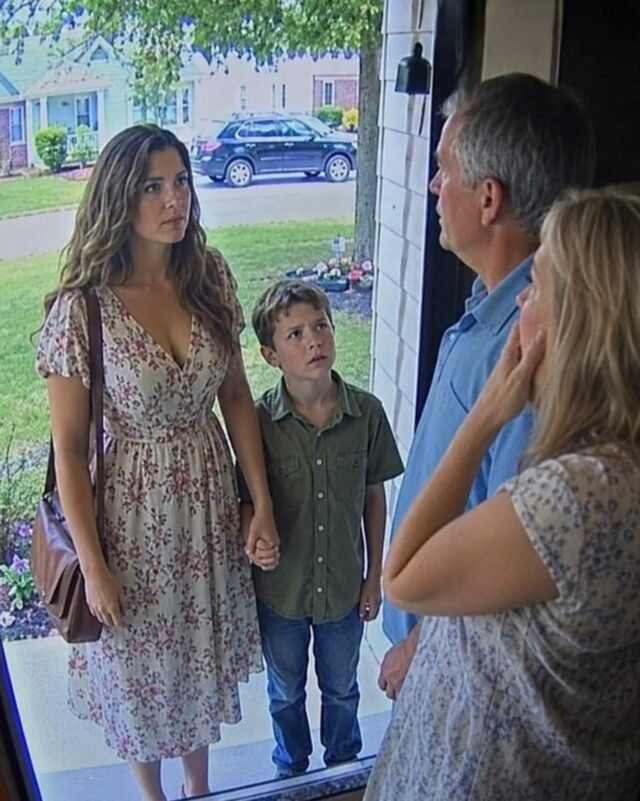
The moment I said it, my father stepped back as though the floor had shifted beneath him.
My mother gripped the edge of the doorframe. Her lips parted, but no sound came out. For ten years, I had imagined this moment in a hundred different ways. I thought they might yell. I thought they might accuse me of lying. I thought my father might slam the door again and prove that nothing in that house had changed.
But I had never imagined silence.
Not this kind.
Not the kind that seemed to swallow the whole porch.
Leo stood beside me, holding the strap of his backpack with both hands. He looked from my face to theirs, trying to understand why one name had made three adults look like they had seen a ghost.
“Noah?” my mother finally whispered.
I nodded.
“No,” my father said, but there was no strength in it. “Noah died.”
“I know.”
“He died before you left.”
“I know that too.”
My father stared at Leo then, really stared. His eyes moved over my son’s face—the blue eyes, the soft brown hair, the dimple that appeared only when he was trying not to smile.
Noah’s dimple.
My mother made a small sound and covered her mouth.
Leo moved closer to me.
“Mom?” he asked quietly.
I placed a hand on his shoulder. “It’s okay.”
But nothing about that moment felt okay.
My father looked older than I remembered. His hair had thinned, and deep lines framed his mouth. My mother seemed smaller, as if ten years of regret had quietly folded her inward. Yet standing there, I was nineteen again, clutching a duffel bag while they watched me leave.
“Why didn’t you tell us?” my mother asked.
I almost laughed, not because it was funny, but because the question hurt in a place I thought had healed.
“I tried,” I said. “You wouldn’t listen.”
My father looked away.
“I said it would affect all of us. I said one day you’d understand. But you were so angry that you decided my silence meant guilt.”
My mother’s eyes filled with tears. “Emma…”
“Noah and I were together for almost a year,” I continued. “We kept it quiet because we wanted to be sure it was real before both families got involved. Then I found out I was pregnant. Noah was scared at first, but happy. He said he wanted to tell everyone properly.”
My voice trembled.
“He died three days later.”
The words hung between us.
I had said them before, to myself, in the dark. To doctors. To forms that asked for father’s information. To Leo when he was finally old enough to ask why his dad wasn’t at school plays.
But saying them on that porch felt different.
It felt like opening a locked room.
My father rubbed a hand over his face. “Noah came here,” he said.
I froze.
“What?”
“The night before the accident.” His voice was rough. “He came by. Said he needed to talk to me.”
My heart began to pound.
“You never told me that.”
“You were at work,” my mother said faintly.
My father looked at her, then back at me. “I thought he was just being dramatic. He was nervous. Kept saying it was important, that it involved you. I told him whatever it was could wait.”
A coldness moved through me.
“Noah told me he was coming here,” I said slowly. “He said after he talked to you, everything would be easier.”
My father closed his eyes.
For the first time in my life, I saw him not as the immovable man who had thrown me out, but as someone standing in the shadow of a choice he could never undo.
“He left upset,” my mother whispered. “Your father thought he was protecting you.”
“Protecting me from what?” I asked.
Neither of them answered.
Leo tugged lightly on my sleeve. “Mom, who was Noah?”
I knelt in front of him. “He was your father.”
His face changed in small, careful ways. His eyebrows drew together. His mouth softened. He looked past me toward my parents, then down at the porch boards.
“My dad had a name,” he said.
I nodded, tears burning my eyes. “Yes. He had a name.”
“Did he know about me?”
“He knew I was pregnant.”
Leo swallowed. “Was he happy?”
The question broke something in me.
I pulled him into my arms. “Yes,” I whispered. “He was scared, but he was happy.”
My mother began crying openly then.
My father opened the door wider. “Come inside.”
For a moment, I could not move.
Ten years earlier, that same doorway had meant rejection. Now it stood open, but I did not know whether walking through it meant forgiveness, surrender, or simply the beginning of a truth none of us could escape.
Leo looked up at me.
“Are we going in?” he asked.
I took a breath. “Yes.”
The living room looked almost the same.
The same faded blue curtains. The same family photos on the mantel, though I noticed mine stopped at age eighteen. The same clock ticking above the hallway, loud in the uneasy silence.
My mother hovered near Leo as if afraid to frighten him away.
“Would you like something to drink?” she asked. “Juice? Water? I might have lemonade.”
“Water is okay,” Leo said politely.
His manners seemed to undo her. She pressed a hand to her chest before hurrying toward the kitchen.
My father sat slowly in his recliner, the same one from that day. I remained standing.
Leo wandered toward the mantel and studied the photos.
“Is that Mom?” he asked, pointing to a picture of me in a graduation gown.
“Yes,” my father said. His voice cracked slightly. “That’s your mom.”
“She looks nervous.”
“She was always nervous before big things,” my mother said, returning with water. “But she always did them anyway.”
I looked at her.
It was such a small sentence. Such an ordinary motherly thing to say.
It hurt more than an apology.
Leo accepted the glass. “Thank you.”
My mother smiled through tears. “You’re welcome, sweetheart.”
Sweetheart.
The word settled uneasily in the room.
My father leaned forward, elbows on knees. “Does Noah’s family know?”
“No,” I said.
My mother’s face crumpled.
“Diane doesn’t know she has a grandson?” she asked.
“No.”
“That woman mourned herself sick,” my father murmured.
“I know,” I said. “Do you think I don’t know that?”
My voice rose despite my effort to keep calm. Leo looked at me, and I forced myself to breathe.
“I was nineteen. Pregnant. Alone. You threw me out. Noah was dead. His parents were drowning in grief, and I had no proof except my word. I didn’t know how to walk up to a grieving mother and say, ‘By the way, your son left something behind.’”
My mother sat on the couch, covering her face.
“I wrote letters,” I said.
She looked up sharply.
“What letters?”
“To you. To both of you. For almost a year after I left.”
My father frowned. “We never got letters.”
I reached into my purse and pulled out a folded plastic envelope. Inside were copies I had kept for myself, paper worn from being handled over the years.
“I stopped sending them after the eighth one came back unopened.”
My mother took them with shaking hands.
My father stared at the envelopes. “I never saw these.”
“They were returned from this address.”
My mother turned one over, her brow furrowing. “This says ‘refused.’”
“Yes.”
My father stood. “I didn’t refuse them.”
The room changed again.
Not dramatically. No thunder. No music.
Just a quiet shift, like a door opening somewhere in the walls.
My mother looked at him. “Then who did?”
He did not answer.
Leo watched us all, his water untouched.
“Maybe the mail carrier made a mistake,” my father said, but even he did not sound convinced.
“Eight times?” I asked.
He sank back into the chair.
For a while, no one spoke.
Then my mother reached for the first letter and unfolded it. Her eyes moved across the page. I remembered writing it at a kitchen table in a borrowed apartment, Leo kicking beneath my ribs while I tried not to cry onto the paper.
Mom, Dad, I’m safe. I know you’re angry. I know you think I made a terrible mistake. But this baby is Noah’s. I didn’t tell you because he wanted to speak with you first. Please call me. Please don’t shut the door forever.
My mother pressed the page against her chest.
“Oh, Emma.”
I could not look at her.
Leo came back to my side and slipped his hand into mine.
My father stared at the floor. “All these years,” he said quietly. “We thought you disappeared because you hated us.”
“I disappeared because I had to survive.”
He nodded once, like the words had struck him exactly where they needed to.
That evening, we stayed.
I had not planned to. I had booked a small motel near the highway, prepared for rejection, awkwardness, maybe a short conversation before driving away again.
But Leo asked if we could have dinner.
My mother nearly dropped the pot she was holding.
So we sat at the kitchen table where I had once done homework and where, ten years ago, I had begged them to hear me. My father ordered pizza because my mother was too nervous to cook. Leo told them about school, about his science fair project, about how he wanted to build robots that helped people after storms.
My father listened as if every word mattered.
My mother asked careful questions.
Leo answered with the cautious openness of a child who wanted to belong but was not sure whether belonging was safe.
At one point, he looked at the empty chair beside me and asked, “Did my dad sit here?”
My mother smiled sadly. “Many times. Noah was always here after school. He liked your grandfather’s terrible chili.”
“It was not terrible,” my father said.
“It was,” my mother and I said at the same time.
The three of us went still.
Then Leo laughed.
The sound loosened something in the room. My father smiled, just barely. My mother wiped her eyes and reached for another napkin.
After dinner, she brought out a shoebox of old photos. There were pictures of Noah and me at twelve, standing ankle-deep in creek water. Noah at sixteen, holding a guitar. Noah and my father fixing the porch steps. Noah sitting at that very kitchen table, grinning at the camera with the same dimple Leo had.
Leo touched the photograph with one finger.
“He looks like me,” he said.
“Yes,” I whispered. “He does.”
My father cleared his throat. “Noah was a good boy.”
I looked up. “He was.”
“I should have listened to him.”
No one rushed to comfort him.
Some regrets need room to breathe.
Later, after Leo fell asleep on the couch under a quilt my mother had made years ago, the three of us sat in the dim kitchen.
The house was quiet except for the hum of the refrigerator.
My father turned his coffee mug in slow circles.
“I was angry back then,” he said. “Not just at you. At everything. Work was bad. Money was tight. I thought if I controlled the house tightly enough, nothing could fall apart.”
“But it did,” I said.
“Yes.”
My mother stared into her tea. “I wanted to call you after you left.”
I looked at her.
“Why didn’t you?”
“Because every day I waited, it became harder. Then your father said you needed to learn responsibility. Then the days became weeks.”
“And then years,” I said.
She nodded, tears slipping down her cheeks. “I was ashamed.”
I wanted to tell her shame was a poor excuse for abandoning your child. But Leo was sleeping in the next room, and I was tired of carrying sharp words like weapons.
So I said the truest thing I could.
“I needed you.”
My mother covered her mouth.
“I needed my mom,” I said. “Not solutions. Not approval. Just you.”
She bowed her head.
My father’s voice came quietly. “Can we meet him?”
I turned. “Who?”
“Noah’s parents.”
My stomach tightened.
Diane and Paul Whitaker still lived two streets over. I knew because I had driven past their house before coming here, slowing just enough to see the white fence and the maple tree Noah used to climb.
“I don’t know,” I said.
“They deserve to know,” my father said.
“I know that.”
“Tomorrow,” my mother whispered. “Before you lose your courage.”
I almost smiled at that, because it sounded like something the old version of her would have said.
The next morning, Ohio woke under a pale gray sky.
Leo ate cereal at my parents’ kitchen table while my mother watched him like he was both miracle and memory. My father stepped outside twice, pretending to check the car, but I knew he was nervous.
I was nervous too.
At ten o’clock, the four of us walked to the Whitakers’ house.
Every step felt heavier than the last.
Diane opened the door before we knocked, holding pruning shears and wearing gardening gloves. Her hair, once dark and thick, was mostly silver now. For one second, she smiled politely.
Then she saw me.
“Emma?”
“Hi, Diane.”
The pruning shears slipped from her hand onto the porch mat.
Her eyes moved to Leo.
I watched the realization arrive slowly. Not because anyone had told her, but because grief has a memory sharper than reason. She saw Noah in him before I said a word.
Diane reached for the doorframe.
Paul appeared behind her. “Di? What is it?”
Then he saw Leo too.
His face changed.
No one invited us in. No one needed to.
I stepped forward. “This is Leo,” I said. “He’s Noah’s son.”
Diane made a sound that was almost a sob and almost a laugh. She dropped to her knees in front of Leo, stopping short before touching him.
“May I?” she asked.
Leo looked at me.
I nodded.
He stepped closer, and Diane placed both hands gently on his shoulders.
“Oh,” she whispered. “Oh, Noah.”
Paul turned away, pressing his fist to his mouth.
My father stood rigid behind us, guilt written into every line of him.
Diane looked up at me. “You were pregnant?”
“Yes.”
“And you were alone?”
I nodded.
She closed her eyes.
When she opened them, there was pain there, but not anger. Not yet.
“Come inside,” she said.
Their house smelled like lemon polish and fresh bread. Photos of Noah lined the hallway. Noah at graduation. Noah with muddy soccer knees. Noah laughing beside a lake.
Leo studied them all with quiet fascination.
Paul brought out a wooden box from a cabinet in the dining room. His hands shook as he set it on the table.
“Noah left this in his room,” he said. “After he passed, Diane couldn’t bear to open it for months. When she finally did, there was a note on top that said it belonged to you.”
My breath caught.
“To me?”
Diane nodded. “We tried to send it through your parents.”
My mother went pale.
My father frowned. “We never received a box.”
Paul looked at him. “I brought it to your house myself.”
The air tightened.
My father stared at him. “No, you didn’t.”
Paul’s grief-hardened eyes narrowed. “I handed it to someone at your door.”
“Who?” I asked.
Paul looked slowly toward my mother.
My mother stood very still.
“Margaret?” my father said.
She shook her head. “No. I don’t remember.”
But her voice had changed.
Diane opened the box before anyone could speak.
Inside were pieces of Noah’s life. A guitar pick. A movie ticket stub. A folded photo of us at the county fair. A tiny knitted pair of yellow baby socks I had never seen before.
At the bottom was an envelope with my name on it.
My hands trembled as I picked it up.
Emma.
Noah’s handwriting.
For a moment, I couldn’t breathe.
Leo stood beside me, pressed close against my arm.
“Open it,” he whispered.
I slid my finger beneath the flap.
The letter inside was dated the day before Noah died.
Em,
I’m going to talk to your dad tonight. I know you’re scared. I am too. But I don’t want our baby starting life as a secret. Whatever happens, I want you to remember this: I choose you. I choose our child. I choose the life we’re building, even if everyone needs time to understand it.
There’s something else I need to tell you, but not in a letter. It’s about our families. My mom knows part of it, and I think your mom knows the rest. I found something in Dad’s old papers that doesn’t make sense. Maybe it’s nothing. Maybe I’m overthinking it. But if I’m right, this baby connects our families in a way nobody has admitted.
I read the last sentence twice.
Then a third time.
My mother sat down hard in the nearest chair.
Diane looked at her.
“What did he mean?” I asked.
My mother’s face had lost all color.
“Mom?”
She pressed her fingers to her lips.
My father turned to her slowly. “Margaret.”
Diane’s voice was barely audible. “You knew.”
My mother shook her head, but tears spilled over. “I didn’t know he had found anything.”
“Found what?” I demanded.
Paul reached into the wooden box again. “There’s one more envelope.”
He pulled out a smaller one, yellowed at the edges.
It was not addressed to me.
It was addressed to my mother.
Margaret, if Emma ever comes home with the child, tell her the truth before someone else does.
The room seemed to tilt.
Leo looked up at me. “Mom, what truth?”
My mother stared at the envelope as if it had been waiting ten years to accuse her.
And then, in a voice I barely recognized, she whispered, “Noah wasn’t supposed to know.”
PART 3 — FINAL PART
“Noah wasn’t supposed to know.”
My mother’s words were so quiet that, for a moment, I thought I had misunderstood them.
But the silence that followed told me everyone had heard.
Diane sat frozen across the table, one hand pressed against her chest. Paul’s jaw tightened as if he were holding back questions too heavy to ask all at once. My father stood behind my mother’s chair, staring at her like he was seeing a stranger wearing his wife’s face.
And Leo—my sweet, bright, ten-year-old boy—looked from adult to adult with wide eyes, trying to piece together a puzzle none of us had known we were standing inside.
“Mom,” I said carefully, “what wasn’t Noah supposed to know?”
My mother stared at the envelope addressed to her.
Her hands shook, but she did not touch it.
“Margaret,” Diane said, her voice trembling, “tell her.”
My mother closed her eyes.
For the first time, I noticed how tired she looked. Not just from age. Not just from grief or surprise. She looked like someone who had spent years guarding a door from the inside, terrified of what would happen if anyone opened it.
My father pulled out the chair beside her and sat down slowly.
“Maggie,” he said, softer than I had ever heard him speak. “What is this?”
She flinched at the nickname.
Then she reached for the envelope.
The paper made a faint scraping sound against the table. She turned it over, broke the seal with a careful thumb, and unfolded the single page inside.
Her eyes moved across the words.
Then her face crumpled.
Diane stood. “Read it.”
“I can’t.”
“You can,” Diane said, but not cruelly. “We all lived with pieces of this. Emma deserves the whole truth.”
My mother pressed the page flat against the table.
Her voice shook as she began.
“Margaret, if Emma ever comes home with the child, tell her the truth before someone else does. Noah found the adoption records. He came to me, confused and scared, asking why his father’s name appeared beside yours on old paperwork from St. Agnes. I told him some of it, but not enough. I told him to speak to you. I should have told him everything myself.”
She stopped.
The room seemed to shrink.
“Adoption records?” I whispered.
My father stared at my mother.
“What adoption records?”
Mother folded one hand over the letter as if the rest of the words might escape.
Diane’s eyes shone with tears. “Keep reading, Margaret.”
My mother swallowed.
“The truth is this: before either of you built the lives you have now, before your marriages, before your children, Margaret and I were both young women at St. Agnes Home. We were scared, unmarried, and pressured into decisions we barely understood. I gave birth first. Margaret gave birth three days later. The records were altered. The babies were moved. One child stayed. One child disappeared into adoption.”
She stopped again, but this time nobody pushed her.
I could hear the wall clock in the hallway.
Tick.
Tick.
Tick.
Leo leaned against me.
“Mom?” he whispered.
I placed my arm around his shoulders, though I barely felt steady enough to stand.
My father’s voice came out hollow. “Margaret… did you have another child?”
She looked at him then.
And in that look, I saw the first crack in the version of my mother I had known all my life.
“Yes,” she whispered.
My father’s face drained.
“Before me?”
She nodded.
“When you were seventeen?”
“Yes.”
He pushed back from the table. The chair legs scraped the floor.
Not in anger.
In disbelief.
“You never told me.”
“I was told never to tell anyone,” she said, tears falling freely now. “My parents said it would destroy my future. The priest said the child would have a better life. The nuns said I should be grateful someone would take him. I signed papers I didn’t understand while I was still bleeding and crying and asking to hold him one more time.”
Her voice broke.
“I never even knew if he was a boy or a girl.”
Diane covered her mouth.
My mother turned toward her. “But you knew?”
Diane shook her head. “Not at first. Not until years later.”
Paul sat heavily in the chair beside his wife. “My father kept papers. Too many papers. After he died, Noah helped me clean the attic. He must have found the old St. Agnes file in a box marked tax receipts.”
“Noah told me he found something strange,” Diane said. “A paper with your name on it, Margaret. And another name. A baby boy.”
My knees weakened.
“A baby boy,” I repeated.
My mother nodded without looking at me.
“I had a son,” she whispered.
The words landed on the table like a key.
A son.
A hidden child.
A life erased before it could be spoken of.
My father gripped the edge of the table. “What does that have to do with Noah?”
Diane looked at him sadly.
“Because the boy Margaret gave up was placed with my husband’s aunt and uncle,” she said. “The Whitaker family. They raised him for six months before another relative stepped forward to take him permanently.”
Paul’s brow furrowed.
“Wait,” he said. “My aunt Eleanor? The one who moved to Indiana?”
Diane nodded.
“She took the baby?”
“For a little while,” Diane said. “Then there was another transfer. The paperwork was sealed.”
My mother looked lost. “I never knew.”
“Noah kept digging,” Diane continued. “He thought maybe there was a family connection between him and Emma. He was afraid he and Emma might be too closely related.”
My breath caught.
For one dizzy second, the room blurred.
My hand tightened around Leo’s shoulder.
Diane saw the fear on my face and stood quickly.
“No,” she said firmly. “No, sweetheart. He checked enough to know that wasn’t true. Noah was not your brother. He was not your cousin by blood. That’s not the secret.”
I let out a breath I had not realized I was holding.
“Then what was?”
Diane looked at my mother.
My mother stared down at the letter.
“Noah found evidence that the child I gave up—my son—had been searching for me.”
The room stilled again.
My father’s expression changed from shock to something gentler, more wounded.
“You have a son out there?”
My mother nodded.
“I had letters,” she whispered. “From the agency. They contacted me when he turned eighteen. I panicked. I told them I didn’t want contact.”
“You refused him?” I asked.
She looked up at me then, and the shame in her eyes was raw.
“Yes.”
The answer hurt more than I expected.
Not because I knew the man. Not because I understood the full story yet.
But because I suddenly saw a pattern stretching through my mother’s life like a long shadow.
A frightened young woman had been told to bury her child.
Years later, when her daughter came to her frightened and pregnant, she had watched the same door close again.
Not because she did not know the pain.
Because she knew it too well.
Diane touched the back of a chair. “Noah thought if Emma had the baby, the child might be the bridge that brought the truth out. He wanted Margaret to meet the son she lost. He wanted both families to stop hiding.”
My father turned to my mother.
“Is that why you refused Emma’s letters?”
My mother’s lips parted.
For several seconds she said nothing.
Then she nodded.
The answer cut through the room.
My father stood abruptly. “You told me you never received them.”
“I did receive them.”
“All eight?”
She covered her face.
“Yes.”
I stepped back as if she had struck me.
Leo’s hand slipped from mine.
“Mom,” I whispered.
She reached toward me. “Emma, please—”
“You read them?”
“No.”
The answer came too fast.
My mother lowered her hand.
“I couldn’t,” she admitted. “I saw Noah’s name on the first envelope. I knew. I knew if I opened it, everything I had spent my life burying would come back. I was a coward.”
My father stared at her. “You let me believe our daughter abandoned us.”
“I was ashamed.”
“You let her raise a child alone.”
Her face collapsed.
“I know.”
“You let Noah’s parents mourn without knowing they had a grandson.”
“I know.”
His voice broke. “And you let me become a man who thought his own child hated him.”
My mother pressed both hands to her mouth and sobbed.
No one comforted her immediately.
Not because we wanted to punish her.
Because the truth needed to stand in the room without being covered too quickly.
Leo stepped closer to me again.
His voice was small. “Grandma sent your letters back?”
I looked down at him.
I wanted to protect him from adult pain. I wanted to tell him everything was simple and fixed now. But he had already seen too much confusion to accept a painted-over answer.
“Yes,” I said softly. “She was scared.”
He looked at my mother.
“But Mom was scared too.”
My mother let out a broken sound.
Diane walked around the table and knelt in front of Leo.
“You’re right,” she said gently. “Your mom was very brave.”
Leo nodded once, serious and solemn.
Then Paul, who had been quiet for a long time, reached into the wooden box and pulled out a small folded newspaper clipping.
“There’s something else,” he said.
Every eye turned to him.
He smoothed it against the table.
“This was with Noah’s things. I never understood why.”
The clipping was yellowed and brittle. At the top was a small headline from an Indianapolis paper dated thirteen years earlier.
LOCAL TEACHER SEEKS BIRTH FAMILY AFTER SEALED RECORDS PARTIALLY RELEASED
Below it was a photograph of a man in his early thirties standing in front of a school building, smiling with one hand tucked into his jacket pocket.
My mother gasped.
She did not need to say it.
I saw it too.
The shape of his eyes.
The curve of his mouth.
The same delicate crease between his brows that appeared on my mother’s face whenever she was worried.
“His name is Daniel Harper,” Paul said.
My mother touched the photograph with trembling fingers.
“My son.”
Her voice was barely air.
My father bent over the clipping, stunned.
“He was looking for you?”
Paul nodded. “According to the article, yes. He had partial records. Not your name, but enough to know he was born at St. Agnes. Noah must have connected it somehow.”
Diane looked at me.
“That was the secret he wanted to tell you. Not just that Leo connected our families through him. But that your mother’s first child was alive.”
Alive.
The word lit something in my mother’s face so sharply that I had to look away.
For ten years, I had carried the ache of my son not knowing his father.
For decades, my mother had carried the ache of not knowing whether her first child existed anywhere except in memory.
And now, across one table, all our missing pieces sat among envelopes, baby socks, and old paper.
My father lowered himself back into the chair.
“Where is he now?”
Paul hesitated.
“I don’t know. The article is thirteen years old.”
My mother’s fingers curled around the clipping.
“I refused him,” she whispered. “He came looking, and I refused him.”
Diane placed a hand over hers.
“Then write now.”
My mother looked up.
“What if he doesn’t want me anymore?”
The question was so frightened, so human, that some of my anger shifted—not gone, not forgiven, but moved aside enough for me to see her clearly.
I thought of myself at nineteen.
Of the screen door.
Of my mother crying behind it.
Of all the years I had imagined her silence as coldness.
Now I understood it had been fear.
Fear could still cause harm.
But understanding gave me somewhere to begin.
I pulled out the chair across from her and sat down.
“Then you apologize,” I said. “And you tell him the truth. And you don’t make his response about your pain.”
My mother nodded slowly, tears clinging to her lashes.
“I can do that.”
My father looked at me then.
There was so much in his face that he could not seem to choose one emotion.
“I’m sorry,” he said.
The words were quiet.
I had imagined them louder. Dramatic. Earned through some grand display. But spoken there, in the soft morning light of the Whitakers’ dining room, they felt more real because they came without defense.
“I was wrong,” he continued. “I failed you. I thought being a father meant making hard decisions and standing by them. But sometimes standing by a wrong decision just makes you wrong longer.”
My throat tightened.
He looked at Leo.
“I failed you too, young man. Before I even knew you.”
Leo studied him carefully.
Then he asked, “Do you know how to build a birdhouse?”
My father blinked.
“What?”
Leo shrugged, suddenly shy. “Mom said you used to fix things.”
My father looked at me.
A laugh slipped out of me before I could stop it. It came through tears, strange and unsteady.
“Yes,” my father said, wiping at his eyes. “I know how to build a birdhouse.”
Leo nodded, as if this was the most important test my father could have passed.
“Maybe you can teach me.”
My father’s face changed.
Softened.
Opened.
“I’d like that.”
Diane smiled through tears.
And just like that, the room took its first breath.
But the story was not finished.
That afternoon, we returned to my parents’ house with copies of the clipping, Noah’s letter, and more questions than answers. My mother sat at the kitchen table with a notepad in front of her, trying to write to Daniel.
She wrote Dear Daniel three times.
Crossed it out twice.
Then sat staring at the page.
Leo was outside with my father, examining a pile of old lumber beside the garage as if it were treasure. Through the window, I watched my father hand him a pencil and show him how to mark measurements. Leo leaned close, listening with full concentration.
My mother followed my gaze.
“He’s wonderful,” she said.
“Yes,” I replied.
“I missed everything.”
I did not answer.
She deserved the truth, and the truth was not soft.
“You did.”
She nodded.
“I don’t know how to make that right.”
“You don’t make it right all at once.”
She looked at me.
“You show up,” I said. “You tell the truth. You don’t run when it gets uncomfortable. You let people be angry without trying to hurry them into forgiving you.”
My mother absorbed every word.
Then she picked up the pen again.
This time, she wrote slowly.
Dear Daniel,
My name is Margaret Collins. I believe I am your birth mother. I owe you the truth, and I owe you an apology before I ask for anything at all.
Her hand trembled, but she did not stop.
By evening, she had written four pages.
My father read them silently, then placed his hand over hers.
“I’ll help you find him,” he said.
She looked up, startled.
“You don’t hate me?”
His face tightened.
“I’m angry. I’m hurt. I don’t understand all of it yet.” He glanced toward the yard, where Leo was now holding two boards in a crooked cross. “But I spent ten years letting pride cost me my daughter. I won’t spend another day letting pain decide what kind of man I am.”
My mother bowed her head.
A different kind of silence entered the house then.
Not the old silence of secrets.
A silence where healing had begun but did not yet know its shape.
The next unexpected turn came from Leo.
After dinner, while my parents washed dishes side by side in awkward cooperation, he tugged on my sleeve.
“Can I see my dad’s room?”
I glanced toward Diane and Paul’s house through the window. “At their house?”
He nodded.
“I want to know what he liked.”
So the next morning, Diane led us upstairs to Noah’s old bedroom.
She had changed almost nothing.
Not in a shrine-like way. It did not feel frozen or haunted. It felt gently preserved, like a room waiting for the right person to open a drawer.
There were books on the shelf, a faded baseball cap hanging from the bedpost, a guitar in the corner, and glow-in-the-dark stars still scattered across the ceiling.
Leo stood in the middle of the room and looked up.
“He liked space?”
“He loved space,” Paul said from the doorway. “He wanted to be an engineer.”
Leo turned sharply. “I like engineering.”
Paul smiled. “I heard.”
Diane opened a desk drawer and pulled out a notebook.
“Noah kept sketches,” she said.
She handed it to Leo.
He opened it with reverence. Inside were drawings of bridges, small machines, a treehouse design, and something that looked like a rescue drone with notes written in Noah’s slanted handwriting.
Leo’s eyes widened.
“He drew robots too.”
I looked over his shoulder.
The page showed a small wheeled device with an arm attachment. At the top, Noah had written:
Storm Helper — for flooded roads, fallen branches, and people who can’t get out.
Leo looked at me slowly.
“Mom,” he whispered, “that’s like my science fair project.”
A chill moved over my skin.
Not fear.
Wonder.
Diane pressed a hand to her mouth.
Paul looked away, blinking hard.
Leo traced the drawing without touching the ink.
“I didn’t even know,” he said.
“No,” I whispered. “You didn’t.”
He hugged the notebook to his chest.
“Can I finish it?”
Diane’s face folded with emotion. “Honey, I think Noah would have loved that.”
That became the second bridge.
Not the one Noah had planned.
Not the one built from secrets and sorrow.
A new one.
Built from a boy discovering he had inherited more than a face.
Over the next few days, Ohio changed for us.
At first, I had planned to stay one night. Then two. By the fourth morning, Leo had built half a birdhouse with my father, eaten pancakes with both grandmothers, and spent hours in Noah’s room with Paul, comparing the old sketches to his own notebook.
My mother still moved carefully around me.
She did not demand warmth.
She did not ask when I would call her Mom again in the way she wanted to hear it.
She simply showed up.
She made coffee the way I liked it, though I had not told her I still took it with cinnamon. She found an old box of my childhood books in the attic and gave them to Leo. She asked before touching his hair. She apologized in small ways and large ones.
One afternoon, I found her on the porch swing holding my returned letters.
All eight had been opened.
She looked up when I stepped outside.
“I read them,” she said.
I sat beside her.
The swing creaked beneath us.
“For years, I told myself not reading them made it less real.” She ran her thumb along the edge of the first page. “But it was real. Every word was real.”
I looked out at the street.
Children rode bikes past the house. A dog barked somewhere. The maple leaves shifted in the breeze.
“I used to imagine you reading them,” I said. “I imagined you crying and calling me. I imagined Dad driving through the night to find me.”
My mother closed her eyes.
“I’m so sorry.”
“I know.”
She turned toward me, almost afraid.
“Does that mean—”
“It means I know you’re sorry,” I said gently. “Forgiveness is going to take longer.”
She nodded quickly, accepting the boundary like a gift she had no right to unwrap too fast.
Then she handed me the last letter.
“I want you to have these back.”
I shook my head.
“No. Keep them.”
Her eyes filled.
“Why?”
“Because when you forget what fear can cost, I want you to read them again.”
She held the letters to her chest.
“I will.”
That evening, my father knocked on the guest room door.
I was folding Leo’s clothes into our overnight bag, though neither of us had said aloud when we were leaving.
“Can we talk?” he asked.
I nodded.
He stepped inside, holding something wrapped in an old towel.
“I found this in the garage.”
He unwrapped it.
Inside was a wooden music box.
My breath caught.
“I made that,” I said.
“You were fifteen,” he said. “You were angry because the lid didn’t fit right.”
I smiled despite myself. “You said sanding fixes almost everything.”
He looked down at the box.
“I kept it on my workbench for years.”
“You did?”
He nodded.
“After you left, I used to open it sometimes. It didn’t play anymore. But I kept thinking I could fix it.”
He turned the tiny key.
A few notes struggled out, thin and uneven.
Then stopped.
“I never did,” he said.
I took the box from him.
The wood was scratched. The corner was chipped. But beneath the dust, I could still see the uneven flower I had carved into the lid.
My father’s voice lowered.
“I think I kept it because it was easier to try fixing this than admit I wanted to fix us.”
I ran my fingers over the carving.
For a long moment, I was silent.
Then I said, “Maybe Leo can help you fix it.”
My father looked up.
The hope in his face was almost painful.
“I’d like that.”
The next morning, the call came.
My mother had mailed the letter to the agency, but my father had also found Daniel Harper through the school named in the old article. He had retired from teaching in Indiana and now ran a community workshop for foster youth outside Columbus.
Columbus.
Less than two hours away.
My mother held the phone with both hands, pale and shaking.
“He answered my email,” she said.
I stood in the kitchen doorway.
“What did he say?”
She swallowed.
“He said he wondered if this day would ever come.”
My father took her elbow, steadying her.
“He wants to meet?”
She nodded, tears spilling silently.
“Tomorrow.”
The house went very still.
This time, the silence did not feel like a trap.
It felt like a doorway.
Daniel chose a public garden halfway between our town and Columbus.
The next day dawned bright and clear, sunlight pouring over Ohio fields as we drove in two cars. Diane and Paul came too, at Daniel’s request after learning how tangled the families had become. Leo sat in the back seat beside me, Noah’s sketchbook on his lap.
“Are you nervous?” he asked.
“Yes.”
“Me too.”
I smiled. “You’re meeting your uncle.”
He considered that.
“Kind of a secret uncle.”
“Kind of.”
“Do you think he’ll like us?”
I glanced at my mother in the front passenger seat. Her hands were clasped tightly in her lap.
“I think he’s probably wondering the same thing.”
The garden was quiet when we arrived. Roses climbed wooden trellises. A fountain murmured at the center path. Bees drifted lazily between purple flowers.
Daniel Harper stood near a bench under a sycamore tree.
He was older than in the clipping, with silver at his temples and kind, cautious eyes.
My mother stopped walking.
For a moment, nobody moved.
Daniel looked at her.
She looked at him.
Decades narrowed to the space between them.
“Margaret?” he asked.
My mother covered her mouth.
“Yes.”
Daniel’s smile trembled.
“I thought I’d know you,” he said. “I told myself I wouldn’t. But I do.”
My mother took one step forward.
Then stopped.
“I don’t know whether I’m allowed to hug you.”
Daniel’s eyes filled.
“I’ve waited a long time for you to ask.”
She crossed the distance then.
When they embraced, it was not dramatic. There was no sweeping music, no perfect healing in a single moment.
It was awkward.
Careful.
Beautiful.
My mother held him as if she feared he might vanish. Daniel closed his eyes, one hand pressed lightly against her back, and his face shifted through grief, relief, and something like peace.
My father stood beside me, wiping his eyes without pretending otherwise.
Diane leaned into Paul.
Leo whispered, “That’s Grandma’s son.”
“Yes,” I said.
“And your brother.”
I nodded slowly.
“My brother.”
Daniel eventually stepped back and looked at me.
“You must be Emma.”
“I am.”
He smiled gently. “Noah wrote about you.”
My heart skipped.
“What?”
Daniel reached into his jacket pocket and pulled out a folded page.
“I received a letter from him thirteen years ago. He had found the article and tracked me down. He asked if I knew Margaret Collins.” Daniel’s expression softened. “I didn’t. Not then. But he said he was going to talk to your family. He said there was a baby coming and he wanted that child born into truth instead of silence.”
My eyes blurred.
“Noah wrote to you?”
Daniel nodded.
“I kept the letter because it was the first time someone connected me to where I came from.”
He handed it to me.
I unfolded it with shaking hands.
The handwriting was Noah’s.
Daniel,
You don’t know me, but I think someone I love may be connected to you. I don’t want to cause pain. I just think secrets have a way of making good people lonely. If I’m wrong, forgive me. If I’m right, maybe one day we can all sit at the same table and stop pretending missing people don’t matter.
I pressed the paper to my chest.
Leo leaned against my side.
“He did all this?” he asked.
Daniel crouched to Leo’s level.
“And you must be Leo.”
Leo nodded.
Daniel smiled, and in that smile I saw my mother.
Then he looked at the sketchbook under Leo’s arm.
“What have you got there?”
“My dad’s drawings,” Leo said. “I’m going to finish one.”
Daniel’s eyes warmed.
“I run a workshop with tools, parts, and a lot of kids who like building things. Maybe you can come by sometime.”
Leo’s face lit.
“Really?”
“Really.”
That was the final unexpected bridge.
Noah had searched for Daniel.
Daniel had spent years helping children who felt unwanted find tools, skills, and confidence.
Leo had inherited Noah’s dream.
And somehow, through grief, silence, mistakes, and courage, the path had curved back toward something none of us could have planned.
A beginning.
Not long after, we all sat together beneath the sycamore tree.
My mother told Daniel what she could. Not excuses. Not polished history. The truth.
She told him about St. Agnes. About her parents. About signing papers through tears. About refusing contact because she had built her life on a sealed wound and did not know how to open it without falling apart.
Daniel listened quietly.
Once, he looked away.
Once, he wiped his eyes.
But he did not leave.
When she finished, he said, “I was angry for a long time.”
My mother nodded.
“You had every right to be.”
“I imagined you many ways,” he continued. “Cruel. Dead. Rich and ashamed. Poor and trapped. Sometimes I imagined you as someone who looked for me every day and just couldn’t find me.”
My mother’s lips trembled.
“I should have looked.”
“Yes,” Daniel said gently. “You should have.”
She bowed her head.
Then he added, “But you’re here now.”
My mother looked up.
Daniel held out his hand.
She took it.
Watching them, I understood something I had not wanted to understand before.
Forgiveness was not a door that opened once.
It was a road.
Sometimes narrow.
Sometimes steep.
Sometimes walked in silence.
But still a road.
Weeks later, Leo and I returned home.
Not because the story was over.
Because life was waiting.
School. Work. Bills. Laundry. Science fair forms. Ordinary things that once felt lonely and now felt threaded to something larger.
My parents called every Sunday.
At first, the conversations were careful.
My father asked about Leo’s homework. My mother asked if she could send recipes. I answered honestly, sometimes warmly, sometimes with distance when I needed it.
They accepted both.
Diane and Paul visited in October. Paul brought Noah’s old guitar, restrung and polished, though Leo was more interested in taking apart the tuning pegs to see how they worked. Diane brought a photo album and cried when Leo asked if he could call her Grandma Diane.
At Thanksgiving, we all gathered at Daniel’s workshop.
Not at anyone’s old house.
That felt important.
The workshop was a converted brick building with high windows, long wooden tables, shelves of donated tools, and walls covered with projects made by kids: birdhouses, lamps, model bridges, wooden cars, painted signs.
Leo’s Storm Helper prototype sat in the center of the room.
He had built it with Daniel, my father, and Paul over video calls and two weekend visits. It was clunky, bright blue, and slightly lopsided, with wheels from an old toy truck and a little mechanical arm that could lift small objects.
On the side, Leo had painted two words:
NOAH ONE
When my father saw it, he turned away for a moment.
Then he crouched beside Leo.
“Your dad would be proud.”
Leo looked up.
“You think so?”
“I know so.”
Daniel stood beside my mother near the coffee table. They were not perfectly comfortable yet. No one expected them to be. But she had brought him a small framed copy of his baby footprint from the only record she had been given at St. Agnes.
He had brought her a photograph of himself at age ten.
“I thought you might want to see who I was,” he said.
My mother held the photo with both hands.
“I do,” she whispered. “I want to know all of it.”
That night, after dinner, my father asked everyone to gather near the workbench.
He held the old wooden music box.
The one I had made at fifteen.
The one he had never managed to fix alone.
Leo stood beside him, practically bouncing.
“We fixed it,” Leo announced.
My father smiled. “He did most of the delicate work.”
“I supervised,” Daniel said.
“You handed me the wrong screwdriver twice,” Leo told him.
Everyone laughed.
My father placed the music box in my hands.
The wood had been sanded smooth. The chipped corner remained, but polished. The carved flower was still uneven. They had not tried to make it perfect.
That mattered.
My father nodded toward the key.
I turned it.
This time, the melody played clearly.
Soft.
Familiar.
A lullaby my mother used to hum when I was little.
I looked at her.
She was crying.
“I forgot that song,” I said.
“I didn’t,” she whispered.
Leo leaned into my side. “What is it?”
My mother wiped her cheeks.
“It’s the song I sang to your mom when she was a baby.”
Daniel looked at her.
“Did you sing it to me?”
The question quieted the room.
My mother’s face crumpled, but she held his gaze.
“For three days,” she said. “Every hour they let me hold you.”
Daniel’s eyes filled.
Then he smiled, small and aching.
“Then I heard it too.”
No one spoke for a moment.
The music box played on.
And I realized the final truth was not hidden in a letter or sealed in an agency file.
It was there, in the melody.
My mother had not been heartless. She had been wounded.
My father had not been strong. He had been afraid.
Noah had not disappeared from our lives. He had left behind a map made of courage, sketches, questions, and love.
And Leo had not been the mistake they once accused me of making.
He was the answer none of us knew we were waiting for.
Months passed.
The science fair came in spring.
Leo stood beside his improved Storm Helper in a school gym filled with poster boards and nervous children. My parents drove eight hours to be there. Diane and Paul came too. Daniel arrived carrying a toolbox “just in case,” though the rules clearly said adults could not repair projects during judging.
Leo’s machine rolled forward, lifted a small branch from a tray of water, and dropped it into a basket.
The judge smiled. “What inspired you?”
Leo looked at all of us.
Then at the sketchbook open on the table beside him.
“My dad had the idea first,” he said. “He didn’t get to build it. So I did.”
The judge’s expression softened.
“And what did you learn?”
Leo thought for a moment.
“That sometimes people leave you things without knowing it,” he said. “And sometimes families are kind of like machines. If one piece gets stuck, the whole thing stops working right. But you can fix some things if everyone tells the truth and nobody gives up.”
Behind him, my father lowered his head.
My mother took Daniel’s hand.
Diane pressed Noah’s old guitar pick between her fingers like a prayer.
And me?
I stood there watching my son explain gears, batteries, and second chances.
For years, I had believed I returned to Ohio to reveal a secret.
But that was not the whole truth.
I returned because Leo asked a question.
Can I meet them?
Such a small question.
Such a brave one.
It opened a door that had been closed for ten years. Then another that had been closed for decades. Then another none of us even knew existed.
That summer, we went back to Ohio again.
This time, we did not stay in a motel.
We stayed in my old room, repainted pale green by my mother, with new curtains and a shelf Leo immediately filled with rocks, wires, and half-finished inventions.
One evening, my father and Leo hung the birdhouse they had finally completed from the maple tree in the front yard. It was crooked, bright red, and far too large for any reasonable bird.
“It’s more of a bird mansion,” I said.
Leo grinned. “Birds deserve options.”
My father laughed.
My mother stood beside me on the porch.
After a while, she said, “I used to think the worst thing that could happen was everyone knowing the truth.”
I looked at her.
“What do you think now?”
She watched Daniel pull into the driveway, waving through the windshield.
“I think the worst thing was living without it.”
I reached for her hand.
She looked down, startled.
I did not say I forgave everything.
I did not need to.
Her fingers closed around mine.
Across the yard, Leo called, “Mom! Come see!”
We walked down the porch steps together.
Diane and Paul arrived a few minutes later with lemonade. Daniel opened the trunk of his car and pulled out a box of donated motors for Leo. My father complained that no ten-year-old needed that many motors. Leo insisted he needed more.
The sun dropped low behind the houses, turning the windows gold.
Neighbors passed and waved.
The porch swing creaked in the breeze.
And for the first time in years, the old house did not look like the place where my life had shattered.
It looked like the place where the pieces had been gathered.
Not perfectly.
Not without scars.
But with care.
Later, after everyone had eaten and the sky had turned violet, Leo sat between his grandmothers on the porch steps, showing them how Noah One’s new sensor worked. Paul and Daniel discussed tool storage in the garage. My father stood beside me near the maple tree.
“I wish Noah could see this,” he said.
I looked toward Leo, laughing as the little machine bumped gently into my mother’s shoe.
“Maybe part of him does.”
My father nodded.
Then he took a folded paper from his pocket.
“I wrote something,” he said. “For you.”
I accepted it.
My hands trembled a little as I unfolded the page.
Emma,
Ten years ago, I closed a door when I should have opened my arms. I cannot return those years to you. I cannot give Leo the grandfather he should have had from the beginning. But I can give you the rest of my life with honesty, patience, and love that does not demand to be trusted before it earns trust.
You warned me we would all regret it one day. You were right.
But you also came back.
Because of that, regret did not get the final word.
I looked up at him through tears.
He was crying too.
“I love you, Dad,” I said.
The words surprised both of us.
His face folded.
“I love you too, sweetheart.”
This time, when he hugged me, I let myself lean into it.
Not because the past had vanished.
Because I was tired of letting it stand between us with more power than love.
From the porch, Leo shouted, “Group picture!”
Everyone groaned, which only made him more determined.
He arranged us beneath the maple tree with serious artistic authority. Diane beside Paul. Daniel beside my mother. My father next to me. Leo in front, holding Noah’s sketchbook in one hand and the remote timer in the other.
“Everybody smile,” he ordered.
The camera blinked.
For one second, we all stood together.
Messy.
Unfinished.
Alive.
The picture captured my mother laughing through tears, my father looking at me instead of the camera, Daniel’s hand resting gently on his birth mother’s shoulder, Diane holding Paul’s arm, and Leo grinning with Noah’s dimple bright on his face.
Behind us, the red birdhouse hung crooked in the maple tree.
Above us, the first evening star appeared.
When I look at that photo now, I no longer see only what was lost.
I see what survived.
I see a young man named Noah who loved the truth enough to chase it.
I see a frightened girl who became a mother and kept going.
I see grandparents who learned that pride can cost years, but humility can still build days worth keeping.
I see a brother found after a lifetime of absence.
And I see Leo, the child they once thought would ruin my future, standing at the center of a family finally brave enough to begin again.
THE END
—