Entertainment

Why You Might Think You Hear Your Name When No One Is Around: Possible Explanations

Many people have experienced a curious moment while alone in a quiet place: everything is silent, yet it suddenly feels as though someone has called their name. The experience can feel vivid and surprising, leaving a person wondering what just happened. Throughout history, such moments have been interpreted in different ways, including within Christian spiritual tradition, where reflection and discernment are encouraged before drawing conclusions. Rather than immediately assuming a supernatural cause, many faith leaders emphasize approaching the experience calmly and thoughtfully.

In Christian teaching, figures such as Saint Teresa of Ávila advised believers to focus less on the event itself and more on its effects. If an experience leads to feelings of peace, humility, or a desire for reflection and prayer, some believers may view it as an invitation to renew their spiritual focus. Scripture often describes God calling individuals by name, symbolizing a personal relationship rather than anonymity. For many people of faith, moments of unexpected reflection can become opportunities to reconsider priorities, strengthen compassion, or reconnect with spiritual values.

Christian tradition also speaks about guardian angels as symbols of protection and guidance, suggesting that moments of sudden awareness may encourage caution or reflection during important decisions. At the same time, spiritual teachers caution that human imagination, stress, fatigue, or environmental sounds can easily create the impression of hearing one’s name. Psychological explanations, such as the brain’s sensitivity to familiar sounds or heightened awareness in quiet environments, can also play a role. Because of this, spiritual writers often recommend balancing faith with reason and avoiding fear or obsession over such experiences.

Ultimately, whether understood spiritually or psychologically, hearing one’s name when alone can serve as a reminder to pause and reflect. Rather than focusing on mystery or fear, many faith leaders encourage responding with calmness, prayer, or quiet reflection. Living with kindness, maintaining healthy routines, and seeking guidance from trusted spiritual or community advisors can help keep such moments in perspective. In the end, the most meaningful outcome is not the experience itself, but how it inspires individuals to live thoughtfully, care for others, and remain attentive to both their inner well-being and everyday responsibilities.

After Losing My Husband and My Home, an Unexpected Call Changed Everything

When my husband Daniel passed away after a long illness, I believed grief itself would be the hardest thing to endure. We had been married for fifteen years, and although he had children from his first marriage, I cared for him through hospital stays, sleepless nights, and every difficult day in between. But after the funeral, reality struck harder than loss. Daniel’s will left everything to his children, including the home we had shared. I suddenly found myself with nowhere to go. When his daughter coldly told me I had no place there and mocked my inability to have children of my own, I packed my belongings quietly and left, too tired and heartbroken to argue.

I moved into a small rental on the other side of town, trying to rebuild my life piece by piece. Three days later, my phone rang late at night. It was Daniel’s daughter, her voice shaking as she begged me to come back to the house immediately. My first instinct was to refuse, remembering how she had treated me, but something in her panic made me hesitate. I drove back, unsure of what awaited me. When I stepped inside, I found the house in chaos. Water was leaking from a burst pipe upstairs, flooding the living room, and none of them knew how to stop it. Daniel had always handled repairs, and I was the only one who knew the system well enough to act quickly.

I rushed to shut off the main valve Daniel had shown me years before, and together we spent hours cleaning and salvaging what we could. As exhaustion replaced panic, Daniel’s daughter finally broke down, admitting she didn’t know how to manage the responsibilities her father once handled. Through tears, she confessed that anger and grief had made her lash out at the easiest targetβ€”me. She apologized for her cruel words, explaining she had felt threatened by how much Daniel relied on me in his final years.

Standing in that water-soaked living room, I realized we were all carrying pain in different ways. Losing Daniel had left everyone unsteady, and hurtful words had only deepened the wounds. Over the following weeks, we began speaking again, slowly finding mutual understanding. I still moved forward with my own life, but the hostility between us faded. Sometimes, the coldest moments reveal unexpected truths: that grief can divide people, but compassion can still rebuild bridges. And in the end, dignity is not defined by what we inherit, but by how we choose to move forward after loss.

An Important Kitchen Safety Habit Many People Forget Before Going to Bed

Air fryers have quickly become a favorite appliance in many kitchens thanks to their speed, convenience, and ability to cook meals with less oil. From reheating leftovers to preparing full meals, they save time and simplify cooking routines. However, safety experts remind homeowners that convenience should always be paired with careful appliance use. One commonly overlooked habit is leaving an air fryer plugged in overnight, which may increase unnecessary electrical risks while everyone is asleep.

Like many high-powered kitchen appliances, air fryers rely on heating elements and fans that draw a noticeable amount of electricity. While modern appliances include safety features, electrical devices can still develop issues over time due to wear, damaged cords, or internal component faults. Even when switched off, a plugged-in appliance can remain connected to power, and in rare situations, electrical problems may lead to overheating or damage if not noticed quickly. Because these situations often occur quietly, they can become more concerning when appliances are left unattended for long periods.

Another factor to consider is where air fryers are commonly placed. Kitchen counters often hold items such as paper towels, wooden utensils, or packaging materials that can be sensitive to heat. Grease buildup inside or around the appliance can also increase the chance of smoke or odor if the unit is accidentally activated or if residue overheats. For this reason, fire safety professionals often recommend unplugging appliances like air fryers after use, especially before going to bed or leaving the home for extended periods.

Fortunately, keeping your kitchen safe requires only a few simple habits. Allow the appliance to cool, clean it regularly to prevent grease accumulation, and inspect cords and plugs occasionally for signs of damage or overheating. Unplugging the unit takes only a moment but adds an extra layer of protection for your home and family. Air fryers remain safe and useful tools when handled responsibly, and small precautions can help ensure they continue to make cooking easier without compromising peace of mind.

The Old Couch My Father Left Me Held a Secret That Changed Everything

Dad died and left me nothing. My sister got the house. She said, β€œDivorced, childless, weak. You’re our family’s shame.” That night, I was sent Dad’s broken couch. I sent it for repair. The guy called, in panic: β€œCome NOW!” My blood went cold when I found hidden.At the workshop, the repairman lifted a torn cushion and revealed a narrow wooden panel built into the frame. Inside lay a stack of envelopes, a worn notebook, and a small tin box wrapped carefully in cloth.

My father’s handwriting stared back at me, shaky but unmistakable. The notebook held years of quiet thoughts β€” regrets, memories, and apologies he’d never spoken aloud. In one entry, he admitted he’d struggled to show affection, especially after my divorce, fearing he’d say the wrong thing. The envelopes held savings he’d secretly set aside, along with a note explaining that the couch was meant for me all along because, in his words, I was the one who always needed encouragement, not judgment.

Reading those pages, something inside me softened. For months, I’d believed my father sided with my sister, that he saw me as a disappointment. Instead, his words told a different story β€” one of a man clumsy with emotions but deeply proud of my independence. He wrote about how I rebuilt my life after heartbreak, how kindness mattered more than appearances or success. The hidden savings weren’t life-changing money, but the message was: he saw me, even if he didn’t know how to say it while he was alive.

I left the workshop lighter than I’d felt in years. My sister kept the house, but I carried something far more valuable: proof that my worth never depended on anyone’s approval. I used part of the money to move into a small apartment and donated the rest to a local shelter, hoping someone else might find a fresh start too. And every evening, sitting on that repaired couch, I remembered that families can misunderstand each other, but love sometimes hides in unexpected places β€” waiting patiently to be found.

A Birthday Dinner in Rome Took an Unexpected Turn and Forced Me to Reconsider My Place in the Family

The dinner was meant to celebrate Marco’s family, but from the moment Elena arrived, something felt wrong. A seat had not been set for her, and no one rushed to correct it. Jokes were made, laughter moved on, and Elena was left standing awkwardly while others settled comfortably into their places. Marco brushed it off as a simple mistake, and his mother quickly dismissed the situation. Yet the message was clear: Elena was present, but not truly welcome. Instead of creating a scene, she quietly stepped away and later made a decision that surprised everyone β€” she canceled the reservation she had personally arranged and paid for, ending the evening before it truly began.

While the family scrambled in confusion at the restaurant, Elena sat alone by the river, calm despite the storm of messages flooding her phone. Marco called repeatedly, insisting they could fix things, but Elena already understood what the night had revealed. For years she had tolerated small dismissals to keep peace, convincing herself they were harmless misunderstandings. Canceling the dinner was not an act of revenge but a realization that she no longer wanted to invest energy in a place where she was tolerated rather than respected. The financial loss from the cancellation didn’t matter; clarity mattered more.

Back at the hotel, Elena packed quietly, determined to leave with dignity rather than anger. She gathered her essentials, leaving Marco’s belongings untouched, and wrote a simple note explaining she would handle future conversations through lawyers once they returned home. There was no shouting or dramatic confrontation β€” just the calm decision of someone who finally recognized her worth. When Marco later found her in the lobby, upset and confused, she spoke without raising her voice. The problem, she explained, wasn’t a single dinner mistake but years of feeling invisible while he failed to defend her place in the family.

In the months that followed, the separation unfolded peacefully but firmly. Elena focused on rebuilding her life, organizing her finances, and protecting her future with the same careful planning she brought to her career. When friends asked what really happened in Rome, she didn’t describe anger or revenge. She simply explained that the moment revealed a truth she could no longer ignore: belonging should never feel like something you must beg for. By the time the divorce was finalized, Elena wasn’t celebrating or seeking sympathy. She simply felt lighter, knowing she had chosen self-respect over silent endurance β€” and that sometimes walking away is the only way to finally take your seat in your own life.

SAD – DIED TODAY AT 76!

Today marks a quiet, heavy moment in the world of journalism. Bob Edwards has died at the age of 76, and with him goes a voice that shaped how millions of people understood the world each morning. For decades, his presence was steady and unmistakableβ€”measured, thoughtful, and humane in an industry that often rewards noise over substance. His passing leaves more than an absence. It leaves a silence that feels unfamiliar.

Bob Edwards was not just a broadcaster. He was a companion to listeners, someone who entered kitchens, cars, and offices before sunrise and made sense of the day ahead. His voice carried authority without arrogance and warmth without sentimentality. He spoke clearly, listened carefully, and understood that journalism, at its best, is not about performing but about serving. In an era increasingly dominated by speed and outrage, Edwards stood for patience, depth, and respect for the audience’s intelligence.

What set him apart was not volume or spectacle, but trust. People trusted Bob Edwards because he earned it every day. He asked questions that mattered and then allowed the answers to breathe. He did not rush conversations to fit a headline or bend them to fit an agenda. He believed that facts, when presented honestly and thoughtfully, were powerful enough on their own. That belief guided his entire career.

For many listeners, mornings began with Bob Edwards. His calm delivery became part of daily life, a reassuring constant during times of uncertainty and change. Wars, elections, cultural shifts, personal triumphs, and collective tragedies all passed through his microphone, and he treated each with the same seriousness and care. He understood that behind every story were real people, and he never lost sight of that responsibility.

Colleagues often described him as disciplined, meticulous, and deeply principled. He prepared relentlessly, not out of fear, but out of respectβ€”for the subject, for the audience, and for the craft itself. He did not chase attention. He let the work speak. That quiet professionalism became his signature and set a standard many aspired to but few matched.

Edwards’ influence extended far beyond the programs he hosted. He shaped generations of journalists who learned by listeningβ€”absorbing how he framed questions, how he handled silence, how he navigated difficult conversations without turning them into confrontations. He showed that you could be firm without being cruel, curious without being intrusive, and serious without being cold.

His legacy is woven into the fabric of modern broadcast journalism. Long after voices changed and formats evolved, his approach remained a benchmark. Even those who never met him personally felt they knew him. That connection was not accidental. It came from years of consistency, honesty, and a refusal to talk down to the people on the other side of the radio.

Outside the studio, Bob Edwards was known as a private man, focused more on ideas than on celebrity. He valued substance over spectacle in his personal life as much as in his professional one. He read widely, listened deeply, and remained intellectually curious well into later years. Journalism, to him, was not just a jobβ€”it was a lifelong discipline.

As tributes pour in, a common theme emerges: gratitude. Gratitude for the steadiness he provided, for the integrity he modeled, for the sense that someone serious and capable was paying attention when it mattered most. In a fragmented media landscape, Bob Edwards represented coherence. He reminded people that news could be informative without being exhausting, and serious without being cynical.

His death is a reminder of how rare that combination truly is. Voices like his are not easily replaced, because they are not manufactured. They are built over time, through discipline, humility, and an unwavering commitment to doing the work the right wayβ€”even when it is harder, slower, or less rewarding in the short term.

Bob Edwards leaves behind more than recordings and archives. He leaves behind an ethic. A reminder that journalism is not about dominating the conversation, but guiding it. Not about being the loudest voice in the room, but the most reliable one. In a time when credibility is constantly tested, his career stands as proof that trust, once earned honestly, endures.

Today, the air feels different without him. The familiar cadence is gone, but the impact remains. His work continues to speak, not loudly, but clearly. And for those who listened, learned, and cared, that voice will never fully fade.

Farewell to Bob Edwards. Your words shaped mornings, your standards shaped journalism, and your presence shaped lives. You will be missed, but never forgotten.

Breaking the Fourth Wall: The β€˜I Love Lucy’ Episode That Quietly Revolutionized TV

The episode β€œLucy Does a TV Commercial”—better known as the β€œVitameatavegamin” episodeβ€”is famous for its physical comedy. But what’s less discussed is how it broke the fourth wall and changed how sitcoms could interact with their audience.

In that unforgettable scene, Lucy rehearses for a commercialβ€”getting progressively drunker with each take of the tonic that β€œhas vitamins, meat, vegetables, and minerals.” What makes it groundbreaking is that Lucy looks straight into the camera, addressing viewers as if they’re part of the television audience she’s performing for in the commercial.

It wasn’t just a jokeβ€”it was meta before meta was cool.

By allowing Lucy to play directly to the camera, the writers subtly blurred the line between the audience and the show. She becomes both a character in a story and a performer within a performance. This layer of complexity was rare in the 1950s but would become a staple of later comediesβ€”from The Office to Fleabag.

The genius of the episode is that it never overexplains itself. It just does it, trusting the audience to feel like they’re in on the joke. The β€œVitameatavegamin” moment is now in the Smithsonian, but its real legacy is its influence on comedy style. Lucy Ricardo wasn’t just a fictional characterβ€”she was the original master of comedic direct address.

β€˜I Love Lucy’: Scripts for This Storyline Had To Be Approved by a Minister, Priest or Rabbi

The iconic television show β€˜I Love Lucy’ featured a storyline that had to go through several channels of approval.

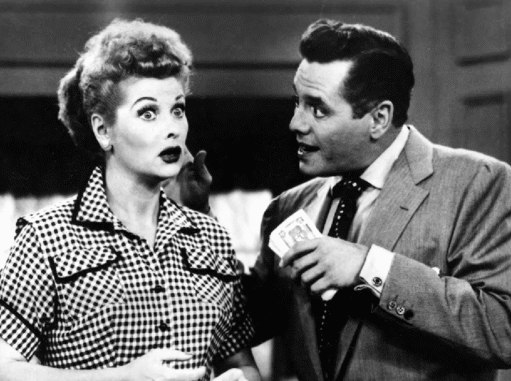
Lucille Ball remains a comedic icon. Married for 20 years to I Love Lucy co-star and Desilu Studios partner Desi Arnaz, the mom of two made television history for six seasons on her iconic show.

One of the comedy’s highest-rated episodes involved a storyline that needed massive oversight, including approval by a clergy member.

Lucille Ball and Desi Arnaz of β€˜I Love Lucy’ | CBS Photo Archive/Getty Images

β€˜Lucy is Enceinte’

In season 2 of I Love Lucy, Ball was actually pregnant with her second child, Desi Jr. With the show airing in the early 1950s, advertisers and networks felt featuring a pregnant woman on television to be somewhat scandalous. Lucy and Ricky were even filmed in separate beds during any scenes in the bedroom.

According to Ranker, Ball and Arnaz feared the show may be cancelled due to her pregnancy. Producer Jess Oppenheimer lobbied to keep the show on and even write the pregnancy into the show. The networks gave in due to I Love Lucy’s popularity, where Lucy shares her baby news in the infamous episode β€œLucy is Enceinte.”

With her pregnancy now part of the show, Ball and Arnaz had to be careful with how they worded Lucy and Ricky Ricardo’s expecting a new family member.

Lucille Ball and Desi Arnaz of β€˜I Love Lucy’ | CBS via Getty Images

β€˜I Love Lucy’ baby episode delivers huge ratings

After the massive success of β€œLucy is Enceinte,” the comedy featured six more episodes highlighting the Ricardos upcoming arrival. According to Vulture, 44 million viewers tuned in to see β€œLucy Goes to the Hospital,” where the couple welcomes Little Ricky on January 19, 1953.

That number translates to nearly 72% of American households tuning in to watch the groundbreaking episode, outranking President Dwight Eisenhower’s inauguration the following day.

Ball was seven months pregnant in real life when they filmed the episode. Maybe the comedic icon wanted to stick the script even off camera. Just like her character, Ball delivered Desi Jr. on the same night β€œLucy Goes to the Hospital” aired. With a nod to her personal doctor Joe Harris, Ball gave Lucy’s obstetrician the same name in the landmark episode.

Scripts for Lucy’s pregnancy episodes received intense scrutiny

When the storyline for Lucy’s pregnancy was introduced in late 1952, only one other woman had appeared on television while pregnant. In 1948, Mary Kay Stearns of Mary Kay and Johnny was featured during her pregnancy. Since television had yet to hit most homes at that time, the storyline wasn’t considered controversial.

It was a different story on I Love Lucy, where advertisers wouldn’t even allow the word β€œpregnant” to be used. Terms like β€œexpecting” or other vague references were substituted to keep the network and sponsors happy.

The top cigarette manufacturing corporation Philip Morris was a top backer of the show. The tobacco titan was extremely concerned how the pregnancy storyline would play out and demanded strict oversight to each script focused on the topic. Ranker reported the company even required a minister, priest, or rabbi to approve each draft before being finalized.

Despite the strict approval loop, Lucy’s pregnancy made television history and remains one of the most beloved storylines inΒ I Love Lucy’s six-season run.

A woman was born in 1975 and died in 1975!

In the vast, interconnected landscape of the modern internet, few things possess the viral potential of a perfectly constructed paradox. The digital age has fostered a unique fascination with lateral thinking puzzlesβ€”riddles that appear to defy the laws of logic until a single, hidden detail is unearthed. Recently, a specific linguistic puzzle has swept across social media platforms, migrating from niche message boards to the mainstream feeds of millions, sparking a global debate that highlights the fascinating ways the human brain processes information. The riddle is deceptively simple, consisting of only a few short sentences: β€œA woman was born in 1975 and died in 1975. She was 22 years old when she died. How is this possible?”

At first glance, the statement reads like a clerical error or a mathematical impossibility. Our cognitive architecture is conditioned to look for patterns, and in the context of four-digit numbers beginning with β€œ19,” the brain almost instantaneously categorizes the information as a chronological date. This is the primary mechanism of the riddle’s success: it exploits a psychological phenomenon known as mental set, where individuals approach a problem with a pre-established framework. Because the year 1975 is a well-known historical marker, the reader immediately assumes they are looking at a timeline. Within that framework, the math simply does not hold up. If a person is born and dies in the same calendar year, their lifespan is measured in months, days, or hoursβ€”not decades.

The viral explosion of this puzzle began on February 4, 2026, as users on platforms like X, TikTok, and Instagram began sharing the prompt, often accompanied by frustrated captions and lengthy comment threads filled with wild theories. Some users speculated that the woman might have been born in a leap year, or perhaps she was traveling near the speed of light, invoking Einstein’s theory of relativity to explain time dilation. Others suggested more macabre or supernatural explanations, ranging from reincarnation to the idea that the woman lived in a region where the local calendar system differed vastly from the Gregorian standard. The beauty of the puzzle lies in this frantic search for complex answers to what is, in reality, a very simple linguistic trick.

As the discussion intensified, the β€œsolution” began to circulate, providing that satisfying β€œaha!” moment that characterizes the best brain teasers. The resolution of the paradox hinges on the recontextualization of the number 1975. The riddle does not state that she was born and died in the year 1975; it simply provides the number as a location. The woman was born in hospital room 1975, and twenty-two years later, in a poetic but tragic coincidence of fate, she passed away in that very same room. Once the reader shifts their perspective from a temporal measurement to a spatial one, the logical contradiction vanishes entirely. The numbers remain the same, but their meaning is transformed by a single change in the assumed preposition.

This specific riddle serves as a profound example of how human perception is governed by context. In the field of linguistics and semiotics, this is often referred to as β€œpriming.” By presenting a number that fits perfectly into the expected format of a year, the author of the riddle primes the audience to think about time. We are so accustomed to seeing four-digit numbers used as dates that we stop seeing them as mere integers. This cognitive shortcut is usually efficient, allowing us to navigate the world quickly without over-analyzing every piece of data. However, as this viral trend proves, those same shortcuts can be used to lead us into a logical cul-de-sac.

The β€œRoom 1975” riddle also touches on the nature of digital engagement in the mid-2020s. In an era of short-form content and rapid-fire scrolling, a puzzle that can be consumed in five seconds but takes five minutes to solve is the ultimate currency for engagement. It encourages users to stop, think, andβ€”most importantly for the algorithmsβ€”comment. The comment sections of these posts became a microcosm of human behavior, showcasing everything from the β€œknow-it-all” who posts the answer immediately to the β€œskeptic” who argues that the riddle is poorly constructed because hospitals rarely have room numbers that high. The latter point actually fueled even more discussion, as users began researching hospital floor plans and numbering conventions, proving that even the flaws in a riddle can contribute to its longevity.

Beyond the entertainment value, educators and psychologists have pointed to this viral sensation as a valuable tool for teaching critical thinking. It demonstrates the importance of challenging one’s own assumptions and looking for alternative interpretations of β€œfactual” statements. In a world where misinformation can often be spread through the clever manipulation of context, the ability to step back and ask, β€œWhat else could this number represent?” is a vital skill. The riddle acts as a low-stakes training ground for the brain, reminding us that reality is often dictated by the lens through which we choose to view it.

The emotional resonance of the story, even as a fictional construct, also played a role in its spread. The idea of a life coming full circleβ€”beginning and ending in the exact same physical spaceβ€”carries a certain narrative weight. It evokes a sense of symmetry and irony that captures the imagination. While the woman in the riddle is a hypothetical figure, the scenario creates a vivid mental image that sticks with the reader longer than a purely abstract mathematical problem would. This β€œnarrative hook” is what separates a dry logic puzzle from a viral story.

As the trend eventually begins to fade, replaced by the next internet mystery or meme, the β€œ1975” puzzle will remain a classic example of lateral thinking. It joins the ranks of other famous riddles, such as the one about the man who lived on the twentieth floor and only took the elevator to the tenth floor on sunny days (because he was a person of short stature and could only reach the higher buttons with his umbrella). These stories persist because they remind us of the fallibility of our own logic. They celebrate the quirkiness of language and the infinite ways in which words can be arranged to hide the truth in plain sight.

In the end, the viral mystery of the woman who lived twenty-two years between two β€œ1975s” is less about the woman herself and more about the people trying to solve her story. It is a testament to the human desire to make sense of the nonsensical and to find order in chaos. Whether viewed on a smartphone screen in a crowded subway or discussed over a dinner table, the riddle serves as a brief, shared moment of intellectual playβ€”a small reminder that sometimes, the answer we are looking for is right in front of us, hidden only by the narrowness of our own expectations. When we finally realize that 1975 was a room and not a year, we don’t just solve a puzzle; we experience a momentary expansion of our own cognitive boundaries, a small but significant shift in how we choose to interpret the world around us.

Wheel of Fortune Player Stuns Internet After Solving This Tough $74,000 Puzzle!

The bright lights of a television studio have a peculiar way of magnifying human emotion, but on a recent Tuesday night, they captured something truly transcendent. Chad Hedrick did not arrive on the set of Wheel of Fortune with the swagger of a professional gambler or the frantic energy of a superfan. He entered the arena with the polished, measured composure of a man who spent his life on the other side of the lens. As a local news reporter from Kentucky, Hedrick was intimately familiar with the art of the story, the rhythm of a deadline, and the importance of maintaining a β€œreporter’s mask” regardless of the chaos unfolding off-camera. He looked every bit the part of a seasoned journalist in his sharp suit and professional smile, but by the end of the half-hour broadcast, that mask would not just slipβ€”it would be completely shattered by a moment of pure, unadulterated human triumph.

The trajectory of Hedrick’s game was a masterclass in the psychological resilience required of great game-show contestants. For the first two acts of the episode, the script seemed destined for mediocrity. He hit the dreaded β€œBankrupt” wedge, he watched as β€œLose a Turn” drained the momentum from his sails, and he faced the silent, mounting pressure of the spinning wheel. To the casual observer, he was merely holding his own, taking the hits with a professional shrug that suggested he had seen far worse during live breaking-news segments. Yet, beneath that calm exterior, a reporter’s tenacity was beginning to simmer. He started β€œclawing back,” as fans later described it, snatching puzzles from the brink of expiration with a surgical precision. By the time the final bell rang for the main game, Hedrick had navigated the minefield of the wheel to secure a spot in the coveted Bonus Round.

Standing on the legendary mark beside host Ryan Seacrest, the atmosphere shifted. The lighthearted banter of the early rounds evaporated, replaced by the heavy, electric tension of the endgame. In the audience, Hedrick’s mother and sister watched with bated breath, their faces a mirror of the anxiety and hope radiating from the man center-stage. When the category appeared and the initial letters were revealed, the board looked like a linguistic wasteland. The sparse arrangement of consonants and vowels offered no immediate path to victory.

As the ten-second timer began its relentless countdown, Hedrick appeared to be faltering. His initial guesses were hesitant, voiced with the upward inflection of a question rather than the certainty of a conviction. He seemed to be arguing with himself in real-time, his brain a frantic library of possible phrases, most of which he discarded as soon as they reached his lips. Then, with the clock nearing its final tick, the internal fog suddenly cleared. In a burst of sheer, instinctive clarity, he blurted out the correct phrase.

The reaction was instantaneous and deafening. The studio audience erupted into a wall of sound, a collective release of the tension that had been building since the beginning of the round. Ryan Seacrest, usually the epitome of the unflappable host, momentarily froze in a state of genuine surprise. The puzzle was notoriously difficult, the kind of β€œstumper” that usually results in a polite consolation prize and a walk into the wings. But Hedrick had solved it.

The emotional climax, however, was yet to come. When Seacrest reached for the prize envelope and flipped the card to reveal an additional $55,000β€”bringing Hedrick’s total winnings to a staggering $74,000β€”the composure that had defined Hedrick’s career vanished. In a moment of stunned, reflexive disbelief, the Kentucky reporter actually gave Seacrest a playful, shocked shove. It was a reaction born of pure adrenaline and cognitive dissonance. He began laughing and gasping in equal measure, his knees visibly buckling as the reality of the windfall began to sink in.

β€œYou’re joking,” he repeated over and over, his voice cracking. β€œYou’re joking.” It was a beautiful irony: the man who made his living finding the right words for every situation was suddenly, hilariously speechless. He wasn’t a reporter anymore; he was a son, a brother, and a winner whose life had just been fundamentally altered in the span of a single breath.

Social media was quick to seize on the moment. Clips of the β€œSeacrest shove” and Hedrick’s jubilant breakdown flooded timelines, with viewers praising the β€œraw, unscripted joy” of the segment. In an era of television that often feels overly produced and rehearsed, Hedrick offered a glimpse of something real. He reminded the audience why we watch game shows in the first placeβ€”not just for the puzzles or the prizes, but for the chance to see a regular person overcome the odds and experience a life-changing epiphany in front of millions.

The episode has already been etched into the annals of Wheel of Fortune history, not merely because of the dollar amount, but because of the man who won it. Hedrick’s journey from a humble reporter to a viral sensation is a testament to the idea that sometimes, the best stories are the ones we don’t write for ourselves. As he stood on that stage, showered in confetti and surrounded by his family, Chad Hedrick proved that while he might be the one usually covering the news, he was more than capable of being the biggest headline in the country. He walked off the set that night with much more than a check; he walked off with a legendary TV moment that will be discussed for as long as the wheel keeps spinning.

Popular

My Entitled Daughter In Law Tried To Trap Me As An...

0
The complex emotional landscapes of multigenerational families frequently feature subtle, deeply hidden power dynamics where younger generations mistakenly conflate a grandparent’s unconditional love with...