Entertainment

Sweet and Salty Pretzel Caramel Chocolate Bars Recipe

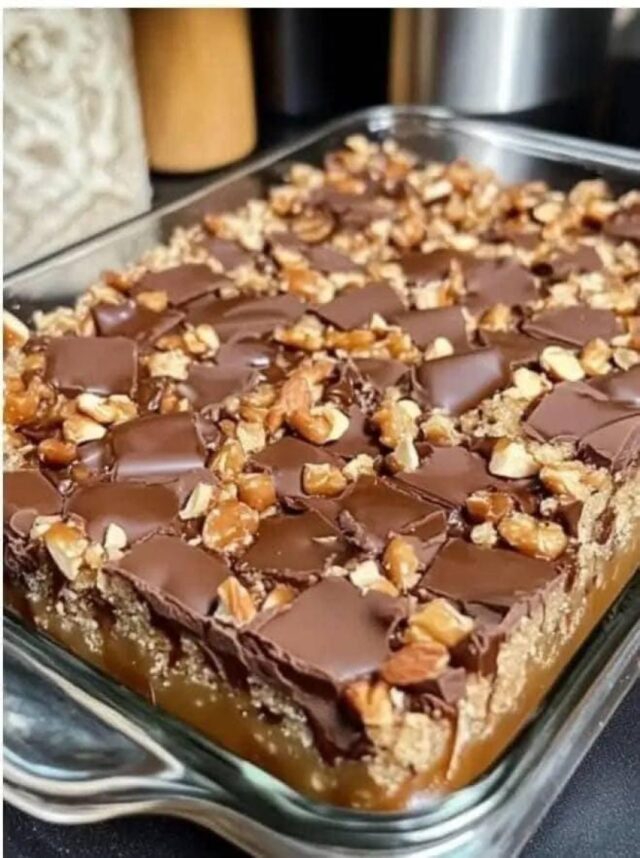
If you’re searching for a dessert that perfectly blends sweet, salty, and crunchy flavors, pretzel caramel chocolate bars are an excellent choice. This layered treat combines a crisp pretzel crust, smooth homemade caramel, and a rich chocolate topping for a dessert that feels both indulgent and easy to prepare. It’s a recipe that works just as well for family gatherings and holiday celebrations as it does for a simple weekend treat at home. Even if you’re not an experienced baker, the straightforward steps make this dessert approachable, rewarding, and fun to create.

The foundation of these bars is a simple pretzel crust made with crushed pretzels, melted unsalted butter, and a small amount of granulated sugar. After mixing the ingredients, the mixture is pressed firmly into a greased 9×9-inch baking pan to form an even base. The crust is then baked at 350°F (175°C) for eight to ten minutes, just long enough to help it set while preserving its signature crunch. Once removed from the oven, the base is allowed to cool completely. This cooling step is important because it ensures the caramel layer will sit smoothly on top without softening the crust.

Next comes the caramel layer, which adds a warm, buttery richness to the dessert. Light brown sugar, butter, and heavy cream are combined in a saucepan over medium heat and stirred constantly. As the mixture begins to boil, it thickens into a glossy caramel over the course of four to five minutes. A touch of vanilla extract is added once the pan is removed from heat, enhancing the flavor and aroma. The warm caramel is poured carefully over the cooled pretzel base and spread evenly. The pan is then placed in the refrigerator for about thirty minutes, allowing the caramel to firm up before adding the final layer.

The finishing touch is the chocolate topping, which brings everything together with a smooth and satisfying finish. Semi-sweet chocolate chips are gently melted in a microwave-safe bowl, stirred until silky, and spread evenly over the chilled caramel. For a decorative option, melted white chocolate can be drizzled on top to create a simple design. After chilling the bars for at least an hour, they become firm enough to slice neatly into squares. The result is a batch of delicious dessert bars with a perfect balance of crunch, creaminess, and sweetness — a homemade treat that looks impressive, tastes delightful, and is sure to be enjoyed on any occasion.

How a Daily Banana Can Support Healthy Living After Age 50

As people move through their 50s, 60s, and later years, the body gradually begins to process food differently. Metabolism often slows, energy levels may fluctuate more easily, and digestion can become less efficient than in earlier decades. At the same time, concerns such as heart health, blood pressure balance, and muscle comfort tend to require greater attention. These changes are a normal part of aging, but they highlight the importance of choosing foods that are both nourishing and easy to incorporate into daily routines. Simple dietary habits can make a meaningful difference in supporting overall well-being over time.

One everyday food that fits naturally into a balanced diet is the banana. Although it is familiar and widely available, it offers several nutrients that can be especially helpful for adults over 50. Bananas are naturally rich in potassium, a mineral that supports fluid balance in the body and plays a role in maintaining healthy blood pressure levels. They also contain magnesium, which contributes to the normal function of the heart and blood vessels. Together, these nutrients can help support cardiovascular wellness when combined with an overall healthy lifestyle.

Bananas also provide dietary fiber in both soluble and insoluble forms, which can help promote comfortable digestion and regularity. This can be particularly beneficial as digestion may slow with age. The natural carbohydrates found in bananas supply gentle, steady energy without feeling heavy, making them a convenient snack during busy days. In addition, vitamin B6 found in bananas assists the body’s energy metabolism processes. Potassium further supports normal muscle function, which may help reduce occasional muscle tightness when paired with proper hydration and light physical activity.

Incorporating a banana into daily meals is simple and flexible. It can be sliced over oatmeal or cereal, blended into a smoothie, paired with yogurt or nuts, or enjoyed on its own as a quick snack. As with any food, moderation is important, especially for individuals managing specific health conditions such as blood sugar concerns or kidney-related issues. However, for most adults, bananas are affordable, gentle on digestion, and easy to enjoy regularly. Adding one banana a day can be a small but nourishing habit that supports digestion, energy, heart wellness, and muscle comfort. Over time, consistent, thoughtful food choices like this can contribute to a stronger foundation for healthy aging.

The Shoebox He Left Behind: A Story of Forgiveness and Strength

For twelve years, she believed her marriage was built on shared dreams and quiet loyalty. She supported her husband through career changes, late nights, and uncertain beginnings, often putting her own ambitions aside. When he finally reached success, she thought they would celebrate together. Instead, he told her he had “outgrown” her and left for someone younger, claiming he had climbed the ladder while she had stayed behind. The words cut deeply, but she focused on rebuilding her life, learning to find confidence and independence again.

Only a few months later, life took an unexpected turn. Her ex-husband fell seriously ill, and the new woman in his life chose to walk away rather than face the challenges of caregiving. Despite everything he had said, she couldn’t ignore the years they had shared. She welcomed him into her home, helping him through appointments and daily struggles, not out of obligation, but out of compassion. During quiet evenings, he apologized for his harsh words, admitting he had confused success with happiness and underestimated her strength. She forgave him—not to erase the past, but to free herself from carrying anger.

After he passed away, she attended the modest funeral feeling a mix of sadness and closure. She didn’t expect to see his former partner there, let alone receive a small shoebox placed gently into her hands. Inside were handwritten notes, photographs, and a simple journal he had kept during his illness. The pages were filled with reflections about their marriage, regrets about his choices, and gratitude for her kindness when he had no one else. He had written that she was the person who taught him what real partnership meant, long before he understood its value.

Reading those words was emotional, but also healing. She realized that people often recognize love too late, but that doesn’t erase the impact it had. The shoebox became a symbol of closure and growth rather than sorrow. She decided to keep the journal as a reminder that her worth was never defined by someone else’s success or failure. Instead of bitterness, she chose to carry forward the lessons of empathy, resilience, and self-respect. In the end, she understood that her kindness had not been wasted—it had shaped a story of forgiveness, dignity, and quiet strength that would stay with her for the rest of her life.

Easy Slow Cooker Pork Chops with Apples and Onions Recipe

There is something truly comforting about pork chops slowly simmered with apples and onions. The gentle aroma fills the kitchen with warmth, reminding many people of classic home-cooked meals and relaxed family dinners. This simple dish brings together tender pork, naturally sweet apples, and savory onion flavor in a way that feels both nostalgic and satisfying. Best of all, it requires very little effort, making it perfect for busy days when you still want a wholesome, homemade meal.

This recipe is built around just three main ingredients, plus a little water, yet it delivers rich flavor and a natural sauce as it cooks. Bone-in pork chops work best because they stay juicy and tender during slow cooking, while apples such as Honeycrisp, Fuji, or Granny Smith provide a pleasant balance of sweetness and slight tartness. A packet of onion soup mix adds depth and savory notes without the need for many spices. Simply layer the apples in the slow cooker, place the pork chops on top, sprinkle the soup mix over everything, and add water around the edges. Then let the slow cooker do the work while you go about your day.

Cooking the dish on low heat for six to seven hours, or on high for about four hours, allows the flavors to blend beautifully and the pork to become fork-tender. When it is ready, spoon the apples and cooking juices over the pork chops to create a natural sauce. For extra richness, a small amount of butter or a touch of Dijon mustard can be stirred into the juices before serving. This dish pairs well with mashed potatoes, rice, noodles, or roasted vegetables, making it easy to create a complete and balanced meal.

Leftovers store well in the refrigerator for several days, and the flavors often become even better the next day. The dish can also be frozen for later use, making it a convenient option for meal planning. If you prefer, you can add potatoes to the slow cooker so they cook alongside the pork and apples, soaking up the flavorful juices. This slow cooker pork chops with apples and onions recipe proves that delicious home cooking does not have to be complicated. With just a few simple ingredients and minimal preparation, you can create a comforting meal that tastes like it took hours of effort and care.

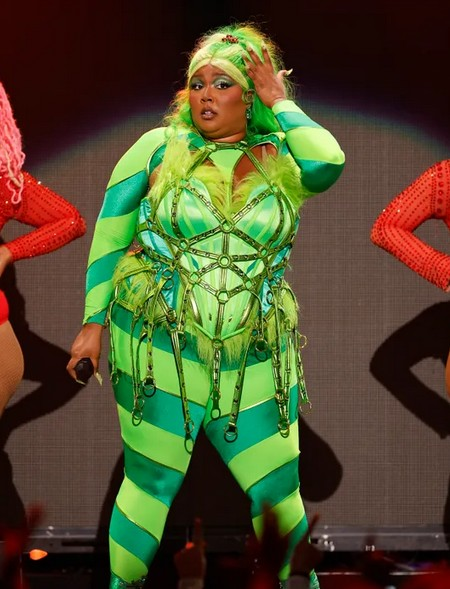
Lizzo Shares Her Personal Wellness Journey in Recent Photos

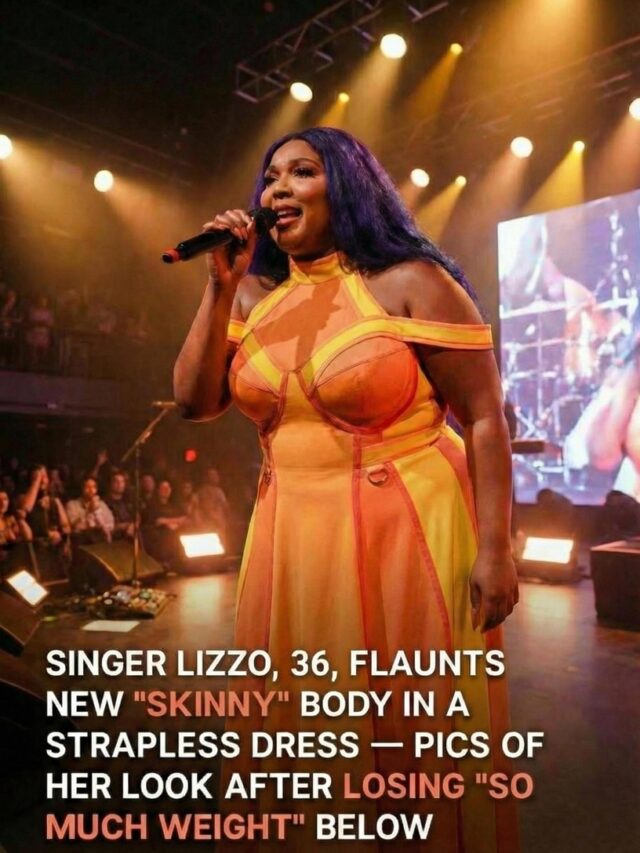
Lizzo has recently captured attention with her public appearances and social media updates, as fans noticed a visible personal transformation over time. The Grammy-winning artist has always been open about her wellness journey, emphasizing that her focus is on feeling strong, energized, and balanced rather than conforming to external expectations. While discussions online have highlighted her changing appearance, Lizzo approaches the topic with humor and honesty, reminding her followers that personal health is unique to each individual and should be defined by one’s own goals, not public opinion.

Since 2020, Lizzo has regularly shared insights into her fitness routines, giving fans a glimpse into her consistent dedication to movement. From cycling and jump-rope sessions to Pilates and strength training, she emphasizes fitness as a way to build both physical and mental strength. In several posts, she clarified that her motivation has never been about achieving a particular look. Instead, Lizzo views her routines as tools for improving endurance, mental clarity, and overall well-being. She notes that transformations happen gradually, and often, others notice changes before she does herself.

Beyond her workouts, Lizzo has been candid about her relationship with food, stress, and mental wellness. She has shared that her nutrition choices evolve based on what works best for her body, not because of trends or outside pressure. Over time, she explored plant-based meals and later incorporated higher-protein options after professional guidance. She has also addressed rumors about weight loss methods, emphasizing that her progress comes from consistent exercise, mindful eating, and lifestyle adjustments rather than quick fixes. Her transparency has resonated with many, highlighting the value of honest, judgment-free conversations about health and self-care.

Throughout her journey, Lizzo continues to advocate for body respect, self-acceptance, and inclusivity. She promotes the concept of “body neutrality,” recognizing that feelings about one’s body naturally fluctuate from day to day. This perspective is reflected in her professional work, including her shapewear brand Yitty, designed to celebrate comfort, confidence, and representation across all sizes and identities. Lizzo’s story showcases growth, authenticity, and self-awareness, serving as a reminder that true transformation is not about changing who you are—it’s about supporting yourself in ways that feel healthy, sustainable, and empowering.

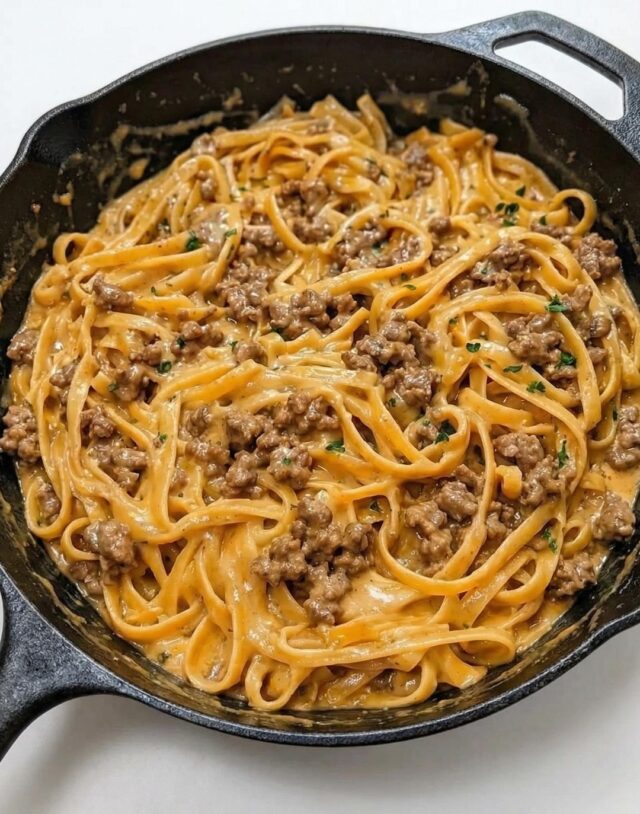
Creamy Garlic Butter Pasta with Ground Beef: Easy One-Pot Comfort Meal

If you’re craving a comforting, all-in-one meal that combines tender ground beef, perfectly cooked pasta, and a rich, creamy garlic butter sauce, this dish is exactly what you need. It’s simple, satisfying, and comes together with minimal effort, making it perfect for busy weeknights, casual dinners, or anytime you want a little indulgence without spending hours in the kitchen. One pot is all it takes to create a meal that feels both hearty and luxurious, yet stays easy to prepare and clean up afterward.

The beauty of this recipe is its versatility. You can feed a hungry family, treat friends at a small gathering, or simply enjoy a quiet dinner for yourself. Using basic ingredients like pasta, ground beef, butter, garlic, and Parmesan, you’ll get bold, comforting flavors that taste like they took hours to prepare. Optional additions like sautéed mushrooms, spinach, or roasted red peppers can elevate the dish with extra color and nutrition. Seasoning is simple but impactful—Italian herbs, a pinch of red pepper flakes, salt, and pepper transform the dish from ordinary to unforgettable.

Cooking this meal is straightforward and satisfying. Start by browning the ground beef in a large pot, letting it develop a rich, savory base. Then, stir in butter and garlic until fragrant, followed by pasta, broth, and seasonings. Simmer until the pasta is tender and most of the liquid is absorbed. Finally, add cream and freshly grated Parmesan to create a silky sauce that clings to every piece of pasta. Toss in any vegetables you like at this stage, then taste and adjust seasonings before serving. A sprinkle of fresh parsley adds a pop of color and a touch of freshness to the finished dish.

For the best results, choose fresh Parmesan over pre-grated cheese, as it melts more smoothly and enhances the sauce’s texture. You can also experiment with different proteins, like turkey, sausage, or plant-based alternatives, to suit your preferences. Leftovers store beautifully in an airtight container for up to three days; simply reheat gently with a splash of cream or milk to bring the sauce back to life. Whether served with garlic bread, a crisp salad, or on its own, this creamy garlic butter pasta is a reliable, crowd-pleasing meal that’s bound to become a favorite in your rotation.

Katy Perry and Justin Trudeau Make Headlines at the World Economic Forum

Katy Perry turned heads at the World Economic Forum in Davos, Switzerland, on January 20, 2026, making a standout appearance alongside her boyfriend, former Canadian Prime Minister Justin Trudeau. Known for attracting global leaders and top business figures, the forum took a surprising celebrity turn as Perry arrived in a fitted beige button-down dress, seated prominently during Trudeau’s session. The former prime minister, looking sharp in a navy suit, accompanied her confidently, with cameras capturing them holding hands and sharing smiles. Social media quickly buzzed with photos and commentary, with fans both admiring her style and speculating about her appearance.

Reactions online were mixed but largely focused on Perry’s elegance and poise. Instagram and Facebook users praised her confidence, noting her “professional” and “first lady-like” presence, while others expressed curiosity or concern about her health or possible pregnancy. The unexpected sight of a pop star alongside a former world leader added a fresh, human element to the traditionally formal event, highlighting how celebrity moments can intersect with global gatherings. Despite speculation, Perry’s composure and charm remained the center of attention.

Meanwhile, Perry’s ex-husband, Russell Brand, made headlines for his comments on her new relationship. Speaking at an event in Phoenix, Arizona, Brand referenced Perry and Trudeau, generating reactions ranging from amusement to criticism. While some viewers interpreted his remarks as jealous, others dismissed them as his usual humor. Reflecting on his past marriage, Brand acknowledged that their divorce ended amicably and expressed respect for Perry, describing their separation as stemming from ordinary, human differences. His comments, though controversial, reinforced the public fascination with Perry’s personal and romantic life.

Amid the attention, sources close to Perry emphasized her happiness and appreciation for Trudeau’s support. Despite her demanding Lifetimes World Tour schedule, the couple has made time to connect, including a celebrated public outing in Paris for Perry’s 41st birthday. Insiders describe the relationship as genuine and unexpected, with both valuing mutual respect, humor, and shared moments. Social media responses reflected admiration for their pairing, with fans celebrating Perry’s confidence and the couple’s visible chemistry. Perry and Trudeau’s romance continues to flourish, showing that even amid public scrutiny, personal happiness and meaningful connection can take center stage.

My Date Paid for Dinner, But What Happened Next Left Me Shocked!

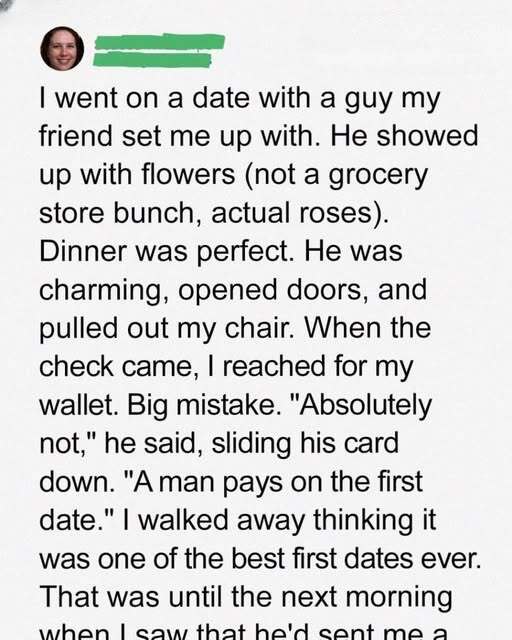
In the modern landscape of dating, where digital ghosting and superficial swiping have become the norm, a recommendation from a trusted friend feels like a rare insurance policy. When my best friend Mia suggested setting me up with Eric, a close friend of her boyfriend Chris, I felt a cautious optimism. Blind dates had always felt like high-stakes theater to me, but Mia’s endorsement was glowing: she described Eric as “old-school,” respectful, and incredibly steady. Our initial correspondence seemed to validate her assessment. Eric was a man of complete sentences and thoughtful inquiries. He didn’t rely on the low-effort banter of dating apps; instead, he asked about my favorite travel memories and my professional goals. After a week of pleasant digital preamble, he suggested dinner at a prestigious Italian trattoria downtown—a choice that felt intentional and sophisticated.

The evening of the date arrived, and Eric’s performance was nothing short of cinematic. He was standing by the hostess stand five minutes early, clutching a vibrant bouquet of long-stemmed roses. He was dressed in a crisp, charcoal suit that suggested he took the occasion seriously. Throughout the meal, he was a paragon of traditional gallantry. He pulled out my chair with a practiced grace, complimented the color of my dress without being overbearing, and even presented me with a small, engraved silver keychain. He explained that he had seen it in a boutique earlier that day and it had reminded him of a story I’d told him about my love for vintage maps. It was a gesture that felt deeply attentive.

Over plates of handmade pasta and a shared bottle of Chianti, the conversation flowed with an ease that is rare for two strangers. We laughed about past dating fiascos and bonded over our mutual ambition. Eric seemed grounded, confident, and entirely present. There were no red flags, no subtle jabs, and no uncomfortable silises. When the check finally arrived, I made the customary reach for my purse, but Eric waved it away with a sharp, confident smile. “Absolutely not,” he insisted. “A man pays on the first date. It’s a matter of principle.” While the sentiment felt a bit performative, I accepted it as a charming, if slightly antiquated, romantic gesture. He walked me to my car, waited until I was safely inside with the engine running, and offered a polite wave as I pulled away. I drove home feeling a rare sense of accomplishment; I had finally gone on a “good” date.

The following morning, I sat down with my coffee and opened my laptop, fully expecting a “hope you got home safe” email or a request for a second meeting. Instead, I found a message with a subject line that felt like a bucket of ice water: “Invoice for Services Rendered / Date of Jan 23.”

I laughed out loud, leaning back in my chair. I assumed it was a high-level piece of dry, sarcastic humor—a witty way of saying he wanted to see me again. But as I scrolled down, the laughter died in my throat. It was a formal, itemized spreadsheet. Eric had billed me for exactly half of the dinner total, half the cost of the roses, the full retail price of the engraved keychain, and a calculated portion of the gas he used to drive to the restaurant. But the most jarring entry was the final one: a $50 charge labeled “Emotional Labor and Curated Conversation.”

The bottom of the email contained a clinical, detached note. It stated that while he had enjoyed the evening, he felt that the “investment of resources” should be shared equally until a formal commitment was established. He requested that I settle the balance via a mobile payment app by the end of the business day. The message concluded with a subtle, veiled threat: he hoped I would “do the right thing” so he wouldn’t have to discuss my “lack of financial integrity” with Chris and Mia.

Shock gave way to a cold, focused irritation. I immediately screenshotted the document and sent it to Mia. Her response arrived within seconds, devoid of her usual humor: “Oh my god. He’s doing it again. Do not send him a dime. Chris is handling this.”

As it turned out, I wasn’t the first victim of Eric’s “dating audits.” Mia revealed that Eric had a history of treating social interactions like business mergers, but he had managed to hide this particular trait from Chris for months. Chris was horrified to learn that his friend was using his name as leverage to extort money from women. Together, Mia and Chris decided to fight fire with fire. They drafted a “Counter-Invoice” and sent it to Eric, billing him for “Brokerage Fees for a Failed Introduction,” “Compensation for Mia’s Time Wasted on Vetting,” and a “Reputational Damage Surcharge” for Chris.

The situation escalated with a speed that revealed the true depth of Eric’s instability. When he realized he wasn’t going to get his “reimbursement,” his polished exterior completely disintegrated. His subsequent messages moved through the classic stages of a bruised ego. First came the defensive intellectualization, where he argued that “true equality” required shared financial risk. When that failed to elicit a response, he pivoted to raw anger, accusing me of being a “professional diner” who used men for free meals. Finally, he devolved into pathetic self-pity, claiming that the world was rigged against “nice guys” who just wanted to be appreciated for their efforts.

I watched the notifications pop up on my phone, but I never typed a single word in response. There is a specific kind of power in silence when dealing with someone who is desperate to control the narrative. Mia and Chris eventually blocked him on all platforms, effectively excommunicating him from their social circle. They realized that the “respectful and steady” man they thought they knew was actually a transactional predator who used kindness as a debt-collection tool.

Looking back, that Italian dinner serves as a profound life lesson. Eric had provided all the surface-level elements of a romantic beginning—the flowers, the suits, the polite doors held open—but they were all hollow. It taught me that true generosity is never followed by an invoice, and courtesy is not a down payment on future compliance. Kindness loses its soul the moment it is treated as a line item on a balance sheet. I never paid that invoice, and I never saw Eric again. However, I did gain something valuable from that night: a sharpened intuition and the realization that a man who insists on paying for your dinner might just be trying to buy the right to own the evening. I didn’t pay the bill, but I certainly paid attention, and that has made all the difference in every date I’ve been on since.

I Gave Up My Family for My Paralyzed High School Sweetheart – 15 Years Later, His Secret Destroyed Everything

I met my husband in high school.

He was my first love—the kind that doesn’t feel like fireworks, not at first. It feels quieter than that. Steady. Certain. Like you’ve finally found the place you’re supposed to rest your head.

We were seniors, stupidly confident, wrapped up in the idea that love made you untouchable. We talked about the future like it was a straight line—college, careers, a nice house, all of it waiting for us like it was guaranteed.

We had no idea how quickly life can turn.

It was a week before Christmas when everything cracked open.

I was on my bedroom floor wrapping presents when my phone rang. His mom’s voice hit my ear like a siren—screaming, sobbing, trying to form sentences.

I caught fragments.

“Accident.”
“Truck.”
“He can’t feel his legs.”

The hospital smelled like disinfectant and stale coffee. Everything was harsh—fluorescent lights, beeping machines, the metallic coldness of fear that sits in your mouth.

He was there in the bed with rails and wires, a neck brace, his eyes open, trying to look brave and failing.

I took his hand and didn’t let go.

“I’m here,” I told him. “I’m not leaving.”

A doctor pulled me and his parents aside and delivered the words that changed the shape of our lives.

“Spinal cord injury,” he said. “Paralysis from the waist down. We don’t expect recovery.”

His mother folded into herself. His father stared at the floor like it had answers.

I went home numb.

And my parents were waiting at the kitchen table like they were about to negotiate a deal.

“Sit,” my mother said.

I sat because I was too stunned to argue.

“He was in an accident,” I said. “He can’t walk. I’m going to be at the hospital as much as—”

“This is not what you need,” she cut in, clean and cold.

I blinked. “What?”

“You’re seventeen,” she said. “You have a real future. Law school. A career. You cannot tie yourself to… this.”

“To what?” I snapped. “To my boyfriend who just got paralyzed?”

My dad leaned forward, voice lower but no kinder.

“You’re young. You can find someone healthy. Successful. Don’t ruin your life.”

I laughed because I truly thought they were joking. Because no one could be that cruel that fast.

“I love him,” I said. “I loved him before the accident. I’m not walking away because his legs don’t work.”

My mother’s face went flat, like a switch turned off.

“Love doesn’t pay the bills,” she said. “Love won’t lift him into a wheelchair. You have no idea what you’re signing up for.”

“I know enough,” I said, shaking now. “I know he’d do it for me.”

Her hands folded neatly on the table.

“Then this is your choice,” she said. “If you stay with him, you do it without our support. Financial or otherwise.”

I stared at her. “You’d really cut off your only child for not dumping her injured boyfriend?”

My dad’s jaw clenched like he was holding back anger—not at the situation, but at me for not obeying.

The next day my college fund was gone. Drained. Like it had never existed.

“We are not going to fund you throwing your life away,” my father said, and his calmness was somehow worse than yelling.

The fight went in circles. I cried, I begged, I raised my voice. They stayed steady and ruthless.

And then my mother said it like a final ruling.

“Him or us.”

My voice shook when I answered. “Him.”

So I packed a duffel bag.

Clothes. A few books. A toothbrush. The bare essentials of a life I suddenly had to build from scratch.

I stood in my childhood room and stared at everything I’d assumed was permanent. The bed. The posters. The mirror where I’d practiced smiles for school pictures. The version of myself who thought her parents’ love was unconditional.

Then I left.

His parents lived in a small worn house that smelled like onions and laundry detergent. When his mom opened the door and saw my bag, she didn’t ask questions. She just stepped aside like she’d already made room for me in her heart.

“Come in, baby,” she said. “You’re family.”

I broke right there on the threshold.

After that, life became something grittier than love stories. It became work. It became training. It became survival.

I went to community college instead of my dream school. I worked part-time in coffee shops and retail. I learned how to help him transfer from bed to wheelchair. How to do catheter care. How to argue with insurance companies. How to be seventeen and exhausted and still show up the next day.

People stared. Of course they did.

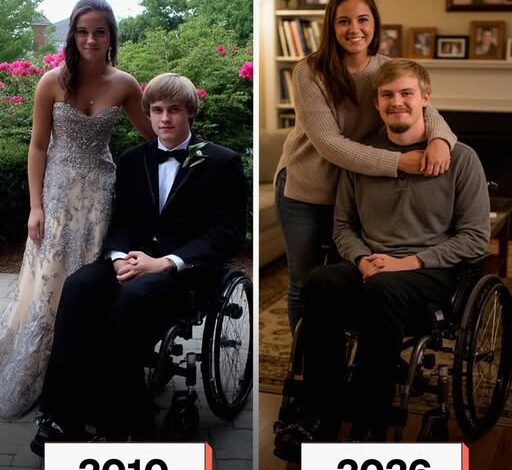
I convinced him to go to prom anyway.

“They’ll stare,” he muttered, looking down at the wheelchair like it was the only thing anyone would see.

“Let them choke,” I told him. “You’re coming.”

We rolled into the gym under cheap lights and bad music. A few friends moved chairs without making it a big deal. Someone cracked jokes until he laughed, and for a couple hours, it almost felt like we were normal teenagers again.

My best friend Jenna hugged me in her sparkly dress and leaned down to him with a grin.

“You clean up nice, wheelchair boy.”

We danced with me standing between his knees, his hands on my hips, swaying like we were the only two people in the room.

No one from my family came.

After graduation, we got married in his parents’ backyard. Folding chairs. Costco cake. My dress from a clearance rack.

I kept glancing toward the street like my parents might show up out of nowhere, swept up by guilt or love or something human.

They didn’t.

We had our son a couple years later. I mailed a birth announcement to my parents’ office because some small part of me still believed they might soften at the idea of a grandchild.

No response.

No call. No card. Nothing.

Then fifteen years passed.

Fifteen Christmases. Fifteen anniversaries. Fifteen years of scrolling past my parents’ numbers sometimes and feeling that familiar ache, then forcing myself to swallow it down.

Life wasn’t easy, but we made it work. He got a degree online and built a remote IT career. He was good at it—the patient kind of smart. The guy who could walk someone’s grandma through a password reset without ever sounding annoyed.

We fought sometimes, sure. About money. About exhaustion. About whose turn it was to deal with whatever crisis came next.

But I believed we were strong.

I believed we’d survived the worst night of our lives.

I believed our love story was “against all odds” and that meant it was unbreakable.

Until one random afternoon when I came home early with takeout, planning to surprise him.

I opened the front door and heard voices in the kitchen.

One was my husband’s.

The other stopped my heart.

My mother.

I hadn’t heard her voice in fifteen years, but my body recognized it instantly—like a bruise that never fully healed.

I walked in and saw her standing by the table, red-faced, waving a stack of papers at my husband. He was pale, sitting very still, like his body had decided to shut down before his mind could catch up.

“How could you do this to her?” she screamed. “How could you lie to my daughter for fifteen years?”

“Mom?” I said, and even hearing myself say it felt unreal.

She whipped around. For a second—just a second—something like pain crossed her face. Then the anger snapped back into place.

“Sit,” she said. “You need to know who he really is.”

My husband looked at me with wet eyes.

“Please,” he whispered. “I’m so sorry. Please forgive me.”

My hands shook as I took the papers.

Printed emails. Old messages. A police report.

The date of the accident.

The route.

An address that wasn’t his grandparents’ house.

And then a name that punched the air out of my lungs.

Jenna.

There were messages between him and Jenna from that day.

“Can’t stay long,” he’d written. “Got to get back before she suspects.”

“Drive safe,” she’d replied. “Love you.”

My vision blurred.

“No,” I whispered, like the word could undo what I was reading.

My mother’s voice sliced through the room.

“He wasn’t driving to his grandparents that night,” she said. “He was driving home from his mistress.”

I turned to my husband, desperate for him to deny it. To laugh. To call it fake.

“Tell me she’s lying,” I said.

He didn’t.

He just started crying, shoulders shaking like grief had finally caught up to him.

“Before the accident,” he said, voice breaking, “it was… it was stupid. I was stupid. Jenna and I… it was a few months.”

“A few months,” I repeated, tasting the words like poison.

He swallowed hard.

“I thought I loved you both,” he said miserably. “I know how that sounds. I was young and selfish.”

“So the night of the accident,” I said slowly, “you were driving home from her.”

He nodded. Eyes squeezed shut.

“I was leaving her place when I hit the ice,” he admitted. “Spun out. Woke up in the hospital.”

“And the grandparents story?” I asked, voice oddly steady now.

“I was scared,” he whispered. “I panicked. I knew you… I knew if you thought I’d done nothing wrong, you’d stay. You’d fight for me. And if you knew the truth…”

“I might have left,” I finished.

He nodded again, like he’d been waiting fifteen years for the sentence to land.

And that—more than the affair, more than Jenna’s betrayal, more than anything—was the thing that cracked me open.

Because it wasn’t just that he cheated.

It was that he stole my choice.

He let me burn my life down for him based on a lie. He let me choose him over my parents without giving me the facts that might’ve changed everything.

I turned to my mother, voice low.

“How do you know all this?”

She exhaled like she’d been holding her breath for days.

“I ran into Jenna at the grocery store,” she said. “She looked awful. She started talking about miscarriages, about God punishing her. So I asked—punishing her for what? And she told me.”

Of course Jenna framed it as punishment.

Of course my mother hunted down proof.

Then my mother’s voice softened—just slightly.

“We were wrong too,” she said. “For cutting you off. For not reaching out. We thought we were protecting you, but we were protecting our image. I’m sorry.”

I didn’t have space for her apology yet. My head was too full. My chest felt too tight.

I set the papers down on the table and looked at my husband.

“I need you to leave,” I said.

His chin trembled. “Where am I supposed to go?”

I laughed once, sharp enough to cut.

“That’s what I had to figure out at seventeen,” I said. “I’m sure you’ll manage.”

I went to our bedroom and pulled out a suitcase, hands steady in a way that surprised me.

This time I wasn’t a scared teenager begging for love to be enough.

I packed for myself and our son—clothes, important documents, his favorite stuffed dinosaur. Our son was at a friend’s house, safe and oblivious.

On the drive to pick him up, I rehearsed the gentlest version of the truth I could give a child.

“Hey buddy, we’re going to stay at Grandma and Grandpa’s for a bit.”

He’d never even met them.

When I arrived at my parents’ house with him, they opened the door, saw their grandson, and both looked like the air had been knocked out of them. My mother started sobbing. My father gripped the doorframe like he needed it to stand.

They apologized again. For everything. For cutting me off. For missing fifteen years. For never meeting him.

I didn’t say “it’s okay.”

Because it wasn’t.

But I did say, “Thank you for saying that.”

We got lawyers. We worked out custody and schedules and money. The divorce was messy, and I hated every second of it. I didn’t want to be his enemy—I just couldn’t be his wife anymore.

Our son knows the kid version of the truth.

“Dad made a big mistake a long time ago,” I told him. “He lied. Lying breaks trust. Adults mess up too.”

I still cry sometimes.

I still miss the life I thought I had.

I don’t regret loving my husband.

I regret that he didn’t trust me with the truth.

Because choosing love is brave.

But choosing truth?

That’s how you survive.

From poverty and bullying to the Oscars – the actress who refused to break!

From the depths of poverty and the scars of childhood bullying to the glittering stage of the Academy Awards, Jessica Chastain’s life is a testament to the power of a resilient spirit. Today, she is recognized as one of the most formidable talents in Hollywood, an actress whose name is synonymous with intellectual depth and emotional complexity. However, the path to her current status as a cinematic icon was paved with significant hardship, hunger, and a relentless refusal to be defined by her circumstances.

Born on March 24, 1977, in Sacramento, California, the world first knew her as Jessica Howard. Her mother, Jerri Hastey, was a teenage parent and a vegan chef who struggled to keep the family afloat. Her stepfather, a firefighter named Michael Hastey, provided what stability he could, but the household was far from privileged. For a young Jessica, the reality of life was often dictated by what was missing. She has been candid in her adult life about the “very difficult upbringing” she endured, recalling many nights when she and her siblings went to bed on empty stomachs. This early exposure to food insecurity left a lasting mark on her psyche, instilling a profound sense of empathy for those marginalized by society. Rather than focusing on her own ego, Chastain has often remarked that her background forced her to constantly consider the experiences of others, a trait that would later fuel her transformative acting performances.

The family dynamic was further complicated by the absence of her biological father, Michael Monasterio, a rock musician who was not a presence in her formative years. The lack of a paternal figure was so absolute that no father was even listed on her birth certificate. While she shared a bond with her younger sister, playing outside until the sun dipped below the horizon to avoid the realities of their home life, tragedy was never far away. In 2003, her sister died by suicide at their biological father’s home, a loss that shattered the family. Years later, when Monasterio passed away from bronchitis in 2013, Chastain chose not to attend the funeral or speak publicly about him, maintaining a boundary around a past that offered little “proof of anything.”

Her challenges were not confined to the walls of her home. At school, Chastain was a target for relentless bullying. With her striking red hair and a face full of freckles, she looked different from the other children, and they were quick to weaponize that uniqueness. She was told daily that she was ugly and that no one wanted to be her friend. These cruel taunts could have easily crushed her self-esteem, but they instead fostered a “rebellious streak.” This defiance became her armor, protecting a burgeoning passion that would eventually lead her out of Sacramento.

That turning point came at the age of seven when her grandmother took her to see a professional production of Joseph and the Amazing Technicolor Dreamcoat. While other girls her age were envisioning traditional futures, Chastain had an “aha moment” of total clarity. She realized that acting was not just a hobby but her destiny. Despite her struggles in the public-school system, her imagination remained a vibrant sanctuary. She began working at a performing arts school in exchange for classes because her family could not afford the tuition. It was during these years that she learned the importance of community; she realized that while she was working hard, there were kind individuals who stepped in to help her when she was most vulnerable. She also credits access to Planned Parenthood for providing her with the reproductive healthcare and choices that allowed her to pursue a career rather than following the cycle of teenage pregnancy that she saw all around her.

Her talent eventually earned her a spot at the prestigious Juilliard School in New York City, a dream that felt almost out of reach due to the staggering costs. However, fate intervened in the form of the legendary Robin Williams. As a Juilliard alumnus, Williams had funded a scholarship that covered everything—tuition, books, rent, and even airfare to see her family during the holidays. Though she never met Williams before his death in 2014, she wrote him numerous letters expressing her gratitude. His generosity provided her with the breathing room to focus entirely on her craft, transforming her from a girl who grew up in poverty into a classically trained artist ready to take on the world.

Chastain did not become an overnight sensation. She spent years honing her skills on stage and in television guest spots before making her film debut at age 31 in Jolene. However, 2011 became the year of the “Chastain explosion.” She released six films in a single year, including the critically acclaimed Take Shelter and Terrence Malick’s The Tree of Life. Suddenly, the industry was buzzing about the mysterious redhead who seemed to have appeared out of nowhere. She solidified her stardom with her performance as the bubbly, outcast socialite Celia Foote in The Help, which earned her an Academy Award nomination. Walking the red carpet at the Cannes Film Festival flanked by Sean Penn and Brad Pitt, Chastain knew her life had changed forever.

Her career continued to skyrocket with roles that defied Hollywood’s typical gender pigeonholes. In Christopher Nolan’s Interstellar, she played a character originally written for a man, proving that her presence could command a high-stakes, big-budget sci-fi epic. She also earned a second Oscar nomination for her role as a relentless CIA analyst in Zero Dark Thirty, a character defined by her intellect and drive rather than her romantic interests. This became a hallmark of Chastain’s career: she intentionally chose roles with strong feminist themes, refusing to be reduced to a sex symbol.

Her dedication to the craft eventually led to the ultimate industry recognition. In 2021, her transformative portrayal of the titular televangelist in The Eyes of Tammy Faye earned her the Academy Award for Best Actress. Beyond the trophies, Chastain has used her platform to advocate for gender and racial equality, as well as mental health awareness. She remains deeply connected to her roots, often stating that her success makes her “angry” on behalf of those who are still denied a voice or a meal.

In her personal life, she has found a steady partner in Gian Luca Passi de Preposulo, an Italian fashion executive. The couple married in 2017 in a beautiful ceremony in Italy and now reside in New York City with their two children. Despite her fame, Chastain remains fiercely private, often attending events alone to maintain a sense of normalcy for her family. She is an actress who values substance over celebrity, a woman who hasn’t forgotten the girl who went to bed hungry. Jessica Chastain stands as a vivid reminder that while your beginnings might be written in struggle, the middle and end of your story are yours to create through grit, humility, and an unwavering belief in your own worth.

Popular

Fathers Day Drive that turned into a surprise!

0
On Father’s Day, I drove six hours back to the house I grew up in, carrying with me a tray of my mother’s lemon...

Shattered At The Gas Station