The short film opens on a sunny city morning. A young, wealthy couple drives through the streets in a red convertible — he’s in a sleek suit, she’s in a sparkling blue dress. They look every bit the picture of success — until a moment of arrogance reveals their true character.
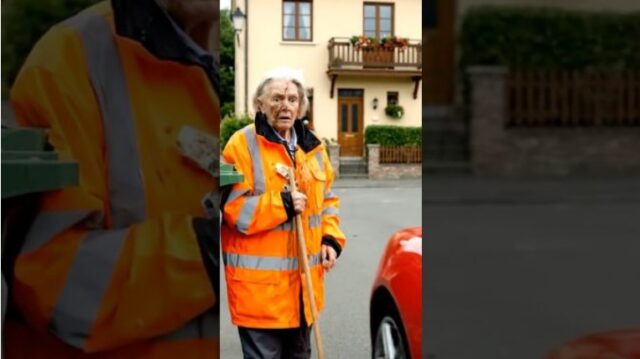
An elderly woman in a neon vest sweeps trash from the curb, her broom moving slowly but steadily. She’s a sanitation worker — someone who keeps the city running, though few stop to notice.
The couple slows down beside her. The man smirks, grabs a black garbage bag from the backseat, and with a mocking laugh, throws its contents all over her. The woman beside him bursts into laughter as debris rains down.
The elderly worker freezes — tears mixing with grime as the couple drives off, leaving her humiliated in the middle of the street.
Moments later, a fellow worker rushes to her side, helps her up, and quietly radios for backup.
Garbage Justice Delivered
Within minutes, the distant roar of engines fills the air. Four massive garbage trucks appear from different directions, their orange hazard lights flashing like beacons of solidarity.
The sports car suddenly finds itself trapped — boxed in by the sanitation trucks. The couple’s laughter fades as the drivers step out, forming a silent wall of orange uniforms.
Then, without a single word, one of the trucks raises its bed high.
A mountain of trash comes crashing down — right into the red convertible. Bottles, paper, food waste, and sludge rain down, burying the luxury car in the same filth they had mocked moments earlier.
The couple screams, flailing in the mess. Their designer clothes are ruined, their arrogance drowned beneath the stench of their own cruelty.
As the trucks pull away, their engines echo through the street, leaving behind silence — and poetic justice.
The Lesson in Humility
The final shot lingers on the couple, sitting in the wreckage, surrounded by garbage. The message is clear: those who disrespect honest work deserve the weight of their own arrogance.
The elderly woman watches quietly from afar — not vengeful, just dignified. Her coworker stands beside her, offering quiet support. The camera fades out on a single phrase:
“Respect the hands that clean the world you live in.”
Moral
True justice doesn’t always come from courts — sometimes, it comes from conscience. Every job has dignity, and arrogance is often its own punishment.
Sofia Martinez, a young traveler exploring a historic Spanish festival, found herself at the wrong place at the wrong time. She had come to enjoy the music, the traditions, and the colorful atmosphere that filled the narrow streets. Curious but cautious, she stood beside an old stone wall, watching from a distance, until one frightened bull broke from the herd.
The ground trembled.
Hooves smashed against the cobblestones.
The crowd screamed.
Sofia froze.
Before she could move, the massive black bull turned the corner—its heavy breaths steaming in the warm air. Locals gasped and stepped back as it trotted directly toward her. In panic, Sofia tried to squeeze herself between a doorway and iron-barred window, her hands gripping the frame desperately.
But there was no escape.
The bull stood just inches behind her—close enough for her to feel every warm breath against her back. Its horns were leveled, powerful muscles twitching with tension. The alley fell silent. People covered their mouths, some whispered prayers, others turned away in fear of what was about to happen.
But then… something unexpected happened.
Instead of charging, the bull slowed—and stopped.
Its head lowered, nostrils flaring—not with rage, but with confusion. It leaned forward gently, pressing its nose to her back. Sofia trembled uncontrollably, tears filling her eyes as she whispered under her breath, “Please… please don’t hurt me.”
But the bull didn’t attack.
It simply stood there, breathing softly, as if it could feel her heartbeat, her fear… and chose not to harm her.
People watching could not believe their eyes. Murmurs spread through the alley.
“Why isn’t it attacking?” “Is it protecting her?” “Or is it just scared?”
For a long moment—though it felt like an eternity—they stayed this way: a terrified girl pinned against a wall, and a powerful creature that could kill her in seconds… but didn’t.
Finally, local animal handlers quietly approached, ropes in hand. The bull lifted its head one last time, looked at Sofia, then stepped back and allowed itself to be led away.
Sofia collapsed to her knees—shaking, crying, but alive.
Why Didn’t the Bull Attack? Experts Explain
Veterinarians and animal behavior experts later explained that the bull was not acting out of aggression, but fear. The loud cheers, bright clothing, and crowded streets overwhelmed it. Bulls, like many animals, don’t always choose violence when cornered—sometimes they freeze, observe, or react with curiosity.
Sofia shared her experience in a local interview, her voice still shaky: “I thought it was the end. I could feel its breath, its strength… but then I felt something else. It wasn’t angry. It was just as scared as I was.”
❤️ A Moment That Changed Everything
In the days that followed, the video of the encounter spread across social media. Millions watched in silence, not because of the danger—but because of the compassion in the unexpected. Sofia now speaks out about animal protection, saying: “That bull could have taken my life. Instead, it taught me the value of it.”
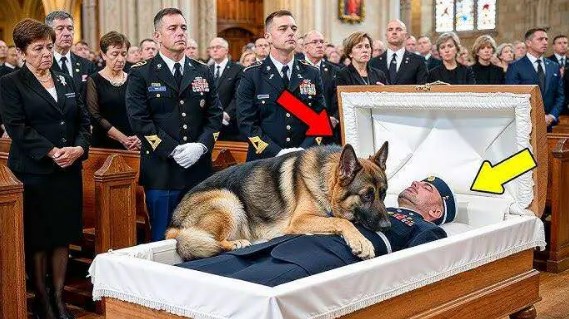
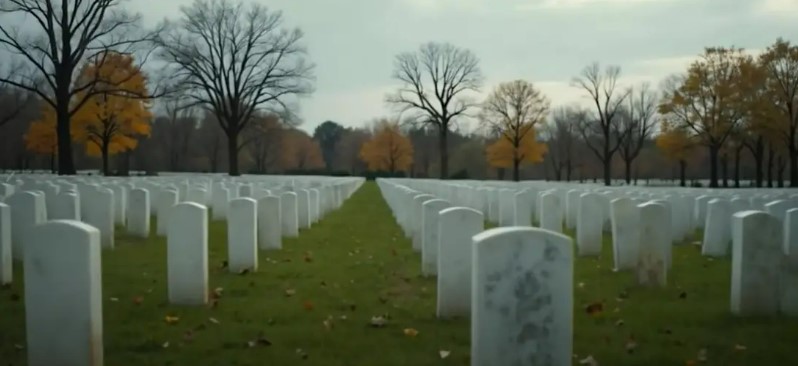
That day at the military cemetery is one I will never forget. The air was still, filled with the weight of silence that only true loss can bring. Soldiers stood tall in perfect formation, families held one another close, and the flag fluttered softly over the resting place of Sergeant Daniel Hayes — a brave man, a leader, and a hero.
But amidst the uniforms and solemn faces, there was one figure that captured every heart — Daniel’s loyal German Shepherd, Max. This wasn’t just any dog; Max had served with Daniel through the toughest days of battle. They had shared long nights, endless patrols, and a bond that could only be forged in the heart of danger.
As the ceremony began, Max grew restless. His eyes scanned the crowd, searching for the man he trusted more than anyone. And then, without warning, he broke free from his leash. The sound of boots shifting echoed softly as everyone turned to look.
Max ran straight to Daniel’s flag-covered resting place. He lowered his head, placed his paws gently against the flag, and refused to move. It was as if he was saying, “I’m still here, and I’m not leaving you.”
The air grew heavier. Even the toughest soldiers — men who had faced years of combat — felt their throats tighten. Many had tears in their eyes. The loyalty of this dog spoke louder than any words could.
When the final salute rang out, Max let out a quiet, mournful sound that seemed to echo through the hearts of everyone present. It wasn’t just grief — it was devotion. He stayed there, silent and unyielding, standing guard for the man who had once protected him.
That moment reminded us all of something profound — that love and loyalty don’t end with life. They remain, carved deep within the soul, just like Max’s devotion to Daniel. True loyalty doesn’t fade; it endures.
Even now, whenever I think of that day, I can still see Max lying quietly beside his best friend, a living symbol of honor and love — the kind that never dies.
The rain fell steadily against the windowpane, tracing thin silver lines down the glass. Inside a small apartment on the edge of the city, Michael Turner sat alone in silence. Once a joyful musician, he now lived surrounded by dust-covered instruments and old memories.
His life had changed after the accident. A car crash had taken his wife three years earlier, and ever since that night, the light in his eyes had dimmed. He rarely played music anymore, and his laughter once warm and easy had vanished into the same grayness that filled the sky outside.
On that particular night, he sat in his armchair, staring blankly at the rain. He didn’t even notice the faint sound of scratching coming from the door.
A Guest in the Silence
Michael hesitated for a moment. He wasn’t the type to keep pets. Yet, as he looked at the trembling creature, something inside him softened.
“Alright, come in,” he said, stepping aside.
The cat walked in slowly, cautious but curious. It shook itself dry and immediately curled up near the small heater. Michael watched it for a while before fetching an old towel and a bowl of milk.
A Silent Companion
Days turned into weeks, and the cat whom Michael eventually named Milo stayed.
He was no ordinary cat. He seemed to sense Michael’s moods before Michael even understood them himself. When the man sat at his piano, staring at the keys but unable to play, Milo would leap onto the instrument, resting on the cool surface as if to say, Try again.
Sometimes, late at night when Michael woke from nightmares, drenched in sweat and haunted by loss, Milo would be there curled beside him, purring softly, grounding him in the present.
Slowly, the apartment began to change. Dust disappeared. Curtains were opened. Light found its way inside again.
And then, one morning, as sunlight spilled through the window, Michael sat at the piano and pressed a key. The sound echoed through the room hesitant but beautiful. Milo lifted his head, watching quietly.
That was the day music returned.
The Return of Music
Each day after that, Michael played a little more. His fingers trembled at first, but soon, melodies flowed from his heart like a long-forgotten language. The neighbors stopped in the hallways to listen; the mailman lingered outside a little longer.
Milo would always sit nearby, eyes half-closed, tail swaying to the rhythm.
It was as though the cat had awakened something sleeping deep within Michael’s soul. The music wasn’t perfect, but it was alive.
The Cat Who Saved a Heart
From that night onward, Michael often thought about the strange way Milo had come into his life. Some of his friends joked that the cat had rescued him more than once.
But Michael knew it was true — not just physically, but emotionally. Milo had saved him from drowning in loneliness, from forgetting who he was.
He began volunteering at the local animal shelter, helping abandoned cats find homes. Every time he placed one into loving arms, he whispered, “Take care of them — they might just save you one day.”
Because he believed that no act of kindness was ever one-sided.
It was a calm morning in the small countryside town of Alder Creek. The air was crisp, carrying the scent of wet earth and pine after a light rain. Daniel Brooks, a forest ranger, had begun his daily patrol earlier than usual, walking down the narrow trail that wound through the hills.
His loyal companion, a four-year-old German Shepherd named Rex, trotted beside him. Rex had been Daniel’s partner for nearly three years trained, disciplined, and remarkably intelligent. The two shared a bond that went beyond the typical handler-and-dog relationship.
A Cry for Help
It started as a faint sound something between a whimper and a distant shout. Daniel stopped in his tracks.
“Did you hear that, boy?” he whispered.
Rex’s ears perked instantly. He turned his head toward the eastern slope, eyes sharp, muscles tense. Without hesitation, he barked once and started running through the underbrush.
“Rex! Wait up!” Daniel called, but he knew better than to hold him back. When Rex heard distress, instinct took over.
They sprinted through thick ferns and across muddy ground until the trees opened up into a small ravine. That’s where they saw it a car lying on its side at the bottom, half-buried in leaves and mud.
Daniel’s heart jumped. He could smell the faint scent of gasoline.
Trapped Beneath the Metal
He climbed down the slope carefully, Rex leading the way. Inside the wrecked vehicle, through a cracked windshield, Daniel saw movement a woman, barely conscious, trapped by the collapsed dashboard.
Her voice was weak but filled with fear. “Help… please…”
Daniel rushed forward. “Ma’am, don’t move! My name’s Daniel, I’m a ranger. We’ll get you out of here!”
He tried pulling the door, but it was jammed tight. The front of the car had caved in. Rex barked anxiously, circling the car, his tail low, his body alert.
“Rex, find another way in!” Daniel commanded.
The dog sniffed around, then darted to the back window, which had shattered. He crawled inside through the broken glass, careful and deliberate. Inside, he began licking the woman’s hand, trying to keep her awake.
The Fire Sparks
Then Daniel smelled it smoke.
The electrical wiring had shorted, and a faint flame flickered beneath the hood. His pulse quickened. There wasn’t time to wait anymore.
“Rex, come out!” he shouted, but the dog didn’t move. He stayed beside Sarah, barking at Daniel as if to say, Don’t leave her.
“Rex! That’s an order!”
The dog looked from the flame to Sarah and back to Daniel. Then, in one sudden motion, he grabbed her sleeve with his teeth and tugged gently. It was as if he understood they needed to act now.
Daniel pulled open the rear door with all his strength. It finally gave way, bending just enough for him to reach her. He crawled halfway inside. “Good boy, Rex, keep pulling!”
Together, man and dog worked in desperate unison Daniel pushing, Rex pulling. Sarah cried out in pain but managed to slide free from the metal trap just as the smoke grew thicker.
Seconds later, the front of the car erupted into a burst of flame.
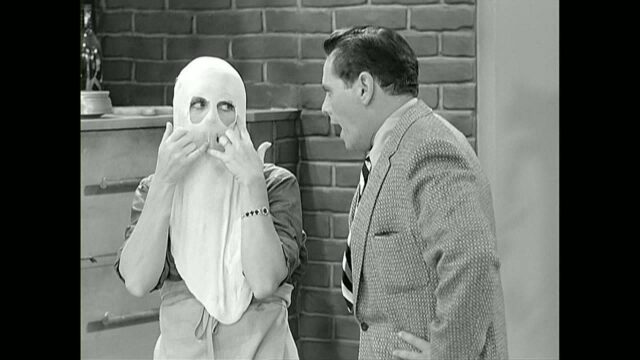
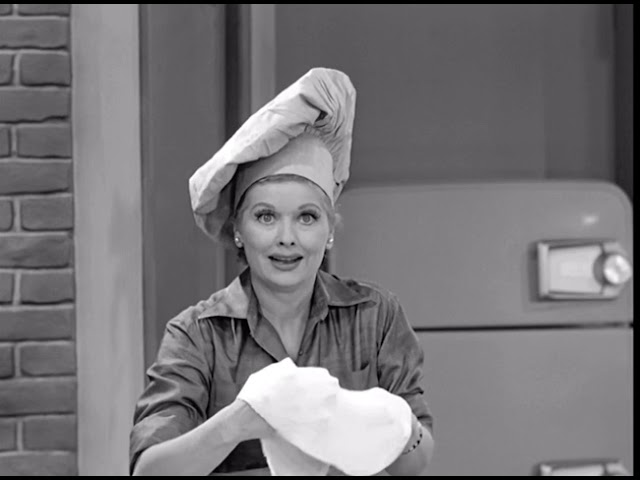
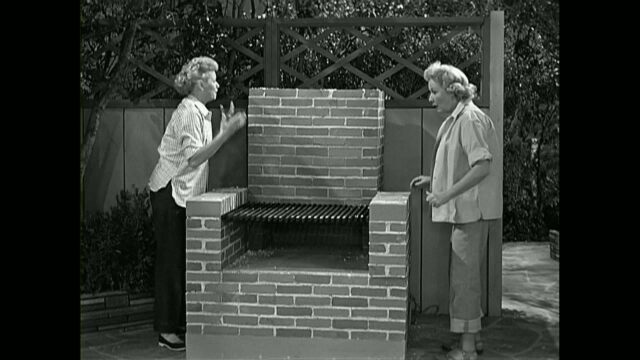
When Lucy Ricardo takes a job at a local Italian pizzeria, she’s determined to prove she can handle real work. But in true Lucy fashion… let’s just say things don’t exactly go according to plan! 😂
From the moment she steps behind the counter, Lucy is all enthusiasm and zero experience. Her boss, the fiery Italian chef, tries to show her how to make pizza dough the right way — but Lucy’s hands, the dough, and the rolling pin have minds of their own. Before long, flour fills the air, pizza toppings are flying, and Lucy’s outfit looks more like part of the menu than a uniform!
The audience howled as Lucy struggled to stretch the dough properly — at one point it ends up covering her completely like a doughy blanket. The scene perfectly captures Lucille Ball’s physical comedy genius — she doesn’t just do the joke, she becomes the joke.
It’s one of those moments that reminds us why I Love Lucy is still unmatched — simple premise, pure chaos, and Lucille Ball turning everyday life into timeless comedy.
🍕 1. Real Dough, Real Mess: Lucille Ball insisted on using real pizza dough for authenticity — which made the scene much messier (and funnier). The sticky chaos was all genuine!
🎭 2. A Return to Classic Lucy: This episode was a deliberate throwback to her I Love Lucy factory-style chaos — a nod to fans who loved seeing Lucy tackle “real jobs” with disastrous results.
😂 3. Vito Scotti’s Perfect Partnering: Character actor Vito Scotti appeared in several Lucy productions — his over-the-top reactions matched her comedic energy perfectly.
📺 4. Audience Favorite: “Lucy’s Italian Pizzeria” consistently ranks as one of the funniest Lucy Show episodes in fan polls, thanks to that unforgettable dough fight!
When Zohran Mamdani was declared the next mayor of New York City on Tuesday night, he made history becoming the first Muslim mayor and the youngest to lead the city in over a century.
But standing beside him, smiling quietly as the crowd roared, was someone about to make history too – his wife, 28-year-old artist Rama Duwaji.
While Mamdani’s political rise has captured headlines, his love story with Rama is straight out of a movie — one that begins not in City Hall, but on a dating app.
A match made on hinge
The couple first connected on Hinge in 2021, back when Mamdani had just been elected to the New York State Assembly. Rama, a Syrian-American illustrator based in Brooklyn, wasn’t familiar with New York politics — and Mamdani wasn’t exactly looking for the spotlight.
Their first date was refreshingly normal: coffee at Qahwah House, a cozy Yemeni café in Brooklyn, followed by a walk through McCarren Park. On their second date, Mamdani took Rama on a tour of his Astoria district, the same neighborhood that would one day help make him mayor.
By October 2024, the two were engaged.
“Couldn’t possibly be prouder,” Rama wrote on Instagram alongside photos of the couple and a childhood picture of Mamdani.
Just days after announcing their engagement, Mamdani launched his campaign for mayor. The couple celebrated their nikah and engagement party in Dubai that December, a rooftop ceremony overlooking the Burj Khalifa, filled with white roses and trailing greenery.
“This engagement and Nikkah were more than an event — it was a floral installation set against Dubai’s dusky skyline,” LMF Dubai, the event designer, wrote on Instagram.
A civil ceremony in New York
Two months later, in February 2025, they made it official in a civil ceremony at the City Clerk’s Office in Lower Manhattan. Mamdani later shared photos of the day, writing:
The lead photo captured the couple in a candid black-and-white moment on the New York City subway at Union Square. Smiling as they held onto a pole, Duwaji stood out in a white dress paired with black boots, clutching a bouquet, while commuters around them went about their day, seemingly unaware they were sharing a train with the city’s future first couple.
“Three months ago, I married the love of my life, Rama, at the City Clerk’s office. Now, right-wing trolls are trying to make this race — which should be about you — about her. Rama isn’t just my wife; she’s an incredible artist who deserves to be known on her own terms. You can critique my views, but not my family.”
Who is Rama Duwaji?
Born in Houston, Texas, Rama moved with her family to Dubai when she was nine. She later returned to the U.S. to attend Virginia Commonwealth University and earned her master’s in illustration from the School of Visual Arts in New York.
Her work — featured in The Cut, Vogue, The New Yorker, and BBC — explores themes of identity, womanhood, and displacement.
On Instagram, where she has more than 250,000 followers, her artwork often focuses on Middle Eastern women, Gaza, and the Palestinian cause.
”I believe everyone has a responsibility to speak out against injustice, and art has such an ability to spread it,” Duwaji said in an interview earlier this year.
“With so many people being pushed out and silenced by fear, all I can do is use my voice to speak out about what’s happening in the US and Palestine and Syria as much as I can,” she added.
Sometimes, Rama also enjoys stepping away from her digital work to craft her own ceramics, especially hand-painted blue-and-white plates adorned with her signature illustrations.
Despite avoiding the traditional “first lady in waiting” role, no campaign speeches, no glossy magazine profiles, Rama played a quiet but key part in Mamdani’s rise.
She helped design his campaign’s branding, a vibrant mix of Metrocard yellow, Mets blue, and firehouse red, seen across posters and digital ads citywide.
“She’s been a huge influence on how we present our message,” one campaign staffer said. “Even if she’s not on stage, she’s everywhere.”
From Brooklyn to Gracie Mansion
Now, the couple is set to move into Gracie Mansion, where Rama Duwaji will officially become New York’s First Lady, and the first member of Gen Z to hold the title.
Rushing to social media to celebrate the historic moment, one X user wrote: “If Mamdani wins the election, becoming the city’s first Muslim mayor and its youngest in a century, Duwaji too would be positioned to make and shape history. She would be the first member of Gen Z to serve as New York City’s first lady.”
“Now, that’s exciting!” exclaimed another, while a third added: “The new First Lady of NYC, Rama Duwaji, ladies and gentlemen.”
“First-ever Gen Z First Lady of NY!” gushed a fourth.
Whether she chooses to stay behind the scenes or step into advocacy, one thing is certain: she’s redefining what it means to be a political partner in the modern age.
Together, Zohran Mamdani and Rama Duwaji aren’t just New York’s newest power couple. They’re symbols of a new generation leading with creativity, conviction, and love.
When Lucy Ricardo loses something, it’s never just a simple “oh well.” It’s a full-scale, all-hands-on-deck emergency — complete with panic, confusion, and side-splitting comedy! 😂
In this unforgettable I Love Lucy episode, Lucy misplaces her wedding ring — and what starts as a small mishap turns into one of the funniest domestic disasters the Ricardos have ever faced.
At first, she tries to stay calm, casually searching the apartment while pretending everything’s fine. But when she realizes it’s really gone, chaos begins! She retraces her steps, searches the laundry, the kitchen, and even poor Ethel’s handbag — because when Lucy’s in panic mode, no one is safe!
The episode peaks in a hilarious scene where Lucy accidentally sucks up the ring into the vacuum cleaner — or so she thinks. The sight of her frantically tearing the machine apart while Ricky looks on in disbelief is pure comedy gold.
❤️ Classic Lucy: Chaos, Charm, and Heart
What makes this episode unforgettable isn’t just the laughs — it’s the way Lucille Ball turns anxiety into art. Her facial expressions, her body language, that tiny gasp of horror when she realizes the ring is missing — it’s perfection.
Desi Arnaz, as always, plays the perfect straight man. Ricky’s attempts to calm Lucy down only make things worse as she becomes more and more dramatic (“Ricky, I’ve lost the most important thing in my life — besides YOU!”).
It’s moments like these that remind us why I Love Lucy became the blueprint for every sitcom that followed — relatable chaos wrapped in heart and humor.
💍 1. Lucille Ball’s Real Ring: The wedding ring used in this episode was actually Lucille Ball’s real ring from her marriage to Desi Arnaz!
😂 2. The Vacuum Scene Was Improvised: Lucy’s frantic struggle with the vacuum was partly ad-libbed. The prop wasn’t working correctly, so Lucille just kept going — making it even funnier.
🧵 3. A Running Gag: The writers revisited the “lost item panic” theme several times in the show — fans loved watching Lucy spiral into chaos over small mishaps.
💞 4. Real-Life Parallels: Lucille Ball once admitted she actually lost her ring on set once, and Desi helped her find it. The writers decided to include that idea in an episode later!
🎭 5. A Favorite of Fans: This episode ranked among the Top 20 in CBS’s I Love Lucy fan poll — proving that even the simplest storyline could shine in Lucille Ball’s hands.
If you ask Donald Trump himself, he believes everything is going well after 10 months as president.
But according to some opinion polls, the reality is far from that rosy picture.
Economy and cost of living biggest concers
Donald Trump’s approval rating has sunk to one of the lowest points of his presidency, with just 37% of Americans expressing support for his performance, according to a new CNN/SSRS survey. That’s a steep drop from 47% back in mid-February, shortly after he began his second term.
The survey, conducted from October 27–30 among 1,245 adults, shows 63% disapproval, nearly matching Trump’s all-time low recorded by CNN after the January 6 Capitol riot in 2021.
Americans are clearly feeling the strain. When asked how things are going in the U.S., 68% said “pretty/very badly”, while only 32% said “very/fairly well.”
The economy and cost of living topped voter concerns at 47%, followed by the state of U.S. democracy at 26%. Surprisingly, immigration — despite Trump’s aggressive policies — was cited as a top concern by only 10%.
61% believe Trump has gone too far
Public opinion on Trump’s policies is equally harsh: 61% believe his policies have worsened economic conditions, while only 27% say they improved the economy. On foreign policy, 56% think Trump has hurt America’s standing in the world, compared to just 32% who say he helped.
The survey also revealed concerns about presidential authority: 61% of Americans believe Trump has gone too far in using his powers, amid executive orders, National Guard deployments, and international strikes conducted without congressional approval.
With midterm elections approaching, 41% of Americans said their congressional vote would be a way to oppose Trump, while only 21% would vote to support him.
These numbers reflect growing frustration as the federal government faces what may become the longest shutdown in U.S. history, and Americans contend with rising costs, political uncertainty, and questions about the nation’s democratic future.
Trump has responded angrily to the polls, branding them “fake,” continuing a pattern of dismissing unfavorable public opinion.
”So many Fake Polls are being shown by the Radical Left Media, all slanted heavily toward Democrats and Far Left Wingers. In the Fair Polls, and even the Reasonable Polls, I have the Best Numbers I have ever had and, why shouldn’t I? I ended eight Wars, created the Greatest Economy in the History of our Country, kept Prices, Inflation, and Taxes down, and am setting standards for Right Track / Wrong Track for a future U.S.A. Fake News will never change, they are evil and corrupt but, as I look around my beautiful surroundings, I say to myself, “Oh, look, I’m sitting in the Oval Office!,” he wrote on Truth Social.
It’s terrifying to look at photos of innocent children… and then realize that some of them grew up to become mass murderers.
We’re wired to see kids as pure, sweet, and untouchable. That’s why seeing a smiling baby and knowing they later committed unimaginable crimes hits so hard.
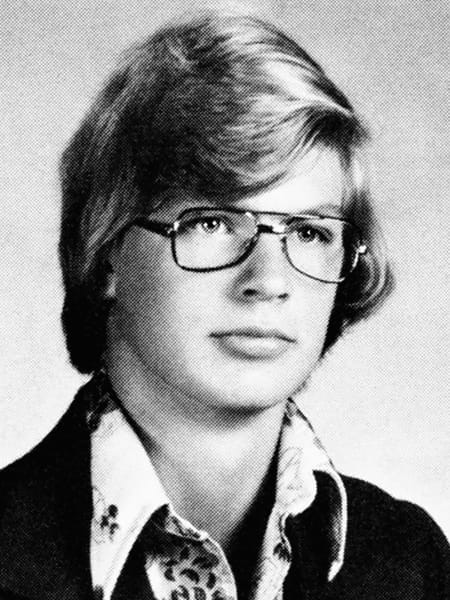
And the seemingly sweet, innocent child we’re about to introduce would one day grow into one of the most terrifying killers in American history.
On a warm day in May 1960, a baby boy was born in Milwaukee, Wisconsin. His parents — a 23-year-old chemistry student and a 24-year-old teletype machine instructor — welcomed their first child with hope and dreams for his future.
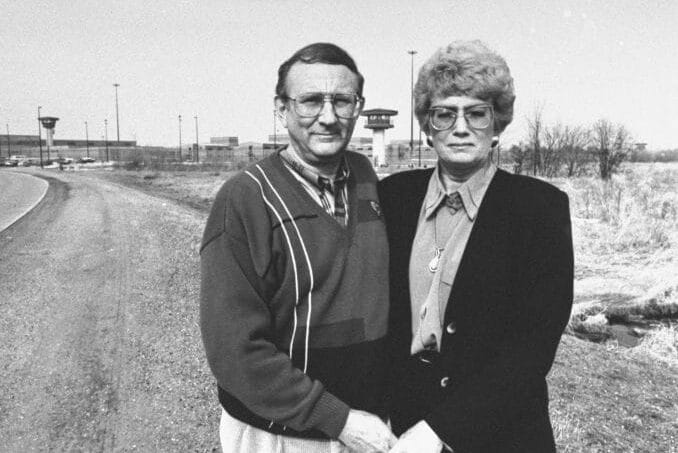
The boy’s dad and stepmother / Steve Kagan/Getty Images
By all accounts, he was a lively, cheerful boy in his earliest years, full of energy and promise. But something changed.
Shortly before his fourth birthday, he underwent double hernia surgery, and his family noticed an immediate shift in his behavior. The once-bubbly child became quiet, withdrawn, and increasingly uneasy.
Resentment toward his baby brother
By the time he started school at six, the boy was reportedly already grappling with feelings of abandonment and had begun to harbor resentment toward his baby brother. Teachers described him as timid and reserved, often sensing feelings of neglect as his father’s studies kept him away and his mother battled depression and hypochondria.
The household was tense. Arguments between his parents were frequent, and his mother even attempted suicide at least once, demanding constant attention and spending much of her time bedridden. The boy later admitted that he never felt his family was stable, never sure if his home would remain intact.
However, the thin, blonde-haired boy did have a few friends growing up.
“He was a fun kid to be around as a child,” said Ted Lee, who grew up in the same neighborhood.
But as the young man grew, a dark fascination began to emerge. Some people think it started when he was just four years old and watched his father dig up animal bones beneath their house.
The sounds of the bones sparked a strange thrill, and he became obsessed with what he called his “fiddlesticks.” He explored further, searching for bones and even dissecting live animals to study their skeletons.
When the family moved to Bath Township, Ohio, his interest intensified. He began collecting large insects and small animal skeletons in a hut near their wooded property, some preserved in jars of formaldehyde.
His father, assuming it was scientific curiosity, taught him how to clean and preserve bones, skills the boy eagerly adopted.
Escalating obsession
The obsession soon escalated. He started gathering roadkill, dissecting animals, and burying them near his hut. Sometimes, he placed skulls on makeshift crosses.
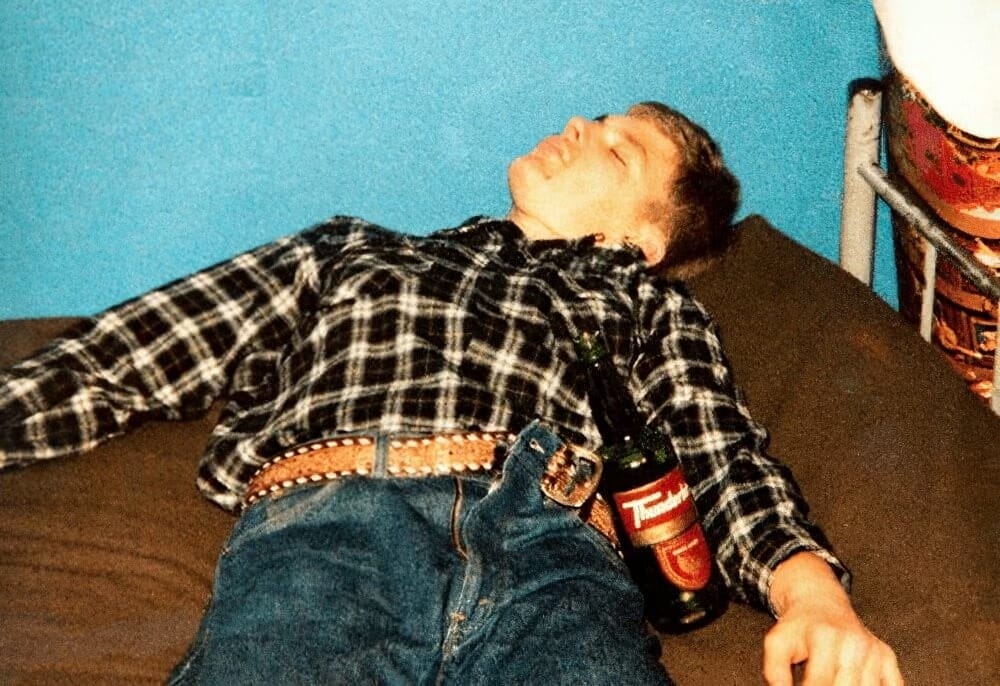
By 14, he had started drinking heavily, hiding liquor in his jacket and calling it “my medicine.” His parents’ marriage collapsed, ending in a bitter divorce. By the time he graduated in May 1978, his mother had moved out with his younger brother, leaving the 18-year-old alone in the family home.
By age 15, he had decapitated a dog, nailed its body to a tree, and impaled its skull on a stick. In high school, he became known for strange pranks, bleating and faking seizures to get attention.
For example, he began mimicking the slurred speech and awkward movements of a man with cerebral palsy who, he claimed, his mother had once hired as an interior decorator. Some dismissed it as bizarre behavior, even cruelty – but to others, especially his teenage peers who overlooked the tastelessness, he was genuinely funny. Their laughter seemed to fuel him.
He’d stumble past open classroom doors while lessons were in session, peer through windows from outside the building, or make strange bleating noises just out of the teacher’s earshot.
“He would bleat like a sheep,” recalled former friend and classmate John Backderf.
“Sometimes he did it loud. He knew it cracked us up.”
First victim
But underneath the jokes, darker compulsions were forming.
Just three weeks later, on June 18, 1978, the young man picked up a hitchhiker —and committed his first murder.
Over the next 13 years, he killed 16 more young men, dismembering some and, in horrifying cases, consuming parts of their bodies. The majority of his victims were first drugged with sedatives and then strangled to death.
His crimes also included necrophilia, cannibalism, and attempts to create compliant “zombies” by drilling into victims’ skulls and injecting acid into their brains.
Caught in 1991
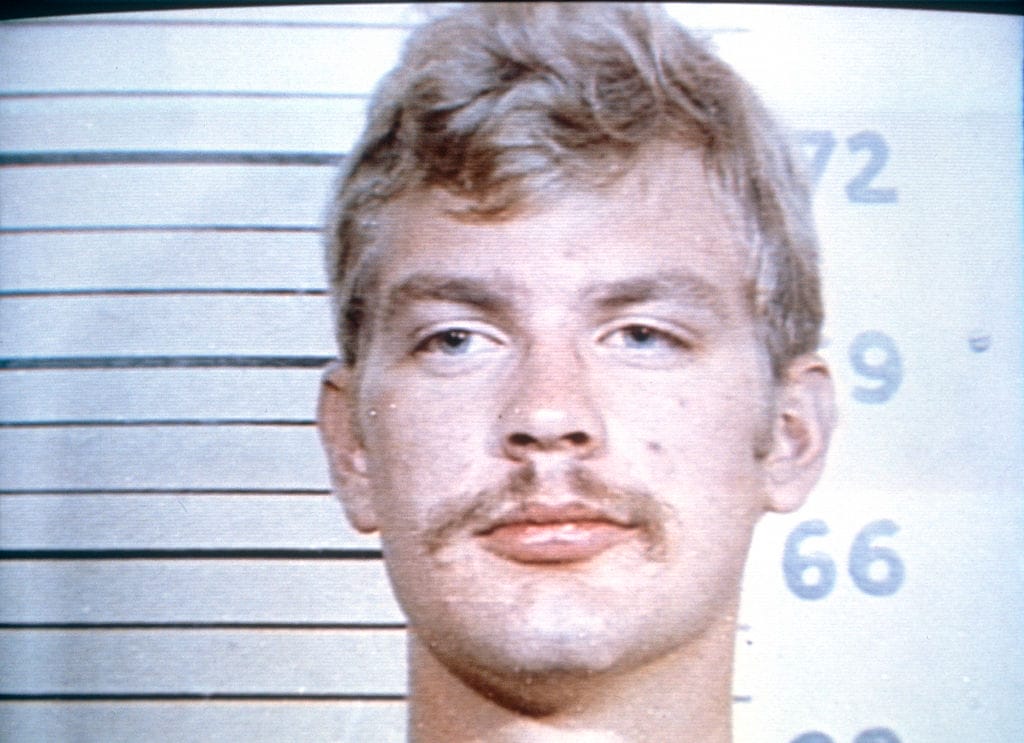
He was finally caught on July 22, 1991, when one of his intended victims escaped and led police to his apartment. Inside, authorities found photographs of dismembered bodies, severed heads in the refrigerator, and a horrifying collection of human remains.
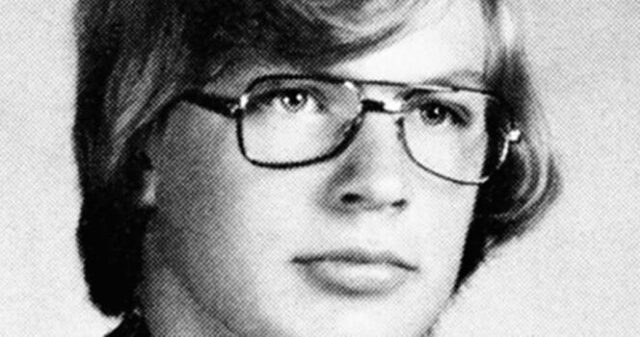
The boy who once played innocently with “fiddlesticks” had grown into Jeffrey Lionel Dahmer, the Milwaukee Cannibal, one of America’s most infamous serial killers, later chronicled in Netflix’s Monster.
Ralf-Finn Hestoft/Corbis via Getty Images
Jeffrey Dahmer met his own violent end on November 28, 1994, when beaten to death by a fellow inmate at age 34.
The inmate who killed Jeffrey Dahmer, Christopher Scarver, claimed that God told him to do it.
When news of Dahmer’s death broke, his mother, Joyce, lashed out at the media, saying, “Now is everybody happy? Now that he’s bludgeoned to death, is that good enough for everyone?”
Reactions from the victims’ families were divided. Some expressed relief, while others said the news only deepened their pain. Catherine Lacy, the mother of victim Oliver Lacy, said, “The hurt is worse now, because he’s not suffering like we are.”
The district attorney who prosecuted Dahmer urged the public not to glorify Scarver, reminding everyone that Dahmer’s killing was still an act of murder.