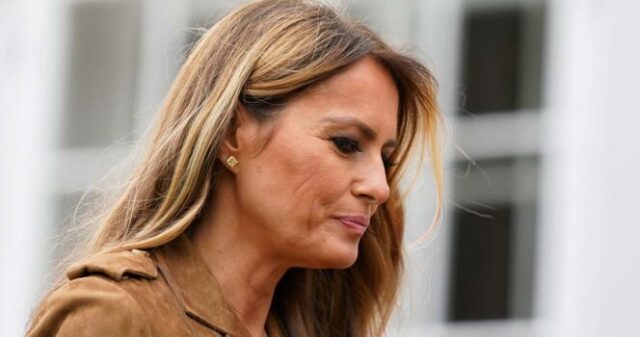
Melania Trump is continuing to keep a low profile as First Lady of the United States. However, now, she might be in for some legal trouble. Author Michael Wolff, who has written several books on Trump, is now suing Melania, calling what she did ‘harassment, intimidation and punishing.’
Author Michael Wolff has written several books on Trump. The reactions from the president and his family to the content have never been positive. It’s not only Donald Trump that the books have focused on, but Melania has also been written about several times. Soon, they might be facing each other in court.
As per AP, Michael Wolff has sued Melania Trump after he claims she threatened to sue him for $1 billion in damages if he didn’t withdraw and retract the Jeffrey Epstein-related statements he recently made about the first lady.
The statements were made by Wolff to The Daily Beast earlier this year, with a story whose headline read, “Melania Trump ‘Very Involved’ in Epstein Scandal: Author.” Wolff also appeared on a podcast talking about Melania’s links to Epstein.
The Daily Beast later retracted the original article, adding an editor’s note which read, “Upon reflection, we have determined that the article did not meet our standards and has therefore been removed from our platforms.”
On October 15, Melania’s lawyer, Alejandro Brito, wrote that she was “left with no alternative” but to sue for $1 billion as the statements had caused her “overwhelming reputational and financial harm.”
Melania Trump sued
Meanwhile, Wolff’s lawsuit against Melania claims the article was taken out of context, and he maintains he has not defamed Trump.
The author stated that he intended to use the legal action to put the President and First Lady of the United States under oath to answer questions about Epstein.
The lawsuit was filed Tuesday in the state Supreme Court in Manhattan as Wolff seeks unspecified damages. He claims Melania was shutting down questions relating to her and Jeffrey Epstein.
Wolff said Donald and Melania “have made a practice of threatening those who speak against them” using costly legal actions “to silence their speech, to intimidate their critics generally, and to extract unjustified payments and North Korean style confessions and apologies.”
In a statement, Nicolas Clemens, a spokesperson for Melania said, Nicholas Clemens, a spokesperson for Melania Trump, issued a statement, saying: “First Lady Melania Trump is proud to continue standing up to those who spread malicious and defamatory falsehoods as they desperately try to get undeserved attention and money from their unlawful conduct.”
What do you think of this? Please give us your opinion in the comment section on Facebook!
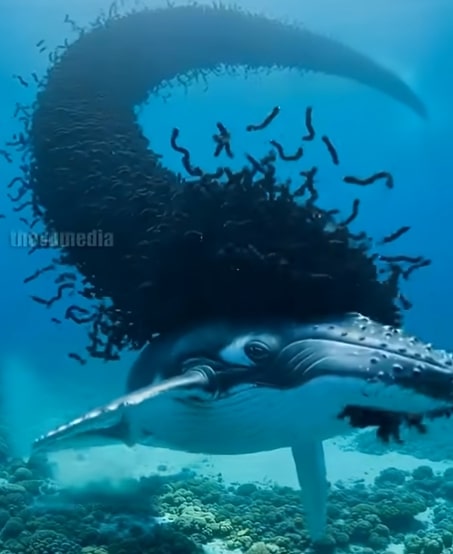
In a dramatic turn of events that stunned beachgoers and left millions emotional online, a majestic whale washed ashore completely covered in thousands of blood-sucking leeches. Its once smooth blue skin had turned dark and rough, swarmed by parasitic invaders that left it weak, motionless, and barely breathing.
The ocean giant, normally a symbol of strength and freedom, lay helpless as the sea waves lapped against its body—calling silently for help. What happened next would become one of the most unforgettable rescue missions ever witnessed by humankind.
As the distressed whale beached itself in search of relief, a nearby wildlife response team mobilized with incredible speed. People ran from every direction—rescue workers, marine biologists, coast guards, and volunteers—forming a human chain of hope. The scene was heartbreaking: the whale’s eyes flickered with exhaustion, and its massive tail barely moved. The parasites had drained its strength, feeding rapidly and multiplying across its body. But humanity refused to stay silent.
The Moment Hope Arrived
Rescuers began to gently wash the whale with a special ocean-safe treatment, designed to weaken the parasites without harming the animal. Thousands of leeches began slipping from its skin, falling into the sand like black rain. The task was exhausting—each section of the whale’s body had to be scrubbed, medicated, and rinsed, while others continuously poured cool seawater to keep the whale alive. The crowd stood silent, some praying, others crying, as the rescue unfolded.
Every minute counted. Experts warned that if the whale’s body overheated or the infestation reached its heart, it would be too late. But the heroic team never gave up. Even when waves threatened to push the whale further ashore, they formed barriers and used straps to slowly reposition the mammal toward the sea.
A Powerful Connection Between Humans and Nature
What made this rescue even more emotional was the gentle way the whale responded to help—its eye followed the rescuers as if understanding they were fighting to save its life. With every parasite removed, its breathing grew stronger. The once darkened skin began to shimmer with natural blue-gray tones again. The moment the rescue team called out, “It’s ready!” the entire beach erupted in applause.
With coordinated effort, large flotation belts were placed under the whale, and people pushed against the powerful current. For a brief moment, nothing happened… then suddenly, the whale’s tail lifted. In an awe-inspiring display of life overcoming death, the giant creature propelled itself forward and began to swim.
The beach shook with cheers. People raised their hands in tears as the whale breached the surface one last time—sending a splash of water into the air—a gesture many believe was the whale’s way of saying thank you.
A Message the World Needs to Hear
Not only did this rescue save one life, it sparked a global conversation about ocean pollution and how human negligence allows harmful parasites and waste to thrive. Marine experts have now issued a call for worldwide action to protect our oceans from contamination. The heroic rescue proved one powerful truth: when humans stand together to protect nature, miracles happen.
This whale’s survival became a symbol of hope. It reminded the world that every creature—no matter how big or small—deserves a chance to live free from suffering. What began as a tragedy ended in triumph, and millions online now recognize this moment as one of the greatest wildlife rescues of our time.
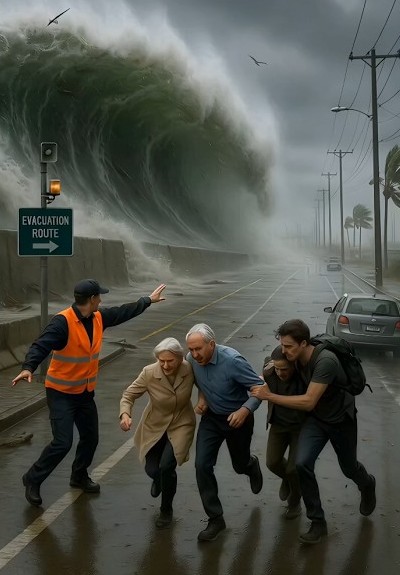
it’s rare to witness a moment where nature becomes both the destroyer and the savior. This is the astonishing true story of a dedicated safety officer who risked his life to guide civilians to safety during a catastrophic tsunami—only to be saved by one of nature’s most powerful creatures in a moment that defies explanation.
The Day the Ocean Turned Violent
As towering tsunami waves—some estimated over 50 feet—rushed toward the coastline, chaos erupted across the evacuation route. Cars were abandoned, alarms blared, and terrified families ran for higher ground. Leading them was a safety officer in an orange vest, shouting directions and refusing to leave until every last civilian was accounted for.
He helped elderly citizens, supported injured travelers, and directed stranded motorists out of harm’s way. According to eyewitnesses, he was “the last man remaining on the road,” ensuring no one was left behind.
But when the final wave surged forward, there was no time left to escape.
The Moment of Impact
A monstrous wall of water struck with unimaginable force. The safety officer was swept completely off his feet, engulfed in the churning flood. Waves crashed around him as he clung to a palm tree, struggling against the current. Rescue operations could not reach him, and helicopters had already been grounded due to wind speeds.
The water level rose, and his grip began to fail.
All hope seemed lost.
Then Came the Miracle
Through the roar of the waves, a piercing cry echoed across the sky. A massive bald eagle—symbol of strength and freedom—swooped down. In what witnesses called “a divine intervention,” the eagle locked its talons into the officer’s safety vest, lifting him upward with astonishing power.
In disbelief, onlookers watched as the eagle, wings spread nearly eight feet wide, carried the exhausted man above the raging floodwaters. The bird flew him across the devastated town and landed safely on the rooftop of a nearby building surrounded by water. Moments later, the eagle spread its wings and vanished into the stormy sky.
A Rescue Beyond Logic
Experts are calling this one of the most mysterious survival stories ever recorded. While birds of prey are known for strength, to rescue a full-grown human in life-threatening conditions is beyond natural explanation.
“Whether it was nature, divine power, or pure miracle—something extraordinary happened,” said one emergency responder.
The Man Who Refused to Give Up
The safety officer, now recovering, shared a message with the world:
“I was ready to face my fate. I didn’t expect to survive. I only thought about making sure others lived. And then… nature saved me.”
Social media platforms have erupted with the story. Millions are calling it “the miracle of the tsunami,” with many believing the eagle was sent as a guardian or protector.
Why This Story Matters
Amid disasters and loss, this remarkable event reminds us:
Humanity still stands strong when we put others first.
Heroes walk among us—ordinary people who make extraordinary sacrifices.
Nature has its own mysteries, and sometimes its own way of protecting those who protect others.
The safety officer is being honored for his bravery. Local authorities say hundreds owe their lives to his calm leadership and refusal to abandon his post.
A Symbol of Hope
In a time when headlines are filled with tragedy, this story offers something different: hope. It shows that even in our darkest moments, miracles can happen in the most unexpected ways. Whether you view it as fate, nature, or divine power, there’s no denying this was a moment beyond ordinary reality—a moment that will be remembered for generations.
From ancient legends to modern films, stories about the healing power of love have captured human hearts across generations. Yet sometimes, these stories are not just fiction—they are real. One of the most emotional and medically groundbreaking events occurred in 1995 in a neonatal intensive care unit (NICU) in the United States, where a dying premature baby was saved not by advanced machines, but by the loving touch of her twin sister.
Paul Jackson and his wife welcomed twin daughters, Brielle and Kyrie, 12 weeks prematurely at UMass Memorial Hospital. Each baby weighed only two pounds, and their survival was far from guaranteed. Doctors warned the parents that the first 78 hours were critical, and even if the babies made it past that stage, their health could change without warning.
At three weeks old, baby Brielle began to deteriorate rapidly. Her heart rate spiked, her oxygen levels dropped dangerously low, and her tiny body started turning blue. Medical staff feared the worst. Despite every technological intervention, nothing seemed to calm her failing body.
That is when NICU nurse Gayle Kasparian made a bold and unprecedented decision—one that would change neonatal medicine forever. She suggested placing Brielle in the same incubator as her stronger twin sister, Kyrie, a practice known internationally as Kangaroo Care but never before attempted in the United States for infants in critical condition.
What happened next left everyone in the room speechless.
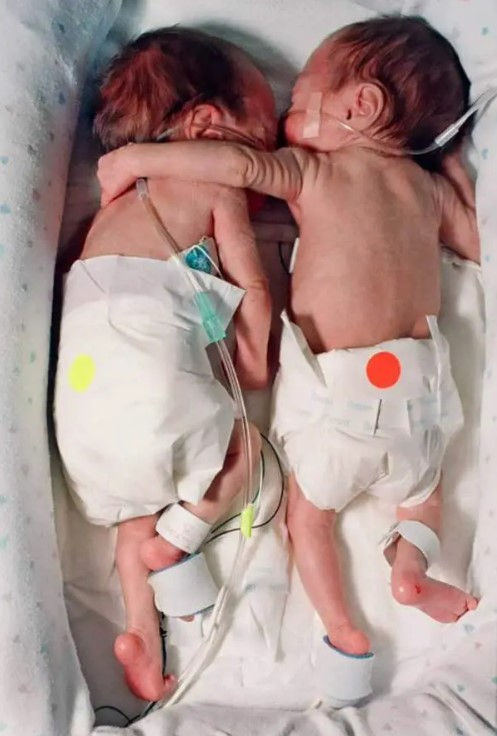
As soon as baby Kyrie was placed beside her sister, she instinctively reached out and wrapped her tiny arm around Brielle. This gentle touch—later called the rescuing hug—had an immediate effect. Brielle’s heart rate stabilized, her breathing became steady, and her skin color returned to normal. It was as though her sister’s touch reminded her that she was not alone, giving her the strength to survive.
Dr. Stuart Weisberger of UMass Memorial later stated that this moment transformed neonatal care practices in the country. Before this event, twins and triplets were routinely kept in separate incubators. After this powerful demonstration of the life-saving impact of physical closeness, hospitals across the United States began adopting skin-to-skin twin care to help regulate premature babies’ vital signs.
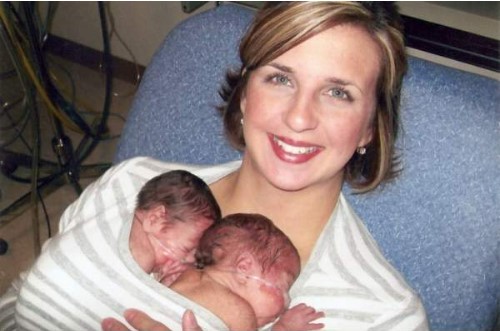
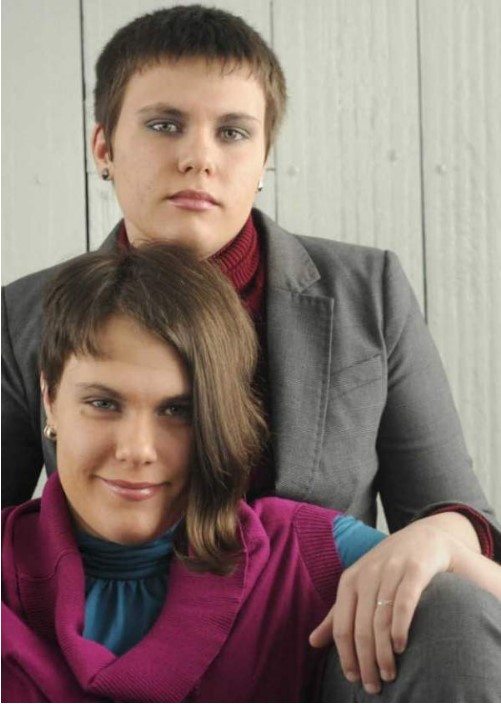
Today, Brielle and Kyrie are healthy young adults, deeply bonded by the miracle that saved one of their lives. They share a connection that goes beyond sibling love—a living example of how human touch can heal in ways medicine cannot always explain.
This real-life miracle reminds us that sometimes, the greatest healing power lies not in machines or medicine, but in the simple, powerful act of love.
In a quiet Indiana neighborhood, a story of love, sacrifice, and community unfolded that touched hearts nationwide.
James “Pops” Carter, a 68-year-old Black Vietnam veteran, was well-known in his town for his kindness and resilience. Among his prized possessions was a gleaming black Harley-Davidson motorcycle — a symbol of freedom and independence he had earned after years of service and hard work. He affectionately called it “The Freedom Machine.”
Life, however, had a harsh test in store. When his seven-year-old granddaughter, Mia, was diagnosed with a rare autoimmune condition, medical bills quickly became overwhelming. Insurance only covered part of her care, and James faced a heartbreaking choice: keep his cherished Harley or secure the treatment his granddaughter desperately needed.
Without hesitation, he made the decision. “I didn’t even think twice,” James said. “She’s my heart. That bike can be replaced. She can’t.”
Selling his beloved motorcycle was an act of pure love — one that would soon inspire a wave of kindness beyond anything he could imagine.
News of James’s sacrifice spread through the local biker community, eventually reaching one of America’s most notorious biker groups: the Hell’s Angels. Known for their rebellious image, few expected what they would do next.
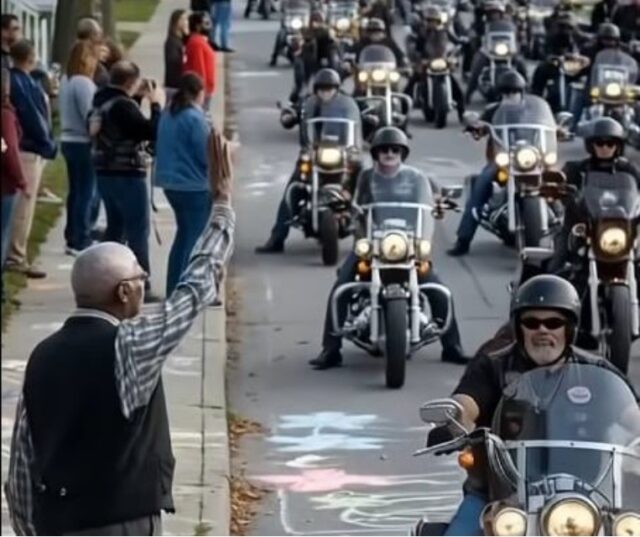
One Saturday morning, the roar of over a hundred Harley-Davidsons echoed down James’s street. Neighbors peeked from their windows, worried something had gone wrong. But instead, the bikers arrived with a message of solidarity. Leading the pack was a Hell’s Angels member holding a brand-new set of keys.
They presented James with a fully paid Harley-Davidson and a check covering Mia’s next year of medical expenses. Their simple but powerful message resonated: “No veteran should ever have to choose between family and freedom.”
Overwhelmed, James broke down in tears. “I didn’t expect this,” he said. “I’m just an old man trying to take care of his family. But this… this is brotherhood.”
The story quickly spread across social media, inspiring thousands. It wasn’t just about a motorcycle or the Hell’s Angels — it was a reminder that acts of compassion transcend color, age, and reputation.
James “Pops” Carter’s story shows that one act of selfless love can ignite a chain reaction of hope, proving that humanity still rides strong in the hearts of those willing to step up for others.
Sometimes, it takes a small gesture to create a movement of kindness.
In Boston, a seemingly ordinary day turned into a cautionary tale about responsibility and accountability for pet owners. The case centered around Leticia Jenkins and her dog, Jaylen, whose peaceful walk near a neighbor’s home ended with a sudden, unexpected attack.
On December 16th, around 6 PM, Jenkins and her young son were strolling down a quiet neighborhood sidewalk. Everything seemed normal until Ginger, the dog belonging to their neighbor Patricia Saunders, ran up to Jaylen.
According to Jenkins, Ginger bit Jaylen on the neck and eye without any provocation, causing visible injuries. The sudden attack left Jenkins alarmed and anxious, especially as her son watched helplessly. Concerned for Jaylen’s safety, Jenkins immediately rushed him to a veterinarian, incurring a bill of $653.
The incident didn’t just cause physical harm—it also brought emotional distress. Witnessing a beloved pet being attacked can be traumatic, particularly for children, and Jenkins knew she needed to take action. She decided to file a lawsuit against Patricia Saunders, holding her responsible for the attack and the resulting veterinary expenses.
In court, Saunders defended herself by claiming that Ginger was not aggressive and that the attack was an unfortunate accident. She suggested that Jaylen’s behavior might have triggered Ginger’s reaction, despite admitting that the dogs were previously unfamiliar with each other. Saunders also expressed doubts about the necessity and cost of the veterinary treatment.
Despite these defenses, Judge Marilyn Milian carefully examined the evidence. She noted that pet owners have a legal obligation to ensure their animals do not pose a threat to others, especially in public spaces. The court ultimately ruled in favor of Jenkins, recognizing that Jaylen’s injuries were serious and warranted medical attention. Saunders was ordered to pay the full $653 for veterinary expenses.
This case serves as a significant reminder for all pet owners. Even dogs that seem calm or friendly in private settings can act unpredictably in public. Leash laws, proper supervision, and preventative measures are not just formalities—they are crucial steps to keep the community safe and avoid potential legal consequences. Pet insurance can also play a key role in mitigating the financial burden when such incidents occur.
Moreover, the case highlights the broader lessons of responsibility and accountability. It demonstrates that actions—or inactions—can have lasting consequences and that legal systems can offer protection and remedies for victims. For the Jenkins family, the ruling ensured Jaylen received necessary care and reinforced the principle that pet owners must remain vigilant and responsible at all times.
The Boston dog bite case quickly gained attention across social media and local news outlets. While the story may seem like a simple incident, it resonates deeply because it involves not only the welfare of a pet but also the emotional well-being of a child and the ethical duty of a neighbor.
Ultimately, this incident reminds all pet owners and members of the community that vigilance, precaution, and accountability are essential. Responsible pet ownership is not merely a recommendation—it is a duty. Leticia Jenkins’ proactive actions ensured her dog received proper care, highlighted the legal responsibilities of pet owners, and sparked conversations about public safety and awareness.
In the end, the Boston dog bite case stands as a modern example of how responsibility, law, and compassion intersect in everyday life, showing that sometimes even ordinary walks can teach extraordinary lessons about accountability, care, and respect for others.
It was a calm autumn afternoon in the countryside. The golden light of the setting sun stretched across the open fields, where farmers worked peacefully, finishing the day’s harvest. The hum of tractors mixed with the soft chirping of birds, and the scent of fresh soil filled the air.
The Sudden Panic
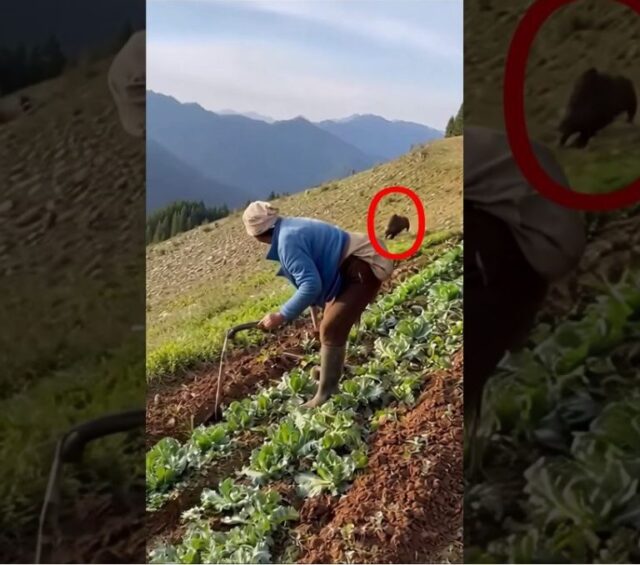
For a moment, everyone froze. Wild boars were known to roam the forest nearby, but they rarely came this close to people. This one, however, looked panicked — its thick black fur bristling, eyes wide, tusks gleaming in the sunlight.
The workers dropped their tools and scattered. One young man, Eli, stood frozen near the edge of the tractor. He had never seen such raw power before. The animal’s hooves pounded the ground, leaving deep marks in the soil as it came straight toward him.
The Moment of Decision
As Eli reached the trailer, he made a split-second choice. Instead of trying to climb it, he darted behind it, crouching low. The boar thundered past, missing him by inches, crashing into the wooden side with a loud crack.
By now, the other workers had found their courage. Two men shouted from across the field, waving their jackets and sticks, trying to draw the animal’s attention away. A third man jumped into the tractor, revving the engine loudly. The sound startled the boar, which turned toward the noise instead of Eli.
The Boar’s Fury
Wild boars are unpredictable. When they panic, they often don’t know where to run — and that makes them even more dangerous. This one began to circle the field, grunting and pawing at the ground. Dust rose around it in clouds.
For several tense minutes, nobody dared move. The animal’s breathing was heavy, its flanks heaving. Then, suddenly, it made another charge — not at the people this time, but toward the tractor. The driver quickly backed away, the engine roaring, keeping a safe distance.
Understanding the Wild Boar’s Behavior
Later, when experts were called to check the area, they explained that wild boars often wander into open fields when searching for food — especially during harvest season when crops are plentiful. However, if they feel cornered or threatened, they will charge to defend themselves or their offspring.
In this case, tracks near the edge of the forest suggested there were two smaller boars that had run off earlier — likely the mother’s young. The adult had charged into the field not out of aggression, but out of fear and instinct to protect them.
A Lesson in Respect
That day became a local legend in the village. People talked about the “charging boar” that had startled an entire construction crew but hurt no one. Yet beneath the laughter and storytelling, there was a deeper lesson.
Conclusion: The Day the Field Roared
The question “What if a wild boar charges from the field?” is no longer just a warning — it’s a reminder. It reminds us that the line between human and wild is thinner than we think, and that every living being, when cornered, deserves understanding, not hatred.
For Eli and his team, the day the field roared was a day they learned both fear and respect — a moment when man and beast met in chaos, and both walked away alive.
The sky was painted in gray, and the first drops of rain began to fall over the quiet outskirts of a small town named Millfield. Most people had already rushed indoors, closing their windows tightly against the growing storm. But on the edge of the town, in a small, weathered wooden house surrounded by fields, one old man was still outside Mr. Thomas Hale, a 72-year-old retired schoolteacher who lived alone with his memories and his garden.
A Heart Too Kind to Ignore
The dogs hesitated, trembling from the cold. But the gentle tone of his voice, the warmth in his eyes, and the small pieces of bread he held in his palm drew them closer. One by one, they crept toward him a small brown puppy, a white mixed breed with a limp, and an older black dog that looked like it had been protecting the others.
The Long Night of Compassion
The rain poured all night. The sound of it hitting the tin roof was almost deafening. Inside, Thomas sat on the floor beside the three dogs, gently drying their fur with an old towel and speaking to them as if they were old friends.
The brown puppy fell asleep first, curled up on his lap. The white dog leaned against the old man’s leg, sighing softly, while the black one lay near the door, still alert but slowly closing its eyes.
A Mission of Mercy
Over the next few days, Thomas took care of the dogs as best as he could. He made them a small shelter beside his garden, fed them warm soup and bread, and talked to them every morning as he watered his plants.
When neighbors passed by, they would smile at the sight the old man walking down the muddy path with three loyal dogs following him in perfect harmony.
Word spread quickly through the town about what he had done. Children began visiting him after school, bringing old blankets, leftover food, and medicine for the dogs. A local veterinarian offered to check them for free.
The Reporter’s Visit
One afternoon, a young reporter from the local newspaper knocked on Thomas’s door. She wanted to feature his story the old man who saved dogs in the rain.
The reporter published his story with the title: “The Man Who Sheltered Hope in the Rain.” It went viral across social media, inspiring people to rescue stray animals, donate to shelters, and adopt instead of buying pets.
A Legacy of Kindness
Years later, when Thomas passed away peacefully in his sleep, the townspeople built a small wooden sign near his home. It read:
“In memory of Thomas Hale — who taught us that love has no limits.”
The three dogs were adopted together by a young family who had once brought him food. They still live in that same village, where children often point to them and say, “Those were Mr. Hale’s dogs the ones he saved from the rain.”
And every time the rain falls in Millfield, people remember him not as a hero in shining armor, but as a kind old man who saw suffering and decided to do something about it.
The Billionaire’s Secret: A Widow’s Discovery on a Rainy Day Unearths a Hidden Family and a Shocking Betrayal
Once upon a time in the heart of Victoria Island, there lived a woman named Amora Oronquo. She was the kind of woman people stopped to stare at when she walked into a room. Not just because she was beautiful, but because she carried herself like a queen. Tall, light-skinned, with sharp cheekbones and eyes that never smiled.
Amora always wore designer clothes and never repeated an outfit twice. She lived in a white mansion surrounded by guards, flowers, and a tall black gate that never opened for strangers. People said she was heartless. They said she had no family, no friends, no one she trusted, just money. And they were right.
Amora was alone. Her husband had died 3 years ago, and they never had children. Since then, she worked, traveled, and came home to silence. That was her life. but that life was about to change. All because of one rainy afternoon. The sky had turned dark that Thursday. Thick gray clouds covered the sun.
Rain started to fall slowly at first, then heavier and louder. The sound of thunder rumbled far away like an angry drum. Amora sat in the back seat of her black Range Rover. Her driver, Caru, was moving slowly through traffic. He glanced at the rear view mirror.
Madam, should I take the ley shortcut? This traffic might hold us till night. Amora didn’t answer at first. She was staring at her phone. A message had just come in from the board. Meeting rescheduled to 5:00 p.m. Please confirm. She sighed and put the phone down. Go through Ozamba. I don’t care if it takes 2 hours. Yes, ma. Caru said and turned the steering wheel.
Outside, the rain splashed hard against the windshield. On the sidewalks, people were running, trying to find shade. Some had umbrellas. Most didn’t. Cars honked. Street vendors shouted. Everyone looked like they were trying to escape something. Then the car stopped. A red traffic light ahead blinked. The wipers moved back and forth. Caru was about to comment on the jam when Amora raised her hand slightly.
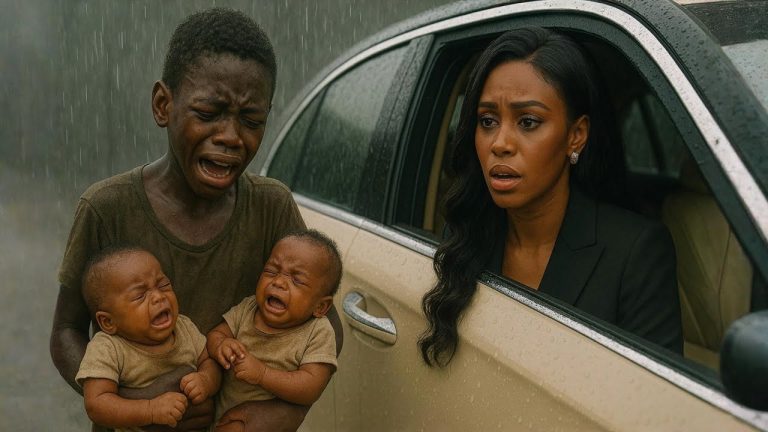
“What’s that?” she said, squinting through the window. Carl looked too. What’s what, Mau? There, near that pole. That boy. Carl turned and saw a skinny boy, maybe 12 years old, barefoot and shaking, holding two small babies, one in each arm. The babies were wrapped in what looked like nylon bags. Their clothes were soaked.
Their cries were faint but sharp, even through the glass. The boy was standing in the middle of the road divider, his head bent as rain poured down on all three of them. Caru frowned. They’re always doing this begging trick. Ma, some of them even rent babies. But Amora wasn’t listening. Her eyes were fixed on the baby’s faces. Something about them made her chest feel tight.
She leaned forward as if getting a closer look would explain what her brain couldn’t. She whispered, “Those eyes.” The left twin lifted her face briefly. Her eyes were hazel, the same rare light brown color as her late husband’s. It couldn’t be, Amora thought. She blinked. Maybe it was the rain or the street lights or her mind playing games.
But then the second baby looked up and the same eyes stared back. Her heart jumped. Stop the car, Amorus said quickly. Caru looked confused. Mow. I said, “Stop the car now.” The driver hit the brake and parked by the curb. Amora opened the door and stepped into the rain, ignoring the water that hit her face and soaked her designer dress.
Her heels sank into the muddy ground, but she didn’t care. Carl quickly followed her with an umbrella. “Madam, you’ll catch cold, please.” But Amora was already walking fast straight toward the boy. When she reached him, the boy looked up, his face full of fear and surprise. He didn’t speak. “Who are you?” Amora asked, her voice firm.
He looked down at the babies again, then back at her. “I’m I’m Toby.” She crouched slightly, eyes on the twins. “They are yours.” “Yes,” he said, tightening his grip. “They are mine.” She raised her eyebrows. your sisters. He hesitated. No, my daughters. Amora stepped back slightly. You’re what? He nodded slowly. I’m their father.
Amora stared at him, unsure whether to be angry, shocked, or confused. You’re 12. I’m 13, he said quickly. She shook her head. And where is their mother? He looked away. She died when they were born. The rain kept pouring. The babies shivered. One of them began to cry again, weak and horsearo. Amora’s lips parted, but she didn’t know what else to say.
The boy was clearly lying about something, or maybe everything, but the way he cradled the twins, it didn’t feel like a trick. He didn’t ask for money. He didn’t stretch his hand. He didn’t even move. Amora took a deep breath and looked back at her car. The wipers were still moving. Caru was still holding the umbrella behind her. She turned to him. Bring them in. Ma.
I said, “Carry them into the car.” Caru stood frozen. Amora snapped. You want me to repeat myself in Igbo. No, Ma. Caru stepped forward quickly. Toby looked scared and stepped back. Please don’t take them. Amora raised her hand gently. We’re not taking them from you. You’re coming with us. I don’t want to go to police.
No police, she said, eyes soft. I promise. Toby hesitated. Then slowly, carefully, he followed her to the car. Inside the Range Rover, the heat was turned on. The twins were wrapped in a Morris scarf and one of her shaws. They stopped crying. Toby sat stiffly, water dripping from his hair, eyes darting around like a trapped animal. Caru drove slowly.
Amora didn’t speak much. She just stared at the babies, their hazel eyes closed now, tiny chests rising and falling. She didn’t know what this meant yet. But she knew one thing for sure. This was not a mistake. Something had brought her to them, and she was going to find out why. The car was quiet.
Only the sound of the rain hitting the roof and the gentle hum of the air conditioner filled the space. Amora sat stiffly, her eyes glued to the two babies lying on her lap, wrapped tightly in her soft cashmre scarf. They were asleep now. Their small faces were peaceful, but their skin was cold. She could still feel how weak their bodies were when she carried them into the car.
Toby sat at the edge of the back seat, his hands folded, wet clothes clinging to his thin body. His eyes kept bouncing around the car, from the expensive leather seats to the glowing dashboard lights. He looked nervous, like a child who had entered a palace he had no right to be in. Amora glanced at him, but she said nothing. She didn’t know what to say.
Her heart felt heavy, but her mind was moving fast, too fast. Questions kept piling up in her head, one after another. Who was this boy? Where was he from? How did he end up with twin babies in the rain? And most of all, why did they have her husband’s eyes? The car turned into her estate.
The long curving driveway led to a giant white mansion surrounded by tall palm trees and a wide fence. The gate opened slowly as the security guard recognized the car. Toby’s mouth dropped slightly. He stared at the big house like it was a movie. “You live here?” he finally asked, his voice quiet. Amora didn’t answer. She was still staring out the window.
When the car stopped at the entrance, two uniformed workers ran out with umbrellas. One of them opened Amora’s door. Another reached to carry the babies, but she pulled back quickly. “Don’t touch them,” she said. The worker stepped aside, confused. Amora stepped out carefully, holding the babies to her chest. Her heels clicked against the wet tiles. Toby stepped out slowly, too.
He wiped his feet on the mat like he didn’t want to stain anything. Caru stood by the door, whispering something to one of the guards. The look on his face showed confusion and worry. Inside the house, the lights were warm. The smell of lemons polish filled the air. A giant chandelier hung above the marble floor and soft music was playing from hidden speakers. Toby stopped at the door. He looked down at his muddy feet.
Amora turned around. What is it? He looked up. I’m dirty. She stared at him for a second. Then she walked back and opened a nearby cabinet. She brought out a towel. Step in. He obeyed. She handed him the towel. Wipe your feet. He bent down quickly and did as she said. Then she called out, “Noy.”
A woman in a green housekeeper uniform rushed in. “Yes, madam.
Get a warm bowl of water and tell Dr. Martins to come immediately.
Toby watched everything quietly. His eyes scanned the ceiling, the painting on the wall, the gold trimmings on the staircase. He had never seen anything like this before.
Amore walked to the living room and gently placed the babies on a soft white couch. She took off her scarf and used it to dry their faces again. One of them stirred and let out a small cry. Toby ran over. “Is she okay?” he asked.
Amora looked at him. “You know which one is which?”
He nodded. “That’s Chidma. The other one is Chisum.”
She blinked slowly.
“Chidenma and Chisum,” she repeated as if testing how the names sounded in her mouth. “You named them?”
“Yes,” he said, rubbing his hands nervously.
Amora stared at the babies again. She didn’t know why she brought them here. It had happened so fast. One moment she was heading to a meeting. The next she was cradling twin babies that didn’t belong to her.
Or maybe somehow they did. Her heart didn’t want to believe it. But her eyes couldn’t forget what they saw. Those hazel eyes. Those rare golden brown eyes. Her late husband had them. And now so did these babies. A few minutes later, a middle-aged man in a white coat walked in with a black medical bag.
“Good evening, madam,” he said, bowing slightly.
“Doctor, thank you for coming quickly,” Amora said, standing. “Please check them. They’ve been under the rain.”
The doctor bent over the babies, placed his hand gently on their foreheads, and began his checkup. Toby stood at the corner, watching silently. After 10 minutes, the doctor looked up. They are cold.
Their breathing is shallow, but there’s no chest congestion yet. We’ll need to warm them fast and give them fluids. They’re very weak, probably from hunger.
Are they safe? Amora asked.
They are stable for now, but they need rest, milk, and close care.
Amora nodded. Do what you need to do.
As the doctor set up a small drip bag for each child, Amora turned to Toby. Have they been eating?
He nodded slowly. I try to feed them everyday, but it’s hard.
What do you give them?
Sometimes pap, sometimes soaked bread. If I get money, I buy milk, but most days I don’t get anything.
She stared at him. Where do you live?
Toby lowered his head.
I sleep at the back of the church under the wooden shed.
She blinked slowly. Just you and the babies?
Yes.
How long?
Since Chidimmer and Chisum were born. And before that, we stayed in a woman’s kiosk. But she sent us away after my mommy died.
Amora pressed her lips tightly. She didn’t like the way her chest felt. It was tight, like someone had placed a heavy stone there.
Who was your mother?
Her name was Adessa. She was a teacher.
And your father?
Toby hesitated. I…….I don’t know much. He used to visit sometimes. Not always. Just once in a while.
Amora’s breath caught. Her eyes locked on his. What did he look like?
Toby looked confused. I don’t know. I was small. I just remember his eyes.
What about them?
They looked like like theirs.
He pointed to the twins. Amora didn’t answer. She turned her face away quickly.
That night, the babies were placed in one of the guest rooms. In a clean, soft cribora staff brought down from storage. The heater was turned on. Warm blankets covered them. Toby was given a warm bath and a new change of clothes. An old outfit from one of the gardener’s boys.
He ate rice and stew like someone who hadn’t seen food in days. Then he fell asleep on a small couch near the baby’s room, arms folded around himself. But Amora didn’t sleep. She stood by the window in her bedroom, watching the rain fall on the garden below. She kept thinking about Dyke, her late husband. They had been married for 10 years, 10 whole years. He told her he loved her.
He told her they were in this together. He told her it didn’t matter that they couldn’t have children, that they would travel, grow old together, be happy. But he lied. If these children were his, if that boy was telling the truth, then Dyke had betrayed her in the worst way, and he was not even alive to explain.
At midnight, Amora opened her drawer. She brought out an old photo album, the one she hadn’t touched in years. She flipped through it slowly. There he was. Dyke Kungquo smiling beside her at their wedding. Strong, tall, handsome, with those same hazel eyes. Eyes she used to fall in love with.
Eyes she now saw in twin baby girls. Her hand trembled as she closed the album. She sat down on the bed, her face buried in her palms.
I need to be sure, she whispered. She stood up, picked her phone, and dialed Dr. Martins again. He answered sleepily.
Doctor, I need a DNA test. He sat up quickly.
Madam, I want you to run a DNA test on those babies. Compare them with Dyke’s sample in the records. The one we submitted when doing his autopsy.
Okay.
Yes, I remember. We have it on file.
Good. Start tomorrow.
All right. Ma, are you are you okay?
She didn’t answer that. She ended the call and stood still in the dark. She had just taken the first step.
And deep down she knew the truth was coming. Whether she liked it or not, morning came slowly. The rain had stopped, but the sky was still gray. The house was quiet. A calm kind of quiet that made you feel like something big was coming. Amora sat alone at the long dining table. She wasn’t eating. A plate of untouched toast and eggs sat in front of her.
Her fingers were locked together tightly. Her phone was beside her, face down. She kept staring at the table, but her mind was far away. Last night, she had ordered a DNA test. This morning, she was waiting for the doctor to collect the samples. She hadn’t told anyone, not even the boy. She wanted to be sure first. She needed proof before she even allowed her heart to feel anything.
But the truth was her heart had already started to feel things and that scared her. Footsteps came from the hallway. She looked up. Toby entered the dining room holding a baby in each arm. He was barefoot, still wearing the oversized shirt they gave him last night.
The twins looked much better, clean, dry, and quiet. One of them was sucking her thumb. The other had her head resting on Toby’s shoulder.
Good morning, Ma. He said softly. Amora gave a small nod.
Sit, she said. He moved slowly and sat at the far end of the table. He didn’t reach for the food. You can eat, she said, her voice low.
There’s more in the kitchen. He looked unsure. “Go ahead,” she added. He placed the babies in a blanket on the floor beside his chair and began eating slowly, not rushing like before. He was learning to behave like he didn’t expect the food to disappear. Amora watched him closely.
He ate with both hands, breaking the bread into small bits before putting it in his mouth. He fed one of the babies a few drops of water from a spoon. He didn’t speak unless spoken to, but he didn’t look scared anymore either.
“Are they always this calm?” she asked after a moment.
He nodded. “Yes, if I feed them and hold them close, they don’t cry.”
She looked at him carefully. You said their names are Chidma and Chisum, right?
Yes. Ma,
How old are they?
7 months.
She frowned a bit. And you’re 13.
Yes.
Amora paused. You’re too young to be their father.
He didn’t answer. She leaned forward. Toby, tell me the truth. Did your mother have them before she died?
He blinked quickly. Yes.
So, you’re their brother, not their father.
He looked down. Yes.
She folded her arms. Why did you lie?
He didn’t speak for a long time. Then he said, “People don’t help if you say you’re just a brother. But when I say I’m their father, they listen.”
Amora let out a slow breath. “I don’t like lies,” she said.
“I’m sorry.”
There was silence between them. Then Amora stood. Finish eating. Dr. Martins will be here soon.I want him to check the twins again. He nodded but didn’t look up. An hour later, Dr. Martins arrived with a small black case. He greeted Amora politely and walked to the guest room where the babies had been moved.
He wore gloves, took swabs from the baby’s cheeks, and placed them in labeled containers. Amora stood by the door watching.
Will it take long? She asked.
Two days, he said. Maybe less.
Good. Dr. Martins packed his things. You’re doing the right thing, madam.
She didn’t reply. She just nodded. As he left, Amora turned to the twins and knelt beside them.
They were lying quietly in the crib, looking up at the ceiling with big, curious eyes. Those same eyes again. Hazel, light brown, almost golden in sunlight, just like Dyke. Her fingers touched the edge of the crib. “Who are you?” she whispered.
That evening, Amora went to her late husband’s old study. It was the only room she hadn’t touched since he died. She had locked it up and left everything the way he liked it.
Books on the shelf, photos on the desk, his suits in the closet. She stood by the door for a long time before opening it. The room smelled of dust and something else, something old and quiet. She walked to the desk and Saturday, she opened the drawers one by one. Old bank statements, pens, a halffinish cross word puzzle. Then she found a small wooden box.
Inside it were letters, love letters, not from her, from someone else. She opened one.
Dyke, thank you for coming last weekend. Toby was so happy. I wish you could stay longer. I understand your life is complicated, but I want you to know I don’t expect anything. Just come when you can.
Love, Adessue.
Amora’s chest tightened.
Another letter.
Toby asks about you every day. I tell him you are busy saving the world. I don’t want him to hate you, so I always say good things. But Dyke, sometimes I wish you would just tell her. Tell your wife the truth.
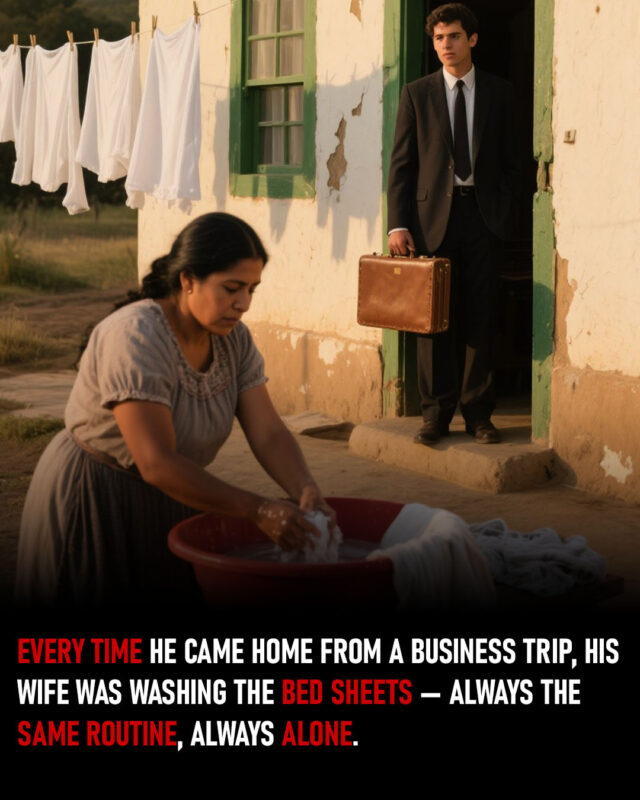
Every time the husband returned from a business trip, he found his wife diligently washing the bed sheets. Curious and uneasy, he secretly installed a camera in their bedroom—only to be devastated by the heartbreaking truth it revealed.
After being promoted to Regional Manager for a construction company in Seattle, Ethan Parker had to go on business trips continuously.
At first, it was only a few days, then gradually it became weeks—sometimes even half a month.
Every time he packed his suitcase and left the peaceful little house in the suburbs of Portland, his wife, Lily Parker, still saw him off with a gentle smile and a tender hug on the porch.
She never complained, never said a word of reproach.
But there was one thing that made Ethan increasingly uneasy.
Every time he returned, Lily was washing the bed sheets — even though the bed was always flat, clean, and smelled of fabric softener.
Once, he jokingly asked, “Are you obsessed with cleanliness? I was gone for a whole week, and the bed still looks the same.”
Lily just smiled faintly and lowered her head. “I have trouble sleeping, so I like to change the sheets for comfort… besides, they were a bit dirty.”
“Dirty?” Ethan thought. Who made them dirty? He hadn’t been home all that time.
A feeling of doubt crept into his heart like a cold wind at the beginning of winter.
That night, Ethan didn’t sleep. Unpleasant scenarios kept appearing in his mind. Was someone else coming here while he was away?
The next morning, he bought a mini camera and quietly mounted it on the bookshelf, pointing it straight at the bed.
He lied to his wife, saying he had to fly to Chicago for a meeting for ten days this time—but in fact, he only rented a small room near their house.
On the second night, he turned on the camera on his phone, his palms cold. The screen showed a scene of a dark bedroom, with only a soft yellow night light glowing in the corner.
10:30 p.m. The door to the room opened. Lily walked in, holding something in her arms. Ethan held his breath.
At first glance, he thought it was a pillow, but when she placed it on the bed, he realized it was—an old shirt. The one he had worn on their wedding day.
The shirt she had kept for more than ten years was now old and wrinkled.
She gently climbed onto the bed, hugging the shirt to her chest as if embracing a person.
Then… she began to talk to herself, her voice choked with tears.
“I miss you again today…I’m sorry I couldn’t keep the baby that day…I was wrong, I’m sorry… please don’t be angry with me anymore…”
Ethan was speechless. Tears welled up in his eyes as he listened to his wife’s trembling voice.
The woman he once doubted, the woman he feared might betray him, was actually still hugging her husband’s old shirt every night, imagining him lying next to her, talking to him as if he were still there—just to ease the ache of her lonely, empty nights.
The bed sheet was wet every night, not because of the sin of an affair, but because of the tears of a wife who still silently loved her husband, missed their lost child, and endured loneliness in quiet strength.
Ethan buried his face in his hands, a wave of guilt rising and choking him.
He realized that while he had been consumed by work and ambition, the woman at home had been quietly keeping their world warm— piece by piece, with steadfast love.
The next morning, Ethan didn’t go on his business trip anymore. He returned home earlier than planned, without saying a word.
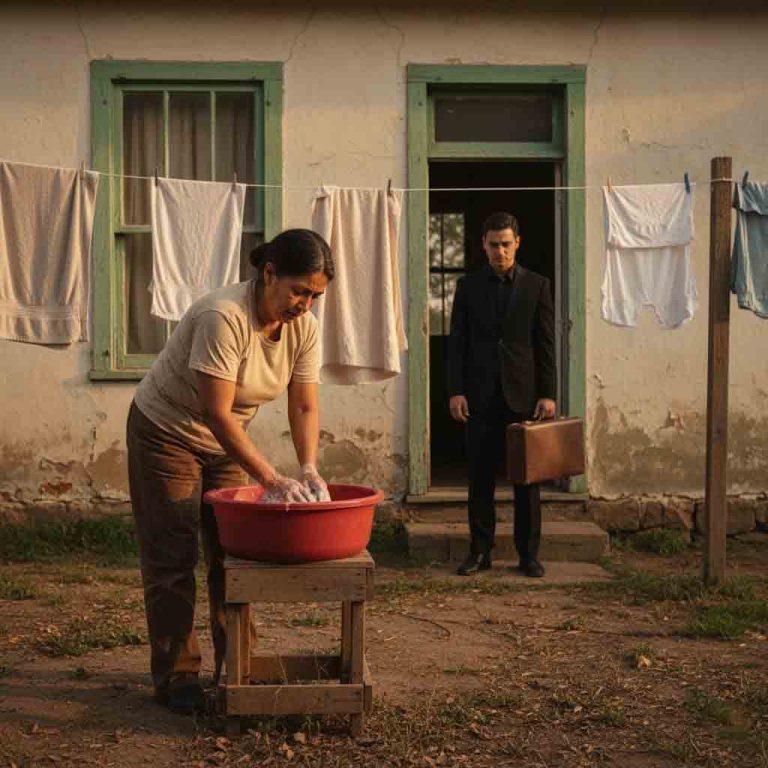
While Lily was washing clothes in the yard, he quietly walked over hugged her from behind, holding her tightly.10:30 p.m. The door to the room opened. Lily walked in, holding something in her arms. Ethan held his breath.
At first glance, he thought it was a pillow, but when she placed it on the bed, he realized it was—an old shirt. The one he had worn on their wedding day.
The shirt she had kept for more than ten years was now old and wrinkled.
She gently climbed onto the bed, hugging the shirt to her chest as if embracing a person.
Then… she began to talk to herself, her voice choked with tears.
“I miss you again today…I’m sorry I couldn’t keep the baby that day…I was wrong, I’m sorry… please don’t be angry with me anymore…”
Ethan was speechless. Tears welled up in his eyes as he listened to his wife’s trembling voice.
The woman he once doubted, the woman he feared might betray him, was actually still hugging her husband’s old shirt every night, imagining him lying next to her, talking to him as if he were still there—just to ease the ache of her lonely, empty nights.
The bed sheet was wet every night, not because of the sin of an affair, but because of the tears of a wife who still silently loved her husband, missed their lost child, and endured loneliness in quiet strength.
Ethan buried his face in his hands, a wave of guilt rising and choking him.
He realized that while he had been consumed by work and ambition, the woman at home had been quietly keeping their world warm— piece by piece, with steadfast love.
The next morning, Ethan didn’t go on his business trip anymore. He returned home earlier than planned, without saying a word.
While Lily was washing clothes in the yard, he quietly walked over hugged her from behind, holding her tightly.
Lily was startled, then smiled softly.
“You’re back so early? Is something wrong?”
Ethan buried his face in her shoulder, his voice trembling.
“Nothing. It’s just… from now on, I won’t go on business trips anymore. I’m home.”
She turned around, her eyes surprised and wet.
“What did you say? Are you okay?”
Ethan smiled, though tears still fell down his cheeks.
“I’m okay… and I’m sorry for not realizing you’re the one who stayed, keeping everything from falling apart.”
From that day on, Ethan limited his business trips. He spent more time at home, helping his wife, cleaning the garden, cooking dinner. Every night, when he lay down on the bed, he held Lily’s hand, feeling the real warmth—the warmth he had forgotten.
Now, every time they changed the sheets, they did it together, laughing and talking. No more silent tears, only the scent of laundry detergent, sunlight through the window, and two people who had learned to be together again.
In a world that is too noisy, sometimes what people need most is not sweet words, but the real presence of each other.
And Ethan understood—love does not die because of distance; it only dies when one person no longer wants to come back.
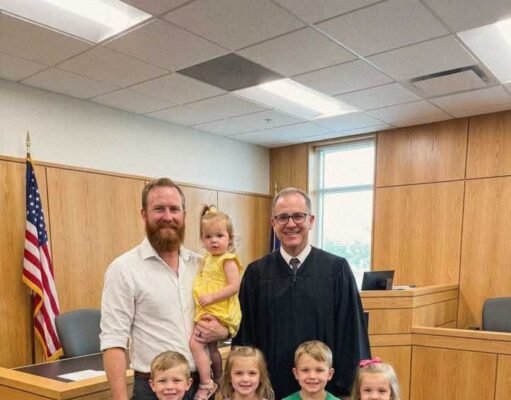
Everyone expected the judge to separate five young siblings that morning. Then a quiet carpenter stood up, and one heartbreaking truth changed the courtroom...