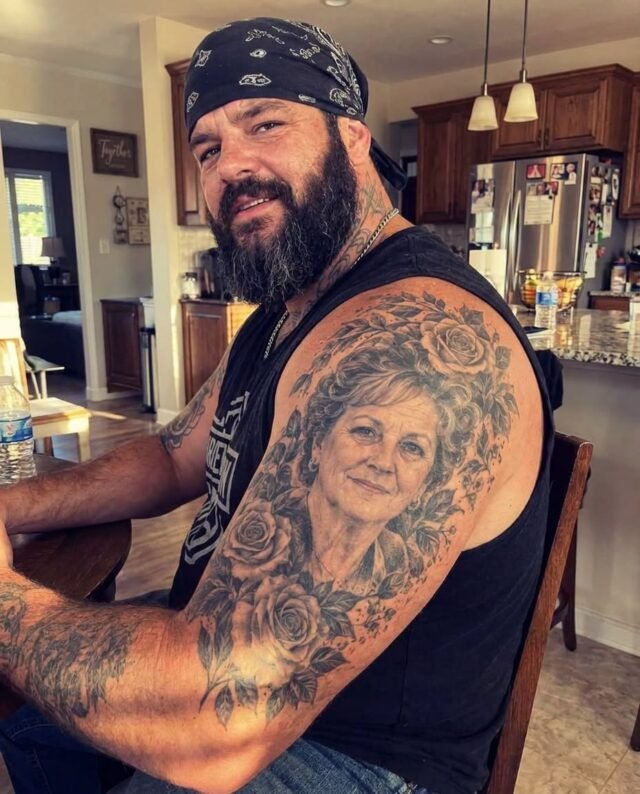
My husband’s wineglass stopped halfway to his mouth the moment Marcus took off his leather jacket. Beneath the sleeve of his dark shirt was a remarkably detailed tattoo of a woman’s face—dark hair, strong cheekbones, steady eyes—and Martin stared at it as though someone had opened a door he had spent twenty-six years trying not to touch. Our daughter Julia, newly home from London with an engagement ring on her hand, looked from her fiancé to her father and immediately sensed the change in the room. Martin set down his glass and asked, very carefully, who the woman was. “My mother,” Marcus said. “Elaine.” The color drained from Martin’s face. A few minutes later he excused himself from the table, and when he returned he asked the question that changed the evening: “Was her name Elaine Marsh before she married?”
Martin had loved Elaine in his twenties, years before he met me. They had been together from 1992 to 1994, separated when their lives began moving in different directions, and crossed paths only once afterward at a gallery opening in 1997. Elaine had started to tell him something that night—“Martin, I thought you should know”—but the conversation was interrupted and never resumed. Martin carried that unfinished sentence for decades. Marcus, meanwhile, had been raised by Elaine and her husband David Hale, the man Marcus considered his father in every meaningful sense. After Elaine died, she left Marcus a sealed box containing photographs, twelve unsent letters, and a copy of the same old Maine photograph that still sat on our mantel. Marcus eventually discovered Martin’s name in those letters. When he later met Julia in London and learned her surname was Carlisle, he began to suspect an impossible connection.
That evening, Marcus finally gave Martin the whole sentence. Elaine had discovered she was pregnant shortly after she and Martin separated. By then both of them had started building other lives, and she chose not to call him back out of obligation. David later raised Marcus as his son, loved him completely, and died when Marcus was twelve. Elaine spent years questioning whether she had made the right decision, and in one of her final letters wrote that Martin deserved to know the truth someday. She left Marcus explicit instructions identifying Martin as his biological father. Julia already knew about the box and the possibility before bringing Marcus home, but neither of them had treated the letters alone as proof. They had wanted Martin to hear Elaine’s story first and then pursue proper confirmation. The emotional revelation, however, created an immediate practical reality none of us could ignore: if Martin was Marcus’s biological father, then Marcus and Julia were biological half-siblings.
The engagement stopped there. No one tried to turn the discovery into something romantic or argue around what it meant. Over the following days, Martin and Marcus arranged formal DNA testing through an accredited laboratory, and the result confirmed paternity. Julia and Marcus ended their engagement and sought counseling separately because affection does not simply disappear when a laboratory report changes the name of the relationship. There were also medical reasons to document the newly established family history accurately, including inherited health information that could matter to both of them later. Marcus made one thing clear to Martin: David Hale remained the father who had raised him, and he was not looking for anyone to replace him. Martin understood. What Marcus wanted was the truth Elaine had preserved for him and the freedom to decide, slowly, what relationship he and Martin could build now that they finally knew who they were to each other.
Months later, the photograph from Maine still sat on our mantel, but none of us looked at it the same way. Martin and Marcus began meeting occasionally for coffee and long conversations that did not try to manufacture thirty missing years. Julia needed more distance at first, and Marcus respected that completely. What had begun as an engagement became something entirely different and far more complicated: the discovery of a brother, a son, and a family history hidden by one painful decision made decades earlier. Elaine’s tattoo was still on Marcus’s arm, and Martin sometimes caught himself looking at it with that same stunned expression from the first night. But the unfinished sentence was unfinished no longer. Elaine had wanted Martin to know that he had a son. Marcus had been brave enough to tell him—and once the truth arrived, all of us had to let it rearrange the family rather than pretend the old arrangement could survive it.