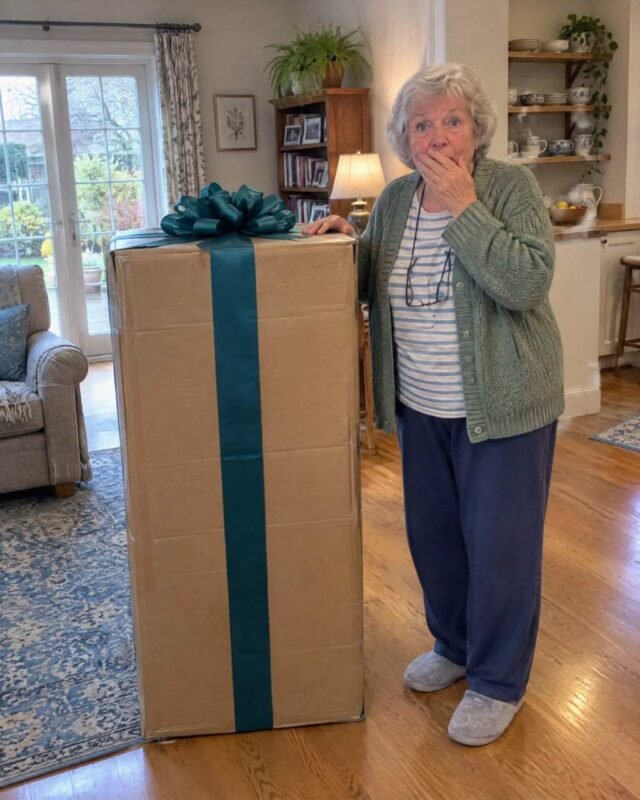
I spent years wondering what I’d done to make my stepdaughter shut me out of her life. I thought I’d finally accepted that I’d never know, until one afternoon changed everything.
The box sat in the middle of my living room as if it had a heartbeat.
My name was written across the top in handwriting I hadn’t seen in 12 years, looped and neat, the C in “Chloe” curling the way it always did.
My hands wouldn’t stop shaking.
It had a heartbeat.
Three days ago, I had made the hardest decision of the last 13 years. I hadn’t sent Chloe, my stepdaughter, a birthday gift. And now this.
David, my husband and Chloe’s father, stood behind the couch, not moving, his face the color of old paper.
“Alice,” he said quietly. “Maybe you should wait. Take a minute.”
“A minute for what?”
He didn’t answer.
“Maybe you should wait.”
I sat down on the rug next to the box and let my palm rest on the cardboard. It was warm from being in the sun at the back of the delivery truck.
Okay. So. Here is where I have to back up, because none of this makes sense without the whole picture.
I’m 58. I married David 12 years ago, when I thought love had already forgotten my address.
It was warm from being in the sun.
He called me his second chance, saying it into my hair at our small backyard wedding, and I believed him with my whole being. His daughter, Chloe, was 17 then. Her mother had passed a few years before, and I want to be clear: I never once tried to slide into that empty seat.
I just wanted my own chair at the table.
But my stepdaughter was clearly not happy about having me there.
He called me his second chance.
I knew becoming her stepmother wouldn’t be easy, but I swear I tried.
I cooked her favorites those first few weeks. Baked ziti. That awful blue box of mac and cheese she loved. I asked about her friends without prying. I gave her space without disappearing. I never interfered in her personal life, but I was always ready to offer advice if she needed it.
And for a little while, it worked. Chloe laughed at my dumb jokes and asked me how I got my pie crust to flake.
I swear I tried.
Then, almost overnight, she went quiet and started pushing me away.
“Is she okay?” I asked David one night, drying a plate. “She barely looked at me at dinner.”
“She’s a teenager, honey. Grades. Boys. Don’t take it personally.”
“Did something happen?”
“I don’t think so. I’ll talk to her.”
“Is she okay?”
My husband always talked to her. That was the pattern. I’d ask, he’d handle it, and he’d return with a soft explanation that made me feel small for pushing.
A few months after the wedding, Chloe left for college, 10 hours away in another state. She didn’t come home for Thanksgiving, Christmas, or the summer.
“She got a job on campus,” David told me.
“For the whole summer?”
That was the pattern.
“Maybe she needs the money, Al. Don’t make her feel guilty about it.”
So I didn’t.
Year after year, I didn’t. Every time David’s phone buzzed late, he was already picking it up. “It’s just my brother,” he’d say. Or, “Spam again.” I never once looked for myself.
Guilt makes you believe anything. Love does too. And I had both of them stacked on top of each other like bricks.
He was already picking it up.
I noticed things and ignored them. The Christmas card from Chloe’s college roommate, which arrived already opened, with tape neatly slit along the top. David said the mailman must have been sloppy or caught it on something.
I remembered that he was always the one to check the mail. Always. Even in the rain, even when he was sick, even when I offered.
I remembered him and Chloe having a long, loud argument in the garage the weekend before she left for school.
I noticed things and ignored them.
I overheard them through the garage door; my husband’s voice low and hard, my stepdaughter crying and saying, “That’s not fair.”
He told me it was about her switching majors.
When I asked what the argument was about, he said, “Her grades. Nothing for you to worry about.”
I remembered his phone buzzing late at night and him tilting the screen away from me.
I believed him. I always did.
I overheard them through the garage door.
Now I sat on my rug with a box that weighed more than my wedding dress, and my husband was standing behind me like a man watching a match land in dry grass.
I slid my finger under the flap.
“Alice,” David said again. “Please.”
I looked up at him, and for the first time in years, I didn’t listen.
I slid my finger under the flap.
Let me backtrack a bit again, because to understand that box on my living room floor, you have to understand the 13 years of birthdays that came before it.
When Chloe turned 18, in the first year I was her stepmother, I bought her a thin gold necklace with a tiny star on it because she used to doodle stars on the corners of her homework when she still sat at our kitchen table.
I bought her a thin gold necklace.
I wrapped it myself. I drove it to the post office. I told myself she’d at least open it, even if she didn’t call.
Two weeks later, it came back. “Return to Sender,” in blocky black marker.
I stood in the laundry room and cried into a dish towel so David wouldn’t hear me.
At 21, I sent her a soft leather bag, the kind a young woman could carry to her first real job.
That one came back too.
I stood in the laundry room and cried.
At 25, I sent a cookbook. I remembered how she used to love baking before everything went wrong. Chocolate chip cookies, banana bread, a lopsided birthday cake for her dad.
I remembered her laughing at my terrible frosting job. I remembered her calling me “Alice” in a warm voice, not a cold one.
That cookbook came back unopened, like all the others.
I remembered how she used to love baking.
After the fifth or sixth returned package, I’d tried everything I could to stay in touch with Chloe, but she wouldn’t even answer my calls. The number just rang. I asked David to please talk to her and explain that I’d love for her to visit us; he told me he’d already spoken to her about it.
He said they’d had a terrible argument.
“She said she can’t stand having you in this house, Alice,” he told me. “She thinks I chose you over her.”
I sat down on the edge of our bed, and I couldn’t speak for a long time.
He said they’d had a terrible argument.
“Did I do something?” I finally asked.
“No, honey. She’s just grieving her mother. It isn’t about you.”
“But she was warm at first. Remember? She used to help me chop onions.”
“Kids change,” he said. “Please. Stop taking it so personally.”
So I stopped asking. But I didn’t stop sending gifts.
“Did I do something?”
Every year. A scarf. A journal. A little pair of earrings. Every year, the box came back, and every year, I put it in the closet with the others and told myself, maybe next year.
But love makes you a very good liar to yourself. And guilt does the rest.
Then came year 13.
I sat on our bedroom floor with a small silver photo frame in my lap.
I put it in the closet.
I’d wrapped it in blue paper because it was her favorite color at 17. Maybe it wasn’t anymore. Maybe I didn’t know a single true thing about her.
I sat there for almost an hour, holding that frame.
I thought about a woman I’d never really met, a 30-year-old stranger who wore my last name on paper and nothing else.
“She’s told you for 12 years she doesn’t want this,” I whispered to myself. “You have to hear her.”
Maybe it wasn’t anymore.
Right then, I remembered David saying the previous year, “You need to stop, Al.”
I unwrapped the frame slowly. I put it on the top shelf of the closet with the other unopened packages that had all come home to me.
I didn’t tell my husband. I didn’t want his judgment.
I just went downstairs and made dinner as if it were any other day.
I didn’t tell my husband.
Three days passed. I almost felt lighter. Like maybe I’d finally set something down.
Then, on that third afternoon, the doorbell rang.
I wiped my hands on a dish towel and opened the front door.
A young man in a brown uniform stood on the porch with a clipboard tucked under one arm and a delivery truck behind him.
“Ma’am,” he said, squinting at his paper, “are you Alice? I’ve got a heavy one for you.”
The doorbell rang.
The driver unloaded a huge cardboard box with my name on it. I had no idea what it was.
He and David had to carry it into the living room because it was so heavy.
The box was from Chloe. I was shocked.
Why would she send me anything?
I had no idea what it was.
On top was a note addressed to me. I read it aloud.
“Maybe Dad will finally tell you himself why I left home. It was never about you, Alice. Look inside, and you’ll understand everything.”
David went very still beside me. The kind of stillness that comes over a person when something they’ve been waiting for finally shows up.
“David,” I said. “What does she mean?”
David went very still beside me.
“She’s bitter, Alice. You know how she is.”
“I don’t know how she is. That’s the whole point.”
“Don’t open it.”
I looked at him. His face had gone the color of old paper.
“I’m opening it,” I said. “And you can either help me or not.”
He reluctantly helped me, and we opened it together.
“Don’t open it.”
I lifted the flap.
Inside, wrapped in tissue and stacked carefully, were 12 boxes; my stepdaughter’s handwriting appeared on every gift tag.
I couldn’t breathe right as I turned pale.
Under the presents were cards. Twelve of them, in Chloe’s handwriting, each one dated on my birthday. Each one addressed to “Alice.” Not Stepmom. Not Mrs. Alice. Just my name, the way a friend would write it.
I opened one card.
I turned pale.
It thanked me for the lasagna I used to make on Sunday nights. It thanked me for the hug at the wedding. It said, “I hope you’re okay.”
I opened another. My stepdaughter had written it at 22. She said she was sorry she’d been distant that first summer and asked if maybe we could talk.
I’d never gotten a single one; they all said, “Return to Sender.”
It thanked me.
At the bottom of the box was a bundle of envelopes tied with a rubber band. Letters. All addressed to me, in Chloe’s hand, from her college address, from an apartment in Denver, and from a place in Portland.
Every one of them was stamped “Return to Sender.”
I finally noticed that the return message was in David’s handwriting!
All addressed to me.
I held one up. My hand didn’t shake. I was past shaking.
“You sent all these back,” I said. “This is my name, our address, and you sent it back.”
My husband sank onto the couch.
“Alice.”
“Say it.”
“I was scared.”
“Of what?”
“Of losing you. Of losing her. Of the two of you…”
I was past shaking.
“Of the two of us, what, David?”
“Of the two of you being closer to each other than you were to me.”
Silence enveloped us.
“You told me she hated me,” I said.
“I know.”
“You told me there was an argument. You said she couldn’t stand having me here.”
Silence enveloped us.
“There wasn’t any serious argument. Not like that.”
David wouldn’t look at me.
“David. What did you do?”
“I told her you found her exhausting, okay! That you wanted the house to yourselves. I told her that after a few weeks of you being here.”
“She was an impressionable teenager.”
“I know.”
“What did you do?”
“She was a child who’d lost her mother, and you told her the woman moving in didn’t want her.”
“I thought it would blow over. I thought she’d come around and I’d fix it and no one would ever know. And then every year it got harder to say.”
I sat down on the floor next to the box because I needed something under me.
“Why now?” I asked. “Why did she send this now?”
“I thought it would blow over.”
“Chloe called me. Last week.”
“And?”
“When Margaret, our neighbor, ran into you at the store a couple of weeks back, you spoke about Chloe. You told me you called your stepdaughter ‘my girl.’ Margaret’s daughter, Maya, is Chloe’s friend; she passed the message on. Maya also told Chloe that you never hated her. That you’ve been asking after her for 12 years.”
I looked down at the cards on my lap. A stack of birthdays I never got to have.
“You spoke about Chloe.”
I picked up the note again with Chloe’s handwriting.
I stood up.
“Give me her phone number, David.”
“Alice, please, let me…”
“The real one. Not the one you told me was disconnected.”
He hesitated.
“Give me her phone number.”
I said his name again, low and level, and he folded. My husband picked up his phone, scrolled for a long moment, and read the number out to me in a voice I barely recognized as his.
“Now leave the room,” I said. “I have a call to make. By myself.”
He walked out. I dialed the number with shaky hands.
It rang twice. On the third ring, a careful voice answered.
“Now leave the room.”
“Hello?”
I couldn’t speak for a second. Chloe said it again, softer, as if unsure.
“It’s me. I’m here, sweetheart,” I finally managed. “I’m here.”
“Alice! I thought you hated me,” my stepdaughter said. “Dad never talked about you. I figured that was your rule.”
“I thought you hated me too,” I whispered. “He told me you couldn’t stand having me in the house.”
A long pause, then she started to cry.
“I’m here.”
“I loved the lasagna nights,” she said. “I loved when you laughed at my terrible knock-knock jokes!”
“I still have the cookbook birthday gift I bought you,” I told her. “I’ve thought about you every year!”
“Can I drive down this weekend?”
“Yes,” I said. “Please! Yes!”
“Can I drive down?”
When David returned, I was sitting on the couch.
“Alice, I’m so sorry. I never meant…”
“You didn’t just steal over a decade from us,” I said quietly. “You stole it because you were more afraid of being second than of being alone.”
He didn’t answer. I didn’t need him to.
“I don’t know what our marriage is anymore,” I said. “But I’m not deciding that today.”
“You stole it.”
Two weeks later, a car pulled into our driveway for the second weekend in a row. I met her on the porch.
My stepdaughter stepped out holding the cookbook I’d bought for one of her birthdays.
“I brought this,” Chloe said. “I thought maybe we could tackle it together.”
I opened the door, and we walked into the kitchen together.
A car pulled into our driveway.
For years, I thought the silence was a wall she had built. It turned out to be a door my husband had locked from both sides.
That year I learned that sometimes the gift you don’t send is the one that finally arrives.