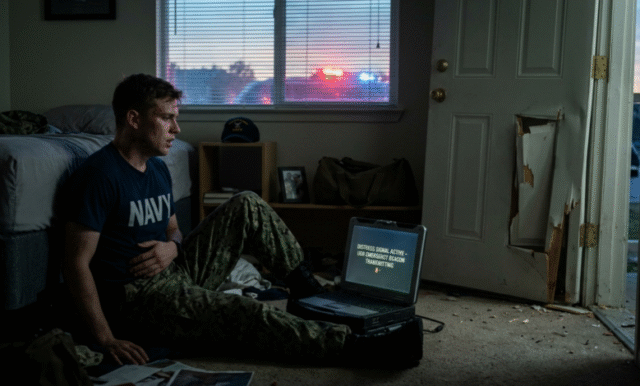
**My Stepfather Beat Me at 2 A.M., But One Navy Distress Signal Exposed His Darkest Secrets by Sunrise**
Everything had always been my fault when he needed someone to blame.
“Tell them,” Richard repeated, crouching beside me. His voice softened into the familiar imitation of kindness he used whenever someone outside our home might be listening. “Ava, sweetheart, you fell. You hear me? You slipped. You don’t want to ruin your career over a misunderstanding.”
I stared at him.
He was kneeling in the wreckage of my apartment, hands trembling, and he still believed my greatest fear was disappointing him.
He had never understood me.
“Get away from me,” I whispered.
The softness vanished.
“You ungrateful little—”
The door shook as someone struck it from the hallway.
“STEP AWAY FROM HER! NOW!”
Richard scrambled backward.
Two military police officers entered first, followed by another carrying medical equipment. Their movements were quick and coordinated. One officer positioned himself between Richard and me while the other ordered Richard to put his hands where they could be seen.
Richard started talking before they had even finished securing the room.
“This is a family matter! I’m her stepfather! She attacked me first!”
The officer nearest him glanced at the broken door, the overturned furniture, and the blood on the kitchen tile. Then he looked at Richard’s hands.
“Sir, turn around and place your hands behind your back.”
“You can’t arrest me for arguing with my daughter!”
“Turn around. Now.”
Richard hesitated. That hesitation cost him the last illusion of control he had left.
The officers restrained him and moved him away from me. He continued shouting, insisting that I was unstable, that I had a history of anger, that I was a difficult woman who had always hated him.
I closed my eyes.
Not because I believed him.
Because I finally understood that I did not have to convince him of anything anymore.
### The Night the Signal Went Out
A medic knelt beside me.
“Lieutenant Reynolds, can you hear me?”
“Yes.”
“My name is Chief Petty Officer Daniel Hayes. We’re going to take care of you. Don’t try to stand up.”
He checked my breathing, stabilized my injured arm, and asked several questions. I answered as clearly as I could, though every word required more effort than the one before it.
When he asked what had happened, I turned my head toward the doorway where Richard was still shouting.
“He’s my stepfather,” I said.
Chief Hayes looked at me. “I understand.”
“No,” I whispered. “I don’t think you do.” My throat tightened. “He’s been doing this since I was a child.”
For the first time that night, the room became completely quiet around me.
Chief Hayes didn’t offer an empty promise. He didn’t tell me that everything would be fine. He simply placed a steady hand near my shoulder and said, “You don’t have to explain everything tonight. Right now, your job is to stay with us.”
Those words nearly broke me.
For years I had been the person who stayed alert, who handled emergencies, who kept her voice steady when everyone else was falling apart. I had become so good at surviving that I had forgotten survival was not supposed to be a permanent assignment.
As the medics prepared to move me, Richard called my name.
“Ava! Tell them to take these handcuffs off!”
I didn’t look at him.
Then he shouted something that made every person in the room stop.
“YOUR MOTHER WILL NEVER FORGIVE YOU FOR THIS!”
Even then, he tried to reach me through the one person whose silence had hurt me almost as much as his violence.
I turned my head toward him.
“Maybe,” I said quietly. “But at least tonight, someone believed me.”
His face twisted with rage. The officers escorted him into the hallway.
And for the first time in my adult life, I watched Richard Lawson leave a room without following him.
### The Hospital
I was taken to the hospital shortly before three in the morning. By then my apartment had been secured as a crime scene. Photographs were being taken. Officers were documenting the broken door, the damaged furniture, and the evidence scattered across the floor.
My phone had survived the attack. The emergency signal remained logged in the military system, complete with its timestamp and location.
Doctors discovered several fractured ribs, a dislocated shoulder, extensive bruising, and a concussion. My injuries were serious enough to require close monitoring, but I was conscious, and they believed I would recover.
Somewhere between the scans and the examinations, I began to cry. Not loudly. Not dramatically. I simply couldn’t stop.
A nurse pulled a chair beside my bed. “You’re safe here,” she said gently.
I wanted to believe her immediately. Instead I stared at the ceiling and counted my breaths until the shaking eased.
Because the hardest part of escaping an abusive home is not always leaving the house. Sometimes it’s teaching your body that the danger has actually passed.
At 4:17 a.m., my commanding officer arrived.
Captain Elizabeth Morgan entered my hospital room in uniform, her face pale with concern.
“Lieutenant Reynolds.”
I tried to sit up.
“Don’t move.”
She pulled a chair close to my bed. For several seconds she said nothing, looking at the bandages, the swelling around my eye, and the sling supporting my arm. Then her expression hardened.
“Your emergency signal reached the watch desk. The response team arrived within minutes of receiving the alert. We have the initial incident report, and the military police are coordinating with the appropriate civilian authorities.”
“Is he still in custody?”
“He was detained at the scene. His legal status will be determined through the appropriate process.”
Captain Morgan leaned forward. “Ava, I need you to understand something. Your career is not in jeopardy because someone assaulted you.”
I looked away. “You don’t know what he’ll say.”
“I know what he might say. That isn’t the same thing as evidence. Your responsibility tonight was to get help. You did exactly that.”
My eyes filled again.
I had received medals, commendations, and praise for doing my duty. None of those things had ever made me feel as relieved as hearing my commanding officer tell me that asking for help had not made me weak.
Before she left, she stopped at the doorway.
“One more thing, Lieutenant. Don’t make any decisions about your future based on what that man might tell other people. Your future belongs to you.”
### The Messages from My Mother
At 5:26 a.m., my phone began vibrating. Twenty-three missed calls. Three were from my mother.
The first voicemail was only eleven seconds long.
“Ava, call me immediately. Richard says there’s been some terrible misunderstanding. I need you to tell me what happened.”
I listened to it twice. Not once did she ask if I was alive.
The second message came four minutes later.
“Your stepfather says you attacked him. He’s very upset. I don’t know what to believe, so please call me.”
At 5:41 a.m., another message arrived.
“Ava, I swear to God, if you’ve done something to destroy this family, you need to fix it before it gets worse.”
There it was. Not concern. Not fear for her injured daughter. A demand.
Fix it. Make it quiet. Make it disappear. Make Richard comfortable again.
I had spent years believing that if I became successful enough, disciplined enough, and independent enough, my mother would finally see me as someone worth defending. I had graduated. I had earned my commission. I had served through difficult assignments and built a life thousands of miles away from the house where I grew up.
Still, a part of me had been waiting for her approval.
Now, lying in a hospital bed with fractured ribs, I finally understood something painful. I could spend the rest of my life proving that I deserved protection, and my mother might still refuse to give it to me.
I opened her contact. My thumb hovered over the call button. Then I deleted the three unfinished messages I had written.
I wasn’t ready to speak to her. For once, I allowed that to be enough.
### The Investigation Begins
By late morning, Special Agent Miller arrived with a folder held against her chest.
She asked about Richard’s arrival, the damaged door, the assault, and the emergency signal. I answered carefully.
When she asked whether Richard had threatened me before, I paused.
“Yes.”
For years I had treated each incident as a separate event. A bad night. An argument. A misunderstanding. A private family problem that would become worse if anyone outside the house knew about it.
But the memories were connected. The bruises I covered. The threats I ignored. The calls I stopped answering. The move I made without telling him my new address. The way I checked every parking lot before getting out of my car. The way I always sat facing the door in restaurants.
I had called those habits discipline. Some of them had been fear.
I began describing what I remembered. The agent didn’t interrupt. She took notes and asked follow-up questions when necessary.
At the end she asked, “Is there anything else you think we should know?”
I almost said no. Instead I remembered something I had not thought about in years.
“When I was seventeen, he threatened to make sure I never left that house. He told me that nobody would believe me if I ever told anyone what happened inside. I think I believed him for a long time.”
She nodded, her expression serious. “Thank you for telling me.”
After she left, I lay still and watched sunlight move across the wall. Speaking about the past had not made me feel powerful. Mostly it made me tired. But beneath the exhaustion was something new.
The truth had finally been spoken aloud to someone who wasn’t asking me to protect the person who hurt me.
And that mattered.
### My Mother Arrives
At noon my mother arrived.
“Where is she?”
The nurse answered quietly. “She’s resting. You’ll need to wait until we confirm she’s ready for visitors.”
“I’m her mother. I have a right to see my daughter.”
The nurse came into my room. “Your mother is here. You don’t have to see her if you don’t want to.”
“Did she ask how I was?”
The nurse hesitated. “She asked whether you had spoken to the investigators.”
That answered the question.
“Please tell her I’m not ready.”
I heard my mother’s voice rise in the hallway. “You can’t keep me away from my own daughter!”
Then came a sentence that made the room feel colder.
“Richard is the one who needs help! He’s never been good at handling anger, and Ava knows how he gets. She knows how to push his buttons!”
There it was again. The old family explanation. Richard had anger issues. I was difficult. My mother was caught in the middle. Everyone was suffering, so no one could be blamed.
Except the person who had been beaten was lying in a hospital bed.
I heard footsteps move away from the door. Then silence.
For the first time, I didn’t chase after her. I didn’t call her back. I didn’t try to explain what she had done to me by refusing to protect me. I let her leave without giving her another opportunity to turn my pain into a debate.
That afternoon I asked the hospital staff to document my visitor restrictions. It was a small decision. But it was mine.
And I was beginning to understand how important that word could be.
Mine. My home. My future. My voice. My choice.
Richard had spent years trying to convince me that those things were privileges he could take away.
He was wrong.
### The Friend Who Stayed
That evening I made one phone call. Not to my mother. Not to Richard’s relatives.
I called my closest friend from the Navy, Lieutenant Maya Brooks.
She answered immediately. “Ava? I heard something happened. I’ve been trying to reach you all day.”
“I’m here.”
“Are you hurt?”
I looked at my bandaged arm. “Yeah.”
For several seconds neither of us spoke. Then Maya whispered, “I’m coming. You don’t need to talk. You don’t need to explain. Just tell me where you are.”
Before hanging up I said something I had never said to her before.
“Maya? I think I’m scared.”
Her answer came without hesitation. “Of course you’re scared. Someone hurt you. You don’t have to pretend you’re okay with me.”
I pressed the phone against my ear. A sob escaped before I could stop it. Maya stayed on the line until I could speak again.
She didn’t tell me to be brave. She didn’t remind me of my rank. She didn’t ask what I planned to do next. She simply stayed.
And that night, as darkness returned to the hospital windows, I began to understand that the people who truly cared about me would not require me to hide my pain in order to deserve their presence.
Maya arrived an hour later carrying a small bag of toiletries, a clean sweatshirt, and the worst coffee I had ever smelled.
“Hospital coffee is bad,” she announced, “but this is somehow worse.”
I laughed. It hurt my ribs. We both laughed anyway, more carefully the second time.
For a few minutes we talked about ordinary things. Then Maya grew quiet.
“You know you don’t have to go back to that apartment, right?”
“I know.”
“Do you?”
She reached for my uninjured hand. “We’ll find somewhere safe. We’ll work through the paperwork. We’ll figure out the practical things. You don’t have to solve everything tonight.”
I felt the tension in my chest loosen slightly.
For years I had believed independence meant never needing anyone. Maya reminded me that independence could also mean choosing the people who were allowed to help.
That night I finally slept for four uninterrupted hours. It was the first peaceful sleep I had experienced since Richard broke down my door.
When I woke, the fear was still there. But it was no longer the only thing I could feel. There was anger. There was grief. There was exhaustion. And somewhere beneath all of it, there was the smallest beginning of hope.
### What the Messages Revealed
The investigator called the following morning.
“We’ve uncovered something you should know. Your stepfather has been telling people that he came to your apartment because you invited him. He claims he was trying to help you through a personal crisis.”
Of course he had. Richard had always been good at creating a version of events in which he was the victim.
“But that’s not all. We’ve also received information suggesting that he had been trying to locate your new address for some time.”
My stomach tightened. I had changed my address, restricted my social media, and stopped communicating with people who passed information to him. Someone had helped him find me.
The most important discovery came from a series of messages Richard had sent to my mother during the weeks before the attack.
In one message he demanded my address. In another he complained that I had stopped answering his calls. Then came a sentence that made my blood run cold:
*If she won’t listen to me, I’ll go there myself. She needs to remember who raised her.*
My mother had replied: *Please don’t do anything stupid. She’s finally doing well.*
Richard’s response was chillingly simple: *She thinks she’s better than us now.*
The messages did not explain every detail of what happened that night, but they contradicted his claim that the visit had been innocent or unexpected.
My mother had known he wanted to find me. She had known he was angry. And although I could not know everything she had thought or feared, she had never warned me.
That knowledge hurt more than I expected.
### The Conversation with My Mother
A week later my mother came to see me. I had agreed to the meeting in a public place after discussing it with Maya.
She sat across from me. “You look better.”
“I’m recovering.”
She nodded and folded her hands. “Richard is having a terrible time.”
I looked at her. Not *I’m sorry he hurt you*. Not *I’ve been worried about you*. Richard was having a terrible time.
“Is that why you came?”
Her eyes filled with tears. “He says he’s being treated like a criminal. He’s never been good at controlling his temper, Ava, but he’s still family.”
“He broke down my door.”
“He was angry.”
“He beat me until I could barely move.”
“I know.”
“Do you? Because I was lying on a hospital bed when you arrived, and you didn’t ask whether I could breathe. You asked whether I had spoken to the investigators.”
She looked down. “I was frightened.”
“So was I.”
“I didn’t know what to do.”
“You could have asked if your daughter was alive.”
She began to cry.
For years her tears would have made me apologize. I would have reached across the table, comforted her, and promised that I wasn’t angry. That was how our family had always worked. Richard hurt someone. My mother cried. I made everyone feel better.
This time I kept my hands in my lap.
“I need you to understand something. I can accept that you were frightened. I can even understand that you made mistakes. But I will not keep pretending your choices didn’t hurt me.”
“What do you want me to do?”
“Tell the truth. Don’t contact me on his behalf. Don’t give him information about me. And stop asking me to protect him from the consequences of what he did.”
She stared at me. “Are you saying you don’t want me in your life anymore?”
I took a slow breath. “I’m saying that I can’t have a relationship with you that requires me to sacrifice my safety.”
“I never wanted any of this.”
“I believe you. But not wanting something to happen isn’t the same as protecting someone from it. You had choices, Mom. I was a child. You were the adult.”
She covered her mouth.
“I loved you so much that I spent years thinking if I could just become successful enough, you’d finally stand up for me.”
Her face crumpled. “I am sorry, Ava.”
I believed that she was sorry in that moment. But an apology could not return my childhood. It could not erase the fear I had carried into adulthood. And it could not immediately rebuild the trust she had spent years allowing Richard to destroy.
“I hope you mean that. But I need time. And I need you to understand that time doesn’t come with a promise that everything will go back to how it was.”
When we stood to leave, she reached toward me, then stopped before touching my injured arm.
I wanted to hug her. God, I wanted to hug her. But wanting to comfort someone did not mean I was ready to trust them.
So I said goodbye and walked away.
It was one of the hardest things I had ever done. It was also the first time I had chosen my own well-being without asking my mother’s permission.
### The Months That Followed
The case against Richard moved forward. The evidence included photographs of my injuries, the damaged doorway, the emergency signal records, my statement, and the messages investigators had obtained.
Richard denied the allegations. His representatives challenged parts of the evidence and presented his version of events. But the facts did not disappear simply because he disputed them.
I cooperated with the investigation and attended the necessary legal proceedings when my health allowed. The process was slower and more exhausting than I had imagined. There were days when I wanted to abandon everything. Days when I wondered whether the emotional cost of continuing was worth it.
Whenever those thoughts came, I reminded myself that I was not responsible for making the process easy. I was responsible only for telling the truth as accurately as I could.
Eventually Richard faced the legal consequences established through the proceedings. The outcome was determined by the evidence and the applicable law, not by the rumors spreading online or by the anger of people who had never met either of us.
I did not celebrate his suffering. I celebrated the fact that he could no longer demand that I remain silent.
By then the story had spread far beyond my apartment complex. Some people called me brave. Others said they could never have survived what I had experienced.
I appreciated their kindness, but the word brave sometimes made me uncomfortable. I hadn’t felt brave when I crawled toward my phone. I had felt terrified. I hadn’t felt powerful when I gave my statement. I had felt exhausted. And I certainly hadn’t felt courageous when I cried in front of Maya because I couldn’t understand why I still wanted my mother to love me.
I had simply kept going.
Perhaps that was what courage looked like when nobody was watching. Not fearlessness. Not perfect strength. Just the decision to take one more step, even when every part of you wanted to stop.
### Returning to Duty
Six months after the attack, I returned to limited duty. My injuries had improved. I was continuing to recover emotionally. I still had difficult days, but I had learned to recognize them without treating them as failures.
Captain Morgan welcomed me back with a short conversation in her office.
“I’m glad you’re here, Lieutenant. How are you really doing?”
I considered giving her the familiar answer. *I’m fine.*
Instead I told the truth. “Better than I was. Not completely there yet.”
She nodded. “That’s a reasonable answer.”
As the months passed, I began volunteering with a support program that connected service members experiencing domestic abuse or family violence with appropriate resources. I did not tell strangers every detail of my story. I did not believe I had to turn my trauma into a public performance to make it useful.
Instead I listened. I helped people understand where they could seek assistance. And every time someone whispered, “I don’t know if what happened to me was bad enough to ask for help,” I gave the same answer.
“You don’t have to wait until you’re nearly destroyed to deserve help.”
I wished someone had told me that when I was ten. I wished someone had told my mother. Most of all, I wished I had understood it before I became so accustomed to pain that I mistook it for normal life.
### Returning Home
Nearly a year after Richard broke down my door, I returned to my apartment. The repairs were complete. The damaged door had been replaced. Additional security measures had been installed.
Maya came with me on the first day. We walked through the rooms slowly. The kitchen table had been replaced. The cracked phone was gone. The marks on the wall had been repaired and painted over.
Everything looked almost exactly as it had before. But I was different.
I stood in the kitchen where I had crawled across the floor, trying to reach my phone. For months I had remembered that moment as the point when Richard almost destroyed me. Now I saw it differently. It was the moment I chose to reach for help instead of spending my remaining strength trying to convince him to stop.
I walked into the bedroom and opened the closet. My dress uniform was hanging where I had left it. I touched the sleeve.
I had thought the uniform represented the strongest version of myself. Now I understood that it was only one part of who I was.
I was also the frightened child who had needed protection. The young woman who had learned to hide her pain. The officer who had finally asked for help. The daughter who could love her mother without surrendering her boundaries. And the woman who was learning that healing did not require her to become the person she had been before.
It required her to become someone who no longer abandoned herself.
Maya appeared in the doorway. “You okay?”
I looked around the room. Then I smiled. “Yeah. I think I am.”
### A Beginning, Not an Ending
My mother wrote to me several months later. The letter was three pages long. She didn’t ask me to contact Richard. She didn’t argue about the evidence. She didn’t tell me that family was more important than my feelings.
Instead she described the years she had spent making excuses for him. She admitted that she had seen signs of his behavior long before I left home. She wrote that she had convinced herself that keeping the family together was the same as keeping us safe.
It wasn’t.
Near the end she wrote:
*I cannot ask you to forgive me just because I am finally ready to admit what I did. I should have protected you when you were a child. I cannot change that now. All I can do is stop asking you to pretend it never happened.*
I read the letter twice. Then I placed it in a drawer.
I did not immediately call her. I did not promise that we would rebuild our relationship. But for the first time, she had acknowledged the truth without asking me to make it easier for her.
That was a beginning. Not a complete reconciliation. Not a magical ending in which every wound disappeared. A beginning.
Over time we started exchanging occasional messages. I made it clear that rebuilding trust would require honesty, consistency, and respect for my boundaries. Some days were encouraging. Others reminded me how much remained unresolved. I stopped treating that uncertainty as a problem I had to solve immediately.
My mother would have to do her own work. I would do mine. And whatever relationship we eventually built would have to be one in which I could remain safe, honest, and fully myself.
For the first time, I understood that loving someone did not mean giving them unlimited access to me. Even if that person was my mother.
### Sunrise
On the anniversary of the attack, I woke before sunrise. The apartment was quiet. There was no pounding at the door. No shouting in the hallway. No footsteps moving toward me. Only the soft hum of the air conditioner and the pale light coming through the curtains.
I made coffee and stood beside the kitchen window. For a moment I thought about Richard. I wondered whether he ever understood what he had taken from me. I wondered whether he remembered the fear on my face or only the moment he lost control of the situation.
I might never know. And slowly I realized I no longer needed to know.
His understanding was not a requirement for my recovery. His apology was not a prerequisite for my peace. His opinion of me was no longer the measure by which I judged my life.
I had spent so many years imagining freedom as the day Richard finally admitted that he had been wrong. But freedom had arrived much more quietly.
It was the day I stopped waiting for him to agree that I deserved to be safe.
I finished my coffee and opened the curtains. Sunlight filled the room. My phone rested on the kitchen table, its screen unbroken and its battery fully charged.
I picked it up and looked at it for a moment. That little device had not defeated Richard. It had not erased my childhood or healed my injuries. It had done something simpler and far more important.
It had helped me reach someone who could intervene when I could no longer protect myself alone.
I set it down and walked toward the door. Before leaving for work, I checked the lock out of habit. Then I stopped.
I didn’t check it a second time. I didn’t return to test the handle. I simply took my keys and left.
It was a small thing. Nobody would write a news story about it. Nobody would call me a hero. But I knew what it meant.
For the first time in my life, I was beginning to live without organizing every moment around the possibility of Richard Lawson returning.
He had once convinced me that fear would always belong to him.
He was wrong.
My life belonged to me.
And that morning, as I stepped into the sunlight and closed the door behind me, I finally believed it.
**THE END.**