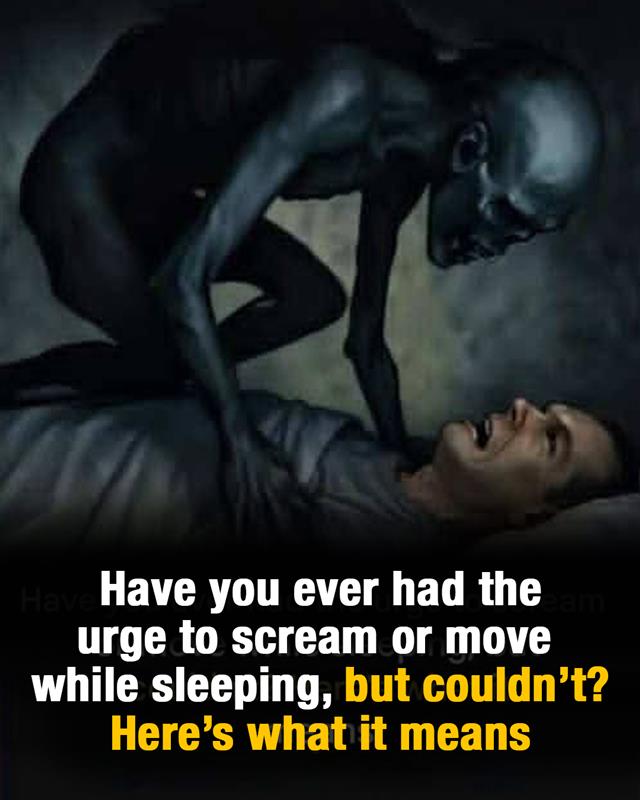
There are few experiences as universally chilling and psychologically unsettling as sleep paralysis. It is a moment where the boundary between the vivid world of dreams and the harsh reality of wakefulness collapses, leaving the individual trapped in a state of conscious immobilization. Imagine waking up in the middle of the night, your eyes fluttering open to see your familiar bedroom, yet realizing with mounting, cold dread that you are entirely unable to move a single muscle. You try to shout for help, but your vocal cords refuse to vibrate. You attempt to lift an arm to break the spell, but your limbs feel like leaden weights bolted to the mattress. It is a terrifying paradox of human biology—a mind that is fully alert and aware, locked inside a body that remains stubbornly, forcefully asleep.
To understand why this phenomenon feels like something out of a horror film, we must look at the intricate mechanics of our sleep cycles. During the stage of sleep known as Rapid Eye Movement (REM), the brain engages in intense, dream-filled activity. To prevent us from physically acting out these dreams—which could result in injury to ourselves or our partners—the brain employs a natural, protective mechanism known as REM atonia. Essentially, the brain sends chemical signals to the motor neurons in the spinal cord to induce temporary paralysis, effectively locking the voluntary muscles of the body. In a healthy sleep cycle, this paralysis dissipates the moment we begin to transition into wakefulness. Sleep paralysis, however, occurs when this internal switch fails to flip on time. The brain surges into a state of consciousness, but the “lock” on the body’s muscles remains firmly in place.
The result is a sensory experience that the brain struggles to interpret. Because the mind is active, it begins to scan the environment for explanations regarding this sudden inability to move. The resulting hallucinations are not merely random; they are often deeply rooted in the primal parts of the brain that respond to threat. Many individuals report feeling a heavy, crushing weight on their chest, as if an invisible intruder is sitting upon them, pressing the air from their lungs. Others describe seeing shadowy, malevolent figures lurking in the corners of the room, or hearing low, rhythmic whispers that seem to emanate from beneath the bed. These terrifying visions are the brain’s way of projecting internal fear onto the external environment, attempting to build a narrative that explains why the body feels so compromised. It is a high-stakes survival reflex gone wrong, turning the safety of one’s own bedroom into a psychological trap.
The history of sleep paralysis is as rich and eerie as the experience itself. Across virtually every culture and throughout every century, humanity has attempted to define these visitations through the lens of folklore and mythology. In Newfoundland, it is known as the “Old Hag,” a nocturnal entity that sits upon the chests of sleepers. In other parts of the world, it has been attributed to demonic possession, spirit visitations, or the lingering presence of malevolent ghosts. These historical accounts reflect the sheer intensity of the experience; when the paralysis is so profound and the sensations are so vivid, it is difficult for the human spirit to accept a purely clinical explanation. The fear feels external because the body is reacting to an external threat that simply does not exist.
From a modern medical perspective, sleep paralysis is categorized as a parasomnia—an undesirable physical event that occurs during sleep. While it is rarely dangerous, its connection to stress, sleep deprivation, and irregular schedules is well-documented. When the body is exhausted, its sleep architecture becomes fragmented. A brain that is chronically tired may slip in and out of REM sleep in a disorganized, chaotic fashion, significantly increasing the likelihood that the waking process and the REM atonia process will overlap. This is why students during exam weeks, shift workers, and those suffering from intense life stressors are the most frequent targets of these nocturnal visitations. The body is effectively pleading for a return to a consistent, healthy rhythm, and the paralysis is a byproduct of that systemic exhaustion.
For those who have endured this, the aftermath is often just as jarring as the event itself. The adrenaline spike caused by the encounter leaves the heart racing and the nerves frayed, making it nearly impossible to drift back into a restful state. The lingering sense of unease can persist for hours, or even days, leading to a profound anxiety about the prospect of going back to sleep. This fear, in turn, often exacerbates the sleep deprivation that triggered the paralysis in the first place, creating a vicious cycle of fatigue and terror.
However, there is comfort to be found in understanding the mechanics of the event. Knowing that sleep paralysis is not a supernatural visitation or a sign of encroaching insanity can strip away much of the power it holds over the individual. It is a biological glitch, a temporary failure of synchronization within the brain’s complex internal clock. The paralysis will always end, and the body will eventually regain its freedom. Recognizing the warning signs—such as a sudden sense of dread while falling asleep or the sensation of floating out of the bed—can sometimes provide the individual with the presence of mind to “break” the cycle. Simple techniques, such as focusing on wiggling a single finger or toe, can often serve as the physical catalyst that signals to the brain that it is time to release the motor lock.
As we continue to advance our understanding of neuroscience, sleep paralysis remains a stark reminder of the mysteries still locked within our own minds. We are at once the masters of our consciousness and the prisoners of our biology. The experience of being trapped within one’s own skin, unable to act even as the mind races with terror, is perhaps the ultimate test of human resilience. While it remains one of the most frightening things a person can experience while tucked safely into their own bed, knowledge is the ultimate antidote. By stripping away the ghosts and demons we have projected onto this phenomenon, we are left with a simple, albeit startling, fact: the mind is powerful, the body is delicate, and sometimes, the bridge between our dreams and our reality is far thinner than we dare to imagine.