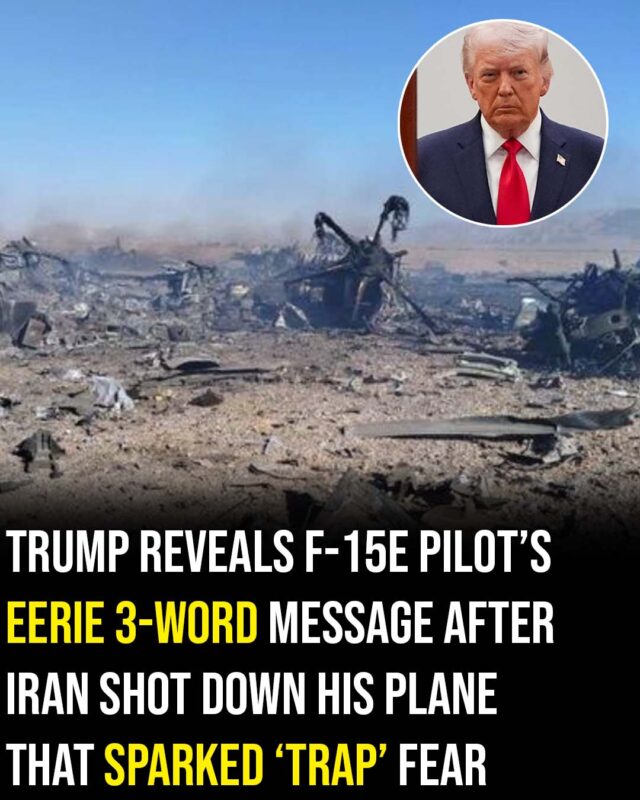
The screaming engines of an F-15E Strike Eagle provide a comforting roar to a pilot, a mechanical assurance of power and safety. But when that roar is replaced by the gut-wrenching silence of a dead engine and the frantic alarms of a failing cockpit, the world narrows down to a few terrifying seconds of survival. Over the jagged, unforgiving mountains of Iran, an American mission transformed in a heartbeat from a display of air superiority into a desperate, high-stakes game of hide-and-seek. When the aircraft was struck and began its terminal descent, the two men inside were catapulted into a nightmare that would eventually reach the highest levels of the United States government, forcing a standoff between faith, technology, and the cold logic of war.
The ejection was a violent blur of G-forces and freezing mountain air. One crew member was located and recovered with miraculous speed, pulled from the slopes before the dust of the crash had even settled. But the other, a high-ranking colonel with decades of service, vanished into the rocky crevices and deep shadows of the Iranian wilderness. As the sun began to dip behind the peaks, the mission shifted into its most dangerous phase. Iranian ground forces were mobilized, and reports began to filter through intelligence channels that local civilians were being offered massive bounties to capture the American airman. For the pilot, the vast mountain range was no longer a landscape; it was a hunting ground where he was the only prize.
Hidden in a narrow fissure with nothing but a standard-issue handgun and a survival radio, the colonel watched as search parties moved through the valleys below. He knew that every time he keyed his radio, he was handing a beacon to the enemy’s electronic warfare units. Silence was his only shield, but it was also his greatest enemy. Without communication, there could be no extraction. Back in Washington, the situation room was a theater of tension. Generals and intelligence analysts hovered over flickering surveillance feeds, watching heat signatures move across the Iranian terrain, unable to distinguish friend from foe. The pressure was mounting to launch a Combat Search and Rescue (CSAR) operation, but the risk was astronomical. Entering Iranian airspace for a rescue mission was an act that could ignite a full-scale global conflict.
Then, the radio crackled. It wasn’t the standard burst of military code or the expected distress signal. Instead, a voice, weary and strained, whispered four words that sent a chill through the White House. To the listeners in the Situation Room, the phrase sounded like a traditional, devout Muslim prayer. The transmission was brief, haunting, and entirely unexpected. For a moment, the room froze. The mechanical certainty of the mission was replaced by a terrifying ambiguity.
The immediate reaction from the intelligence community was one of deep suspicion. In the shadow world of modern warfare, signal spoofing is a common tactic. The fear was that the Iranian Revolutionary Guard had captured the colonel’s radio and was now using it to bait the United States into a deadly trap. If the U.S. sent in Special Operations helicopters based on a fake signal, they could be flying directly into a concentrated kill zone of anti-aircraft missiles. The prospect of a “perfect ambush” loomed large. The phrase heard over the radio didn’t fit the profile of a standard American pilot in distress. It was too specific, too religious, and too culturally aligned with the very people hunting him.
As the debate raged among military leaders, a frantic deep-dive into the colonel’s personal history began. While technology provided the data, it was human intelligence that provided the context. It was revealed that the missing officer was a man of profound, private faith—a man whose spiritual life was as much a part of his identity as his flight suit. Those who knew him best argued that in his final moments of perceived life, or in the depths of his greatest fear, he wouldn’t reach for a manual; he would reach for his Creator. What the analysts in Washington had initially flagged as a potential enemy decoy was, in reality, the desperate cry of a man facing his own mortality.
The decision to go in was not unanimous. It was a gamble of the highest order, balanced on a razor-thin margin of time. If they waited to verify the signal further, the colonel would surely be captured or killed by the advancing ground teams. If they went in and were wrong, they would lose more men and potentially start a war. But the “split-second doubts” that haunt every life-or-death decision eventually gave way to the core military ethos: Leave no man behind. The order was given, and Special Operations teams launched into the darkness, hugging the terrain to avoid radar detection, their rotors thumping against the mountain air in a race against the sunrise.
The rescue was a blur of thermal optics and suppressed gunfire. When the operators reached the coordinates of the signal, they didn’t find an Iranian trap or a decoy. They found the colonel, battered and exhausted, but very much alive. He had held his position against all odds, using the very faith that had almost doomed his rescue as his primary source of strength. As he was pulled into the belly of the transport bird and whisked away to the safety of a base in Kuwait, the tension in Washington finally broke.
The aftermath of the mission left a lasting impact on how the military views communication in the heat of battle. It served as a stark reminder that even in an age of drones, satellite tracking, and artificial intelligence, the human element remains the most unpredictable variable. The pilot’s three-word message—and the four-word prayer that preceded it—revealed the complex intersection of fear and belief. His survival wasn’t just a triumph of technology or a successful execution of a rescue plan; it was a testament to the fact that in the most desperate hours, a person’s true character is revealed.
For the colonel, the mountains of Iran would always represent the place where he looked into the abyss and found his voice. For the leaders in Washington, it was a sobering lesson in the dangers of over-analyzing the human soul through the lens of cold intelligence. The mission proved that while technology can find a person, only understanding can truly save them. The story of the F-15 downing remains a classified legend in many circles, a narrative not of political maneuvering, but of the harrowing, split-second choices that define the boundaries between life and death in the silence of the mountains.