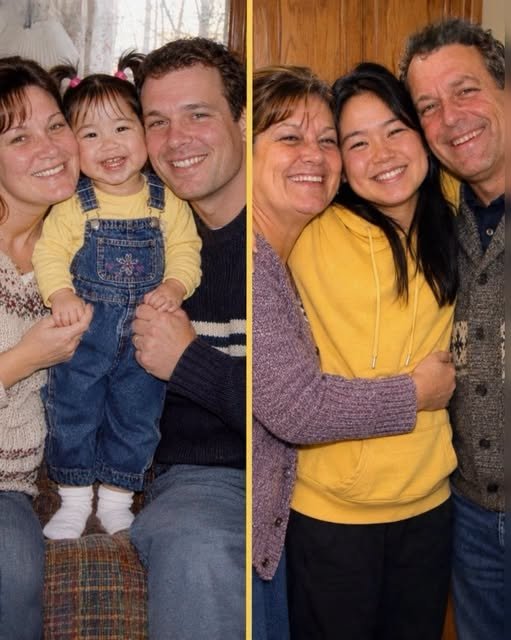
I Found My Daughter at a Bus Stop Nearly 20 Years Ago. Then a Stranger Sent Me a Letter Thanking Me for Raising Her
Richard went pale the moment he saw the note.
“Richard?” I whispered. “Who sent this?”
He stared at the paper in my hand, then at the box on the kitchen table.
“Jules, I can explain.”
Those were the worst words he could have chosen.
Until that Tuesday, I thought I knew exactly how our family began.
Nearly 20 years earlier, Richard and I had been living temporarily in China, where he was working on a contract.
We were both in our early 40s.
After 10 years of trying to have a baby, we’d stopped talking about nursery furniture and names.
Then, one chilly morning, Richard suggested visiting a local market.
We took a bus, and as we stepped off, I heard a thin, strange cry.
At first, I thought a kitten was trapped somewhere nearby.
Nobody waiting at the stop seemed to notice.
I searched beneath the bench and found a small basket.
Inside lay a baby girl wrapped in a blanket far too thin for the cold.
“Oh my God! It’s a baby!” I shouted.
Her tiny hands were ice-cold.
I pulled off my coat and wrapped her in it while Richard called for help.
Police officers and an ambulance arrived, and the baby was taken away.
I cried all the way home.
Temperatures were dropping toward freezing at night.
I couldn’t imagine anyone leaving a newborn outside.
Nor could I stop thinking about her.
Within days, Richard and I asked whether adoption might be possible.
It wasn’t quick.
There were interviews, documents, waiting periods, and long stretches when we were told nothing was certain.
But eventually, through the official process, we were allowed to adopt her.
We named her Maya.
When we returned to the United States, everything changed.
Maya took her first steps toward Richard with both arms outstretched.
On her first day of preschool, she cried until I promised to stay outside the classroom door.
Years later, whenever a friendship went wrong, she still came to me before anyone else.
Now she was 19, away at college, with opinions about everything and a habit of calling me while walking between classes.
She was our miracle.
I had never questioned that.
Then the package arrived.
Richard was at work, and Maya was on campus when a delivery driver knocked.
The box had come from China and was addressed to me.
I hadn’t ordered anything.
I nearly set it aside, but curiosity won.
Inside were photographs, documents, a tiny knitted sweater, and a folded letter placed on top.
“Thank you for raising my daughter. I know you may not believe me. But I have to tell you the truth about the day you found Maya. I can’t keep this to myself any longer.”
I read the next line twice.
“Ask your husband if you really ended up there by accident.”
Richard walked in just as I reached those words.
I waved the letter at him, saying someone was playing a cruel joke.
He didn’t deny recognizing it.
“Her name is Lin,” he said finally. “I knew her in China.”
I gripped the back of a chair.
“You knew Maya’s mother?”
“Not when we found her. Not for certain.”
“What does that even mean?”
Richard sat down, but I stayed standing.
Lin, he explained, had worked as a translator for the company that employed him.
She was young, pregnant, and struggling after the baby’s father disappeared.
Her family had pulled away from her.
Richard sometimes helped her navigate paperwork or find transportation.
“She knew about us,” he said.
“About how badly we wanted a child.”
I remembered Richard coming home from work with stories about people he’d met. He’d never mentioned Lin.
“Why wouldn’t you tell me about her?”
“Because I started thinking we might be able to help each other.”
He said Lin had been frightened about supporting a baby while keeping her job. Richard told her that he and I could offer a stable, loving home if she ever considered adoption.
“And the market?” I asked.
He looked down.
“She asked me to meet her at that bus stop. I suggested you come along.”
I pulled out the chair opposite him.
“You knew there would be a baby there?”
“I thought we’d meet Lin. I thought you’d talk.”
But he had told me we were simply going shopping. He had watched me hunt for the sound beneath that bench, watched me cry all the way home.
I pushed his hand away when he reached for mine.
“Start with the truth this time.”
He explained that Lin had contacted him after giving birth.
She wanted to discuss help caring for her daughter.
He agreed to meet her before work, then asked me to accompany him without revealing why.
Our bus ran late.
On the way, he received a message from Lin.
She said she couldn’t wait any longer and had left the baby for him.
Richard claimed he thought she’d stepped into a nearby shop, or had written the message badly.
“You didn’t think to tell me?”
“I was trying to see what she’d done. When you heard the crying, I realized.”
“You realized before I did?”
He nodded.
I stood so abruptly my chair scraped the floor.
“She could have died, Richard.”
“I know.”
“Did you know her name while I was holding her?”
His eyes filled. “I suspected. I knew it was probably Lin’s child.”
For a moment, I could barely look at him.
Then I remembered the rest of the box.
“There’s more here,” I said. “And I’m reading it before you explain another thing.”
I spread the documents across the table.
Among them was a photograph of a young woman holding a newborn whose cheeks looked unmistakably like Maya’s.
On the back, someone had written, in careful English, “My daughter, before everything changed.”
The knitted sweater was pale yellow and impossibly small.
Beneath it lay a copy of a letter dated before Maya’s birth.
Richard moved closer when I unfolded it.
“Please don’t,” I said.
Lin’s words were simple.
She thanked him for listening and asked whether he could help her find inexpensive childcare.
She needed to keep working.
She wanted somewhere safe to live with her baby.
Then came the sentence that changed the room.
“I am frightened, but I want to keep my daughter. Please help me find a way.”
I looked up.
“You said she wanted us to adopt her.”
“I said I offered.”
“You made it sound like she was asking you.”
He rubbed his forehead. “She told me she couldn’t manage. I thought she was getting ready to let someone else raise the baby.”
“But she told you she wanted to keep her.”
“That was before things got worse.”
“Did she ever tell you she’d changed her mind?”
He didn’t answer.
I thought of the years when every pregnancy announcement had hurt, when I’d sat beside Richard in the dark and whispered that maybe it wasn’t meant to happen for us.
I knew what desperation felt like.
But that didn’t give either of us the right to turn someone else’s desperation into an opportunity.
“Did you hear anything she said,” I asked, “that wasn’t what you wanted to hear?”
Richard stared at the table.
The longer letter from Lin was addressed to me.
She wrote that after Maya’s birth, she had feared losing her job and the room she rented.
She believed Richard and I might look after the baby for a short time while she arranged childcare.
She had expected to discuss the details when he arrived.
But she’d been late for work twice already.
That morning, after waiting and seeing no bus, she panicked.
She set the basket under the bench, sent Richard a message, and left.
“I told myself he was only moments away,” she wrote. “That was a terrible thing to believe was enough. I endangered my daughter, and I have regretted it every day.”
Richard read over my shoulder until I turned the page away.
“She didn’t even know I was coming,” I said.
“No. I wanted you to meet her before you started worrying about what might happen.”
“You wanted me to see the baby.”
“Yes.”
I had spent nearly 20 years describing that morning as fate.
Richard had been steering us toward the bench all along.
But the rest was more complicated.
Lin wrote that she had later learned her daughter was safe in official care.
She came forward and considered how to raise her.
Over time, after receiving information about her options and trying unsuccessfully to improve her circumstances, she chose to relinquish her daughter for adoption.
She did not know which family would be selected.
Richard and I had applied through the official process.
No one had simply handed us the baby because we’d found her.
“I didn’t decide what happened to Maya,” Richard said quietly.
“No,” I replied.
“But you decided what I was allowed to know.”
He told me he’d considered confessing during the adoption process.
Then during Maya’s first year.
Then when she started asking why her birth mother had left her.
Each time, he’d told himself he was protecting us.
“You were protecting yourself,” I said.
He didn’t argue.
I kept reading.
Lin had eventually built a stable life, but she never learned the identity of the Americans who adopted her daughter.
Years later, an old colleague showed her a public photograph of Richard with his family.
Lin recognized him.
She confirmed that the young woman in the photograph was the child Richard had adopted in China.
Then she asked the colleague to help send the package to our address.
She had waited several more months, uncertain whether she had any right to write. Maya’s approaching 20th birthday finally convinced her.
“I am not asking her to call me Mother,” Lin wrote. “I only hope she knows I loved her before I made decisions I cannot undo.”
I put down the letter.
“Why didn’t you find her afterward?” I asked Richard.
“I knew the authorities were handling everything. I was afraid contacting her privately would complicate it.”
“And telling me?”
He covered his face. “I was afraid you’d think I’d pushed her into giving Maya up.”
“Did you?”
“I offered adoption more than once. I should have listened when she asked for help keeping her.” He lowered his hands. “I don’t know whether that changed her final decision. I know I wanted it to.”
That admission hurt more than another excuse would have.
We sat apart until evening.
Richard offered to call Maya with me.
I told him she deserved to hear from both of us, but first I needed to decide how to explain what we knew without pretending we knew everything.
I called Maya and asked whether she could come home that weekend.
“Mom, are you okay?”
“I’m safe, sweetheart. There’s something about your adoption we need to talk about in person.”
She was quiet. “Is Dad okay?”
“He’s here.”
“Then I’ll come tomorrow.”
She arrived Friday afternoon carrying a backpack and the worried expression she’d had as a child whenever someone said we needed to talk.
Richard began with an apology.
Then he told her about Lin, the planned meeting, and the message he hadn’t shared with me.
Maya listened without interrupting. When he finished, she asked, “You knew who she was?”
“Yes.”
“And you let me believe nobody had any idea why I was there?”
“I’m sorry.”
“That’s not an answer.”
He looked at me, but I didn’t rescue him.
“Yes,” he said. “I let you believe that.”
Maya turned toward the box.
“Did she send all this?”
I handed her Lin’s letter.
She read slowly.
Halfway through, she covered her mouth, then continued.
When she reached the end, she asked for a few minutes alone.
I wanted to follow her upstairs.
Instead, I stayed where I was.
Richard whispered, “Do you think she’ll hate me?”
“I don’t know. This isn’t about making you feel better.”
An hour later, Maya came down holding the pale yellow sweater.
“She made this?”
“That’s what her letter says,” I replied.
Maya sat beside me.
“I spent years thinking she put me there because she didn’t want me.”
I took her hand. “She made a dangerous decision that morning. She says she regretted it. And later she made a separate decision about adoption. You can feel however you feel about both.”
“Did you know any of this?”
“No. I knew you’d been placed for adoption, but I didn’t know your father had met Lin.”
Maya leaned against my shoulder, just as she’d done after difficult days at school.
“I want to talk to her,” she said.
“Not right away. Maybe write first.”
“That’s your choice.”
She looked at Richard. “I love you, Dad. But you should have told us.”
“I know.”
“Please don’t decide what else I can handle.”
He nodded, unable to speak.
That weekend, Maya drafted a letter to Lin.
She asked what Lin remembered about her birth, what her life had been like, and why she had made the choices she did.
She also told Lin about college, her friends, and her plans to study education.
Before sending it, Maya asked me to get the old blanket from her baby box.
I’d kept it despite its frayed edges.
For years, it had reminded me how close we’d come to losing her before we’d even met.
Maya spread it across the table.
The faded pattern matched the blanket in Lin’s photograph.
“She wrapped me in this,” Maya said.
“Yes.”
“Can we send her a picture?”
I nodded.
A few weeks later, Lin replied.
She answered Maya’s questions without pretending she’d done everything right.
Eventually, they arranged a video call.
I sat nearby at Maya’s request, but she did most of the talking.
Richard and I were still struggling.
I loved him, but I had told him plainly that rebuilding my trust would take more than apologies.
One evening, after Maya returned to college, I found her photograph of the blanket beside Lin’s first note.
“Thank you for raising my daughter.”
For years, I’d believed that finding Maya had made me her mother.
Now I knew the truth about that morning was far less simple.
But I also remembered the sleepless nights, scraped knees, school plays, arguments, and apologies.
I remembered Maya calling me after a hard exam simply because she wanted to hear my voice.
Richard had helped bring us to that bus stop.
Lin had given Maya life and, eventually, made the painful decision to let another family raise her.
What happened afterward belonged to Maya and me, one ordinary day at a time.
And no secret could take those days away.
If you were Jules, could you forgive your husband for hiding his involvement in your daughter’s adoption for nearly 20 years?