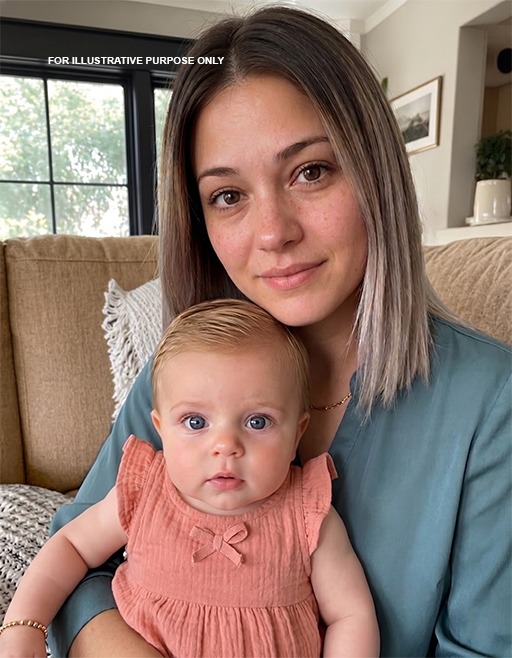
When I first held my daughter in my arms, the world seemed to stop breathing with me.
The delivery room smelled like antiseptic, sweat, and exhaustion. Every muscle in my body trembled after nineteen hours of labor, but none of it mattered when the nurse placed the tiny bundle against my chest.
She was warm. So impossibly small.
A tuft of dark curls rested against her pink scalp, and her sleepy eyes fluttered open for barely a second before closing again. I touched her cheek with shaking fingers and felt tears spill down my face.
“She’s beautiful,” I whispered.
I looked toward my husband, waiting to see the same awe in his eyes.
Instead, I saw confusion.
Then suspicion.
Dylan stood near the hospital window with his hands buried inside his jacket pockets, staring at the baby as though someone had handed him a stranger’s child. The expression on his face chilled me more than the freezing air conditioning.
The nurse smiled politely. “Dad, would you like to hold her?”
He hesitated.
That hesitation hurt more than labor itself.
Finally, he stepped forward and awkwardly took our daughter into his arms. His jaw tightened as he studied her face.
“She doesn’t look like me,” he said quietly.
At first, I thought he was joking.
I even laughed weakly. “She was born ten minutes ago, Dylan.”
But he didn’t smile.
My own smile slowly disappeared.
The nurse shifted uncomfortably before excusing herself from the room. The silence she left behind felt enormous.
“What do you mean?” I asked carefully.
He kept staring at the baby. “Her skin is darker.”
I blinked at him in disbelief.
“So?”
“So…” He swallowed hard. “I think we should get a paternity test.”
The words hit me so violently that for a second, I forgot how to breathe.
The steady beeping of the monitors suddenly sounded deafening.
“You cannot be serious.”
“I’m just trying to be logical.”
“Logical?” My voice cracked. “I just spent nineteen hours giving birth to our daughter, and the first thing you do is accuse me of cheating?”
“I’m not accusing you,” he said too quickly.
“You literally are.”
He rubbed both hands over his face. “Raina, please. Just look at her.”
I looked down at my daughter.
Her complexion was slightly warmer than mine or Dylan’s, but barely. Newborns changed color constantly anyway.
Then realization struck me.
My grandmother.
My father’s mother had been Afro-Latina. Over generations, many of those features had softened through the family line. My father inherited almost none of them. I inherited olive undertones and thick curls. Genetics skipped around unpredictably.
I opened my mouth to explain, but Dylan interrupted me.
“My mother noticed it too.”
Of course she did.
Colleen.
The woman who had disliked me from the day Dylan introduced us.
“She said there’s no way the baby is mine.”
Hum1liati0n flooded through me. I had stitches, bruised arms from IV needles, dried tears on my cheeks, and now this.
“Get out,” I whispered.
“Raina—”
“Get out of my room.”
He stood there for a long moment, conflicted, before gently placing the baby into the bassinet.
Then he walked out.
And something inside me cracked.
The next few days were unbearable.
Dylan visited the hospital only briefly. He barely touched our daughter, whom I named Mira despite his distant indifference. Every conversation between us felt stiff and cautious, like two strangers trapped together in an elevator.
But Colleen was worse.
She arrived on the second afternoon, carrying white roses and poison disguised as concern.
“Oh, she’s certainly adorable,” she said while peering into the bassinet. “Though I admit she doesn’t resemble our side of the family.”
I was too exhausted to fight.
She sat gracefully beside my bed and crossed her legs. “You know, these situations become much uglier when women refuse to cooperate.”
My stomach tightened.
“What situations?”
“The paternity test.”
I stared at her.
“You’re threatening me in a hospital room?”
“I’m advising you.” Her smile never reached her eyes. “My son deserves honesty.”
“I have been honest.”
“Then you should have nothing to fear.”
I turned away from her, trembling with fury.
When she finally left, I cried harder than I had during labor.
Back home, things deteriorated quickly.
Our small house had once felt warm and peaceful. Suddenly, it became hostile territory. Dylan slept in the guest room. He rarely looked at me directly. He spent hours scrolling through articles about false paternity and hidden affairs.
I felt invisible.
No, worse than invisible.
I felt contaminated.
As though his suspicion had stained me somehow.
One night, while I fed Mira in the nursery, Dylan appeared quietly in the doorway.
“She really doesn’t have my eyes,” he murmured.
I nearly laughed from disbelief.
“She’s three weeks old.”
He ignored that completely. “When can we do the test?”
The bottle slipped slightly in my hand.
“You care more about proving me guilty than bonding with your daughter.”
“I need peace of mind.”
“And what about my peace of mind?”
He didn’t answer.
That silence told me everything.
So I agreed to the test….