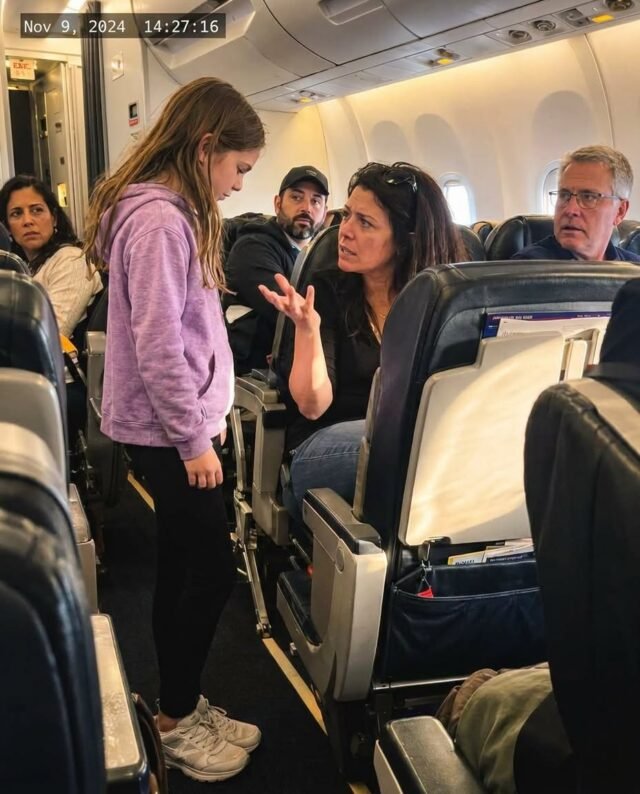
“You have a wallet under your leg,” my ten-year-old daughter said, standing in the airplane aisle with both hands trembling at her sides. Two hours earlier, the woman she was confronting had taken one of the seats I had paid extra to reserve so Maya could sit beside me while I traveled alone with her and my six-week-old son. During boarding, the stranger had refused to move, told me the world did not have to rearrange itself because I had children, and a rushed flight attendant ultimately asked me to take another seat several rows back rather than continue delaying everyone. Maya had quietly agreed to stay behind, trying to make the situation easier for me. Now, minutes after takeoff, she was staring directly at the same woman and saying something no one else in the cabin understood yet. “I saw you pick it up at the gate,” Maya continued. “It belongs to the old man who was looking for it.”
Before boarding, I had noticed an elderly passenger searching his pockets near the gate while an employee helped him retrace his steps. He kept insisting that he had lost his wallet somewhere around security. I had barely registered the scene because my own attention was divided between Maya, the baby, the diaper bag, and the logistics of simply getting us onto the plane. Maya had noticed more. According to her, the wallet fell near the boarding line, the woman who later took our seat picked it up, looked around, and quickly concealed it instead of handing it to an employee. Maya had tried to tell her there was something near her leg when we first boarded, only to be told to mind her own business. So my daughter waited. She watched. And when she became certain about what she had seen, she stood up and said it clearly enough for the flight crew and nearby passengers to hear.
A flight attendant asked the woman to stand. She protested loudly, but when she moved, a worn brown leather wallet appeared wedged beneath her on the seat cushion. Inside were identification, credit cards, and a folded photograph of a smiling woman. The initials on the wallet matched the passenger Maya remembered from the gate. The crew secured the wallet and separated the woman from Maya while they documented what had happened and contacted personnel on the ground. I pulled my daughter against me and felt the courage drain out of her the second she no longer had to hold herself upright alone. “I didn’t know if anyone would believe me,” she whispered. “I waited because I didn’t want to accuse somebody if I was wrong.” That sentence stayed with me more than the discovery itself. She had not acted because she wanted attention. She had acted because she understood that seeing something wrong created a responsibility to say something once she was sure.
After landing, airport authorities handled the matter and took statements from Maya, me, and the crew. The wallet was identified as belonging to Frank Reynolds, the older traveler from the gate, and arrangements were made to return it to him. We later learned that the photograph inside was of his late wife, Dorothy, which explained why he had been so distressed about losing it. I was careful not to turn Maya into an investigator or claim that her observation alone proved every possible allegation; determining what had happened belonged to the airline and law enforcement. What mattered was that her account led the crew to secure property that did not belong to the passenger holding it and preserve the situation for proper review. The airline also addressed the seating problem, refunded the extra fee we had paid, and moved me back beside Maya for the remainder of the flight.
For the rest of the trip, Maya talked far more about the hotel pool than she did about the woman on the plane. That was probably the clearest reminder that she was still just ten. But I thought about the flight constantly. I had surrendered the seat because I was exhausted, carrying a newborn, and trying to keep a tense situation from getting worse. Maya had watched the same woman dismiss us and still managed not to turn her anger into recklessness. She waited, checked what she had seen, and spoke only when she believed she was right. Later she told me that the part she cared about most was the photograph because losing the picture of someone you loved forever seemed unbearably sad. That was the lesson I carried home—not that courage has to be loud, but that sometimes it is simply paying attention when everyone else looks away, then saying the truth plainly when the moment finally comes.