
Entertainment

At age 8, she faced a life-threatening ordeal — now she’s a top Hollywood powerhouse.

Geena Davis has been one of Hollywood’s most recognizable talents for more than four decades — dazzling audiences with her height, presence, and versatility.

And later becoming a passionate advocate for gender equality in media. From her humble beginnings in Massachusetts to her emergence as an Academy Award‑winning actress and a leading voice for representation, Davis’s life story is one of resilience, reinvention, and quiet conviction.

Virginia Elizabeth “Geena” Davis was born on January 21, 1956, in Wareham, Massachusetts, to Lucille (a teacher’s assistant) and William F. Davis (a civil engineer and church deacon).

Both of her parents grew up in small towns in Vermont, and their values reflected a deeply traditional New England upbringing.

Davis later described her family as old‑fashioned to the point that “they would have been Amish had they heard of being Amish,” emphasizing politeness, self‑reliance, and restraint from pop culture and flamboyance.

Growing up, Davis was tall, musical, and intellectually curious. She learned piano, flute, and organ as a youth and served as organist for her local Congregational church. Despite her musicalism.

Davis often felt unusually self‑conscious about her height — listed at 6 feet (1.83 m) — which made her stand out among classmates and attracted teasing and attention she did not always welcome.

From an early age, she was fascinated by performance, recalling that by the age of three she knew she wanted to act — even though her exposure to movies at that age was limited to animated Disney films.

Childhood Episodes That Shaped Her Outlook

In her 2022 memoir Dying of Politeness — named after her lifelong struggle to express discomfort and conflict due to her upbringing — Davis shared powerful memories of her childhood that illustrate her early conditioning toward extreme politeness.

One such incident occurred when she was around eight years old: she and her family were riding with her 99‑year‑old great‑uncle Jack, whose erratic driving brought the car nearly into oncoming traffic.

No one spoke up until, at the last moment, his wife Marion gently directed him to correct the car’s path. The experience — where no one voiced concern until the danger passed — stayed with Davis as a formative moment about reticence and politeness.

Davis has also been candid, in her memoir and interviews, about being a survivor of childhood sexual abuse. She has explained that she did not fully understand what happened at the time or the psychological impact it would later have on her.

Rather than immediately discussing it, Davis internalized shame and silence — a pattern she later broke as an adult.

(This aspect of her life appears in her memoir; personal interviews on the topic reflect her own processing of the experience in adulthood, but she has not given detailed public accounts in major news outlets.)

The High School Years: Feeling Different and Finding Passions

At Wareham High School, Davis was noticeably the tallest girl in her class, an attribute that made her stand out in ways she did not always enjoy.
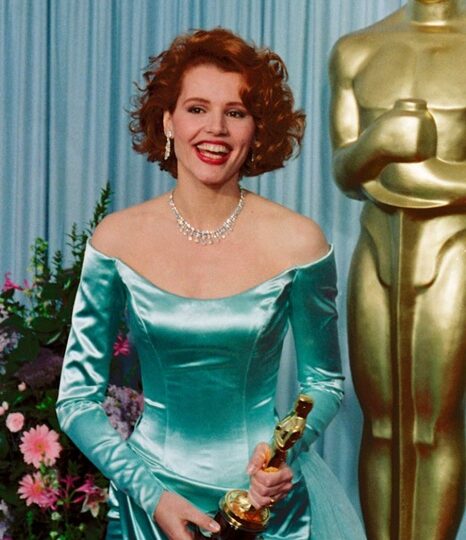
She experimented with athletics — participating in track and field (including high jump and hurdles) and being encouraged to play basketball — but it was music and performance that drew her deepest interest.

During her senior year, Davis even studied abroad in Sweden, becoming fluent in Swedish — an unusual achievement for an American teenager and a testament to her early intellectual curiosity and flexibility.

College, Early Modeling, and the Road to Acting

Davis began her higher education at New England College in New Hampshire before transferring to Boston University’s College of Fine Arts, where she initially majored in drama.

She did not complete her degree, however — leaving in 1979 after not obtaining enough credits to graduate, a fact she later admitted she had sometimes obscured out of habit as a young actress.

After leaving Boston University, Davis moved to New York City and worked a series of jobs — including waitressing and sales — while pursuing opportunities in performance.

During this period she was signed by the Zoli modeling agency and appeared in the Victoria’s Secret catalog, among other gigs.

Modeling was never her ultimate goal, but Davis approached it as a practical step toward her dream of acting — recalling that at the time, models such as Christie Brinkley and Lauren Hutton were crossing over into film roles, and Davis hoped to do the same.
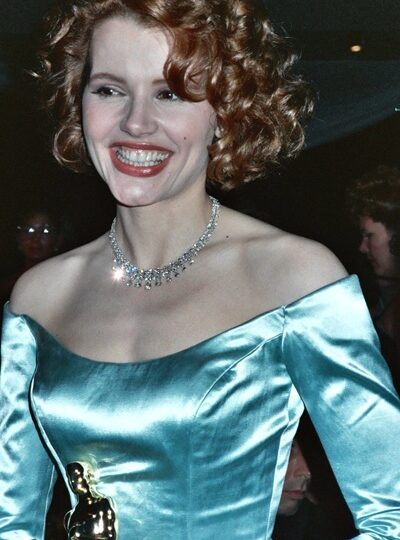
Hollywood Breakthrough: From Tootsie to Cult Classics

Davis’s acting career began with a small role in the 1982 comedy Tootsie, directed by Sydney Pollack and starring Dustin Hoffman. The film was a major box‑office success and opened doors for Davis that would change her life.

In the mid‑1980s, she landed work in television — including a regular role on the comedy Buffalo Bill and guest spots on popular series like Family Ties — before starring in her own sitcom, Sara (1985), which ran for a season.

Her early film work included roles in Fletch and Transylvania 6‑5000, both in 1985, but it was her casting opposite future husband Jeff Goldblum in the science‑fiction horror The Fly (1986) that marked a turning point in her film career.

Rise to Stardom: Iconic Roles and an Oscar

Davis quickly became associated with a string of high‑profile films:

  • In Tim Burton’s Beetlejuice (1988), she played Barbara Maitland, one half of a ghostly couple haunting a quirky household — a role that showcased her comedic timing and versatility.
  • That same year, Davis delivered a critically acclaimed turn in The Accidental Tourist (1988), playing Muriel Pritchett, a vivid and memorable character who helped earn her the Academy Award for Best Supporting Actress.

Academy recognition cemented Davis’s status as a leading Hollywood talent and opened the door to even larger roles.

In 1991, she starred in Ridley Scott’s Thelma & Louise, a culturally significant feminist road film in which she played Thelma, a housewife searching for freedom and identity.
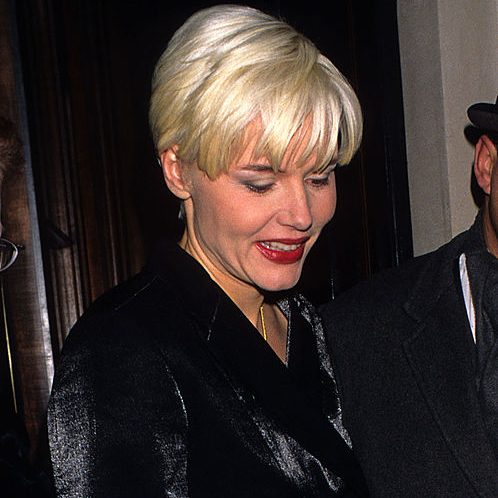
The role earned her a nomination for the Academy Award for Best Actress and remains one of her most celebrated performances.

The following year, Davis starred in A League of Their Own (1992), a beloved sports dramedy about the first professional all‑female baseball league. Her role as Dottie Hinson further solidified her influence and appeal with audiences of all ages.

Later Career: Television, Challenges, and Evolution

In the mid‑1990s, Davis’s film career experienced a downturn with several box‑office disappointments, and she shifted more toward television roles.

She starred in The Geena Davis Show (2000–2001) and later took on the groundbreaking lead role in Commander in Chief (2005–2006), playing the first female President of the United States — a performance that earned her a Golden Globe Award for Best Actress in a Television Drama.

Her later screen appearances have included recurring roles on Grey’s Anatomy, parts in series such as The Exorcist and GLOW, and continued work in film, including Marjorie Prime and others.


I Was Picking Up Groceries for Lunch When I Heard a Little Boy Behind Me Say, ‘Mom, Look! That Man Looks Exactly Like Dad’

It was supposed to be the kind of Saturday you don’t even remember—coffee, breakfast, a simple grocery run, back home before the day really starts.

I’m 35, and that morning I woke up with the rare feeling that life had finally settled. Not perfect. Not flashy. Just steady. Normal. Safe.

Jessica was still asleep when I got up. She’d wrapped herself into a burrito of blankets, hair a tangled mess on the pillow, one leg sticking out like she’d fought the comforter and lost.

The scent of coffee and eggs got her moving anyway. She blinked up at me, face still half-buried in the pillow.

“Hey,” she mumbled. “Don’t forget the turkey and cheese.”

I smiled. “I won’t.”

She squinted at me like she was making sure I understood the assignment. “Shaved turkey. Not that thick weird stuff you always bring home.”

“I got it,” I said, leaning down to kiss her forehead. “Shaved turkey. Cheese. Anything else?”

“Mmm… pickles.”

That was it. That was the whole plan. A quiet Saturday morning where the biggest crisis was choosing the right kind of deli meat.

I threw on jeans and a sweatshirt, grabbed my keys from the hook by the door, and headed to the grocery store we always went to—same aisles, same fluorescent lighting, same little routine that made life feel predictable.

Bread.

Turkey.

Cheese.

Pickles.

Coffee filters.

I was in line at checkout, basket balanced against my hip, already thinking about how quickly I could get back home, when a child’s voice sliced through the noise of scanners and plastic bags like it was amplified.

“Mom! Look! That man looks exactly like Dad!”

I froze so hard it felt like my bones locked.

At first, I tried to shrug it off. Kids say things. They confuse people. They make wild comparisons. But this wasn’t random.

It was certain.

I turned slowly.

Behind me stood a woman and a little boy, maybe seven. The boy stared at me with wide, unblinking eyes—pure recognition, the kind that doesn’t need proof.

But the woman—

Her entire body went stiff.

Her face drained so quickly it was like someone had pulled the color out of her. She looked like she’d seen someone walk out of a grave.

Her hands loosened around a glass jar of pickles. It slipped. It shattered on the tile between us. Brine and broken glass splashed everywhere.

And she didn’t even flinch.

She only stared.

Then she took a shaky step forward. And another.

“Lewis…?” she whispered. “Is that really you?”

My pulse slammed into my throat.

“Sorry,” I said, voice catching. “Do I… do I know you?”

She made a sound that wasn’t quite a laugh and wasn’t quite a sob.

“It’s me,” she said. “Emily.”

She swallowed hard, like the next words might break her in half.

“Your wife.”

The world tilted.

In one blink, the Saturday-morning simplicity vanished—Jessica in bed, sandwiches for lunch, our apartment, our life—like someone had swept it off a table.

The boy tugged at her coat, eyes never leaving me.

“Mom,” he said, small but sure. “That’s Dad.”

People were staring now. The cashier called for cleanup. A worker hurried over with a caution sign. None of it mattered.

Emily stepped closer and touched my wrist lightly, as if she needed to confirm I was real.

“Please,” she said, voice cracking. “Can we talk? Just outside. I know this sounds insane. But I need… I need to talk to you.”

I should’ve said no. I should’ve stepped back. I should’ve done a hundred things that made sense.

Instead, I followed her outside, like my body knew something my mind hadn’t caught up to yet.

We walked to the edge of the parking lot, where a faded yellow bench sat near a row of dented carts. The boy trailed behind us, quiet and watchful.

Emily turned to me, breathing like she’d run a mile.

“You don’t remember me,” she said.

It wasn’t a question.

I shook my head slowly. “No. I don’t.”

Something broke in her eyes, but she held herself together with sheer will.

“You were in a car accident,” she said. “Three years ago. Outside of North Carolina. You were on your way to your brother’s house. They found your car wrapped around a tree. There was blood… enough to believe you didn’t survive.”

She swallowed, voice trembling.

“But they never found your body.”

My mind spun so hard it made me dizzy.

“I’ve never been to North Carolina,” I said. “I don’t have a brother.”

“Yes, you do,” she insisted. “His name is Sean. We lived in a little house. You were a contractor. You used to draw blueprints on napkins.”

She gestured toward the boy, who stood close to her side like he was guarding her.

“Caleb was four when you vanished.”

I looked at him—Caleb—and something deep in my chest tightened. He had my eyes. Not just similar eyes. My eyes.

“You’re telling me I’ve been missing for three years?” My voice sounded like it came from someone else. “That I had a wife and a kid, and I just… forgot?”

“Not forgot,” Emily said, softer now. “They told me amnesia was possible. Trauma-related. But the police eventually closed the case. We assumed the worst.”

I stepped back, my hands shaking.

“I have a life here,” I said. “I live with my girlfriend. I don’t—”

I stopped because the sentence didn’t land the way it should have.

Because the truth was… there were gaps.

Big ones.

I remembered waking up in a hospital with a pounding headache and no wallet. I remembered someone asking me questions I couldn’t answer. I remembered slowly rebuilding from nothing—work, housing, a name.

I had remembered “Lewis,” eventually.

But not childhood.

Not family.

Not history.

And I’d never asked too many questions, because not knowing felt safer than the possibility that the answers would hurt.

Emily stared at me like she was trying to hold two realities at once.

“I looked for you,” she said, and her voice shook with it. “Everywhere. Missing-person forums. Hospitals. Police. I chased leads until I didn’t even recognize myself anymore. And you were just… gone.”

My throat tightened.

“I guess I don’t know who I am,” I whispered.

Emily reached into her bag and pulled out a photo.

I took it, and the air left my lungs.

It was her and me in front of a Christmas tree, smiling. I had a child in my arms—Caleb—pressed against my chest like he belonged there.

We looked normal. Happy.

I sat down hard on the bench, chest heaving, staring at the picture until the edges blurred.

“I have a different life now,” I said quietly. “Jessica and I… we’ve been together two years.”

Emily nodded, pain flickering across her face, but she didn’t weaponize it.

“I’m not here to destroy you,” she said. “I’m in town visiting my aunt. We were just getting groceries. I never thought—” Her voice broke. “I never thought I’d see you again.”

Caleb’s small voice came out shy and careful.

“Do you remember me?”

I swallowed the lump that felt like it was choking me from the inside.

“No, buddy,” I said. “I’m sorry. I wish I did.”

He nodded like he’d expected that answer, then climbed onto the bench beside me anyway, close enough that I could feel the warmth of his jacket.

“You look like my dad,” he said. “And you sound like him too.”

I stood abruptly, overwhelmed, like staying seated would crack me open.

Emily rose with me, her hands open in a calming gesture.

“I know it’s a lot,” she said. “You probably want to leave. I just… I couldn’t stay quiet.”

“I need answers,” I said, voice rough. “I can’t pretend this didn’t happen.”

“I can help,” she said gently. “Let me show you something.”

She pulled out her phone.

Dozens of photos. Caleb’s birthday parties. Me at a grill. A beach selfie. A video.

My fingers trembled as I hit play.

“Say hi, Daddy!” Emily’s voice said on the recording.

A smaller Caleb squealed, “Hi, Daddy! I love you!”

Then I appeared on the screen—me, smiling, holding a juice box.

“Love you too, champ!”

The phone shook in my hands.

Emily lowered her voice. “We can take it slow. I’m not asking you to come back today. I’m not asking you to blow up your life. But maybe… you’ll let me help you remember.”

My world felt split down the middle. Two timelines, both insisting they were real, and me trapped between them.

Finally, I nodded.

“Okay,” I said. “But I need time.”

Emily’s shoulders dropped like she’d been holding her breath for years.

“I understand,” she whispered.

We exchanged numbers. Caleb waved when they walked away.

I stood in that parking lot long after they were gone, grocery bag heavy in my hand, wondering how a quiet Saturday had turned into the moment my life stopped making sense.

When I got home, Jessica was setting up lunch.

“You took forever,” she said, then stopped when she saw my face. “Hey—whoa. Are you okay?”

I set the bag down on the counter like it weighed a thousand pounds.

“Can we talk?” I asked.

Her smile vanished. “Yeah. Of course. What happened?”

So I told her.

Every word.

Jessica blinked like I’d just said something impossible.

“You don’t remember any of that?”

“No.”

“Do you believe her?”

I hesitated. “I don’t know what I believe yet. But it explains… things. The gaps. The way my story never fully added up.”

Jessica sat down slowly, hands folded like she was steadying herself.

“So what does this mean for us?”

“I don’t know,” I admitted. “I need to find out who I am.”

We talked for hours. She was calm—too calm at first—like her brain was trying to keep up with something it couldn’t process. She didn’t lash out. She didn’t call Emily names. But I could see the heartbreak anyway, sitting behind her eyes like a shadow.

That night, I didn’t sleep.

My dreams came in broken flashes: a woman’s laugh I couldn’t place, tires skidding on wet pavement, a child running down a hallway I didn’t recognize.

Over the following weeks, with Jessica’s knowledge and consent, I met Emily again.

More photos. Old birthday cards. Stories about habits I apparently had—how I always tapped a pen against my teeth when I was thinking, how I couldn’t stand thick-cut deli meat, how I used to fall asleep with the TV on.

I saw a neurologist.

After testing, he gave the words a clinical shape: dissociative amnesia caused by severe trauma. Unusual, but not impossible. A mind protecting itself so aggressively it erased an entire identity.

One afternoon at a diner, Emily sat across from me while Caleb stayed with his great-aunt.

“You were right,” I told her quietly. “The doctor confirmed it.”

Emily’s breath shuddered out. She nodded, biting her lip to keep it from trembling.

“Does anything feel familiar?” she asked.

“Sometimes,” I admitted. “Not memories. Just… recognition. Like my brain reacts to your voice before my mind can explain why.”

She reached across the table and rested her hand over mine like it was the most natural thing in the world.

“You don’t have to rush,” she said. “I’ll wait.”

“Why?” I asked, because the question wasn’t about her.

It was about how anyone could keep loving someone who disappeared.

Emily looked at me like the answer was simple, even if the situation wasn’t.

“Because I love you,” she said. “I never stopped.”

And that was the cruelest part: there was Jessica at home—kind, steady, confused, trying to hold herself together.

And there was Emily across from me, carrying years of loss with her chin lifted, offering patience instead of demands.

And then there was Caleb—who deserved something none of us were prepared to give in perfect form.

A father.

Months passed. I didn’t magically recover everything. Some pieces stayed missing, and maybe they always would.

But the more I saw Caleb’s face light up when he spoke to me, the more I realized something uncomfortable and undeniable:

Even if I couldn’t remember being his dad… some part of me still knew how to be one.

One day on a video call, Emily finally asked the question she’d been holding back.

“So… what happens now?”

I looked down before facing the camera.

“Now we make new memories,” I said slowly. “But I can’t make promises I don’t understand yet. I still love Jessica. I’m not ready—maybe I’ll never be ready—to return to the life I can’t remember. But I can be here. Especially for Caleb. He deserves that much.”

Emily’s smile trembled.

“Memories are good enough for me,” she said softly.

And I realized that the sentence that shattered my Saturday didn’t just break my life open.

It forced me to stop hiding from my own missing pieces.

Because whether I liked it or not, the past had found me.

And now I had to decide what kind of man I was going to be in the present—when the only thing I was certain of was this:

Everything can change in one aisle, with one child’s honest voice, and you don’t get to pretend you didn’t hear it.

The Day I Gave Birth Was Supposed To Be Pure Joy But It Became The Day Everything Broke Open

The day I gave birth was supposed to feel like light breaking open. Instead, it became the beginning of a fracture I didn’t see coming.

Caleb and I had been married three years — not perfect, but steady in the ways that count. We argued over bills and chores, then found our way back to each other. When the pregnancy test turned positive, he cried openly. He built the crib himself, painted the nursery long after midnight, and spoke softly to my stomach as if our baby could already understand devotion. I believed him. I believed in us.

Labor lasted fourteen hours before everything shifted. I hemorrhaged. The room filled with sharp lights and urgent voices. When I woke, I felt emptied out, fragile but alive. A nurse placed a warm, dark-haired baby girl in my arms. Relief came like a wave.

I turned to Caleb, ready to share that moment.

He wasn’t smiling.

He stood a few steps back, stiff, staring at the baby as if he were trying to solve something he didn’t want to say aloud. When I called his name, he swallowed and whispered, “She doesn’t look like me.” Then he stepped back, as if proximity itself might confirm something he feared.

He left the room. He didn’t return that night.

At home, something had shifted. He avoided holding her. He startled at her cries. He lay awake, staring at the wall while I fed her in the dim quiet of exhaustion. Then he began leaving the house at the same hour each evening, offering vague explanations about needing air.

I was still healing — body sore, mind unsteady. My thoughts turned dark. An affair? Regret? Some quiet unraveling inside him?

One night I followed him.

His car pulled into a small downtown medical building — a genetic testing and counseling clinic. My chest tightened in a way that felt physical.

Days later, the phone rang while he was in the shower. I answered without thinking.

A calm voice confirmed there was no genetic relationship between my husband and the child.

The words hit like judgment, though I knew I had never betrayed him. Not once. Yet the statement sounded final enough to undo a marriage.

The next morning, I drove back to the hospital. My voice shook as I asked questions I never imagined needing to ask. The head nurse went pale. Records were pulled. Two baby girls born minutes apart. Same ward. Brief overlap during recovery. A mismatched wristband number.

It was a mix-up.

Simple. Devastating.

When I told Caleb, he didn’t explode. He didn’t accuse. He sat down as if something inside him had finally collapsed under its own weight. He said he had felt something was wrong from the first moment but didn’t know how to speak it without tearing us apart — especially after I had nearly died.

An investigation confirmed our biological daughter was alive, living with another family not far away.

Meeting her felt unreal. She had Caleb’s eyes. His dimple. Recognition landed instantly.

And yet the baby I had been holding for weeks knew my heartbeat. She reached for me. She quieted against my chest as if it were the only place she belonged.

Biology clarified facts. It did not erase attachment.

The legal path was clear. The emotional path was not.

Both families wept. There was anger, grief, disbelief — but not hatred. In the end, we chose honesty over resentment. The babies were returned to their biological parents. The other mother and I held each other like women who had survived something neither of us asked for.

Caleb finally told me his nightly disappearances were not escape but fear. He had gone for testing quietly, trying to understand what he sensed without accusing me, terrified that doubt would poison us while I was still fragile.

That night, we cried without defense. Not to win. Not to justify. Just to empty out what had built up between us.

Eventually, our biological daughter came home. Life did not return to what it had been. It moved forward differently — marked, humbler.

I learned something I cannot unlearn.

Love is not secured by DNA alone. It is proven in presence. In restraint when suspicion could turn cruel. In choosing truth, even when it risks everything. In staying when leaving would be easier.

Blood explains origin.

Commitment defines family.

My Husband Showed Up with a Cast on His Leg the Day Before Our First Family Vacation – Then I Got a Call That Changed Everything

The night before our first real family vacation, my husband walked through the front door on crutches.

We had twin girls, and for most of their lives, “vacation” was a word other people used. Families who didn’t sit at the kitchen table on Sunday nights with a calculator and a stack of bills. Families who didn’t debate which payment could be late without consequences.

There was never extra. There was only survival.

So when we both got promoted within weeks of each other, it felt like something out of a different life. I remember sitting at the kitchen table while the girls colored between us.

“What if we actually go somewhere?” I asked.

“Like… a real vacation?” he smiled.

A real one.

I booked everything myself—flights to Florida, a beachfront hotel, kids’ activity packages with cheerful names like Ocean Day. I even booked a spa treatment for myself and felt guilty pressing confirm.

I checked the confirmation emails more times than I needed to, just to make sure they still existed.

I started crossing days off the calendar like a child.

The girls squealed every morning. “How many more, Mommy?”

I didn’t realize how badly I needed something to look forward to until I had it.

Then the night before we were supposed to leave, the front door banged open.

Something heavy hit the wall.

When I walked into the hallway, he was standing there on crutches.

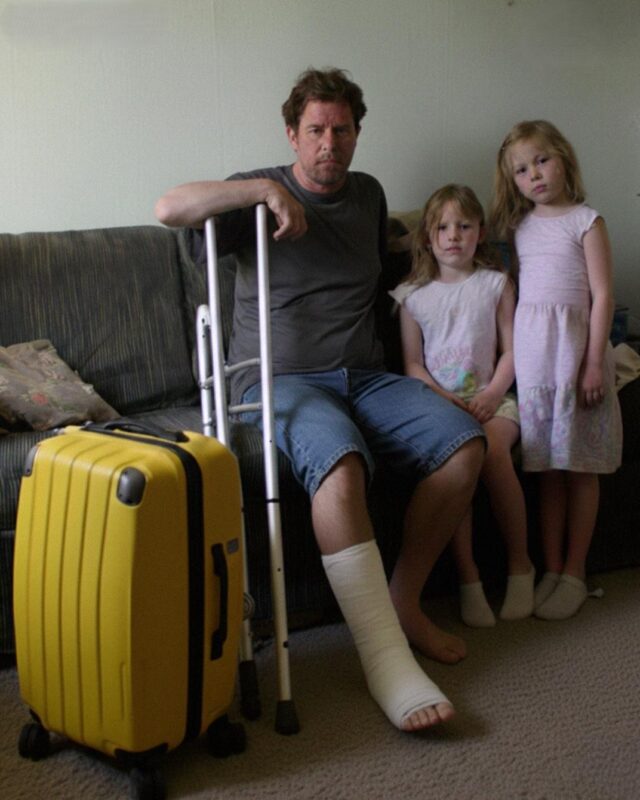
His leg was in a thick white cast.

My brain went blank.

“What happened?” I whispered.

“A woman hit me with her car on the way to work,” he said quietly. “She wasn’t going fast. I’m okay.”

I stared at the cast. My heart dropped straight through the floor.

I burst into tears without even trying to stop them. I wrapped my arms around him, shaking.

“You could have died,” I sobbed. “We’ll cancel everything. I’m not leaving you like this.”

The girls stood behind me, silent and wide-eyed.

But he shook his head.

“No. You and the girls should still go.”

I pulled back. “What?”

“You need this. They need this. I’ll manage. Don’t ruin it.”

He gave me that calm, steady smile he used when he wanted to end the discussion.

I should have pushed harder.

Instead, I thought about the nonrefundable hotel. The girls’ faces. The calendar with no more crossed-off days left.

The next morning, we left.

At the airport, the twins bounced between seats. At the hotel, they ran straight to the pool, shrieking with happiness.

I tried to relax. I really did.

Then my phone rang.

Unknown number.

I almost let it go to voicemail. Something made me answer.

“Hi. Is this Jess?”

“Yes. Who is this?”

There was hesitation.

“I don’t know if I should be telling you this,” the woman said carefully. “But your husband asked me to put a fake cast on his leg so he wouldn’t have to go on vacation.”

The world went silent.

“What?”

“Go home,” she said. “Don’t tell him you’re coming. He didn’t fake that cast just to sit around. What he’s hiding will shock you.”

The line went dead.

I packed our bags.

I told the girls we were going home early. They cried. They asked what they’d done wrong.

“Nothing,” I said. “You did nothing wrong.”

On the drive from the airport back home, my husband texted:
How’s the beach? Did the girls have fun?

I didn’t answer.

When we pulled into the driveway, a large delivery truck was pulling away.

The hallway inside our house looked like a warehouse. Shoulder-high stacks of boxes. Packing foam everywhere. A massive flat-screen TV leaned against the wall. A new media console. An oversized recliner. A mini fridge.

“Is Daddy building us a movie room?” one twin asked.

Before I could answer, he came into view.

He bent down. Lifted a box.

With both hands.

No crutches.

“Daddy!” one of the girls squealed. “Your leg is better!”

He froze.

The cast was still on, but he was walking normally.

“Oh,” he said casually. “You’re home early.”

“You’re walking,” I said.

“It’s better than it looks.”

“You told me a car hit you.”

“I can explain.”

“Please do.”

He gestured vaguely at the boxes. “It all just got delivered. I was moving it downstairs.”

“Why?”

“For a space. A place to unwind. Just something for me.”

“For you,” I repeated, staring at the throne-sized recliner.

“I knew you’d be upset if I told you,” he admitted. “I didn’t want a fight.”

“So you faked an injury.”

“I didn’t want to ruin your vacation.”

“You ruined it anyway.”

“How much?” I asked quietly.

He avoided my eyes. “A few thousand. We finally have disposable income. I thought I deserved something.”

“A man cave?” I said.

“I work hard too!” he snapped—then softened instantly.

The girls were completely silent now.

I pulled out my phone and started taking photos of the hallway.

“Jess, stop.”

I opened our family group chat. Both our families were in it.

I uploaded the pictures.

I came home early from the vacation my husband insisted I take alone. This is what I walked into. By the way, his leg isn’t broken.

The replies flooded in immediately.

His sister: Is this real?
His mother: Why is there a TV in the hallway?
My mom: Are you and the girls okay?

He tried to grab my phone. I stepped back.

“You’re humiliating me,” he hissed.

“You humiliated me first.”

We left that night. I took the girls to my mother’s house.

After they were asleep, I stared at the unknown number in my call log.

A new fear crept in.

What if there was more? What if the woman…

I called her back.

She answered quickly.

“I work at a medical supply store,” she said. “Your husband came in asking for a leg cast. He said his wife and kids were going on vacation. That it was the perfect opportunity to set up a big screen TV and a game console. A space to escape from the noise.”

She hesitated.

“It didn’t sit right with me. I almost didn’t call. But if it were me… I’d want to know.”

I looked down the hallway at the soft glow under the guest room door.

“Thank you,” I said quietly.

When the call ended, everything felt clear.

This wasn’t about a television.

It wasn’t even about money.

It was about deception. Planning. Creating a private escape inside our shared home while sending me and our daughters away under false pretenses.

He didn’t just want a room.

He wanted distance.

Tomorrow, I would decide what came next—lawyers, counseling, or something else entirely.

Tonight, I just knew one thing:

He didn’t need a break.

He was already halfway out the door.

My 7-Year-Old Daughter and Her Father Began Having “Private Talks” in the Garage — So I Installed a Hidden Camera and Instantly Regretted It

I’m thirty-five. My husband Jason is thirty-seven. Our daughter Lizzie is seven.

Jason has always been the kind of father people quietly envy. He doesn’t just attend school events — he volunteers. He braids Lizzie’s hair with surprising patience. He sits cross-legged on the floor for tea parties and never checks his phone. Bedtime stories are never rushed.

So when “garage time” started, I told myself not to read into it.

The first afternoon Lizzie came home from school, Jason leaned down with a grin.

“Hey, kiddo. Garage time?”

Her whole face lit up like someone had flipped a switch.

They disappeared into the garage. The door locked. The old radio crackled to life. Forty minutes later, they walked back inside smiling, cheeks flushed, like they’d just shared the best joke in the world.

The next day, the same thing.

By the third, something tightened in my chest.

Whenever I asked what they were doing, I got identical answers.

“Private talks. You’re not invited.”

Lizzie said it the same way every time. Same rhythm. Same tone. Like she’d memorized it.

Then I noticed the details.

The garage window was suddenly covered.

The radio was loud — just loud enough to blur voices.

When I knocked, Jason took a second too long to open the door. He’d step out first, blocking my view, smiling too casually.

Lizzie always looked happy.

That’s what unsettled me the most.

I grew up in a house where secrets lived behind closed doors. My mind doesn’t default to trust. It defaults to survival.

One afternoon, when Jason ran to the store and Lizzie was in her room, I walked into the garage alone.

Nothing looked wrong.

Tools hung in place. The old workbench sat untouched. But the covered window made the room feel smaller. Hushed.

Hidden.

In the back of a storage box, I found an old Wi-Fi camera we’d used when Lizzie was a baby.

My hands shook as I mounted it in the corner.

That night, when they went into the garage again and the radio came on, I opened the app.

Jason rolled back the rug.

My heart slammed.

Underneath was a small door I had never seen.

He lifted it.

Narrow wooden stairs descended into darkness.

I stopped breathing.

He told Lizzie to wait and disappeared below. The radio volume ticked higher.

Seconds stretched like hours.

When he came back up, he was holding a flat brown-paper package. He shut the door, rolled the rug back into place, and sat down beside her.

He unwrapped the package.

Yarn. Knitting needles.

A tiny pink sweater.

Across the front, stitched in uneven letters:

“I have the best mom in the world.”

My hand flew to my mouth.

They leaned over it together. Jason guided her fingers. Corrected her loops. Untangled mistakes with calm patience.

He knew what he was doing.

This wasn’t a one-time craft project.

Over the next two weeks, I watched every garage session.

A green sweater appeared — Lizzie’s size.

Then a gray one — Jason’s.

And another, larger one, still growing on the needles.

The letters slowly formed:

“I have the best wife in the world.”

Each time I watched, guilt crept in heavier.

I was the one spying.

The one assuming.

The one hiding something.

Then my birthday arrived.

Lizzie launched herself onto our bed at sunrise.

“Happy birthday!”

Jason followed with pancakes and coffee like it was a holiday.

They brought in a large box.

Inside were the sweaters.

Uneven. Slightly crooked. Some stitches tighter than others.

Perfect.

The pink one for Lizzie.

The gray one for Jason.

And mine.

“I am the best mom and wife.”

“We figured you’d never say it about yourself,” Jason said softly. “So we did.”

I cried in a way that emptied something deep inside me.

That afternoon, after they left for ice cream, I went back into the garage.

I unplugged the camera.

I stood there holding it, thinking about what Jason had told Lizzie weeks ago — a story I’d overheard through the app.

How his father once mocked him for knitting when he was a boy. Called it weak. Took the needles away.

How he’d stopped after that.

How he didn’t want Lizzie growing up thinking certain things weren’t “for her.”

The hidden basement? It wasn’t a secret room for something dark.

It was a space he’d built years ago as a quiet workshop. A place where no one would laugh at him.

I slipped the camera into my pocket and never mentioned it.

That night, we sat on the couch wearing our sweaters. Lizzie asleep across my lap. Jason’s fingers tracing the stitched words on my chest.

Just weeks earlier, I had braced myself to uncover something that would shatter my family.

Instead, I found proof of love — awkward, handmade, hidden behind a locked door and a loud radio.

Now, when Lizzie grins and says,

“Private talks in the garage, Dad?”

I don’t panic.

I just smile.

Because I know what’s really happening behind that door.

I Was Asked to Train My Higher-Paid Replacement, So I Taught My Boss an Unexpected Lesson!!

I sensed something wasn’t right the second my boss asked me to “stay late all week” to train the woman stepping into my position. The request felt sudden and overly polished. Still, I wasn’t ready for HR’s offhand revelation: my replacement would be earning $85,000. I had been paid $55,000 for the same role—despite years of experience and a track record of solving issues no one else could handle.

When I questioned the salary difference, HR remained unfazed. “She negotiated better,” they replied, as though that settled the matter.

It settled nothing. But it opened my eyes.

Clarity, Not Anger

In that instant, something changed. Not fury—focus. If the company chose to undervalue me, that was their decision. But they were about to understand exactly how much I had been contributing. I smiled and said, “Of course—I’ll make sure she’s fully prepared.” My boss visibly relaxed, assuming I was complying as usual. He had no idea what I had planned.

The Paper Trail

The following morning, he entered the training room and stopped short. On the table were two neatly arranged stacks of paper:

Official Job Description — a thin bundle outlining the tasks formally tied to my role.
Additional Responsibilities Handled — a pile three times thicker, detailing every extra duty I had taken on: emergencies resolved, workflows improved, after-hours troubleshooting, vendor negotiations, and countless behind-the-scenes fixes that kept operations steady.
My replacement studied the contrast in silence. My boss’s expression shifted immediately.

Redefining the Training

From that point forward, I trained her strictly according to the written job description. No shortcuts. No undocumented systems. No specialized methods I had developed through unpaid overtime. Only the responsibilities they were compensating.

Whenever she asked how I managed escalations, system failures, supply delays, or vendor disputes, I calmly answered:

“You’ll need to speak with management. Those weren’t officially assigned to me.”

Each time, my boss grew more tense. Tasks he had long overlooked were now returning to his desk.

Reality Sets In

By the second day, my replacement understood the scope of what she had stepped into. She wasn’t replacing one person—she was inheriting the workload of several. She wasn’t upset with me; instead, she thanked me for being transparent. She had been promised a streamlined role with clear expectations and strong pay. No one mentioned that the position had relied on unacknowledged overtime and quiet overperformance.

Meanwhile, my boss made hurried phone calls in the hallway. HR sent cautious follow-up questions. When asked to “go over a few advanced processes,” I responded with the same phrase that had limited me for years:

“That falls outside my responsibilities.”

For the first time, they were confronting the full impact of my role—before I had even left.

The Departure

On my final day, after completing the last task listed in my formal job description, I printed and signed a brief resignation letter. No extended notice. No dramatic explanation. Just a professional exit, effective immediately.

My boss looked stunned. My replacement wished me well and thanked me again for my honesty. She wasn’t the problem—she was another professional trying to succeed. She deserved clarity, and I gave it to her.

Now my boss faced a department without the person who had quietly managed far more than expected. The tasks that once “handled themselves” suddenly required attention. The crises I had prevented were no longer invisible.

Closure, Not Retaliation

I walked out feeling lighter than I had in years. It wasn’t about revenge—it was about resolution. I had stopped allowing a company to determine my value.

Two weeks later, I accepted a position with an organization that recognized my contributions. This time, I negotiated with confidence—not ego, but evidence. I understood my worth and ensured my compensation reflected it. They agreed without hesitation.

The Takeaway

When you recognize your value, you stop accepting less. You stop working for those who mistake loyalty for obligation. You stop offering extra effort to employers who treat dedication as unpaid labor. And most importantly, you stop believing you are interchangeable simply because someone else commands a higher salary.

Sometimes the clearest message you can send is this: replacing a title is easy. Replacing real contribution is not.

A little girl went to a police station to confess a serious crime, but what she said left the officer completely shocked.

It started as an ordinary afternoon at the police station — paperwork stacked high, phones ringing, officers moving in and out with quiet urgency.

Then a young family walked through the doors.

A mother. A father. And between them, a tiny girl no older than two or three.

Her cheeks were red from crying. Her little hands were clenched tightly into fists. Whatever had brought them there, it clearly weighed heavily on her small shoulders.

The father approached the front desk, lowering his voice.

“Could we please speak to a police officer?”

The receptionist looked puzzled. “Is everything all right, sir?”

The man hesitated, visibly uncomfortable.

“Our daughter… she’s been crying for days. We can’t calm her down. She keeps saying she needs to see a police officer. She says she has to confess a crime. She won’t eat properly, she won’t sleep. We don’t know what to do anymore.”

The receptionist blinked, unsure how to respond.

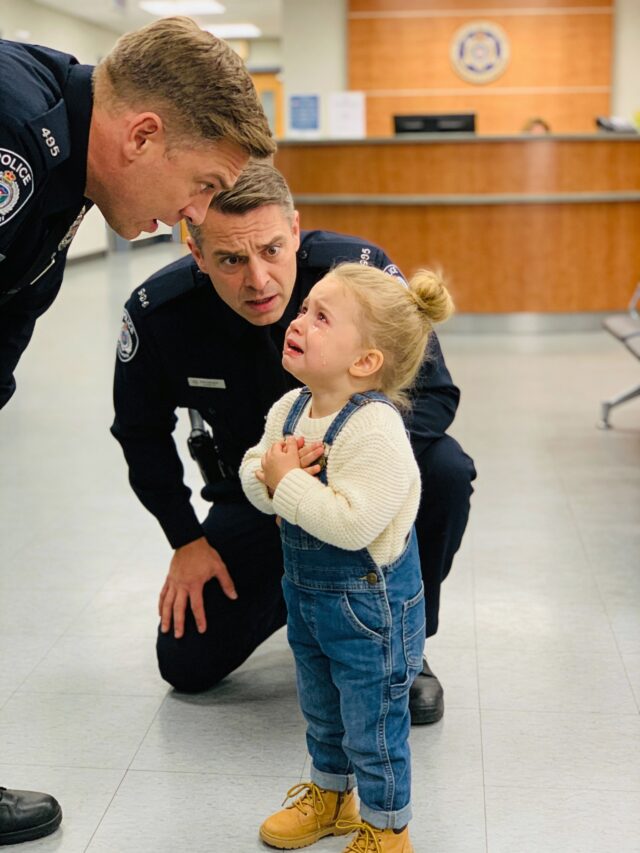
Before he could say anything, a nearby sergeant overheard the conversation. He walked over quietly and knelt down so he was eye-level with the little girl.

“I’ve got a couple of minutes,” he said gently. “How can I help you?”

The father stepped aside. “Sweetheart, this is a real police officer. You can tell him what you’ve been trying to tell us.”

The little girl looked carefully at the uniform, her small face trembling.

“Are you really a police officer?” she asked between sobs.

“I really am,” he smiled. “See the badge? See the uniform?”

She nodded.

Her lower lip quivered.

“I… I did something bad,” she whispered.

“Okay,” the officer replied calmly. “You can tell me. That’s what I’m here for.”

She swallowed hard.

“And… will you put me in jail?” she asked, her voice shaking.

“That depends,” he said softly. “What happened?”

That was all it took. The tears came rushing again.

“I hit my brother on the leg,” she cried. “Really hard. Now he has a bruise. And he’s going to die. I didn’t mean to. Please don’t put me in jail.”

For a brief moment, the entire station went silent.

The officer blinked — stunned — and then his expression melted into understanding.

He gently pulled the little girl into a reassuring hug.

“Oh, sweetheart,” he said kindly. “Nobody dies from a bruise. Your brother is going to be just fine.”

She looked up at him, eyes wide with desperate hope.

“Really?”

“Really,” he nodded. “But we don’t hit, okay?”

She sniffled and wiped her nose.

“Okay.”

“Do you promise?”

“I promise.”

The officer gave her a final reassuring smile. The tension drained from her tiny frame. She reached for her mother, calm for the first time in days.

Her parents thanked the officer repeatedly, relief written all over their faces.

And just like that, what had seemed like a “serious crime” became something else entirely — a reminder of how deeply children feel their mistakes, and how powerful a few gentle words can be.

Sometimes, the bravest confessions don’t come from hardened criminals.

They come from small hearts learning right from wrong — and terrified they’ve broken the world forever.

After a snowstorm acci:dent took my entire family, I raised my granddaughter alone. Twenty years later, she placed a note in my hands – one that completely transformed everything I believed to be true.

People say time softens the sharpest pain. I believed that once. I believed that if you waited long enough, even the worst night of your life would dull into something survivable.

I’m seventy now.

I’ve buried two wives. I’ve outlived friends who once filled my house with noise and warmth. I thought I understood grief — how it settles in your bones and becomes part of your posture. What I didn’t understand was that sometimes grief isn’t finished with you. Sometimes it’s waiting for the truth.

The truth began on a winter night twenty years ago.

It was just before Christmas. My son Michael, his wife Rachel, and their two children had come for dinner. The forecast promised light snow. Nothing unusual for our town.

They left around seven. Michael stood in the doorway, his youngest, Emily, asleep against his shoulder in a puffy red coat.

“We’ll be fine, Dad,” he said with that steady confidence fathers wear like armor. “We’ll beat the weather.”

The wind picked up the moment I shut the door.

Three hours later, someone knocked.

Officer Reynolds stood on my porch, snow melting down his collar. He didn’t have to speak. I saw it in his face.

The road had iced over.

The car left the shoulder.

Michael was gone.
Rachel was gone.
Sam — eight years old — was gone.

Emily survived.

Five years old. Bruised. Ribs cracked. A concussion that doctors said had fractured her memory. “Don’t force recollection,” they warned. “Trauma protects itself.”

So I didn’t ask.

Overnight, I became a father again. At fifty.

At the funeral, people called Emily’s survival a miracle. The pastor did. The police did too. I clung to that word because it was the only thing that didn’t feel like blame.

Life moved forward because it had to. I learned how to braid hair. I burned dinners. I sat through school recitals with a throat that never quite unclenched.

When Emily asked what happened, I gave her the answer I practiced in the mirror.

“It was an accident. A storm. No one’s fault.”

She nodded. She trusted me.

Years passed. She grew into a quiet, observant young woman. Brilliant with puzzles. Drawn to unanswered questions. When she left for college, the house felt hollow in a way I hadn’t anticipated.

After graduation, she came home and started working as a paralegal downtown. We settled into a gentle rhythm.

Then, one winter, just before the anniversary, something shifted.

She began asking about that night.

“What time did they leave?”
“Did anyone else report issues on that road?”
“Did the police ever reopen the file?”

Her voice wasn’t emotional. It was precise.

One Sunday afternoon, she stood in the doorway holding a folded note.

“Grandpa,” she said softly. “We need to talk.”

At the kitchen table — the same one that had seen birthday cakes and condolence casseroles — she slid the paper toward me.

Four words.

THIS WASN’T AN ACCIDENT.

My chest tightened.

“I remember pieces,” she said. “Not everything. But enough.”

She placed an old flip phone on the table. Scratched. Outdated.

“I found it in a courthouse archive box,” she explained. “It wasn’t logged properly. There were voicemails saved on it. One partially deleted.”

She pressed play.

Wind. Static.

A man’s strained voice: “—can’t do this anymore. You said no one would get hurt.”

Another voice, colder: “Just drive. You missed the turn.”

She watched my face carefully.

“Do you remember Officer Reynolds?” she asked.

Of course I did. He was the one who stood in my doorway.

Emily had spent months digging through public records and internal reports. Reynolds had been under quiet investigation back then — bribery, falsified crash reports. A trucking company had paid to redirect blame in multiple collisions.

That road, she discovered, should have been closed. A semi had jackknifed earlier that day. Barricades were removed before conditions were safe.

“They swerved to avoid it,” she said. “That’s why the skid marks never matched the report.”

The official narrative had been simpler. Cleaner.

I asked her the question that had haunted me for twenty years.

“Why did you live?”

She looked down at her hands.

“I was asleep,” she said. “The belt locked differently.”

There was one more document — a letter written by Reynolds’ wife after his death. An apology. An admission. Enough to reopen an old wound and finally name it correctly.

We sat in silence for a long time.

Outside, snow drifted down — softer this time.

For two decades, I had told myself the storm was random. That nothing could have changed the outcome. I had tried to make peace with that version because it was survivable.

But peace built on incomplete truth is fragile.

Emily reached across the table and took my hand.

“You always said something felt wrong,” she told me. “You were right.”

I realized then that she hadn’t just uncovered evidence.

She had reclaimed her parents’ story.
She had given us back the dignity of truth.
She had freed me from a quiet, shapeless doubt I never admitted aloud.

“I should have questioned it more,” I whispered.

“You raised me,” she replied gently. “You kept me safe.”

For the first time in twenty years, the snow outside didn’t feel like a threat.

It felt like a closing.

People say time heals everything. I don’t think that’s true anymore.

Time doesn’t heal.

Truth does.

And sometimes, the child you saved grows up to save you right back.

I Married My Childhood Sweetheart at 71 After Both Our Spouses Died – Then at the Reception, a Young Woman Came up to Me and Said, ‘He’s Not Who You Think He Is’

I never imagined I’d be a bride again at 71.

I had already lived what felt like a full lifetime. I’d loved deeply, built a family, and buried the man I thought I would grow old with. My husband, Robert, died twelve years ago, and after that, life became something I moved through rather than lived inside. I smiled when expected, answered “I’m fine” when asked, and saved my tears for moments when no one could see me.

My daughter used to call and check in.

“Mom, are you okay?”

“I’m fine,” I’d say.

But the truth was, I felt like a ghost in my own life. I stopped going to book club. Stopped meeting friends for lunch. I woke up each morning wondering what the point was.

Then, last year, something shifted. I decided I was tired of hiding. I joined Facebook, posted old photos, and reconnected with people from my past. It was my quiet way of saying I was still here.

That’s when Walter found me.

My first love. The boy who walked me home at sixteen, who made me laugh until my stomach hurt, who I once thought I’d marry before life pulled us apart. He sent a message referencing an old movie theater we used to sneak into on Friday nights. Only one person on earth would remember that.

I stared at the screen for an hour before replying.

We started slowly. Memories. Small conversations. But it felt easy, familiar—like slipping into an old sweater that still fit. He told me his wife had passed six years earlier. He’d moved back after retiring. No children. Just him and his memories.

I told him about Robert. About the love. About the loss.

“I didn’t think I’d ever feel anything again,” I admitted once.

“Me neither,” he said.

Before I realized it, we were having coffee, then dinners, then laughing again in a way I hadn’t in years. My daughter noticed.

“You seem happier,” she said.

“I do?”

“Yeah. What’s going on?”

I smiled. “I reconnected with an old friend.”

Six months later, Walter reached across the table at our favorite diner and said he didn’t want to waste any more time. He pulled out a small velvet box, simple and understated, and asked me to marry him.

I cried the kind of happy tears I thought were behind me forever.

Our wedding was small and beautiful. I planned every detail myself—the flowers, the music, the vows written in my own hand. It wasn’t just a wedding. It felt like proof that my life wasn’t over, that happiness was still allowed to find me.

For the first time in twelve years, my heart felt full.

Then, during the reception, a young woman I didn’t recognize walked straight toward me. She couldn’t have been more than thirty. Her eyes locked onto mine.

“Debbie?” she asked quietly.

“Yes?”

She glanced toward Walter, then back at me. “He’s not who you think he is.”

My heart began to race.

Before I could ask anything, she slipped a folded note into my hand. “Go to this address tomorrow at five,” she whispered. Then she walked away, turning once at the door to nod at me before disappearing.

I stood there frozen, staring at the address. Across the room, Walter was laughing with my son, looking exactly like the man I believed I’d married.

I smiled through the rest of the reception, cut the cake, thanked guests—but inside, I was unraveling. That night, lying beside him, I barely slept. I kept thinking about the note. About the chance that everything I’d just reclaimed might disappear again.

The next day, I told him I was going to the library.

He kissed my forehead and told me not to be gone too long.

I drove to the address with my hands tight on the steering wheel, bracing myself for whatever truth was waiting.

When I arrived, my breath caught.

It was my old high school.

Except it wasn’t a school anymore. It had been transformed into a restaurant, glowing with string lights and wide windows. Confused and trembling, I walked inside.

Confetti exploded over my head.

Music filled the room—soft jazz I remembered from my teenage years. Balloons, laughter, familiar faces. My daughter. My son. Old friends. And there, at the center of it all, stood Walter, arms open, tears in his eyes.

“I was supposed to take you to prom,” he said softly. “But I never got the chance.”

He told me he’d remembered the regret I once mentioned, how I’d never gone. He’d planned this moment for months. The young woman from the wedding was his event planner. Everyone had helped keep the secret.

“I couldn’t give you prom back then,” he said, holding my hands. “But I can give it to you now.”

We danced in the middle of the room, swaying like we were sixteen again, surrounded by love and music and a second chance neither of us thought we’d get.

At seventy-one, I finally went to prom.

And it was perfect.

Love doesn’t disappear. Sometimes it just waits—quietly, patiently—until you’re ready to find it again.

The Surprising Reasons Cats Love Sleeping Beside Their Owners

If you share your home with a cat, you probably know the routine. You finally settle into bed after a long day, only to discover your cat comfortably curled up on your pillow—or stretched out exactly where you planned to sleep. They rarely seem in a hurry to move, and somehow you’re the one adjusting your position. While it might feel like a small act of feline stubbornness, this behavior usually carries a deeper meaning rooted in trust, comfort, and instinct.

One of the main reasons cats choose to sleep beside their owners is a sense of safety. Cats are naturally cautious animals and selective about where they rest. Sleep leaves them vulnerable, so they instinctively seek locations where they feel protected. If your cat regularly chooses your bed, it’s often a strong sign that they see you as a secure presence. In their world, being close to you means they can fully relax. That quiet decision reflects a bond built on familiarity and confidence.

Warmth and comfort also play an important role. Cats are drawn to cozy environments, and your bed offers soft blankets, supportive pillows, and a steady source of body heat. Your natural warmth makes the space even more inviting. In addition, your scent lingers on your bedding, and that familiar smell can have a calming effect. Cats rely heavily on scent for reassurance, and resting near it can help them feel grounded and content. For them, your sleeping space isn’t just comfortable—it’s emotionally comforting as well.

Beyond physical comfort, companionship matters too. Although cats are often seen as independent, many enjoy quiet closeness with the people they trust. Sleeping beside you can be one of the most affectionate gestures they show. Some cats even seem to sense when their owners are tired or stressed and choose to stay nearby. Whether guided by instinct or simple affection, their presence at bedtime is rarely random. So the next time your cat claims your pillow, consider it a quiet compliment. They aren’t just taking up space—they’re choosing to rest where they feel safest, warmest, and most connected.

Popular

A Stranger Took the Airplane Seat I Paid For — Then...

0
“You have a wallet under your leg,” my ten-year-old daughter said, standing in the airplane aisle with both hands trembling at her sides. Two...