
Entertainment

The Silent Architect of Hope: Redefining Greatness Through Sacrifice
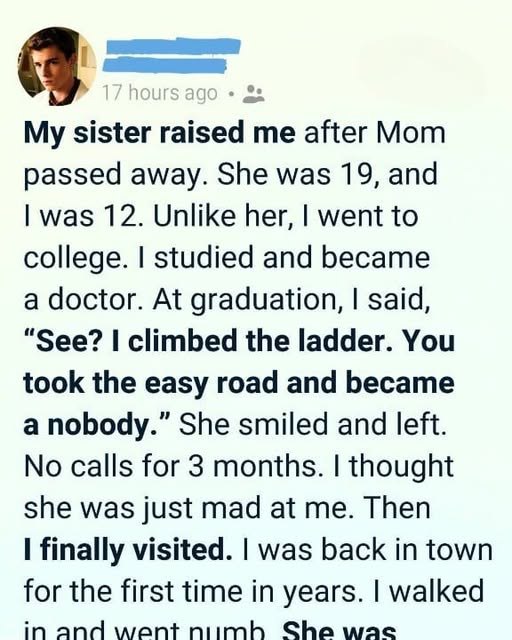
When our mother died, I was twelve years old.

Hospitals have a particular silence after tragedy — the kind that smells faintly of antiseptic and finality. I remember standing in that quiet, unsure where to look or who would guide me next.

My sister was nineteen.

In the weeks that followed, she made a choice that did not come with applause or ceremony. She left her university courses. She folded her ambitions neatly and placed them aside. Without speeches or declarations, she stepped into adulthood faster than anyone should have to.

She became steady.

While others her age prepared for exams and parties, she learned the cost of rent, utility bills, and groceries. She worked long shifts in the service industry, often beginning before sunrise. I didn’t fully understand then how tired she must have been. I only knew that dinner appeared on the table and the lights stayed on.

She never spoke about what she gave up.

She made sure I finished my homework. She attended parent meetings. She laughed at my jokes even when her eyes carried exhaustion. If she cried, she did it quietly — somewhere I would not see.

There is a kind of leadership that doesn’t come with a title. It looks like showing up every day when leaving would be easier.

Years passed.

My classmates celebrated college acceptances and first jobs. My sister collected something different — worn shoes, sore hands, and the discipline of someone who refused to let poverty decide our story.

She taught me that intelligence is not only found in classrooms. It is found in resilience. In budgeting with precision. In knowing when to be gentle and when to be firm. In building safety out of almost nothing.

The degrees on my office wall today carry my name, but they are not mine alone. They were paid for in early mornings and late nights at a diner. In bus rides she walked instead of taking. In meals she skipped so I would not have to.

She does not frame her sacrifices as heroism. She simply says, “We did what we had to do.”

But I know better.

Greatness is not always loud or celebrated. It is often a quiet decision made in the hardest moment: to protect someone else before yourself.

My sister became my anchor when the world tilted.

And if I have become anything of worth, it is because she chose love over ease, responsibility over recognition.

The world measures success with titles and salaries.

I measure it with the memory of her coming home in the rain — tired, but smiling — so I would never feel alone.

That is the kind of greatness no institution can award.

And it lasts longer than any certificate ever will.
The Surprise I Never Expected After My Husband’s Promotion

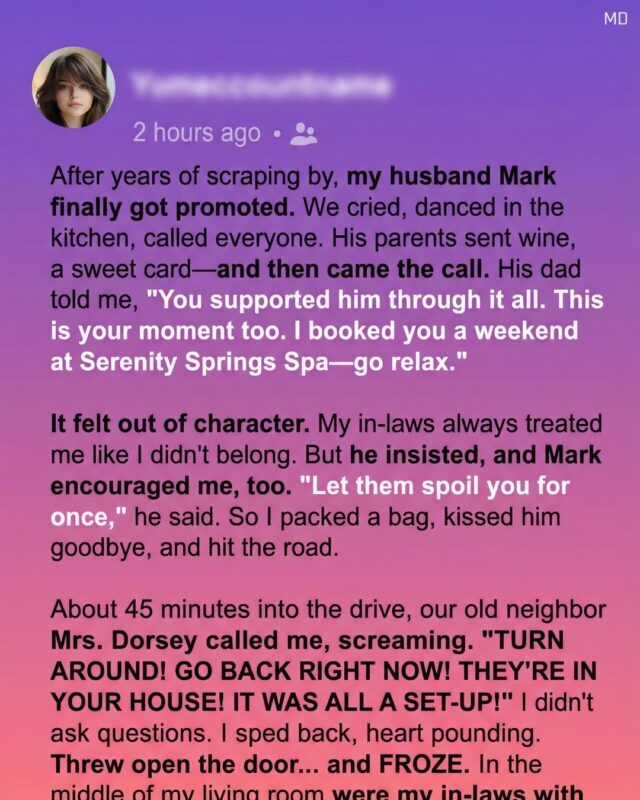
When Mark finally got the promotion he had been working toward for years, it felt like our entire past had led to that moment. We had stretched every dollar, postponed vacations, and encouraged each other through late nights and early mornings. So when the call came, we celebrated in the kitchen like teenagers—laughing, spinning, and holding onto each other as if the walls themselves understood what it meant. His parents sent a thoughtful card and a bottle of wine. Then his father called and surprised me. “You stood by him through everything,” he said warmly. “This weekend is for you. I booked you a stay at Serenity Springs Spa.” It sounded generous, almost too generous, considering our history.

I hesitated. My relationship with my in-laws had always been polite but distant. Still, Mark urged me to go. “Let them show you appreciation,” he said. “You deserve it.” I packed a small bag, kissed him goodbye, and started the drive feeling a mix of gratitude and unease. About forty-five minutes into the trip, my phone rang. It was Mrs. Dorsey, our longtime neighbor, her voice shaking. “Turn around,” she said urgently. “Something’s happening at your house.” My heart began racing before she even finished her sentence. I didn’t ask for details—I just turned the car around and headed back as quickly as I could.

When I pulled into the driveway, everything looked ordinary from the outside. But the front door was slightly ajar. I stepped inside, bracing myself for the worst. Instead of chaos, I found Mark’s parents standing in the living room—along with a small group of friends and family. For a second, I couldn’t process what I was seeing. Then someone shouted, “Surprise!” The room erupted in applause. Balloons floated near the ceiling, and a banner hung across the wall: To the Woman Behind the Success. Mrs. Dorsey had been in on it the whole time. My in-laws had planned a celebration not just for Mark’s promotion, but for the quiet sacrifices I had made along the way.

As the evening unfolded, stories were shared—moments I had long forgotten, small acts of support that others had noticed. Mark took my hand and thanked me in front of everyone. His father admitted that he hadn’t always expressed appreciation well, but he wanted to start now. The spa weekend hadn’t been a distraction; it had been part of a plan to remind me that partnership means lifting each other up. Standing there surrounded by warmth and sincerity, I realized something important: sometimes the most meaningful recognition comes not from titles or pay raises, but from the acknowledgment of the love and loyalty that made those achievements possible.

When Generations Meet: A Heartwarming Moment at the Food Court

I took my 92-year-old father to the mall last weekend to buy a new pair of shoes, something sturdy but comfortable enough for his daily walks. After finding the perfect pair, we decided to sit down at the food court for a simple lunch. That’s when I noticed he seemed distracted. His eyes kept drifting toward a teenager sitting nearby, a boy with brightly colored spiked hair—green, red, orange, and blue blending together like a living rainbow. The young man shifted in his seat, clearly aware of my father’s repeated glances. I braced myself, unsure of what might unfold between two generations shaped by very different worlds.

The teenager finally turned, a playful but slightly defensive smile on his face. “What’s the matter?” he asked. “Never done anything wild in your life?” His tone carried a hint of sarcasm, but also curiosity. I knew my father well enough to expect a thoughtful reply rather than a sharp one. He set down his cup of coffee carefully, his expression calm and reflective. For a moment, the busy noise of the food court seemed to soften, as if the world was waiting to hear what wisdom a 92-year-old man might offer in response to a challenge from youth.

My father chuckled gently. “Oh, I’ve done plenty of wild things,” he said. “I once took a leap into the unknown without knowing where I would land. I started a business with nothing but determination. I moved to a new city with only a suitcase and hope. I fell in love with someone who changed my life forever.” His eyes sparkled as he spoke, not with defiance, but with warmth. “The color of your hair,” he added kindly, “is just one way of showing courage. Life gives us many others.” The teenager’s posture softened, the tension dissolving into a shared smile.

As we left the mall, I realized the exchange had been more than a simple moment of humor. It was a quiet reminder that courage doesn’t belong to any single generation. It shows up in different forms—sometimes in bright hair and bold fashion, other times in steady resilience and life-earned wisdom. Watching my father walk beside me, carrying his new shoes and a lightness in his step, I understood something important: respect grows when we choose conversation over judgment. And sometimes, the most colorful stories are the ones written across a lifetime.

From Storage to Travel Kits: Clever Uses for Eyeglass Cases

In a time when sustainability is more important than ever, many everyday items are thrown away long before their usefulness is truly over. One small but surprisingly versatile object is the eyeglass case. Once a pair of glasses is replaced, the case often ends up forgotten in a drawer—or worse, in the trash. Yet these compact, durable containers are designed to protect delicate items, which makes them perfect for a variety of practical uses. With a little creativity, an old eyeglass case can become a helpful tool for staying organized while also reducing waste.

Because eyeglass cases come in different shapes and materials—hard shell, soft fabric, slim, or wide—they can easily be repurposed for storage. One of the most useful ideas is turning them into mini emergency kits. A small first aid kit with adhesive bandages, antiseptic wipes, and a few basic supplies fits neatly inside and can be kept in a purse, backpack, or car. Similarly, they make excellent travel sewing kits. A few needles, thread, buttons, and safety pins can help you handle quick clothing repairs without carrying bulky supplies. These compact kits are especially helpful for travelers and busy families.

In today’s digital world, eyeglass cases also offer a smart solution for organizing small tech accessories. Charging cables, earbuds, and adapters can be neatly coiled inside to prevent tangling and damage. For creative individuals, the case can become a portable art kit filled with colored pencils, erasers, or a small notepad—perfect for keeping children entertained or inspiring adults to sketch on the go. They also work well as discreet holders for daily vitamins or medications, helping keep them protected and easy to carry during workdays or trips.

Beyond personal use, eyeglass cases can support organization at home. They can store grooming tools like nail clippers and tweezers, hold small hardware items such as screws and nails, or keep craft supplies like beads and buttons neatly contained. When traveling, they even make practical toothbrush holders. Decorative cases can be reused as small gift boxes or cash envelopes, adding a thoughtful touch to special occasions. Instead of discarding these sturdy containers, repurposing them is a simple step toward a more organized life and a more sustainable planet.

How to Adjust Your Fitness Plan Based on Your Body Type

Understanding body types can be a helpful starting point when building a fitness and nutrition plan. While everyone is unique, many people loosely identify with one of three general categories: ectomorph, mesomorph, or endomorph. These classifications describe natural tendencies in body shape, metabolism, and muscle development. They are not strict labels or limitations, but rather guidelines that can help individuals make smarter training and eating choices. By recognizing natural strengths and challenges, people can work with their bodies more effectively and set realistic, sustainable goals.

Ectomorphs are often described as naturally slim, with narrower shoulders, longer limbs, and lower levels of body fat. They typically have a faster metabolism, meaning they burn calories quickly—even at rest. This can make it easier to stay lean, but it may also make gaining weight or building muscle more challenging. For ectomorphs who want to increase muscle mass, strength-focused training is usually most effective. Emphasizing compound movements such as squats, presses, and rows can stimulate overall muscle growth. Limiting excessive cardio and ensuring sufficient calorie intake—especially from protein, complex carbohydrates, and healthy fats—can also support progress.

Mesomorphs tend to have a naturally athletic build, with broader shoulders and a more defined muscle structure. Their metabolism is generally balanced, allowing them to gain or lose weight with relative ease depending on their habits. This adaptability is a major advantage, as mesomorphs often respond quickly to consistent training. However, maintaining balance is key. A combination of strength training and moderate cardiovascular exercise usually works well to preserve muscle while supporting overall health. A balanced diet that includes lean proteins, whole grains, fruits, vegetables, and healthy fats can help maintain steady energy and body composition.

Endomorphs often have a softer, rounder body shape and may store body fat more easily due to a slower metabolism. While weight management can feel more challenging, endomorphs frequently have natural strength and perform well in resistance-based exercises. For this body type, consistency is especially important. A mix of strength training and regular cardio—such as interval workouts or steady-paced sessions—can help support metabolic health and body composition goals. Nutritionally, focusing on protein-rich meals, fiber, and minimally processed foods can help maintain stable energy levels. Ultimately, understanding these body type tendencies empowers individuals to create personalized, balanced routines that promote long-term wellness.

DIY Reed Diffuser: Easy Homemade Room Fragrance for a Fresh, Natural Scent

With just a handful of simple ingredients, you can create an elegant room fragrance that releases a gentle, continuous scent—without sprays, electricity, or open flames. A homemade reed diffuser is an easy and affordable way to keep your living space smelling fresh while maintaining full control over the fragrance and its intensity. Unlike many store-bought options, this DIY alternative allows you to choose exactly what goes into your home environment. You can adjust the aroma to suit the season, your mood, or a specific room, all while adding a decorative touch to your interior.

Making your own room fragrance offers several practical benefits. First, you decide which scents to use, whether that means light citrus notes for freshness or calming lavender for relaxation. Second, you can avoid unnecessary artificial aerosols and overly strong synthetic blends. It is also a budget-friendly solution, as the ingredients are simple and often already available at home. The finished diffuser—typically presented in a small glass bottle with wooden sticks—can double as a stylish décor piece. Best of all, the scent disperses evenly and subtly, creating a pleasant atmosphere without overwhelming the space.

To make a basic reed diffuser, you will need a small glass container with a narrow opening, several wooden sticks (such as bamboo or rattan), a carrier liquid like alcohol or a light base oil, and your chosen fragrance, such as essential oils. Start by ensuring the container is clean and dry. In a separate cup, mix the carrier liquid with a few drops of your selected scent and stir well. Carefully pour the mixture into the bottle, then place the wooden sticks inside. Over the next few hours, the sticks will absorb the liquid and begin diffusing the aroma into the air through a natural process known as capillary action.

You can easily adjust the fragrance strength to your preference. Using fewer sticks will create a lighter scent, while adding more will intensify it. Turning the sticks occasionally can refresh the aroma, and a narrow bottle opening will slow evaporation for longer-lasting results. Popular scent choices include lemon, orange, and bergamot for a bright feel; vanilla or lavender for comfort; and eucalyptus or mint for a clean, refreshing effect. Always place the diffuser out of reach of children and pets, ensure the container is stable, and start with a mild mixture if you are sensitive to fragrances. With minimal effort, you can enjoy a customized, elegant scent that enhances your home naturally and beautifully.

After 39 Years of Marriage, I Finally Opened My Husband’s Locked Closet

My husband Thomas and I shared a quiet, steady marriage built over nearly four decades. We started young, with little more than a small apartment, secondhand furniture, and big dreams. Together, we bought a house, saved for retirement, and built a life grounded in love and trust. Or so I believed—until the day he died, and I was left alone with a locked closet he had always forbidden me to open. Out of grief and curiosity, I hired a locksmith, expecting old papers, only to uncover a life I had never known.

Inside the closet were boxes, letters, and a heavy strongbox. At first, I feared betrayal, imagining secrets that could shatter the marriage I had cherished. But as I read the carefully tied bundles of letters, the truth slowly emerged. Thomas had not been hiding a secret lover or a hidden child. He had been quietly supporting a young man—his nephew—whose life had been upended by tragedy. Through decades of correspondence, I discovered Thomas had helped him through school, sports, and life’s challenges, never seeking credit or recognition.

The strongbox held photographs, a worn baseball glove, newspaper clippings, and legal documents. Thomas had carried the weight of family shame with quiet dignity, protecting both the young man and the family’s reputation. He had quietly stood in the background at graduations, lent support through letters, and ensured his nephew could have a chance at a normal life. His actions were not deceitful—they were acts of love, responsibility, and courage. I realized the locked closet was never a barrier between us but a testament to his character and sacrifice.

When I delivered the box of keepsakes to the nephew, I saw the truth reflected in his eyes: Thomas’s love and honor had endured even in silence. Returning home, I looked at the open closet and felt relief instead of suspicion. For 39 years, I had feared what I might find, confusing secrecy with dishonor. But Thomas had been a man of integrity, quietly protecting those he loved. That closet, once a symbol of mystery, became a reminder that love often works in ways unseen, and that silence does not diminish devotion.

How an Onion Slicer Can Make Cooking Faster, Safer, and Easier

If you’ve ever brought home a curious kitchen gadget from a thrift store and wondered what it does, you’re not alone. One common mystery item is the onion and vegetable slicer—a practical tool designed to make food prep faster and more consistent. Typically made of plastic or metal, it features a base fitted with sharp, parallel blades. By pressing a vegetable through the blades, you can create even slices in seconds. Though simple in design, this handy device has remained popular because it saves time and reduces the need for advanced knife skills.

An onion and veggie slicer is especially helpful for preparing firm vegetables like onions, potatoes, cucumbers, zucchini, apples, and carrots. It produces uniform slices that cook evenly, which is ideal for dishes like roasted vegetables, salads, casseroles, or homemade chips. Because your hands stay above the blades—often with the help of a guard or pusher—it can also be a safer option for beginners or those who find detailed knife work challenging. As a bonus, slicing onions more quickly may reduce exposure to the vapors that cause tearing, making meal prep a little more comfortable.

To use the slicer effectively, place it on a stable, non-slip surface and trim the ends of your vegetable so it sits flat. Apply firm, even pressure to push it through the blades. Afterward, rinse the tool promptly, as small food pieces can lodge between the blades. A soft brush or old toothbrush works well for cleaning hard-to-reach areas. If the slicer is metal, dry it thoroughly to prevent rust. If you purchased it secondhand, soak it in warm, soapy water and sanitize it carefully before use, ensuring the blades are in good condition.

While it may not replace a chef’s knife or a mandoline for every task, the onion and veggie slicer offers simplicity and reliability. It usually provides one fixed thickness, but that limitation can also make it straightforward and easy to manage. For quick weeknight meals or batch prep, it’s a dependable helper that reflects a practical approach to cooking. Sometimes, the simplest tools are the ones that quietly make the biggest difference in the kitchen.

How Dylan and Cole Sprouse Built Successful Careers Beyond Disney Channel

Dylan Sprouse and Cole Sprouse first gained national recognition as twin brothers on a hit family sitcom that became a defining show for a generation of young viewers. Born on August 4, 1992, the duo quickly stood out for their comedic timing, charm, and natural chemistry on screen. As children growing up in the public eye, they experienced a level of fame that few young actors encounter. Yet rather than allowing early success to permanently define them, the brothers made a thoughtful decision to step back from nonstop television work. They chose to create space for personal growth and to explore who they were beyond their childhood roles.

After concluding their run on the Disney Channel, both enrolled at New York University, placing education ahead of immediate entertainment opportunities. Dylan studied video game design, developing an interest in storytelling through interactive media and digital creativity. Cole pursued humanities and archaeology, immersing himself in cultural history and research. Their decision to attend college signaled maturity and independence, demonstrating that long-term development mattered more than short-term visibility. University life gave them the opportunity to grow outside the spotlight, build academic discipline, and experience a more typical young adulthood away from constant public scrutiny.

In the years following graduation, each brother returned to creative work with renewed focus and intention. Dylan explored independent film projects and entrepreneurial ventures that reflected his expanding interests beyond acting alone. Cole stepped into a prominent television role that introduced him to a new audience and later branched into film. Alongside acting, he cultivated a serious passion for photography, contributing to fashion and editorial publications. Both have shown a commitment to selecting projects carefully, prioritizing creative fulfillment and longevity over quick fame. Their careers illustrate a willingness to evolve while maintaining control over their professional direction.

Their personal lives have matured alongside their careers. Dylan married model Barbara Palvin in 2023, while Cole has been publicly associated with model Ari Fournier since 2021. Though fans occasionally hope for a major on-screen reunion, the brothers have indicated that any collaboration would need genuine creative purpose rather than relying solely on nostalgia. Their journey highlights an important message: early fame does not have to dictate an entire life. Through education, thoughtful career decisions, and steady personal growth, Dylan and Cole Sprouse demonstrate how former child actors can successfully transition into adulthood with balance, independence, and vision.

When Doing the Right Thing Changed My Family Forever

For years, I never told my parents that I had become a federal judge. In their eyes, I was still the son who had “dropped out” and quietly drifted away without achieving anything impressive. My sister, Emily, was always seen as the successful one—confident, outspoken, and constantly praised. When I returned home for my father’s birthday, I kept things simple, arriving in my old gray sedan that had long been the subject of family jokes. During dinner, Emily mentioned her SUV was being repaired and casually asked to borrow my car. Before I could respond, my mother encouraged me to hand over the keys. I agreed without hesitation, not expecting the evening to take a dramatic turn.

Just two hours later, Emily rushed back inside looking shaken. She admitted she had been involved in an accident and had panicked, driving away instead of stopping. The situation was serious, yet my parents’ first instinct was to protect her reputation rather than address what had happened. My mother urgently suggested that I say I had been the one driving, insisting it would spare Emily from consequences. My father silently supported the idea. I calmly asked Emily if she had caused the accident and left the scene. When she admitted it without much concern, I realized that ignoring the truth would only make matters worse.

I then explained that there was evidence—dashcam footage from my car, location tracking data, and a recorded conversation from moments earlier. The atmosphere in the room shifted instantly. Shortly afterward, law enforcement officers arrived, having already received reports from witnesses. The injured cyclist had survived but was in critical condition. When one of the officers addressed me as “Judge,” my parents finally understood that the son they had underestimated had built a life rooted in responsibility and public service. That night was not about proving a point or embarrassing anyone—it was about accountability and ensuring that the law served its purpose.

In the months that followed, Emily faced the legal consequences of her actions, and my relationship with my parents changed significantly. Despite the tension, I felt a sense of calm knowing I had acted with integrity. I later visited the injured cyclist, who thankfully recovered, and his resilience reinforced why honesty matters. Justice is rarely loud or dramatic; more often, it is steady and principled. Choosing truth over family pressure was difficult, but protecting wrongdoing would have caused far greater harm. In the end, my decision was not about judgment—it was about upholding the values I had committed my life to protecting.

Popular

PRAYERS ARE NEEDED FOR KURT RUSSELL!!

0
Kurt Russell, one of Hollywood’s most respected and beloved actors, has captivated audiences for decades with his charisma, versatility, and memorable performances. From his...