Entertainment

Her biological father left before she was even born, and she was raped in her own home by a man who claimed he had paid her mother $500.

For decades, Demi Moore has been known as one of Hollywood’s most recognizable and powerful actresses. Her performances captivated audiences around the world, and she eventually became one of the highest-paid actresses of the 1990s.

But behind the fame, glamour, and red-carpet appearances lies a childhood story that was anything but easy.

Long before she became a global star, Demi Moore grew up in a world filled with instability, trauma, and uncertainty.

She was born in 1962 in Roswell, New Mexico, to a teenage mother named Virginia. Her biological father, an Air Force airman named Charles Harmon Sr., abandoned her mother after only a short marriage — leaving before Demi was even born.

By the time she entered the world, her father was already gone.

Just three months later, her mother remarried a newspaper advertising salesman who would become Demi’s stepfather. But stability never truly arrived.

Because of his constantly changing jobs, the family moved again and again across different towns and states. Demi never had time to settle in one place or build lasting friendships.

She later described how lonely those years felt.

“I was desperate for a sense of belonging,” she once said.
“So I would become whoever I needed to be depending on where we moved.”

But the instability at home went far beyond frequent relocations.

Her stepfather struggled with alcoholism, and the household was often filled with chaos and tension. Her mother also battled addiction, and the environment became increasingly unpredictable for a young child trying to find safety and normalcy.

Then came a traumatic moment that would leave a lasting scar.

When Demi was just 15 years old, a man entered her home and sexually assaulted her. According to what she later revealed, the man claimed he had paid her mother $500 to be with her.

The shocking betrayal and violation left a deep emotional wound.

Yet the hardships did not end there.

Her family life continued to unravel. Demi later recalled witnessing her stepfather attempt suicide, an experience that deeply affected her as a teenager.

By the age of 16, she had seen more darkness than many people experience in a lifetime.

Eventually, she made a life-changing decision.

She left home.

Dropping out of high school, Demi began trying to support herself and find her own path. She started modeling and slowly entered the world of acting.

Her big break came when she landed a role on the popular soap opera General Hospital, which helped open the doors to Hollywood.

From there, her career exploded.

She went on to star in blockbuster films like Ghost, A Few Good Men, and Indecent Proposal — performances that made her one of the most famous actresses in the world.

But behind every award and standing ovation was a woman who had survived an incredibly painful beginning.

Her story is not just about Hollywood success.

It is about resilience — about a girl who grew up in chaos and trauma, yet somehow managed to rebuild her life and transform herself into an icon.

And for many fans, that may be the most powerful role Demi Moore has ever played:
survivor.

“I was desperate for a sense of belonging, so I adopted different characters wherever I went.”

I Sewed My Daughter a Dress for Her Kindergarten Graduation from My Late Wife’s Silk Handkerchiefs – A Rich Classmate’s Mom Called Me ‘Pathetic’, but What Happened Next the Whole Town Would Never Forget

My wife, Jenna, died two years ago.

It happened fast—far too fast for either of us to understand what was happening. One moment we were arguing over whether the kitchen cabinets should be painted white or blue. Six months later, I was sitting beside a hospital bed at two in the morning, listening to machines beep while I held her hand and begged the universe for more time.

Time didn’t come.

After the funeral, the house felt like a museum of memories. Her coffee mug on the counter. The half-finished grocery list on the fridge. The way the kitchen still smelled faintly like the vanilla candles she loved.

But I couldn’t fall apart.

Not completely.

Because there was Melissa.

She was only four when Jenna passed away. Now she was six—bright, kind, and somehow wise in the quiet way children sometimes become after losing someone important.

Some days she laughs exactly like her mother did.

On those days, my chest tightens.

Since Jenna died, it’s been just the two of us.

I work in HVAC repair. It keeps the lights on most months, but just barely. Some weeks I take double shifts, trying not to think about the stack of envelopes waiting on the kitchen table.

Bills are like whack-a-mole.

You knock one down and another pops up.

Money was tight. Very tight.

But Melissa never complained.

One afternoon she burst through the front door after school, her backpack bouncing behind her.

“Daddy!” she yelled. “Guess what!”

I had just walked in from a job and was halfway through taking off my boots.

“What’s up?”

“Kindergarten graduation is next Friday! We have to dress fancy!” she said, almost vibrating with excitement. Then her voice softened. “Everyone’s getting new dresses.”

I smiled.

“Already? That was quick.”

She nodded, but I could tell she noticed more than I thought she did.

That night, after she went to bed, I opened my banking app and stared at the balance for a long time.

A fancy dress wasn’t happening.

I rubbed my face and sighed.

“Come on, Mark,” I muttered to myself. “Think.”

Then I remembered the box.

Jenna had loved collecting silk handkerchiefs. Every time we traveled, she’d hunt for them in little boutique shops—floral prints, embroidered corners, soft ivory fabrics. She kept them folded neatly inside a wooden box in our closet.

After she died, I couldn’t bring myself to touch them.

Until that night.

I opened the closet and pulled the box down carefully.

Dozens of delicate fabrics rested inside.

And suddenly, a crazy idea formed.

The year before, my neighbor Mrs. Patterson—a retired seamstress—had given me an old sewing machine when she cleaned out her basement. She thought maybe I could sell it to help with money after Jenna passed away.

I never did.

Instead, that night, I pulled it out.

Three long nights followed—YouTube tutorials, calls to Mrs. Patterson, and more determination than skill.

But slowly, something began to take shape.

The dress was made from Jenna’s handkerchiefs—soft ivory silk stitched together with tiny blue flowers scattered across the patchwork.

It wasn’t perfect.

But it was beautiful.

The next evening I called Melissa into the living room.

“I have something for you.”

Her eyes widened.

“For me?”

I held up the dress.

For a moment she just stared.

Then she gasped.

“Daddy!”

She rushed forward and grabbed the fabric.

“It’s so soft!”

“Try it on,” I said.

A few minutes later she burst out of her bedroom, spinning.

“I look like a princess!” she shouted.

I swallowed hard as she ran into my arms.

“The fabric came from Mommy’s silk handkerchiefs,” I told her softly.

Her face lit up.

“So Mommy helped make it?”

I smiled.

“Something like that.”

She hugged me again.

“I love it!”

Every sleepless night had been worth that moment.

Graduation day arrived warm and bright.

The school gym buzzed with chatter as parents filled the bleachers. Kids ran around in tiny suits and colorful dresses.

Melissa held my hand as we walked inside.

“You nervous?” I asked.

“A little.”

“You’ll do great.”

She smoothed the skirt of her dress proudly.

A few parents smiled when they noticed it.

Then something happened.

A woman wearing oversized designer sunglasses stepped directly in front of us.

She stared at Melissa’s dress.

Then she laughed.

“Oh my God,” she said loudly to the other parents nearby. “Did you actually make that dress?”

I nodded.

“I did.”

She looked Melissa up and down like she was judging something unpleasant.

“You know,” she said sweetly, “there are families who could give her a real life. Maybe you should think about adoption.”

The gym fell silent.

Melissa squeezed my hand.

I felt heat rush into my face.

Before I could answer, the woman laughed again.

“How pathetic.”

I was trying to think of something calm to say when suddenly her son tugged on her sleeve.

His name tag read “Brian.”

“Mom,” he said loudly.

She waved him off.

“Not now.”

“But Mom,” he insisted, pointing at Melissa’s dress. “That looks like the silk handkerchiefs Dad gives Miss Tammy when you’re not around.”

The room froze.

I blinked.

Brian kept going.

“He brings them from the store near the mall. Miss Tammy says they’re her favorite.”

Parents started whispering.

The woman slowly turned toward her husband.

Her confident smile disappeared.

The man looked like he wanted the floor to open up and swallow him.

“Brian,” he muttered. “Stop talking.”

But kids don’t stop when adults want them to.

Brian pointed toward the gym entrance.

“Here’s Miss Tammy now!”

Everyone turned.

A young woman stepped inside, confused by the sudden attention.

Brian’s mother walked straight toward her.

“Tammy,” she said sharply. “Have you been receiving gifts from my husband?”

Tammy hesitated.

Then she straightened her shoulders.

“Yes,” she said quietly. “For months.”

The gym erupted into whispers.

Within minutes the woman who had mocked us was dragging her husband out of the gym while demanding explanations, leaving behind a room full of stunned parents.

Melissa looked up at me.

“Daddy?”

“Yeah?”

“That was weird.”

I laughed softly.

“Yeah,” I said. “It really was.”

The ceremony continued.

Kids walked across the stage one by one while parents clapped and cheered.

Then the teacher called Melissa’s name.

She stepped forward proudly.

Before handing her the certificate, the teacher leaned into the microphone.

“Melissa’s dress was handmade by her father.”

The gym erupted in applause.

Melissa beamed.

And for the first time since Jenna died, I felt something shift inside my chest.

After the ceremony, parents came over.

One mother touched the dress.

“This is beautiful.”

Another father said, “You should sell these.”

I laughed it off.

But the next morning, something unexpected happened.

Melissa’s teacher had posted a graduation photo online.

The caption read:

“Melissa’s father handcrafted this beautiful dress for her graduation.”

The post spread across town.

By afternoon my phone buzzed with a message.

“Hello Mark. My name is Leon. I own a tailoring company downtown. I saw the dress you made. If you’re interested in part-time sewing work, please call me.”

The next evening I walked into Leon’s shop carrying the dress.

He examined every seam carefully.

Finally he nodded.

“I could use help with custom pieces,” he said. “Nothing full-time yet. But it pays.”

“I’ll take it,” I said immediately.

Months passed quickly.

I fixed air conditioners during the day and worked in Leon’s shop at night while Mrs. Patterson watched Melissa.

Eventually Leon grinned at me one evening.

“You know,” he said, “you could open your own place.”

I laughed at first.

But the idea stuck.

Six months later I rented a tiny storefront two blocks from Melissa’s school.

On the back wall hangs a framed photo from her graduation.

Beneath it—inside a glass frame—is the little silk dress that started everything.

One afternoon Melissa sat on the counter swinging her legs.

“Daddy?”

“Yeah?”

She pointed at the dress.

“That’s still my favorite.”

I smiled.

Standing in that tiny shop, I realized something important.

Sometimes the things we create out of love end up building an entirely new life.

And sometimes, the very thing someone tries to mock becomes the beginning of something beautiful.

When My Pregnancy Was Minimized and One Unexpected Voice Finally Spoke Up

By the time I reached my eighth month of pregnancy, my world had narrowed in ways I never expected. Every movement required planning. Every errand took effort. My body felt unfamiliar, stretched and sore, yet deeply purposeful. I was carrying a new life, and while that filled me with quiet pride, it also left me exhausted in ways no one had prepared me for.

That evening should have been unremarkable. My husband and I had gone to the local market for groceries, nothing unusual, nothing dramatic. By the time we returned home, my legs ached and my back throbbed. The weight of the day pressed down on me, and I did what seemed reasonable. I asked my husband if he could carry the grocery bags inside.

It was not said sharply. It was not a command. It was a simple request from a woman nearing the end of pregnancy, hoping for a small moment of support.

Before he had a chance to answer, my mother in law spoke.

Her voice was sharp, impatient, and loud enough to cut through the air. She looked at me with open irritation and said words I will never forget.

“The world does not revolve around your belly. Pregnancy is not an illness.”

I stood there, stunned. The bags felt heavier in my hands. I waited, instinctively, for my husband to step in. To say something. To acknowledge that what she had said was unkind, or at the very least unnecessary.

He did not.

He nodded, as if agreeing with her. As if her words were reasonable and mine were not.

So I picked up the bags and carried them inside myself. Every step hurt, but not in the way sore muscles hurt. This pain came from something deeper. From feeling dismissed. From realizing that the person who should have stood beside me chose silence instead.

That silence followed me through the evening.

A Long Night of Quiet Thoughts
That night, sleep did not come easily. I lay on my back, staring at the ceiling, listening to the steady breathing of my husband beside me. The baby moved gently inside me, a soft reminder that I was not alone, even if I felt that way.

I thought about how often women are expected to endure without complaint. To carry physical strain, emotional labor, and unspoken expectations, all while being told it is nothing special. I wondered if anyone truly saw what pregnancy demanded. Not just physically, but emotionally.

My husband slept soundly. I lay awake, turning over disappointment in my mind, trying to convince myself that I was being too sensitive. That this was simply how things were.

Morning came sooner than I wanted.

An Unexpected Knock
The sharp knock on the door startled me. It was loud and forceful, echoing through the house in a way that immediately raised my heart rate. My husband rushed to answer it, confusion written all over his face.

Standing outside were his father and his two brothers.

We rarely saw them, especially unannounced. Their presence alone suggested something serious. Something out of the ordinary.

My father in law stepped inside without hesitation. He did not greet my husband. He did not remove his coat. He moved past his son as if he were not there at all.

Then he looked at me.

His expression was steady, his posture firm. He met my eyes directly, something he rarely did.

“I came here to apologize,” he said.

The room went still.

He continued, his voice calm but weighted with authority. “I apologize for raising a man who does not understand how to care for his wife or respect the child she is carrying.”

I felt my breath catch.

My husband stood frozen, his mouth slightly open, unable to respond. His brothers shifted awkwardly, clearly uncomfortable, unsure where to look.

My father in law did not pause.

Words That Changed the Room
“I am also here to make something clear,” he said. “Today, I am going to speak with my lawyer. I had planned to leave my estate to my sons, as tradition expects. But I have been forced to reconsider.”

He looked at my husband, then back at me.

“I now see who the strongest members of this family truly are. My sons, and my daughter in law. Even carrying a child, she shows more strength and responsibility than my own son.”

The silence that followed was heavy.

I could feel my heart pounding. I had never expected this man, often distant and stern, to notice me at all, let alone speak on my behalf. His words were not gentle, but they were honest. And for the first time in a long while, I felt seen.

My husband’s face drained of color. His confidence collapsed under the weight of his father’s disappointment. His brothers looked stunned, as though a foundation they had relied on had suddenly cracked.

As for me, I could not speak. I did not need to.

Redefining Strength
In that moment, something shifted inside me. I realized how narrow many definitions of strength truly are. Strength is often imagined as loud voices, firm commands, physical dominance. But what my father in law recognized was something quieter.

Strength was carrying groceries when your body ached and your heart felt unseen. Strength was enduring dismissal without losing dignity. Strength was continuing forward, even when support was absent.

He saw that.

My husband lowered his head. Shame flickered across his face. For the first time, he seemed to grasp the impact of his silence. His father’s words had pierced through a comfort he had long taken for granted.

I remained quiet. My silence was no longer lonely. It was grounded.

After the Door Closed
The visit ended quickly. My father in law left with his sons, his message delivered and his decision firm. The house felt strangely still once the door closed.

My husband sat down heavily, his hands shaking. He could not look at me.

I watched him, unsure what would come next. Change is never guaranteed by one powerful moment. Words can land deeply, or they can fade.

But something had already changed for me.

I carried the weight of my father in law’s words throughout the day. They were not easy words, but they were freeing. For once, someone acknowledged the effort, the endurance, the quiet strength I carried every day.

That acknowledgment mattered more than I realized it would.

A Quiet Resolution
That night, I lay in bed again. The baby moved beneath my hand, steady and reassuring. I placed my palm over my belly and breathed deeply.

My husband turned toward me. His expression was softer than it had been in months. There was regret in his eyes, and something else too. Awareness.

He did not say much. But the silence between us felt different. Less dismissive. Less heavy.

I do not know what the future will hold. Change can be slow, and sometimes it never comes at all. But I know this.

I am strong.

Not because someone finally said it aloud, but because I have always been. Carrying life, carrying responsibility, carrying myself forward even when others failed to lift a hand.

This time, someone noticed. And that made all the difference.

These are the consequences of sleeping with it! See it! sotd?

In the intricate tapestry of human connection, physical intimacy is often regarded as a pinnacle of shared vulnerability. However, when that intimacy is shared with the wrong person, the aftermath can transcend a simple moment of poor judgment, evolving into a complex web of emotional, social, and physical consequences. The decision to share one’s self with another is rarely a vacuum; it carries the weight of personal values, psychological health, and the potential for life-altering shifts in one’s trajectory. Understanding the profound impact of these encounters is not about judgment, but about recognizing the importance of emotional alignment and self-respect in the pursuit of genuine well-being.

The most immediate and often the most lingering consequence is the emotional turmoil that follows an encounter with someone who does not truly value or respect the other person. When physical connection lacks a foundation of mutual care, it can leave an individual feeling hollow, regretful, or even biologically betrayed. This is largely due to the way the human brain processes intimacy. The release of neurochemicals like oxytocin—often called the “bonding hormone”—creates a sense of attachment that the conscious mind may not be ready to navigate. When this biological pull to connect is met with emotional coldness or dismissal from a partner, it triggers a painful cognitive dissonance. What was intended as a fleeting moment of pleasure can quickly ferment into weeks or months of self-doubt, heartache, and a crushing sense of emptiness.

Beyond the internal psychological struggle, the social and relational ramifications of choosing the wrong partner can be equally devastating. In the age of digital interconnectivity, personal choices frequently spill over into the public eye. If an intimate encounter involves someone who is already committed to another, the resulting fallout often includes shattered trust, destroyed friendships, and public drama that can tarnish a person’s reputation and social standing. The “rumor mill” can be a cruel environment, leading to isolation and increased mental strain. Furthermore, mismatched expectations are a frequent source of conflict in casual settings. When one person views the encounter as a step toward commitment while the other sees it as a temporary diversion, the resulting imbalance creates a breeding ground for resentment and hurt feelings.

Physical health risks represent a more tangible but equally severe consequence of ill-advised intimacy. Engaging in sexual activity without the foundation of trust often leads to a lapse in communication regarding safety and boundaries. Even with the use of protection, the risk of sexually transmitted infections (STIs) or unplanned pregnancies is a reality that can change the course of a person’s life in an instant. The anxiety associated with a health scare or the immense responsibility of an unexpected pregnancy can weigh heavily on an individual’s mental state, especially if the partner is unwilling to provide mutual support. These situations often require difficult decisions and long-term commitments that the individuals were never prepared to make, adding a layer of permanent consequence to a momentary choice.

Perhaps the most insidious effect of sleeping with the wrong person is the way it can distort an individual’s self-perception and their approach to future relationships. Repeatedly engaging in intimate acts that lack emotional depth can lead to a cynical view of love and partnership. Some people develop a defensive mechanism, building high emotional walls that make it nearly impossible to open up to the “right” person when they finally arrive. Trust issues become a self-fulfilling prophecy; if you have been used or undervalued in the past, you may begin to expect that same treatment from everyone else. This can lead to a pattern where an individual seeks external validation through physical relationships to fill an emotional void, only to find that each encounter leaves them feeling more unsatisfied and disconnected than the last.

Breaking this cycle requires a profound commitment to self-reflection and the establishment of firm personal boundaries. Recognizing your own worth is the first step in ensuring that your intimacy is reserved for those who align with your values and emotional needs. It involves moving away from the “reckless bravado” of the moment and toward a more intentional way of living. True wellness is not just about physical health, but about the harmony between our actions and our internal sense of self. Learning from the pain of a “wrong” encounter can be a powerful catalyst for growth, helping an individual to define what they truly want in a partner: respect, consistency, and genuine affection.

The narrative of “the wrong person” serves as a stark reminder that physical closeness is not a substitute for emotional intimacy. While society often presents casual encounters as a harmless norm, the human heart and mind are rarely so simple. Every interaction we have leaves a mark on our psyche, and choosing a partner who respects that sanctity is a vital part of long-term happiness. It is about understanding that the body and the mind are not separate entities; what affects one invariably impacts the other. By choosing to wait for alignment—where physical desire meets emotional respect—we protect ourselves from the grinding numbers of regret and the silent erosion of our self-esteem.

Ultimately, the goal is to cultivate a life where intimacy serves as a source of strength and nourishment, rather than a cause for distress. Awareness is not about fear; it is about empowerment. It is about the extra minute taken to evaluate a situation, the courage to say “no” when things don’t feel right, and the wisdom to prioritize one’s own mental and emotional safety. By making informed choices and respecting the biological and psychological reality of human connection, we build a foundation for safety, longevity, and genuine well-being. Food should sustain the body, and relationships should sustain the soul; neither should silently undermine the foundation of who we are. In the end, the most important relationship we will ever have is the one we have with ourselves, and protecting that relationship is the key to navigating the complex world of human intimacy with grace and resilience.

Why Flight Attendants Sit on Their Hands During Takeoff and Landing and What That Quiet Gesture Reveals About Safety in the Sky

Why Flight Attendants Sit with Their Hands Under Their Thighs During Takeoff and Landing

If you’ve ever looked toward a jump seat during takeoff or landing, you may have noticed flight attendants sitting very still—backs straight, feet firmly on the floor, hands tucked beneath their thighs. To many passengers, the posture can seem unusual or even uncomfortable. It might look like a personal habit.

In reality, it is neither casual nor optional.

That position is part of a specific safety practice known as the brace position, used during the most critical phases of a flight. Behind that quiet stillness is a disciplined mindset of readiness and responsibility—an aspect of the job many travelers rarely see.

Why Takeoff and Landing Matter Most

In aviation, takeoff and landing are considered the moments when the aircraft is under the greatest operational stress. Speed and altitude are changing rapidly, and if something unexpected occurs, the window for response can be very small.

Because of this, flight attendants are trained to assume a posture that both protects their bodies and keeps them ready to act.

Sitting upright with hands tucked beneath the thighs helps anchor the body to the seat. In the event of sudden deceleration or turbulence, this position prevents arms from being thrown forward or striking nearby structures. By keeping their arms secured, attendants reduce the risk of injury to joints and muscles—ensuring they remain capable of helping passengers if needed.

Physical Stability and Mental Readiness

The posture is not only about physical protection. It also supports mental focus.

During takeoff and landing, flight attendants are trained to stay fully alert. They quietly scan the cabin, listen for unusual sounds, and watch for anything out of the ordinary. The still posture helps eliminate unnecessary movement and distraction, allowing them to concentrate on their surroundings.

Training simulations often place cabin crew in high-pressure emergency scenarios. In those moments, calm awareness becomes essential. Their role shifts instantly from service to leadership—guiding passengers, managing panic, and coordinating evacuation if required.

Why Passengers Brace Differently

Passengers and flight attendants are instructed to brace differently for a simple reason: their responsibilities are different.

Passengers are generally told to lean forward and protect their heads and necks, focusing on personal safety. Flight attendants remain upright so they can quickly stand, assess the situation, and begin assisting others without delay.

The hands-under-thighs posture is only one small part of extensive training that includes emergency evacuations, fire response, first aid, and crisis management.

A Quiet Signal of Preparedness
So the next time you notice a flight attendant sitting very still during takeoff or landing, it’s not a quirk or a habit.

It is a quiet expression of discipline and preparedness—someone nearby who is trained to remain calm when moments become uncertain.

Most flights pass without incident. But in the rare moments when something goes wrong, that quiet readiness can make all the difference.

I Took My Wheelchair-Bound Grandpa to Prom After He Raised Me Alone – When a Classmate Made Fun of Him, What He Said into the Mic Made the Whole Gym Go Silent!!

The architecture of a family is often built on the assumption of two parents and a child, but mine was constructed from the wreckage of a house fire and the indomitable spirit of a sixty-seven-year-old man. I was barely a year old when an electrical fault turned my childhood home into an orange-tinted nightmare. I have no memory of the heat or the smoke, only the stories told by neighbors who watched from the lawn as my parents perished. They also told me of the man who refused to wait for the fire department—my grandfather, Tim. He ran back into the inferno, emerging with a blanket-wrapped bundle pressed against his chest. He signed himself out of the hospital the next morning, ignoring the smoke-damaged state of his lungs, because he had a granddaughter to raise.

Growing up with Grandpa Tim was the only life I knew, and it was a life defined by a singular, fierce devotion. He was the man who packed my lunches with handwritten notes, the man who spent hours watching YouTube tutorials until he could master a French braid without losing his place, and the man who showed up to every school play to clap louder than any parent in the room. He wasn’t just a grandfather; he was my father, my mother, and my compass. When I reached high school and began to worry about the social minefields of school dances, he would push the kitchen chairs aside and spin me around the linoleum, teaching me that a lady should always know how to move. “When your prom comes,” he’d promise with a wink, “I’ll be the most handsome date there.”

That promise was tested three years ago when I found him collapsed on the kitchen floor. The doctors used clinical terms like “bilateral” and “massive” to describe the stroke that had stolen his speech and the use of his right side. They told me he would likely never walk again. I sat in that hospital waiting room for six hours, refusing to break, because for the first time in seventeen years, the man who had carried me out of a fire needed me to be the steady one.

Grandpa came home in a wheelchair, but his spirit remained unclipped. Through grueling months of therapy, his speech returned, and though his legs remained idle, his presence in my life was as towering as ever. He was there for every scholarship interview and every milestone, always offering a thumbs-up and a reminder that I was the kind of person life makes tougher, not the kind it breaks. However, the social ecosystem of high school is rarely kind to those who stand out, and a girl named Amber made it her mission to ensure I felt every bit of that friction. Amber was smart, competitive, and possessed a cruel streak that she used like a scalpel. She had spent months whispering about who I might “actually” manage to bring to prom, her laughter echoing through the hallways like a bad cold.

When prom season arrived, I didn’t care about the limo groups or the corsage debates. I had one plan, and it involved the navy suit sitting in Grandpa’s closet. When I asked him to be my date, he hesitated, his eyes dropping to the wheels of his chair. “I don’t want to embarrass you, sweetheart,” he whispered. I crouched beside him, taking his hand. “You carried me out of a burning house, Grandpa. I think you’ve earned one dance.”

The night of the prom, the gym was transformed into a sea of string lights and floral centerpieces. I wore a deep blue dress I had altered myself, and Grandpa looked every bit the gentleman in his freshly pressed suit, a matching pocket square tucked into his jacket. As I pushed his wheelchair through the doors, the murmurs began—some of surprise, some of genuine warmth. We had been in the room for less than two minutes when Amber and her entourage approached with the purposeful stride of people looking for a target.

“Wow,” Amber said, her voice carrying across the gym floor. “Did the nursing home lose a patient? Prom is for dates, Macy, not charity cases.”

The gym went silent. I felt the heat rising in my face, my hands tightening on the wheelchair handles until my knuckles turned white. But before I could speak, Grandpa rolled himself forward toward the DJ booth. The music cut out, and the silence deepened until the only sound was the hum of the air conditioner. Grandpa took the microphone, his gaze steady as he looked directly at Amber. “Let’s see who embarrasses whom,” he said, his voice carrying a quiet, resonant authority. “Amber, come dance with me.”

The request was met with a wave of shocked laughter. Amber, caught in the spotlight of her own making, tried to mock him further, but Grandpa didn’t flinch. “Just try,” he challenged. “Or are you afraid you might lose?” Driven by pride and the pressure of a hundred staring eyes, Amber stepped onto the floor.

What followed was a masterclass in resilience. As the music started, Grandpa spun and glided his chair with a grace that silenced the room. He led the space with his left hand, his wheelchair becoming an extension of a man who refused to be defined by his limitations. Amber’s expression shifted from smug irritation to profound surprise, then to a quiet, wet-eyed realization. She saw the tremor in his hand and the sheer effort it took for him to move, yet he moved with the dignity of a king.

When the song ended, the gym erupted in applause. Grandpa took the mic one last time and told the room about our kitchen dances—about the seven-year-old girl stepping on his toes and the grandfather who promised her the world. “My granddaughter is the reason I’m still here,” he said, his voice thick with emotion. “She was there every morning after the stroke. She’s the bravest person I know, and tonight, I finally kept my promise.”

Amber was no longer the school’s apex predator; she was a girl in tears, reaching out to take the handles of Grandpa’s wheelchair to guide him back to me. The DJ transitioned into “What a Wonderful World,” and I took my grandfather’s hand. We danced the way we always had—a push, a turn, and a rhythmic step that we had perfected over a decade of linoleum rehearsals.

When we finally left the gym and headed into the cool night air, the noise of the party faded behind us. The parking lot was a quiet expanse under a canopy of stars. I pushed him toward the car, my heart fuller than it had ever been. Grandpa reached back and squeezed my hand. “Told you, dear. Most handsome date there.”

I laughed, the sound bright against the stillness. “And the best one I could ever ask for.” I looked at him and thought about that night seventeen years ago. He hadn’t just carried me out of the smoke; he had carried me through every dark moment, every doubt, and every victory. He was the bravest man I had ever known, and as we drove home under the starlight, I knew that no fire could ever extinguish the light he had brought into my world.

The Day After the Funeral Nothing Was the Same-

A Letter After the Funeral

The morning after the funeral felt as quiet as I expected. Grief has a way of softening everything—voices, footsteps, even time itself. I assumed the days ahead would simply return to routine.

So when her son called, his voice sharp with anger and confusion, I wasn’t prepared.

He told me that while going through one of his mother’s old boxes, he had found a letter addressed not to him—but to me. His questions came quickly, tangled with frustration. He wanted to know why she would write to someone outside the family, and what it meant.

The truth was, I didn’t know yet.

When he described the contents, however, the picture slowly became clearer.

In the letter, she had written gently. She thanked me for the small things I had done during the final months of her illness—sitting with her when the house felt too quiet, listening when the pain made her restless, speaking calmly when she felt afraid.

She wrote that she could not change her will without stirring conflict within the family. But she wanted me to know that patience and simple kindness had meant more to her than anything she could leave behind.

Her handwriting, he said, was uneven but steady enough to be unmistakably hers.

What unsettled him most, though, was not the letter itself. Beneath it he had found old receipts, scattered notes, and photographs—evidence that at one point she had planned to create a small trust for him.

Plans she had never finished.

He hadn’t known she had tried to close the distance between them. He hadn’t known she regretted the years they had spent apart. Those unfinished papers spoke quietly of something she had hoped to repair, but never quite managed.

As he spoke, his emotions moved through many shapes—anger, sorrow, confusion. Sometimes grief arrives that way, not as tears but as questions that have nowhere to land.

When he finally paused, I answered as gently as I could.

The letter was never meant to hurt him. It was simply the only way she knew to say certain things safely, without reopening wounds she feared she no longer had time to heal.

There was no secret betrayal hidden in it. No attempt to favor one person over another. Only the truth she had carried quietly near the end.

After a while the conversation softened. The sharpness in his voice faded, leaving something more reflective.

And it became clear that what she left behind was not really about money or property.

Her final gift was a reminder—one that many people recognize too late—that time moves faster than we expect. Kindness, even in small moments, leaves deeper marks than wealth ever could. And love left unspoken can become its own quiet burden.

Her letter was perhaps her last attempt to build a bridge she had struggled to cross in life.

Some legacies are written in wills.
Others are written in moments, in regrets, and in the hope that those who remain will choose to speak the words that still have time to be said.

My Groom Pushed Me Into the Pool During Our Wedding Reception and Started Laughing – He Did Not Expect What I Did Next!

The beginning of my relationship with Theo was a series of charming coincidences that I mistook for destiny. We met in a crowded coffee shop when I accidentally claimed his oat milk latte as my own. Instead of the typical urban friction such an error usually causes, he simply tapped me on the shoulder with a grin that could melt the coldest winter morning. He had a natural, effortless charisma that made every room feel warmer. He was the kind of man who remembered your favorite obscure author and had a knack for making you feel like the only person in the room. I fell for the performance completely, as did everyone else in my life.

I still remember the night he met my parents. My mother had prepared her famous pot roast, a dish reserved exclusively for state visits and potential sons-in-law. My father, a retired high school principal with thirty years of experience sniffing out teenage deception, was a harder sell. Yet, within ten minutes, Theo had leaned across the table and managed to convince my father that he was the most earnest man on the planet. By the time the evening ended, my father—a man who rarely gave out compliments—admitted that he genuinely liked him. When Theo proposed a year later in a blooming garden, asking me what I thought about “forever,” I didn’t hesitate. I saw a life of laughter and partnership ahead of us.

However, the architecture of our “forever” began to crack two nights before the wedding. I was hosting a quiet evening with my bridesmaids, our faces covered in skincare masks, when my phone rang. The voice on the other end was slurred, belonging to someone who had clearly spent too much time at Theo’s bachelor party. “You should be careful,” the man wheezed before letting out a pained groan. “He’s planning something.” I dismissed it as the ramblings of a drunk groomsman and went back to my celebrations, never imagining that the warning was a literal foreshadowing of the humiliation to come.

The wedding itself was a masterpiece of planning. We were married under a rose bower on a sweeping estate, and the reception was set around a glimmering pool. I felt otherworldly in my gown—a heavy, intricate creation of white satin and lace that made me feel like the protagonist of a fairy tale. Two hundred guests were enjoying the evening air, the music was perfect, and Theo was working the crowd with his usual magnetic energy. I watched him from a distance, feeling like the luckiest woman alive, until he stepped toward the microphone near the water’s edge.

“Can I have your attention for a second?” he called out, that familiar, boyish grin plastered on his face. “I just need my beautiful bride over here for a moment.”

I walked toward him, my heart full of anticipation for what I assumed would be a romantic public tribute. I stood beside him at the very edge of the pool, smiling at our friends and family. “What are you up to?” I whispered playfully. He looked at me, his eyes gleaming with a mischief I misunderstood. “Well, you said you were hoping for a surprise today,” he said loudly enough for the front row to hear. “So here it is!”

The next thing I felt were his hands on my shoulders, and then I was falling. I didn’t even have time to close my mouth before the cold water of the pool swallowed me whole.

The weight of the satin gown was immediate and terrifying. The fabric, once elegant, became a leaden shroud that pulled me toward the bottom of the pool. Disoriented and gasping, I fought against the wet lace and the heavy veil, my heels catching on the pool floor. I kicked off my shoes, scrambled for purchase, and finally broke the surface, gasping for air. The first sight that met my eyes was Theo, doubled over in hysterics, pointing at me as if I were a punchline in a locker-room joke.

The silence from the guests was deafening, followed by a wave of horrified murmurs. My father was the first to move, the sharp strike of his cane against the terrace sounding like a gavel. His face was a mask of fury I hadn’t seen since my childhood. I raised a hand to stop him, needing to handle this myself. As I struggled to the edge, Theo’s younger brother crouched down to help me out. “I tried to warn you,” he murmured, his eyes full of shame for his brother.

I stood on the tile, water cascading off my ruined dress, my makeup a smeared mess, and my dignity shattered in front of everyone I loved. Theo was still chuckling, telling people to “relax” and not be such “wet blankets.” He actually thought I would laugh this off. He thought that ruining a ten-thousand-dollar gown and endangering my safety in front of our professional and personal circles was a “prank.”

“I was warned that you were planning something,” I said, my voice shaking but clear. Theo’s smile finally began to flicker. “I ignored it because I didn’t believe the man I was about to marry would choose to humiliate me on the most important day of our lives.”

“Babe, come on,” he stammered, looking around for support that wasn’t coming. “It’s funny. You’ll laugh about it later.”

“I don’t think I will,” I replied. I reached for the decorative folder on the table next to the pool—the one containing our marriage license. We were supposed to sign it during a special ceremony later in the evening. I held the crisp, dry paper up so the guests could see it. “It’s a good thing we hadn’t signed this yet,” I said. “Because this wedding is over.”

With a sudden, sharp motion, I tore the license down the middle.

Theo erupted. “What? You’re freaking out over a joke? After everything we built?” But he was drowned out by the guests. My father, my bridesmaids, and even Theo’s own family rose in a collective roar of outrage. The “smooth talker” was suddenly surrounded by two hundred people who saw him for exactly what he was: a man who valued a cheap laugh over the respect of his partner.

My father stepped forward, draping a towel over my shivering shoulders. “I think you should leave,” he said to Theo, his voice like iron. Security guards, who had been watching the debacle with clear distaste, stepped in and escorted a shouting, red-faced Theo toward the gate. When the iron lock clicked shut behind him, the garden fell into a heavy, contemplative silence.

My maid of honor, Cally, took my arm and began leading me toward the main house to get me out of the sodden dress. I looked back at the empty space where Theo had stood, realizing that the man I loved never actually existed; he was just a collection of practiced smiles and hollow jokes.

“The only person here who laughed at you was him,” Cally said, squeezing my shoulder. “That should tell you everything you need to know. We’re going to clean this up, we’re going to move on, and leaving him in the past will be the only thing you’ll actually laugh about later.”

I nodded, feeling the first spark of relief. I had lost a husband, but I had saved my life. I had learned that the most dangerous people aren’t the ones who yell, but the ones who laugh while they’re breaking you. And as I walked away from the pool, I knew I would never let anyone make me the punchline again.

Hollywood’s Beloved Star Who Captivated Generations—Can You Guess Who She Is?

Sally Field, born on November 6, 1946, in Pasadena, California, is widely recognized as one of the most respected and enduring actresses in American entertainment. Her career has spanned more than five decades across television, film, and theater.

Known for her emotional depth and remarkable versatility, Field has built a reputation for portraying characters that feel authentic, compassionate, and deeply human. Her performances often resonate strongly with audiences who see their own experiences reflected on screen.

Field grew up in a family connected to the entertainment world. Her mother, actress Margaret Field, worked regularly in television during the 1950s and 1960s, which exposed Sally to the industry from an early age.

Despite this early connection to Hollywood, Field’s path to success was not immediate or easy. She faced challenges in establishing herself as a serious performer after beginning her career in lighthearted television comedies.

Her first major acting opportunity arrived in the mid-1960s when she was cast in the popular television series Gidget. The show premiered in 1965 and followed the adventures of a cheerful teenage surfer.

Although the series lasted only one season, it quickly gained a loyal audience. Field’s bright personality and natural charm made her stand out, helping her gain national recognition as a promising young actress.

Soon after, Field landed another memorable television role in the series The Flying Nun, which aired from 1967 to 1970. The show featured her as Sister Bertrille, a novice nun who could fly due to strong winds.

The unusual premise of the series became a cultural talking point during its broadcast years. While the show was lighthearted and comedic, Field’s performance demonstrated her ability to anchor even the most unusual storylines with sincerity.

During this early stage of her career, Field became widely known as a wholesome television personality. However, she soon began searching for opportunities that would allow her to demonstrate greater emotional and dramatic range.

In the early 1970s, Field made a conscious decision to transform her public image. She studied acting with renowned coach Lee Strasberg and began seeking roles that challenged the limitations placed on her early television persona.

Her determination paid off in 1976 when she starred in the television film Sybil. The project required her to portray a young woman coping with dissociative identity disorder.

Field’s performance in the demanding role earned widespread critical praise. Many critics and industry professionals viewed the film as a turning point that proved her dramatic ability beyond comedic television roles.

The recognition she received from “Sybil” opened doors in the film industry. Soon afterward, she began receiving opportunities in more complex and emotionally layered cinematic projects.

One of the most defining performances of Field’s career arrived in the 1979 film Norma Rae. In the movie, she portrayed a textile worker who becomes involved in a labor union movement.

The film explored themes of workers’ rights, economic struggle, and personal courage. Field’s powerful performance captured the determination and vulnerability of a woman standing up for fairness in the workplace.

Her portrayal of Norma Rae Webster earned her the Academy Award for Best Actress. The win established Field as a major talent in Hollywood and transformed her career trajectory.

The role also helped redefine how audiences viewed her abilities as an actress. No longer seen only as a television star, she became recognized as a serious dramatic performer.

Field continued to build an impressive body of work throughout the early 1980s. She selected roles that allowed her to explore complex emotional landscapes and portray women facing significant personal challenges.

In 1984, she delivered another remarkable performance in the film Places in the Heart. The story followed a widow struggling to maintain her family farm during the Great Depression.

Her portrayal of Edna Spalding demonstrated extraordinary emotional nuance and quiet strength. Field’s ability to capture both vulnerability and resilience resonated strongly with audiences and critics alike.

For this performance, she received her second Academy Award for Best Actress. During her acceptance speech, she delivered the now-famous line, “You like me, right now, you like me,” which became a cultural moment.

Throughout the late 1980s and 1990s, Field continued to appear in memorable films. One of her most beloved roles came in the 1989 movie Steel Magnolias.

In the film, she portrayed M’Lynn Eatenton, a devoted mother coping with the illness of her daughter. Her emotionally intense performance in the film’s final scenes remains widely remembered.

Field’s ability to portray maternal strength and vulnerability made her particularly effective in family-centered dramas. Audiences often connected deeply with her characters because they felt genuine and relatable.

In addition to acting in films, Field maintained a strong presence in television. Her work in the medical drama ER earned her an Primetime Emmy Award for Outstanding Guest Actress.

Her guest appearance demonstrated her ability to deliver powerful performances even in short roles. The episode remains one of the most memorable guest performances in the long-running series.

Field also explored directing during her career. In 1996 she directed the television film The Christmas Tree, showing her interest in storytelling from behind the camera as well.

Her creative curiosity has always extended beyond acting alone. Field has spoken about her appreciation for the collaborative nature of filmmaking and the importance of storytelling in shaping culture.

In 2012, she portrayed Mary Todd Lincoln in the historical drama Lincoln directed by Steven Spielberg. The film starred Daniel Day‑Lewis as President Abraham Lincoln.

Field’s performance as the First Lady received widespread critical acclaim. Critics praised her ability to portray Mary Todd Lincoln as both emotionally fragile and intellectually formidable.

Her role earned her a nomination for the Academy Award for Best Supporting Actress, further demonstrating her continued relevance in modern cinema decades into her career.

Outside of acting, Field has long been involved in social advocacy. She has supported causes related to women’s rights, healthcare access, and LGBTQ+ equality.

Her advocacy is deeply personal. Field has spoken publicly about her experiences as a mother and about issues affecting families and communities across the United States.

In particular, she has been an outspoken supporter of LGBTQ+ rights, inspired in part by her son Sam Greisman, who is openly gay and works in the entertainment industry.

Field’s willingness to share personal experiences has helped raise awareness about acceptance and understanding. Many people admire her openness and commitment to supporting marginalized communities.

Over the decades, Field has received numerous honors recognizing her contributions to the arts. These awards reflect not only her talent but also her influence on generations of performers.

Her ability to move seamlessly between comedy and drama has always distinguished her from many of her peers. Few actors have demonstrated such a wide emotional and stylistic range.

Even after more than fifty years in the industry, Field continues to remain active in film, television, and stage productions. Her passion for acting remains evident in every performance.

Audiences across generations have grown up watching her work. From classic television series to award-winning films, her performances have become an important part of American cultural history.

TV & Video

Critics often highlight her authenticity as the defining quality of her acting. Field’s characters feel believable because she approaches each role with empathy and careful emotional understanding.

For younger actors entering the industry, Field’s career serves as a powerful example of resilience and reinvention. She successfully transitioned from teen television star to acclaimed dramatic actress.

Her journey illustrates the importance of persistence and dedication in creative professions. Field’s willingness to challenge herself allowed her to build a long and meaningful career.

Today, she remains a beloved figure in Hollywood and among audiences worldwide. Her performances continue to inspire admiration for their honesty and emotional power.

The legacy of Sally Field is defined not only by awards and achievements but also by the deep connection she has built with viewers through decades of storytelling.

Her work reminds audiences that great acting is not only about performance but about empathy, truth, and the ability to illuminate the human experience.

Through television, film, and advocacy, Field has left an enduring mark on the entertainment industry and on the lives of countless people who have been moved by her work.

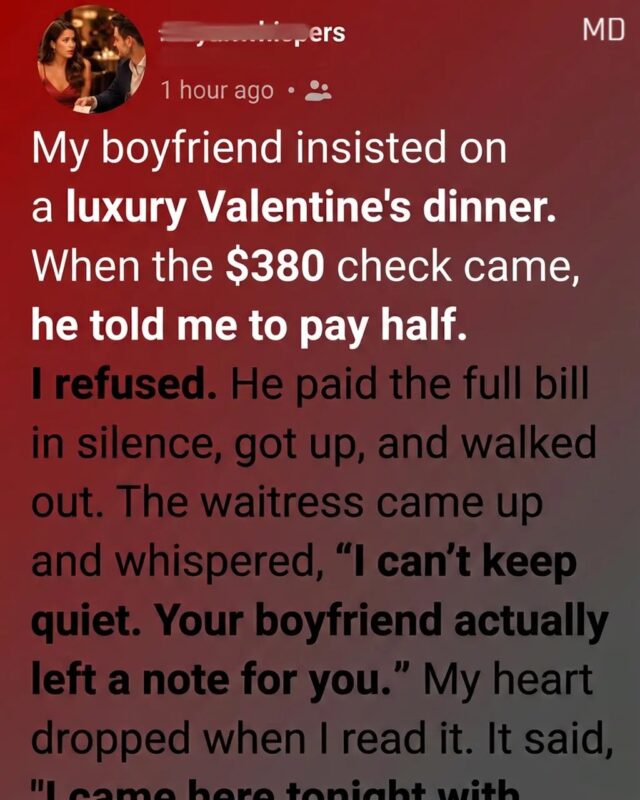
A Valentines Evening That Led to an Unexpected Life Lesson!

The traditional narrative of Valentine’s Day is one of seamless perfection—a scripted sequence of grand gestures, floral arrangements, and carefully curated romance. However, the most profound developments in a relationship rarely occur during the moments that go exactly as planned. Instead, they happen in the friction of the unexpected, when the polish of a romantic evening wears thin and the true character of two people is revealed. For me, a quiet Valentine’s dinner at one of the city’s most elegant establishments became the setting for a psychological unveiling that I never saw coming.

The evening began with a charm that felt almost cinematic. My boyfriend had taken the lead, selecting an upscale restaurant known for its intimacy and culinary precision. The atmosphere was a sanctuary of soft jazz, flickering candlelight, and the low hum of shared secrets from neighboring tables. We spent hours immersed in conversation, the kind of deep, effortless dialogue that makes you feel as though the rest of the world has momentarily ceased to exist. I felt a sense of profound gratitude; he had planned everything, from the reservation to the specific ambiance, and for several hours, the night was a testament to our compatibility.

Then, the bill arrived, and with it, a sudden and jarring shift in the evening’s rhythm. As he glanced at the total—which was undeniably substantial—he casually suggested that we split the amount evenly. The request hung in the air, incongruous with the chivalry of the evening’s lead-up. I paused, the romantic glow of the candlelight suddenly feeling like a spotlight on an uncomfortable reality.

I have always believed that communication is the bedrock of any partnership, and that honesty, even when inconvenient, is a form of respect. I didn’t want to harbor a quiet resentment, so I chose to address the moment with calm clarity. I explained that I found the suggestion surprising; this dinner had been his invitation and his orchestration. In my view, the etiquette of an invitation implies a level of responsibility for the logistics, especially when the guest had no hand in the budgetary planning of the event. I wasn’t being argumentative; I was being firm about my boundaries and my understanding of our social contract.

The air in the booth grew still. He didn’t argue or raise his voice, but the warmth that had defined the last three hours evaporated instantly. He reached for his wallet, paid the full amount in a silence that felt heavy with unsaid things, and stood up. Without a word, he walked away from the table, leaving me alone with the remnants of our dessert and the flickering candle. I sat there for several minutes, the silence of the restaurant now feeling oppressive. I questioned myself: Had I been too rigid? Was I being unfair? Or was I simply standing up for a principle that mattered to me?

As I prepared to leave, the waitress approached the table. She didn’t have the check or a mint; instead, she handed me a small, folded piece of paper. “He asked me to give this to you,” she said softly before moving on.

I opened the note, expecting a parting shot or a cold farewell. Instead, the handwriting was steady and thoughtful. He explained that the evening had been designed with a dual purpose. While it was certainly a celebration of our time together, the suggestion to split the bill had been a deliberate “stress test” for our relationship. He wrote that he wanted to see how we handled a sudden, unexpected disagreement—specifically one involving money and expectations, two of the most common catalysts for relationship failure.

The note argued that anyone can be a perfect partner when the champagne is flowing and the plans are being executed flawlessly. The true measure of a couple, he suggested, is found in how they navigate the moments when expectations clash. He wanted to know if I would fold under pressure, if I would become vitriolic and defensive, or if I would hold my ground with the same calm honesty I had displayed. He wrote that my refusal to compromise my feelings just to keep the peace was, to him, a sign of a person who possessed the integrity required for a long-term partnership.

Reading his words, I felt a profound shift in my perspective. The evening hadn’t been ruined by a dispute; it had been elevated by an experiment in transparency. He wasn’t testing me to be cruel or to “win”; he was observing the machinery of our communication. He valued the fact that I didn’t turn against him in anger, but rather spoke my truth without escalating the conflict into a battle of egos.

This experience redefined my understanding of what a “successful” relationship looks like. We are often taught to avoid conflict at all costs, to smooth over the jagged edges of our differences with the veneer of politeness. But a relationship without friction is often a relationship without growth. The quiet moments where expectations collide are actually opportunities for discovery. They allow us to see the “operational manual” of our partner’s soul—how they listen, how they react to perceived unfairness, and whether they choose patience over frustration.

In the years since that dinner, I have thought often about that note. It serves as a reminder that understanding is built slowly, through small acts of restraint and the courage to be honest even when it’s uncomfortable. A simple dinner had become a classroom for life. It taught me that the most handsome quality a partner can possess isn’t the ability to plan a perfect evening, but the capacity to appreciate the strength it takes to disagree.

Relationships are not static portraits of happiness; they are living, breathing entities that require constant calibration. We learn who people are not when they are giving us what we want, but when they are challenging what we think we deserve. That Valentine’s Day, I didn’t just learn that my boyfriend was a man who valued psychological depth; I learned that I was a woman who was capable of maintaining my dignity in the face of an unexpected challenge.

The evening ended not with a walk into the sunset, but with a drive home in a car filled with a new kind of silence—a silence that was no longer heavy, but reflective. We had survived our first real clash of expectations, and we had done so with a level of clarity that many couples take years to achieve. Sometimes, the best gift you can receive on Valentine’s Day isn’t a piece of jewelry or a grand declaration, but a folded note that tells you that you are seen, you are respected, and your honesty is exactly what the other person was looking for all along. It was a lesson in the quiet power of standing one’s ground, and the rare beauty of a partner who is secure enough to admire it.

Popular

A Simple Christmas Dinner Conversation That Marked the Start of a...

0
Christmas Eve at my parents’ home had always followed the same polished script—beautiful table settings, carefully prepared food, polite conversation, and just enough tension...