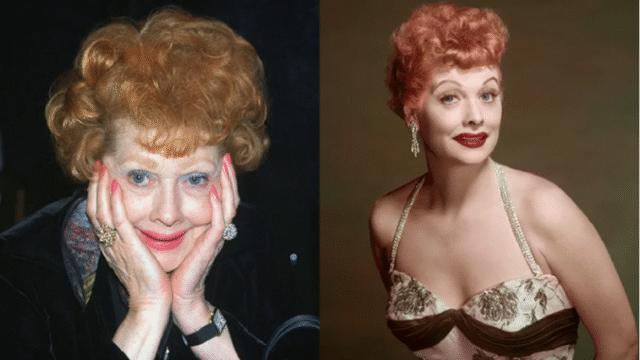
Lucille Ball received a final message of love from Desi Arnaz days after his death.
In the first episode of the CW’s docuseries TV We Love on Oct. 13, Arnaz’s final gesture to his ex-wife and longtime business partner was recalled in a tear-jerker of a segment. While the beloved sitcom couple had divorced in 1960, Arnaz penned a final note to Ball, which was read at her Kennedy Center Honors ceremony on Dec. 7, 1986, just five days after Arnaz’s death.
The letter, which was read onstage by actor Robert Stack, first praised Ball’s talents as a physical comedian in the former couple’s groundbreaking CBS sitcom I Love Lucy. Arnaz then credited Ball for the success of the series.
“The New York Times asked me to divide the credit for its success between the writers, the directors, and the cast. I told them, ‘Give Lucy 90% of the credit and divide the other 10% among the rest of us,’” Arnaz wrote from his deathbed. “Lucy was the show. Viv, Fred, and I were just props, damn good props, but props, nevertheless. P.S. I Love Lucy was never just a title.”
Ball broke down in tears as Stack read the letter. Her second husband, Gary Morton, was by her side to console her. President Ronald Reagan and First Lady Nancy Reagan were also seen in the televised segment as an emotional Ball wiped tears from her eyes.
It wasn’t the first time Arnaz credited Ball for changing his life. In 1954, he delivered a poignant speech at an Ed Sullivan Show tribute at the height of I Love Lucy’s heyday.
“I think if it wouldn’t have been for Lucy, I would have stopped trying a long time ago,” Arnaz admitted. “Because we came to this country and we didn’t have a cent in our pockets. From cleaning canary cages to this night here in New York, it’s a long ways.”
Arnaz died from lung cancer on Dec. 2, 1986, at age 69.
Two days before his death, Ball spoke to him for the last time. During a 2025 interview with CBS Sunday Morning, daughter Lucie Arnaz recounted her parents’ final moments together.
“My mother came down to visit my dad in Del Mar when he was sick,” she said. “And I ran and got as many VHS tapes as I could find. And they did sit there for a couple hours and look at old I Love Lucy shows and laugh and remember.”
She also recounted her parents’ final phone call, which took place on Nov. 30, 1986, their wedding anniversary. Lucie was with her father when her mother called.
“He was very, very sick,” Lucie said of Arnaz. “And I said, ‘I’m going to put him on the phone now, so say what you want to say.’ And I just held the phone to his ear, and all I could hear her saying was, ‘I love you’, like five times in a row. And he listened, and he said, ‘I love you, too, honey.’ And then he said, ‘Good luck with your shows.”
If you’ve watched every episode of I Love Lucy, you may want to know about Lucille Ball’s net worth and how much she made from the show’s six seasons and what she left for her kids when she died.
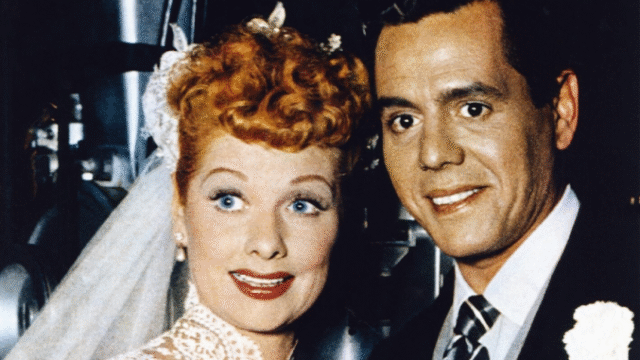
Ball—whose full name is Lucille Désirée Ball—was born on August 6, 1911, in Jamestown, New York. She started acting at the age of 12 years old when her stepfather encouraged her to audition for his Shriner’s chorus line. In 1926, Ball enrolled at the John Murray Anderson School for the Dramatic Arts in New York City (where Bette Davis was also a student). Ball said in a later interview that “all I learned in drama school was how to be frightened.” In 1940, Ball met her future husband, Desi Arnaz, while filming the stage show, Too Many Girls. The couple married that same year.
In 1948, Ball was cast as Liz Cooper, a wacky wife in the CBS Radio comedy show, My Favorite Husband. The show ran for 148 episodes. After the success of My Favorite Husband, Ball was asked by CBS to develop it for television, which she agreed if she could work with her real-life husband, Arnaz. Unimpressed by the pilot episode, CBS turned down a show with Ball and Arnaz, which led them to hit the road as a vaudeville act in which Ball played a zany housewife who tried to get into her husband’s show. After the success of the tour, CBS greenlit I Love Lucy, which went on to run for more than 100 episodes and be one of the most-watched shows in TV history.
Ball and Arnaz’s marriage was portrayed in the 2021 movie Being the Ricardos, in which Nicole Kidman and Javier Bardem starred as the couple. The film was written and directed by Aaron Sorkin. In an interview with Extra in December 2021, Kidman opened up about why she wanted to play Ball. “That is something that Javier and I want to honor,” she said. “But at the same time, you want it to be a true depiction of who they are so that people watching it go, ‘Oh, OK…’ Aaron’s really gone in there, he’s done them proud, but at the same time he has been very true to their spirits… They’re compelling, fascinating… people and at the same time—they are human.”
The story of Ball and Arnaz’s relationship was told in Amy Poehler’s 2022 documentary, Lucy and Desi, which dove into who they were as people in addition to Hollywood stars. “I knew about them as performers, not as people,” Poehler told Variety in 2021. “These two incredible outsiders worked hard to become powerful, influential figures at a time when women and immigrants were not running the system. But at the end of the day, the attempt was to tell a love story: Their long journey of falling in love, working, and staying in love with each other through thick and thin was echoed in their show.” Poehler continued, “And then to watch America’s most powerful couple — they created the idea of a power couple — split up after being on TV, as this example of how things will always be OK, it was interesting. So much is made of their work and comedy, and it should be. But I also think it is also an equal triumph to have a relationship that was the kind that they had. It is hard to maintain a working relationship, as well as a relationship with someone you love and is your partner in raising kids.”
So what is Lucille Ball’s net worth? Read on for how much Ball made on I Love Lucy and how much she was worth when she died.
How much did Lucille Ball make from I Love Lucy?
Lucille Ball starred as the lead of I Love Lucy for 180 half-hour episodes from October 15, 1951, to May 6, 1957. She played Lucy Ricardo, a housewife in New York City, who would concoct various schemes with her best friends, Ethen and Fred Mertz, to appear with her husband, Ricky Ricardo (played by Ball’s real-life husband at the time, Desi Arnaz), the leader of a band at a nightclub. After I Love Lucy ended in 1957, Ball and Arnaz went on to star in three seasons of their own spinoff, The Lucille Ball-Desi Arnaz Show, which was later retitled as The Lucy-Desi Comedy Hour. For four of its six seasons, I Love Lucy was the most-watched show in America and was the first series ever to ends its run at the top of the Nielsen’s rating.
Since its finale, I Love Lucy has been syndicated in dozens of languages across the world, with more than 40 million viewers each year. A re-aired, colorized version of its Christmas episode was watched by more than eight million viewers on CBS in 2013. The show, which was the first scripted TV series to be shot on 35mm film in front of a live studio audience, has won five Emmys and was voted as the “Best TV Show of All Time” in a survey conducted by ABC News and People magazine in 2012.
How much did Lucille Ball make from I Love Lucy? According to Bart Andrews’ 1985 book, The I Love Lucy Book, Ball and Arnaz were paid a joint salary of $4,000 per episode ($2,000 each) for I Love Lucy. The book reports that the couple originally asked for $5,000 per episode, but CBS and Arnaz agreed to $4,000 for complete rights to the show. As for other costs, the book also reports that Philip Morris, a cigarette company, paid the show’s asking price of $26,500 to sponsor I Love Lucy. CBS also paid $5 million for the rights to broadcast the show, according to The I Love Lucy Book.
In 1953, months after the birth of Ball and Arnaz’s second child, Desi Jr., the couple signed a new $8 million contract with Morris for another 100 episodes, with a production budget of around $40,000 to $50,000 per week, according to the book. (The book also reported that twins, Richard and Ronald Lee Simmons, who played Lucy and Ricky’s baby son in I Love Lucy, made $25 per week for one day of filming on Fridays.) After I Love Lucy ended, Ball and Arnaz signed a $2.5 million deal with Ford to sponsor five episodes of The Lucille Ball-Desi Arnaz Show, which was expanded to 13 total episodes. According to The Los Angeles Times, I Love Lucy makes around $20 million each year from reruns.
What was Lucille Ball’s net worth?
What was Lucille Ball’s net worth? Ball died at the age of 77 on April 26, 1989, of a ruptured aorta after open-heart surgery. She was survived by her two children, Lucie and Desi Jr., and her second husband, Gary Morton, whom she married in 1961. Lucille Ball had a net worth of $40 million—equal to about $80 million today—according to the Gazette Review. Desi Arnaz—whom she divorced in May 1960—was worth $20 million at the time of his death, according to Celebrity Net Worth. Arnaz, a regular cigarette smoker, died three years before Ball on December 2, 1986, from lung cancer.
Though much of Lucille Ball’s net worth came from I Love Lucy, a lot of her and Arnaz’s money was also from the merchandise deals that came after the birth of their son, Desi Jr., in 1953, which led to sponsorships for dolls, comic books, cigarette lighters, aprons and more items, according to The I Love Lucy Book. The financial windfall led industry experts to nickname Desi Jr. as “Lucy’s $50 Million Baby.”
In 1950, Ball and Arnaz founded their own production company, DesiLu Productions, which has produced shows like I Love Lucy, The Lucy Show, Untouchables, Mission: Impossible and Star Trek. The company was the second-largest independent television company in the United States until 1962 and remained as the number-one independent production company in the country until it was sold in 1968 to Paramount Television. Both Ball and Arnaz owned a majority stake in DesiLu until 1962 when Ball bought out Arnaz and ran the company by herself for seven years. She sold her shares of Desilu to Gulf + Western (later Paramount Television) for $17 million (a value of $132 million in 2020) in 1968.
Desi Arnaz loved Lucille Ball right until the end.
The famed actor died on Dec. 2, 1986, but just two days before his death, he had a brief conversation on the phone with his ex-wife. Their daughter, Lucie Arnaz, was by her ailing father’s side when she called her famous mother, allowing the former husband and wife duo to have one final conversation.
“He was very, very sick. And I said, ‘I’m going to put him on the phone now, so say what you want to say,’ ” Lucie, 73, told CBS Sunday Morning. “And I just held the phone to his ear, and all I could hear her saying was, ‘I love you’, like five times in a row. And he listened, and he said, ‘I love you, too, honey.’ And then he said, ‘Good luck with your shows.’ ”
The day they last spoke was Nov. 30, which was their wedding anniversary, their daughter revealed.
Lucille, however, would get another surprise from her ex-husband just days later. As she was being celebrated at the Ninth Annual Kennedy Center Honors on Dec. 7, 1986, she discovered that Desi had written a tribute to her, which Robert Stack read on stage.
“I Love Lucy had just one mission: to make people laugh. Lucy gave it a rare quality,” the posthumous letter said. “She can perform the wildest, even the messiest, physical comedy without losing her feminine appeal. The New York Times asked me to divide the credit for its success between the writers, the directors and the cast. I told them, ‘Give Lucy 90% of the credit and divide the other 10% among the rest of us.’ “
“Lucy was the show. Viv, Fred and I were just props, damn good props, but props never the less,” the letter continued. “P.S. I Love Lucy was never just a title.”
Clearly moved, the Three For Two actress was seen wiping tears away and getting emotional.
Lucille and Desi married in 1940, but the next few years were turbulent and filled with frequent fights, as he was routinely caught having affairs.
In chatting with CBS, however, their daughter argued that her father never had affairs of the heart.
“People say he had affairs. He never had an affair. He didn’t even know these dames’ names. They were hookers.” CBS correspondent Mo Rocca chimed in, asking, “They were transactional?”
“Yeah. He loved my mother, he loved his family,” Lucie replied. “It was a very unique, weird problem to have. And I think that’s the reason she stayed with him so long, is that she understood it. I don’t think I could do what she did, but somehow, at the time, with what they had, with what they needed from each other, they stuck it out as long as they could.”
Lucille and Desi ended their marriage and subsequently their hit television show, I Love Lucy, in 1960. Lucie was 8 years old at the time, and her younger brother Desi Jr. was 7.
Desi Arnaz and Lucille Ball celebrate their Emmy in 1953.
In the new book Desi Arnaz: The Man Who Invented Television, biographer Todd S. Purdum claimed that Lucille and Desi’s divorce was ruled invalid just hours after a judge signed it. According to Pardum, the couple was just one day away from officially divorcing when Desi gave the Stone Pillow actress a call, inviting her to a farewell dinner in Beverly Hills. The conversation went well, it seems, as Purdum writes that the two “wound up in bed.”
But the next morning, Lucille woke up in a frenzy, telling her estranged husband, “Oh, my God, I’m late,” before he asked, “Where are you going?”
“I told you, I’m divorcing you this morning,” Ball replied, before telling him she had to “go through with it,” knowing that press had gathered at the courthouse in anticipation.
“She went to court, got the divorce decree from the judge, and came right back and joined Desi in bed again — thus invalidating the breakup under California law, which had a one-year period banning cohabitation after a provisional decree,” Purdum writes. “Cuddled together, they read the afternoon papers announcing their split. After that, they went back to their Desilu ranch — and Desi started coming home on the weekends.”
I bought the movie Titanic as a birthday surprise for my wife, wrapping it carefully and placing it on the kitchen counter where she would find it later. It felt like a small but thoughtful gift—something nostalgic, something we could watch together once the house was quiet. That morning, our three-year-old noticed the case and immediately became curious. He asked if he could watch it after school, his eyes wide with excitement. Without thinking too much, I smiled and told him it was a movie for grown-ups, something Mommy and Daddy watched together. He nodded seriously, as if I had just shared an important rule of the universe
What I didn’t realize was how creatively a young child might interpret those words. To him, “for grown-ups” clearly meant something very specific—and very important. Apparently, the idea stayed with him throughout the day, growing bigger each time he repeated it. Children have a way of filling in gaps with imagination, especially when they don’t yet understand context. In his mind, the movie wasn’t just a long romantic story set on a ship; it became a mysterious symbol of adulthood, something exciting and secret, meant only for parents.
When I arrived at the school to pick him up later that afternoon, I immediately sensed something unusual. The teacher greeted me with a smile she was struggling to keep composed, and a few parents nearby were quietly amused. Before I could ask what was going on, she gently explained that my son had been enthusiastically sharing a story all day. He had proudly announced to anyone who would listen that his parents had a “special movie” they weren’t allowed to watch because it was only for grown-ups. He said it with complete confidence, unaware of how it sounded to adult ears, and entirely convinced he was sharing important information.
That moment was both embarrassing and unforgettable, but it also came with an unexpected lesson. Children listen carefully, but they don’t always understand the same meanings adults assume are obvious. A single sentence, spoken casually, can turn into a full narrative once it passes through a child’s imagination. That evening, my wife and I laughed about it, grateful for the harmless humor of the situation and reminded to choose our words a little more carefully next time. Parenthood, I realized, is full of moments like these—small misunderstandings that turn into stories you’ll laugh about for years, and gentle reminders that even ordinary conversations can leave a lasting impression on young minds.
Losing someone you love is one of life’s most difficult experiences, and finding ways to feel close to them afterward is deeply personal. For many families, a memorial urn offers comfort and continuity, serving as a symbol of remembrance rather than loss alone. While emotions naturally guide these moments, it is also important to approach the handling of an urn with care, thoughtfulness, and awareness. Understanding how to hold and manage a memorial urn properly can help reduce anxiety and ensure that your loved one’s memory is treated with dignity and respect.
When handling an urn, intention and stability matter. Always use both hands and support the base rather than lifting by the lid or decorative elements. Urns are often crafted from materials such as ceramic, stone, or metal, which may be heavier or more delicate than they appear. Moving slowly and deliberately helps prevent accidental slips or damage. If emotions feel overwhelming, it is perfectly appropriate to place the urn on a stable surface and take a moment before continuing. For travel or movement outside the home, using a padded carrying case or protective container can provide added peace of mind and physical security.
It is equally important to be mindful of local customs, cultural traditions, and legal guidelines surrounding cremated remains. Regulations can vary depending on location, especially when transporting an urn or planning a memorial gathering. Some areas require permissions for scattering ashes, while others restrict where remains may be placed or stored. If traveling by air, most airlines permit cremated remains but may request specific documentation or recommend urns made from materials that can pass through security screening. Respecting religious or cultural traditions—whether related to timing, placement, or ceremonies—can bring additional meaning and reassurance during a difficult time.
Above all, a memorial urn represents a connection, not simply an object. It holds memories, shared experiences, and the lasting influence of someone who mattered deeply. Many people find comfort in taking a quiet moment while holding the urn—reflecting, remembering, or expressing gratitude internally. Others prefer to keep the urn in a dedicated space at home or choose a final resting place that feels meaningful. There is no single correct approach; what matters most is choosing what feels respectful and healing for you and your family. Grief evolves over time, and thoughtful handling of a memorial urn can support that process by honoring love, remembrance, and continuity.
My mother had been married to her new husband for two years, after dating him for one year before that. On the surface, everything looked fine. He was polite, held a steady job, and never raised his voice around us. Still, my brother and I could never quite relax around him. There were small things—how he always seemed to know where everyone was in the house, or how he double-checked locks even during the day. None of it was dramatic enough to call out, but it left a lingering sense of unease we could never fully explain. We joked about it sometimes, mostly to convince ourselves it was nothing.
When our mom’s birthday approached, we decided to surprise her. She loved books and collectibles, so we picked out gifts we knew she’d treasure. We didn’t tell her we were coming because we wanted to see her smile when she opened the door. When we arrived at the house, though, the quiet felt heavy. No music, no lights, no familiar sounds. After knocking, the door opened just a crack. Her husband stood there, looking startled rather than welcoming. He didn’t raise his voice or act aggressively, but his words came out low and urgent: “You shouldn’t have come.” My stomach tightened instantly.
We stepped inside anyway, calling out for our mom. She was in the living room, sitting quietly with a book in her lap. She looked surprised to see us, but not distressed—just tired. As we hugged her, the tension in the room slowly eased. Her husband explained, awkwardly, that she hadn’t been feeling well and he was trying to keep things calm and quiet for her. In that moment, the fear we’d built up in our minds softened. Sometimes worry grows louder in silence, and assumptions can take on a life of their own.
That visit didn’t erase all our concerns, but it taught us something important. Trust isn’t built on appearances alone, but neither is fear always rooted in truth. After that day, we started communicating more openly—with each other and with our mom. We asked questions instead of letting discomfort sit unspoken. Over time, the house felt less mysterious and more familiar again. The experience reminded us that intuition matters, but so does clarity. Sometimes the most important thing you can do for someone you love is simply show up, speak honestly, and stay present—even when the situation feels uncertain.
Tom Brady recently shared a family moment that quickly drew attention online, highlighting the close bond he shares with his sons. In a candid photo posted on social media, the retired quarterback stood proudly alongside his two boys, John Edward Thomas “Jack” Moynahan and Benjamin Rein Brady, during an outing they attended together. The relaxed image showed the trio dressed casually, arms around one another, capturing a simple but meaningful snapshot of fatherhood. While the post was meant to celebrate time spent together, many viewers focused on Jack, Brady’s eldest son, whose appearance sparked lively discussion across platforms.
As Jack continues to grow, fans and followers have begun noticing how much he resembles different members of his family. Some commented that he shares striking similarities with his mother, actress Bridget Moynahan, while others pointed out features reminiscent of his father. A few even observed a resemblance to Brady’s former wife, supermodel Gisele Bündchen, who played an important role in Jack’s upbringing. In addition to his facial features, Jack’s height also caught attention, with many noting that he now appears to stand as tall as—or even taller than—his famous father. The comments reflected admiration and curiosity rather than criticism, emphasizing how naturally public interest follows children of well-known figures.
Beyond appearance, Brady has consistently highlighted what matters most to him as a parent: character, effort, and balance. In past interviews, he has shared that while Jack has explored sports, including football, his interests have evolved over time. Basketball and lacrosse have become his preferred activities, and Brady has expressed pride in his son’s willingness to follow his own passions. He has also spoken openly about Jack’s dedication to school and personal growth, emphasizing that success is not defined by following in a parent’s footsteps, but by finding fulfillment in one’s own path.
Growing up in the public eye comes with unique challenges, something Brady has acknowledged with honesty. He has noted that expectations placed on children of high-profile parents can be unfair, and he works to ensure his kids feel supported rather than pressured. Jack, who currently lives in New York, continues to impress his father with his maturity and commitment to whatever he pursues. As he steps further into young adulthood, public interest is likely to continue—but those closest to him remain focused on providing stability, encouragement, and room to grow. Whether Jack chooses a public-facing career or a more private life, his story so far reflects the importance of family connection over fame.
When my fiancé proposed in February, everything felt effortless and hopeful. We set our wedding for June, and I threw myself into the excitement of planning a future together. Not long after the proposal, he mentioned that his family had a “special tradition” tied to weddings. He said it was difficult to explain and suggested it would be better experienced on the day itself. I was curious, of course, but I trusted him. He seemed proud of his family and spoke warmly about their closeness, so I didn’t press for details. When he offered to handle the invitations and guest arrangements to “take stress off my plate,” I thought it was thoughtful and supportive.
As the wedding day approached, I noticed how little I actually knew about the guest list. Whenever I asked who was coming, he brushed it off gently, reminding me that surprises were part of the tradition. I told myself that not every detail needed my control. Love, after all, requires trust. The morning of the wedding arrived in a blur of nerves and excitement. Standing at the entrance, bouquet in hand, I felt ready to begin a new chapter. I took a breath, stepped forward, and started down the aisle—until I looked around and felt my heart skip.
The room was filled in a way I hadn’t expected. Not with unfamiliar faces exactly, but with people I hadn’t anticipated seeing all together. Extended relatives, distant family connections, elders I’d only heard stories about—people whose presence felt formal and symbolic rather than celebratory. For a moment, I froze, overwhelmed by the realization that this ceremony wasn’t unfolding the way I had imagined. I searched my fiancé’s face, hoping for reassurance, and he smiled warmly, as if everything was going according to plan. In that instant, I understood that the tradition wasn’t meant to surprise me—it was meant to surround me.
Later, after the ceremony, we talked quietly away from the crowd. He explained that in his family, weddings were considered a communal promise, not just between two people, but between families and generations. While his intentions were sincere, I shared how unsettling it felt to be unprepared for such a meaningful moment. To his credit, he listened. We both realized something important that day: love grows best when traditions are shared openly, not revealed at the last moment. Marriage isn’t about surprises—it’s about partnership. That conversation didn’t diminish the joy of our wedding; it deepened it. Because from that day forward, we promised not just to honor where we came from, but to build something new together—rooted in honesty, understanding, and choice.
I once believed that first love lives only in memory, sealed away with lockers, handwritten notes, and the awkward certainty of youth. Back in school, Mike and I shared that kind of innocent connection—nothing dramatic, just quiet walks, laughter, and the feeling that the world was simpler when we were together. Then life shifted suddenly. My parents decided to move, and with little warning, I was sent away. Letters faded, phone calls stopped, and time did what it always does best: it created distance. I carried the memory of him like a pressed flower in an old book—fragile, faded, but meaningful.
Years later, I returned to my hometown as a different person, shaped by experiences, responsibilities, and lessons I never imagined back then. One afternoon, while catching up with an old friend, nostalgia crept into the conversation. With a curious smile, she asked if I wanted to see who Mike had married. I hesitated—not out of regret, but out of quiet curiosity. Life had moved on for both of us, yet the past still whispered gently. We decided to stop by a local store where she said he worked. I expected nothing more than closure.
As we walked in, the ordinary hum of daily life surrounded us—shopping carts, soft music, familiar smells. At the register stood a woman, calm and composed, focused on her work. When she looked up, her eyes met mine, and something shifted. It wasn’t hostility or surprise, but recognition—deep, human, and immediate. She studied my face for a brief moment before softly saying my name. In that instant, I realized she wasn’t just his wife; she was someone who knew the history before her, someone who understood that lives overlap in unexpected ways.
We didn’t speak long, but the exchange was gentle and respectful. There was no tension, no drama—just an unspoken understanding that the past had shaped us all differently. Walking out of the store, I felt lighter. Not because something was resolved, but because I understood that love doesn’t disappear; it transforms. People move forward, build new lives, and still carry pieces of who they once were. That moment reminded me that closure isn’t about reclaiming what was lost—it’s about honoring what once mattered and appreciating how beautifully life continues to unfold.
Recent diplomatic decisions in parts of West Africa regarding entry requirements for American citizens reflect more than short-term administrative changes. They illustrate a broader debate over fairness and reciprocity in international travel policies. In particular, the government of Niger publicly suspended visa issuance for U.S. citizens, stating that the move was a response to restrictions imposed on Nigerien officials by the United States following political developments in the country. Officials framed the decision as reciprocal rather than punitive, emphasizing equal treatment in diplomatic relations rather than confrontation.
Elsewhere in the Sahel, travel conditions for foreign nationals, including Americans, have become more complex but not uniformly prohibited. In Mali and Burkina Faso, visa processes and entry requirements have faced delays and increased scrutiny amid security concerns and strained relations with Western governments. While there have been reports of heightened restrictions and procedural hurdles, these countries have not formally announced permanent or universal bans on U.S. citizens. Instead, entry decisions are often assessed on a case-by-case basis, influenced by evolving security and diplomatic conditions.
From the perspective of the United States, adjustments to visa policies are typically described as administrative measures linked to security standards, governance concerns, and compliance with international norms. Officials in Washington have consistently stated that such policies are not intended to target civilian populations. However, leaders in parts of West Africa have expressed frustration, arguing that mobility restrictions disproportionately affect their citizens and reinforce perceptions of unequal treatment in global travel systems. These differing interpretations highlight how policy decisions can be viewed very differently depending on historical experience and political context.
The real-world consequences of these diplomatic disagreements extend beyond government offices. Families, researchers, aid workers, and students have encountered delays and uncertainty as rules change with little notice. Humanitarian and development initiatives have also faced logistical challenges, particularly in regions where international cooperation plays a vital role. Earlier, Chad temporarily adjusted visa access for some Western nationals before later revising its approach, demonstrating that such measures are not always permanent. Together, these developments suggest a period of recalibration rather than outright disengagement. Rebuilding trust will likely depend on sustained dialogue, transparency, and a shared commitment to balancing national sovereignty with international cooperation.
Love compels parents to do extraordinary things for their children’s well-being. Celine Casey, a British mother, took remarkable steps to ensure her daughter Vienna’s...