Entertainment

I Married a Blind Man So He’d Never See My Scars – On Our Wedding Night, He Said, ‘You Need to Know the Truth I’ve Been Hiding for 20 Years’

The morning I got married, my sister cried before I did.

Lorie stood behind me in the small church dressing room, staring at my reflection like she was trying to find the girl I used to be beneath the lace, the careful makeup, the years. Her hands trembled as she covered her mouth.

“You look beautiful, Merry,” she whispered.

That word still felt unfamiliar on me. Once, in a hospital room, I had heard a very different version of it—spoken softly, with pity, while half my face was bandaged and the air itself felt like something I had to borrow just to stay alive.

They called me lucky back then.

Lucky meant surviving.

Lucky meant learning how to live in a body that drew whispers in hallways and long, uncomfortable stares in public. It meant growing up with people pretending not to notice, which somehow hurt more than when they did.

Our parents were gone by then. Lorie had stepped into a life she never chose, becoming everything at once—sister, guardian, anchor. She had been there through every moment I wanted to disappear.

And now she stood behind me on my wedding day, asking softly, “Are you ready?”

I nodded, even though I wasn’t sure what ready meant anymore.

But I walked down that aisle anyway.

I met Callahan in the basement of that same church. He taught piano to children who never stayed on beat and sang louder than they played. The first time I heard him, I smiled before I even saw him—his voice carried patience I had never heard before.

“Again,” he told a boy gently. “Slower. The song isn’t running away from you.”

When I did see him, he sat at the piano wearing dark glasses, one hand on the keys, the other resting on a golden dog lying quietly at his feet. Buddy, his guide dog, looked wiser than most people I knew.

I was thirty by then. I had stopped expecting anything from men except polite discomfort. Most didn’t see me—they saw the scars first, and everything else second.

But Callahan didn’t see any of that.

And somehow, that meant he saw more.

On our first date, I tried to warn him.

“I don’t look like other women,” I said, staring down at the table.

He just smiled and reached for my hand. “Good,” he said. “I’ve never loved ordinary things.”

I laughed harder than I had in years.

That should have told me something.

By the time we stood at the altar, my heart had already decided.

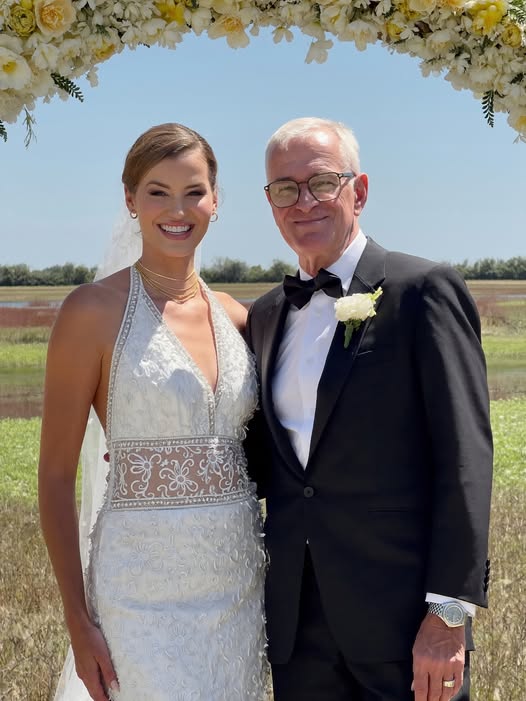
The ceremony was imperfect in the best way—children playing the wrong notes, laughter slipping through the quiet, my sister crying harder than anyone else in the room. For once, I wasn’t the woman people avoided looking at.

I was the bride.

That night, after everything quieted, it was just us.

No music. No guests. No distractions.

Just the reality of what we had promised.

I guided him into the bedroom, my nerves suddenly louder than they had been all day. Not because he could see me—but because he couldn’t.

A part of me had always believed that was why this worked. That with him, I would never have to watch someone’s expression change.

He lifted his hand slowly. “Merritt… can I?”

I nodded.

His fingers touched my face, careful, deliberate. He traced the lines I had spent years hiding. The parts I never let anyone linger on.

I almost stopped him.

But I didn’t.

“You’re beautiful,” he said softly.

And something inside me broke open.

I cried into him, not from pain—but from something I hadn’t felt in a long time. Safety. Not the kind you build by hiding, but the kind that comes from being known and still held.

Then he went still.

“I need to tell you something,” he said quietly. “Something that will change how you see me.”

I tried to laugh it off. “What—can you actually see?”

He didn’t laugh.

Instead, he took my hands, steady but tense.

“Do you remember the explosion?” he asked.

Everything inside me froze.

I had never told him.

Not really.

“How do you know that?” I whispered.

His voice dropped. “Because I was there.”

The room felt smaller suddenly.

He told me about being sixteen, about reckless choices, about gas, about a spark that shouldn’t have happened but did. About boys who ran when they realized what they’d done.

And about reading, days later, that a girl named Merritt had survived.

That girl was me.

For twenty years, he carried it.

Then life took everything from him—his family, his sight—and the guilt stayed behind like something permanent.

I sat there, listening, trying to hold two truths at once.

The man who had just called me beautiful.

And the boy who had unknowingly helped destroy my life.

“Why didn’t you tell me?” I asked.

“Because I was afraid,” he said. “Afraid you’d leave before I had the chance to love you.”

“You took that choice from me,” I said.

“I know.”

And that was the hardest part.

He wasn’t denying it.

I left that night.

Walked out still wearing my wedding dress, into cold air that felt clearer than anything inside that room. I ended up outside my old house—the place everything had started—and called Lorie.

Some truths are too heavy to carry alone.

She came without questions.

I told her everything.

“Part of me hates him,” I admitted. “But part of me can’t forget how he sees me.”

She just held me.

By morning, I knew something simple.

Running had already taken too much from me.

I wasn’t going to let it take this decision too.

So I went back.

Buddy heard me first, his paws rushing across the floor before I even opened the door. Callahan stood in the kitchen, turning toward me the second I stepped inside.

“Merry… you came back.”

“How did you know it was me?” I asked.

He smiled faintly. “Buddy told me. My heart confirmed it.”

He stepped forward, uncertain, reaching.

I caught his wrist before he stumbled.

He stilled.

Then gently, carefully, he found my face again.

“You’re the most beautiful woman I know,” he said.

This time, I believed him.

Then I smelled something burning.

I turned.

“Callie… the stove.”

He frowned. “What?”

The omelet was already black.

I laughed—really laughed—for the first time since the night before. Buddy barked, Callahan laughed too, and something in the room shifted.

Not fixed.

But real.

“The kitchen is mine now,” I said.

He nodded like it was the most serious agreement we had ever made.

And maybe it was.

Because for the first time in years, I wasn’t hiding.

Not from him.

Not from myself.

My scars weren’t something I had to survive anymore.

They were something I carried.

And somehow, even with everything he knew, everything he had been part of, he still chose to see me—not with his eyes, but with something deeper.

And this time, I chose back.

She Had A Tough Childhood Growing Up In A Cabin But Today Everyone Knows Her Name

Long before the fame, fortune, and global recognition, Dolly Parton was a young girl growing up in conditions many would struggle to imagine.

Born in Locust Ridge, nestled within the rugged landscape of the Great Smoky Mountains, Parton’s early life was defined by extreme poverty. She was one of 12 children in a tight-knit family, raised in a small cabin that lacked electricity and running water. Resources were scarce, and survival often depended on what the family could grow or hunt themselves.

Meals weren’t about preference—they were about necessity. Wild game like rabbit or squirrel frequently made its way to the table. For Parton, this wasn’t something to hide from; it was simply reality. Hardship, she has said over the years, was balanced by something far more valuable: a home filled with love, faith, and resilience.

Her parents played a large role in shaping her outlook. Her father, though unable to read or write, was known for his intelligence and tireless work ethic. Her mother, on the other hand, nurtured creativity, encouraging young Dolly to sing and dream beyond the mountains that surrounded her.

But alongside those lessons came heartbreak.

One of the most painful moments of her childhood came when her infant brother passed away just days after being born. As one of the older siblings, Parton had been given responsibility for helping care for him—a common practice in large families at the time. When he died, she carried a heavy sense of guilt, struggling to understand a loss that felt deeply personal despite being beyond her control.

That emotional weight stayed with her, becoming part of the foundation of her songwriting and storytelling.

Life in rural Tennessee also meant limited access to healthcare. In one frightening incident, Parton suffered a severe injury to her foot after stepping on broken glass. With no immediate access to a hospital, her family was forced to act quickly using whatever they had available at home. It was a painful and risky situation, but one that ultimately ended in recovery—a testament to her family’s resourcefulness.

Even her birth came with its own remarkable story. Delivered by a local doctor who accepted cornmeal as payment, Parton has often reflected on how those humble beginnings stand in stark contrast to the life she would later build.

Despite the challenges, those early years planted the seeds for something greater.

Determined to give back, Parton later created the Dolly Parton’s Imagination Library, a program designed to provide books to young children. Inspired in part by her father’s inability to read, the initiative became one of her most meaningful contributions outside of music

Harsh winters, hunger, and uncertainty were constants during her childhood. She has spoken about nights so cold that even basic comfort felt out of reach. Yet through it all, faith and family held them together.

Today, Dolly Parton’s story is often seen as one of the most remarkable success journeys in entertainment. From a childhood marked by struggle to becoming a global icon, her life stands as proof that resilience, talent, and determination can overcome even the toughest beginnings.

Every Christmas, My Mom Fed a Homeless Man at Our Local Laundromat – but This Year, Seeing Him Changed Everything

My mom spent years bringing Christmas dinner to a homeless man at the local laundromat. This year, she’s gone… cancer. So I went alone, carrying her tradition. But when I saw the guy, something felt off. And nothing had prepared me for the secret my mom had kept from me all along.

Every year, people post photos of Christmas traditions like they’re part of some perfect catalog.

But ours didn’t look anything like that.

Every Christmas Eve, my mom cooked a special dinner, the kind that made the whole apartment smell like home.

Every Christmas Eve, my mom cooked a special dinner, the kind that made the whole apartment smell like home.

Honey-glazed ham, if she could afford it. Mashed potatoes drowned in butter. Green beans with bacon. Cornbread that made your mouth water just looking at it.

But the most important plate was the one she wrapped up and handed to someone we didn’t even know.

I was eight the first time I asked who the extra plate was for.

“That one’s not for us,” she said, wrapping it carefully in foil like it was something sacred.

I watched her drop it into a grocery bag and tie it up with the same attention she gave to tying my shoes back then.

I was eight the first time I asked who the extra plate was for.

“Who is it for, Mom?” I asked again when I was 14.

Mom pulled on her coat and handed me mine. “It’s for someone who needs it, baby.”

I didn’t know then that the man we gave that plate to would come back years later and bring something I didn’t even know I was missing.

We lived in a small town, the kind where everyone knows your business unless you’re invisible.

There was an old laundromat at the end of our street. Open 24 hours. It smelled of warm detergent and wet socks.

That’s where he stayed… Eli.

That’s where he stayed… Eli.

He looked barely older than my cousin, maybe late 20s.

He wore the same tattered hoodie every year. Carried everything he owned in one plastic bag and a torn backpack.

And he always slept curled up in the corner near the soda machine.

But the thing I remember most wasn’t his clothes or how thin he looked.

It was how carefully he looked at the world, like it had already let him down more than once.

He wore the same tattered hoodie every year.

He never asked for anything. Never even looked up when we walked in.

But Mom? She walked straight to him every year.

She knelt down beside him, not towering, just level. Then, gently, slid the bag over.

“Hey,” she’d say, soft but steady. “I brought you dinner.”

He’d sit up slowly, like he wasn’t sure this was real. He always said the same thing.

” Thank you, Ma’am… you don’t have to.”

And my mom, with that same soft smile, always replied, “I know. But I want to.”

He never asked for anything.

I didn’t understand it back then. I was a teenager who thought kindness had to come with a price tag or a punchline.

One evening, I whispered as we walked back to the car, “Mom, what if he’s dangerous?”

She didn’t even flinch. Just stared straight ahead, both hands on the wheel.

“Dangerous is a hungry person the world forgot. Not a man who says thank you, sweetheart.”

Over the years, little bits of Eli’s life came out. Never all at once.

“Mom, what if he’s dangerous?”

He never offered it willingly, but my mom never stopped showing up either. That built trust.

One Christmas, when I was 16, he was sitting upright instead of asleep, looking like he hadn’t closed his eyes in days.

Mom handed him the bag. “You okay, Eli?”

He didn’t answer right away. Then, almost like it slipped out before he could stop it, he said, “I used to have a little sister.”

Something in his voice made my stomach twist.

“I used to have a little sister.”

“She was the only family I had. We aged out of foster care together. Then a car crash took her,” Eli revealed.

He didn’t say much else. He didn’t need to.

My mom didn’t pry. Just nodded like she understood the kind of pain that doesn’t need words.

That year, she brought him gloves along with the dinner. And a pair of thick socks.

The next year? A grocery gift card tucked inside. “It came in the mail,” she said, but I knew she bought it herself.

My mom didn’t pry.

Once, she even offered him help in finding a room.

Eli flinched like she’d offered to chain him to something. “I can’t,” he politely protested.

“Why not?”

He looked at me, then back down. “Because I’d rather freeze than owe anyone.”

I don’t know if it was pride or fear. But my mom didn’t push.

She just nodded. “Okay. But dinner still stands.”

Once, she even offered him help in finding a room.

I moved out after high school. Got a job. Started a life that looked fine from the outside.

Then cancer came for my mother. Subtle at first. Fatigue. Weight loss. A laugh that sounded thinner.

“Probably just my thyroid acting up, dear,” she’d say.

It wasn’t.

She was gone in under a year.

We didn’t get one last Christmas. Just a blurry fall full of doctors, silence, and watching the strongest person I knew disappear in pieces.

She was gone in under a year.

By December, I was surviving. Sort of.

Showering, paying the rent, and just functioning.

But I was angry at everyone who still had their mom, and at myself for not being able to save mine.

On Christmas Eve, I stood in Mom’s kitchen, staring at her old roasting pan.

I almost didn’t cook.

But her voice was there, steady and stubborn: “It’s for someone who needs it.”

By December, I was surviving.

So I made what I could. Just enough to bring a warm meal to someone who might be spending Christmas hungry.

Baked chicken. Instant mashed potatoes. Canned green beans. Boxed cornbread mix.

I packed it the way she always did.

I drove to the laundromat, gripping the steering wheel like it was the only thing holding me together.

The building looked the same. Flickering lights. Buzzing sign. Soapy smell.

But what I saw inside wasn’t the same at all.

But what I saw inside wasn’t the same at all.

He was there… Eli.

But not like I remembered.

No hoodie. No blanket. No plastic bag.

He wore a dark suit. Pressed. Clean. He stood tall, shoulders back.

In one hand, he held white lilies.

I froze.

He wore a dark suit.

He turned. Saw me. And his eyes softened instantly, filling with tears.

“You came,” he said, voice rough with emotion.

“Eli?” I whispered.

He nodded. “Yeah… it’s me.”

I held up the dinner bag like an idiot. “I brought food.”

He smiled, but it was shaky and sad. “She taught you well… your mother.”

His eyes softened instantly, filling with tears.

I swallowed hard. “Why are you dressed like… that?”

Eli looked down at the lilies in his hand.

“They’re for your mom.”

My heart raced. “She’s gone.”

“I know. I know she is.”

My heart thudded so loudly I could barely hear him say the next part.

“Why are you dressed like… that?”

“I tried to find you after the funeral, Abby,” he said. “Didn’t want to intrude. But I needed you to know something. Something your mom asked me not to tell you until I could prove I wasn’t just a guy in a corner anymore.”

I didn’t know what scared me more. Or what he knew or what he was about to say.

“What did she hide?”

We sat down on the hard plastic chairs near the dryers. The air smelled of fresh laundry and old floors.

Eli placed the lilies beside him like they were breakable.

I didn’t know what scared me more.

Then quietly, he said, “Do you remember getting lost at the county fair when you were little?”

A chill crawled up my spine.

I nodded slowly. “I thought I’d imagined that.”

“You didn’t.” He paused. “You ran up to me crying. I was just walking by the rides.”

I blinked. “A cop found me.”

“A cop took you from me,” he corrected. “But I found you first.”

A chill crawled up my spine.

He described the glitter butterfly I’d had painted on my cheek that day.

He was right. And it broke something open inside me.

“I didn’t want to scare you, Abby. I just held your hand and walked you toward the security booth… to the cop. Your mom came running the moment she saw us.”

He swallowed hard. “She didn’t look at me like I were dangerous. She looked at me like a person. She thanked me. Then she asked my name… No one had done that in years.”

He described the glitter butterfly I’d had painted on my cheek that day.

My hands shook as Eli continued.

“She came back the following week. Found me at the laundromat. Brought me a sandwich. Didn’t act like I owed her anything. Just gave it to me.”

I wiped my face, tears streaming down.

“I watched you grow up,” Eli added softly. “Not like a stalker. Just from a distance. She’d tell me things when she brought dinner. ‘Abby has passed her driver’s test.’ ‘She’s off to college.’ ‘She got her first real job.’”

“She’d tell me things when she brought dinner.”

I could barely breathe. “She talked about me? To you?”

He nodded. “Like you were her entire world.”

His words hit like waves. And then something even heavier landed next.

“I got help,” he said, looking down at his hands. “Years ago. Your mom connected me with a counseling program. Job training. I learned a trade. Started working and saving money.”

He looked up at me with those same careful eyes, but this time they held something else: hope.

His words hit like waves.

“I promised her that if I ever made it, I’d wear a suit to prove it. To show her I was okay.”

He reached into his coat and pulled out an envelope, worn at the edges like it had been handled a hundred times.

“She told me to give you this if I ever saw you again.”

Inside was a photo of me and Mom at the fair. Young. Happy. Holding cotton candy. In the corner, slightly blurred, stood Eli.

I pressed the photo to my chest, sobbing.

He reached into his coat and pulled out an envelope.

“She didn’t just feed me,” Eli added. “She saved me. And she did it so quietly you never even knew.”

He picked up the lilies, hands trembling.

“Can I come with you? Just to say goodbye to her?”

I nodded because I couldn’t speak.


We drove to the cemetery together. The food was still warm on the passenger seat.

He placed the flowers gently on Mom’s grave and whispered something I didn’t catch.

“She saved me.”

Then he looked at me, tears streaming down his face.

“She asked me something else. Before she got too sick to talk much.”

“What?”

“She asked if I’d look out for you. Not in a creepy way. Just as someone who understands what it’s like to lose everyone you love.”

His voice broke completely.

“She said, ‘Be her guardian. Be the brother she never had. Be someone she can call when the world feels too heavy.’ And I promised her I would.”

I couldn’t hold it together anymore. I broke down completely, right there in the cold cemetery grass.

“She asked me something else. Before she got too sick to talk much.”

Eli knelt beside me, putting a hand on my shoulder.

“You’re not alone, Abby. I know what it’s like to be alone. And I won’t let that happen to you.”

We went back to my place and ate together in silence, the kind of silence that felt like understanding.

Before he left, Eli paused in the doorway.

“I’m not asking for anything. I just needed you to know the kind of wonderful person your mother really was. And that I’m here… if you ever need me.”

“I know what it’s like to be alone.”

I looked at him, and I heard Mom’s voice again in my head: “It’s for someone who needs it.”

So, I opened the door wider.

“Don’t be alone tonight, Eli.”

His smile was small and grateful. “Okay.”

We sat on the couch. Watched an old movie neither of us really paid attention to.

And somewhere around midnight, I realized something: My mom hadn’t just saved Eli all those years. She’d saved me too.

My mom hadn’t just saved Eli all those years. She’d saved me too.

She’d taught me that love doesn’t end when someone dies. It finds a way to keep showing up… one plate, one person, and one act of kindness at a time.

And now I had someone who understood that. Someone who’d been shaped by the same hands that raised me.

Not blood. But family. The kind you choose. The kind that chooses you back.

And maybe that’s what Christmas was always supposed to be about.

Love doesn’t end when someone dies.

Which moment in this story made you stop and think? Tell us in the Facebook comments.

Bernie Sanders Pushes 32-Hour Workweek, Citing AI Productivity Gains

You should not be working more than 32 hours a week. That is something Bernie Sanders wants to make a reality. In a recent interview on Joe Rogan’s podcast, the longtime U.S. senator revealed why it would be a good thing.

In a recent appearance on the Joe Rogan Experience, Sanders proposed using AI’s productivity to our advantage. As it can beat a human regarding productivity, the U.S senator proposes to shorten the traditional workweek, providing workers with more free time.

“You’re a worker, your productivity is increasing because we give you AI, right?” Sanders said. “Instead of throwing you out on the street, I’m going to reduce your workweek to 32 hours.”

Sanders’ vision includes introducing the Thirty-Two Hour Workweek Act, which he first introduced last year. The bill from last year would require employers to pay overtime for any hours worked beyond a 32-hour workweek, effectively moving towards a four-day workweek.

Bernie Sanders says the idea reflects a simple thing: when technology makes workers more efficient, they should have more free time. He has previously emphasized that people should be able to spend more time with family, enroll in classes, or simply enjoy a better quality of life.

“It’s time for a change — real change. As more Americans are giving up on government and democracy, the time is long overdue for Congress to stand up for the hard-pressed working families of our country. And an important step in that direction would be implementing a 32-hour work week with no loss in pay,” Bernie Sanders wrote at the time.

Bernie Sanders calls for a four-day, 32-hour working week

Sanders argues that, with the increased efficiency enabled by AI and automation, workers should no longer have to work 40 hours a week.

“Let’s use technology to benefit workers,” Sanders said. “That means, give you more time with your family, with your friends, for education, whatever the hell you want to do. You don’t have to work 40 hours a week anymore.”

Sanders explained that it would be implemented gradually over 4 years, giving businesses time to adapt. While AI could enable people to work fewer hours, he also warned about the rapid rise of AI.

“I think we are not all that far away from the development of robotic soldiers,” Sanders told NBC News. “Right now, politicians — at least sometimes — have to worry about loss of life when they decide to go to war. If you don’t have to worry about loss of life, and what you worry about is loss of robots, what does that mean for issues of war and peace globally? It’s a big issue.”

He added, “If you don’t have to worry about loss of life, and what you worry about is loss of robots, what does that mean for issues of war and peace globally?”

What do you think of this? Please share your thoughts in the comment section on Facebook.

Little House on the Prairie’s Biggest Bloopers You Never Noticed

If you think Little House on the Prairie was picture-perfect, think again!

Despite its seemingly flawless appearance, a myriad of bloopers and mistakes somehow made it past the editing room.

I still find myself glued to reruns of Little House on the Prairie, just like my parents were back in the day. In an instant, it transports us to the late 19th century, and introduces us to the resilient Ingalls family.

Watching the episodes now, it’s clear that the show’s message is as powerful as ever — treating others with respect, embracing honesty, and valuing the importance of family and friends.

But those of us with a sharp eye have discovered a treasure trove of blunders and goofs that are sure to make you do a double-take — and maybe even make you chuckle.

Laura’s mystic pregnancy

Laura first announced her pregnancy late in season seven, during a warm season, with the flowers blooming and the prairie looking its best.

Yet, by the time the following summer rolled around, she was still very much expecting — leaving fans wondering just how long this prairie pregnancy was supposed to last.

Reddit

Nellie Oleson wore a wig

We all remember Little House on the Prairie‘s resident troublemaker, Nellie Oleson, brought to life by Alison Arngrim. But did you know Nellie’s role in the show was much bigger than in the original books?

The character’s expanded presence is a testament to just how much viewers loved to hate this mischievous villain — especially when she teamed up with her equally conniving onscreen mother, Harriet.

Many surely remember Nellie’s iconic blonde curls, but achieving that look was no easy task. Alison Arngrim’s own hair was transformed into those signature ringlets using an old-fashioned curling iron that had to be heated in an oven — a rather painful process that required both time and patience.

The solution was to bring in a wig. To keep it securely in place, they used a large metal comb along with dozens of long, straight metal hairpins.

Colonel Sanders Cameo

One of the funniest bloopers on Little House on the Prairie has to be the unexpected appearance of Colonel Sanders, the iconic founder of Kentucky Fried Chicken, in a season eight episode titled ”Wave of the Future.” In this storyline, Nellie’s restaurant transforms into a franchise.

But, as you can imagine, things don’t go as planned, and Nellie regrets the whole ordeal. In an attempt to break free from the contract, she teams up with Charles and Nels to open a rival restaurant.

Then, in a bizarre twist, none other than Colonel Sanders himself shows up, offering Harriet a deal to start her own chicken franchise.

Wikipedia Commons

Now, here’s where the hilarity kicks in: the good Colonel wasn’t even born until 1890, and KFC didn’t hatch until 1952. Meanwhile, Little House is supposed to be set in the 1870s and 1880s! Talk about a time-traveling entrepreneur.

And for a little extra flavor — whenever fried chicken showed up in any meal on the show, rumor has it that it actually came straight from KFC. So, maybe Colonel Sanders’ cameo wasn’t that far-fetched after all.

The missing coats

This is something I’ve often wondered about — the glaring lack of winter coats during freezing weather. In the episode titled “Bless All the Dear Children,” Laura’s baby gets kidnapped around Christmas in Minneapolis.

Now, anyone familiar with Minneapolis in December knows it can be downright frigid, yet everyone is strolling around without a coat, as Gilbert points out.

This oversight might be due to the fact that the show was filmed in Tucson, Arizona, during the summer months.

A fashion slip

In some episodes, you can catch a glimpse of Caroline’s bra when she moves just the right way. Considering the series is set in the 1870s and 1880s, this is a bit of an anachronism — since bras weren’t even invented until 1912!

Some of the women also sport hairstyles with perms or curls on set – a look more at home in the 1970s than in the 1880s.

On a similar note, you might have noticed that most of the men in the series are clean-shaven, which is a far cry from the historical photos of the era. In reality, the vast majority of adult men sported facial hair — beards were all the rage. In fact, Charles Ingalls himself had a beard for most of his adult life. It seems like the show’s grooming choices didn’t quite match the rugged fashion of the time.

A dummy instead of a living person

In the season five episode “The Odyssey,” an intense moment unfolds when an unknown assailant tries to throw Albert off a moving train.

But Laura quickly jumps into action, shoving the villain off just in time to save Albert. However, amidst this dramatic scene, a funny blooper happens.

Keen-eyed viewers can spot a dummy being thrown from the train, landing awkwardly in the grass. Meanwhile, a fearless stuntman rolls down the hill, outdoing the stationary dummy in a hilarious contrast.

Melissa Sue Anderson was ”cold and aloof”..

From seasons one to seven of Little House on the Prairie, Melissa Sue Anderson won the hearts of fans as the beautiful blonde-haired Mary, the eldest child of Charles and Caroline Ingalls.

However, her co-stars found it challenging to connect with her. Both Melissa Gilbert and Alison Arngrim shared in their autobiographies that Melissa Sue Anderson —nicknamed “Missy” on set — often came across as cold and aloof during her time on the show. Yet, when you look at photos of the cast together, it’s hard to believe there was any distance between them.

Rumors swirled among the crew that Missy’s overprotective mother contributed to her tendency to keep to herself.

But Nellie and Laura became best friends

Alison Arngrim played the original mean girl, Nellie Oleson, the arch-nemesis of good girl Laura Ingalls, portrayed by Melissa Gilbert. But behind the scenes, it was a different story! Alison and Melissa hit it off and became the best of friends.

When the cameras stopped rolling, they were like real sisters, sharing laughs and creating memories that went beyond the show.

Off-set, they were partners in crime, enjoying sleepovers at each other’s homes and pulling pranks on their unsuspecting co-stars. Who would have thought that the fierce rivalry on screen would spark such a fun and playful friendship off-screen?

The Fallout of grief in “My Ellen”

One of the most memorable episodes of Little House on the Prairie is titled “My Ellen,” which revolves around the tragic drowning of Ellen Taylor.

When Laura and Mary go skinny-dipping with their friend Ellen Taylor, they suddenly find themselves in a tricky situation. Some boys come by, prompting the girls to hide underwater until the coast is clear.

While Laura and Mary manage to resurface safely, Ellen tragically becomes trapped and drowns. The aftermath is heart-wrenching, as Ellen’s grief-stricken mother, in her sorrow, blames Laura for the tragedy.

Screenshot

During Ellen’s funeral, her mother is overwhelmed with sorrow and blames Laura for the tragedy, saying, “YOU did this!” This gut-wrenching accusation hits Laura hard, especially since she already feels guilty about what happened. What stands out, though, is how the adults around them react. Instead of stepping in to defend Laura, they only exchange worried glances and let her suffer alone in her pain.

It’s a confusing moment. With so many adults present, including Reverend Alden and Doc Baker, you’d expect at least one of them to comfort Laura and reassure her that she isn’t to blame. Instead, they leave her to grapple with the harsh words on her own. In “My Ellen,” the emotional weight of the story is undeniable, but there are moments that feel disjointed in terms of storytelling

Michael Landon put frogsin his mouth

Pranks seemed to be a big part of the filming culture, and it was Michael Landon who often led the charge with his creative and funny antics. One hilarious prank was revealed by Rachel Greenbush, who played the youngest Ingalls sibling, Carrie.

The mischievous duo of Greenbush and her on-screen sister, Melissa Gilbert, would sneak off to the creek during breaks for some frog-catching adventures. With their slimy little friends in tow, they’d return to the set to surprise Landon.

In a playful twist, he would take the unsuspecting frogs and pop them in his mouth, then stroll over to fellow cast and crew members. With a cheeky grin, he’d open his mouth to let the frogs jump out, sending everyone around him into startled fits of laughter and panic.

Melissa Gilbert’s rift with Michael Landon

The cast had such great chemistry that you’d think they were a real family, and off-screen the co-stars were a big part of each other’s lives for many years.

But things weren’t always smooth between the actors, and one major incident caused a lasting rift between Melissa Gilbert and Michael Landon.

It all started when the young star discovered news that would forever change how she saw Landon. Landon, while married to his second wife Marjorie Lynn Noe, began an on-set affair with a much-younger woman, Little House‘s makeup artist and stand-in Cindy Clerico.

Getty

Gilbert recalls noticing how close Landon and Clerico were becoming on set, but dismissed the thought, refusing to think Landon would cheat on his wife.

“It was nothing untoward; they weren’t ever in a closed-off room, not that I saw,” she wrote in her memoir. “But Mike would walk around holding her puppy, and she was a pretty young thing who wore stylish tight jeans, leotards, and high-heel boots.”

Soon, the cast, including Gilbert, discovered the affair and were devastated by the actions of the actor they had looked up to as a father figure.

“For us, as kids, it was a real blow,” Melissa Sue Anderson later recalled in her biography. “Although we knew he could be difficult at times and had his flaws, we never dreamed he was capable of inflicting that kind of pain on his real family.

“For me personally, I had held him up to a higher moral standard. He had really let me down.”

The traveling quilt

Eagle-eyed fans with laser-like vision have spotted another hilarious blooper: the family quilt seems to have a mind of its own! This elusive quilt pops up in various locations throughout the series — on the Olsens’ bed, Charles and Caroline’s bed, and even on other characters’ beds.

Mostly white with a charming design resembling a double wedding ring quilt, it’s clear that some props were reused for efficiency.

And speaking of locations, have you noticed the Ingalls children’s puzzling journey to and from school? Their route seems to change from episode to episode. Sometimes, they cross the bridge and stroll past the sawmill, while other times they mysteriously appear on the road behind it.

Dean Butler almost killed himself

Some of the cast came into the show in later seasons, one of whom was Dean Butler, who starred as Laura Ingalls’ husband, Almanzo Wilder. 

Just days following his college graduation, Dean made his way to the film set that was Little House. It would be a day to remember — for many reasons.

In Butler’s first scene, he was supposed to drive a horse wagon 200-yards down a hill. He had never done it before, and when Michael screamed “action”, things didn’t really work out. The breeze picked up his hat, with Butler instinctually dropping the reins to reach for it. At the same time, the horses, no longer under control, flew off the road and charged towards an oak tree.

American actress Melissa Gilbert as Laura Ingalls and Canadian actor Dean Butler as Ingalls’ fiance, Almanzo James Wilder, in an episode from the 1980 – 1981 season of the television series ‘Little House on the Prairie,’ 1980. The series was based on the ‘Little House’ book series by Laura Ingalls Wilder. (Photo by NBC Television/Courtesy of Getty Images)

People in the production were screaming, but luckily, a crew member managed to reach the horses before they hit the tree.

Dean’s first day on Little House could’ve gone better, with Michael Landon deciding to do the scene instead.

“Michael came up to me, chewing on a cigarette, and said ’well, I think I have to double, you know’,” Butler recalled Landon saying. “‘I can double you but not replace the horses on the show’. That was my first taste of being with Michael, but it was great fun.”

Did Albert die?

Albert Quinn Ingalls, played by a young Matthew Labyorteaux, would become a keystone of the series in 1978. The little boy is an orphan who is adopted in by the Ingalls family – but his exit from the series eluded many TV viewers.

In the 1983 made-for-TV movie ”Little House: Look Back to Yesterday”, Albert is diagnosed with leukemia. But did he die or not? That remains unclear to this date.

Matthew Laborteaux as Albert Quinn Ingalls — Photo by: NBCU Photo Bank

“He never officially died in the episode and I think maybe it’s kind of left up in the air to debate… but it was sort of an unspoken thing that we knew he was going to die,” the former child star said in an interview some years ago.

A timeless mistake

In the grand finale of Little House on the Prairie, the TV movie The Last Farewell, there’s a glaring oversight. Set in 1901, it’s clear that most of the characters should be in their 60s or 70s by the start of the 20th century.

For instance, the real-life Charles Ingalls passed away in 1902. The younger characters, like Carrie, Jenny, James, Cassandra, and Nancy, should have transitioned into young adulthood by this point.

Yet, when viewing images from the final seasons, it appears that everyone has aged remarkably little, as if time stood still in Walnut Grove. However, historically, the Wilders had moved to Missouri around the turn of the century.

Went on a pilgrimage to India 

Did you notice that Katherine MacGregor, who played Harriet Oleson throughout all nine seasons, was missing from The Last Farewell?

While various reports state that she was on a pilgrimage to India due to her new Hindu faith, her absence from the series finale has another layer. According to other sources, it stemmed from a longstanding personal conflict with Michael Landon over salary and how her talent was utilized.

Getty Images

As we wrap up our journey through the bloopers and mistakes of Little House on the Prairie, we hope you’ve enjoyed this lighthearted look behind the scenes of Walnut Grove.

If these unexpected moments brought a smile to your face, why not share the joy? Spread the laughter by sharing this video on Facebook! Let’s keep the fun alive!

Inside CECOT: The Brutal Prison Trump Threatens to Send Americans To

Donald Trump’s position on immigration has pulled global attention toward one of the most controversial prisons in the world, a facility critics warn is designed “to dispose of people without formally applying the death penalty.”

El Salvador’s CECOT, short for the Centre for the Confinement of Terrorism, sits about 70 kilometers east of San Sa

lvador and spreads across a 23-hectare site.

Built in February 2023 as the centerpiece of President Nayib Bukele’s aggressive crackdown on gangs, the facility can hold up to 40,000 inmates, making it the largest prison complex in the Americas.

The $115 million project forms a key part of the 44-year-old president’s security strategy, which has driven a sharp drop in homicide rates across El Salvador.

‘Concrete and steel pit’

Bukele’s policies have drawn both praise and alarm. Supporters point to improved public safety, while critics warn that mass arrests and detentions risk sweeping up individuals without sufficient evidence.

The prison itself has become central to that debate. Analysts from the SAIS Review of International Affairs note that the facility prioritizes “security and isolation over rehabilitation, reflecting a punitive approach to incarceration.”

In an interview with BBC, Miguel Sarre, a former member of the United Nations Subcommittee for the Prevention of Torture, described the mega prison as a “concrete and steel pit,” underscoring concerns about conditions inside.

Trump’s deportation fuels controversy

The issue took a sharp turn when Bukele offered the Trump administration a deal to house “dangerous criminals” deported from the United States in the “notorious” prison.

Inspired by the invitation, President Donald Trump used a little-known 18th-century wartime law to justify deporting foreign nationals accused of crimes in the United States, arguing the country faced an “invasion” by violent organizations.

According to Reuters, the White House paid roughly $6 million to imprison about 300 alleged violent criminals to El Salvador for one year.

“President Trump and I have a clear message to criminal illegal aliens: LEAVE NOW,” Kristi Noem, the former Secretary of Homeland Security, warned in a March 2025 social media post.

“If you do not leave, we will hunt you down, arrest you, and you could end up in this El Salvadorian prison.”

Although a federal judge attempted to block the deportations, the ruling came after flights were already in international airspace. The administration has maintained that its actions were lawful.

‘Black hole of human rights’

Human rights groups and international observers have strongly criticized the arrangement. Reports cited by the BBC describe CECOT as a “black hole of human rights,” where international standards for prisoner treatment are not followed.

Sarre also warned that the prison appears to function as a system “to dispose of people without formally applying the death penalty,” highlighting fears that inmates may never leave once they enter.

Life inside

The reality inside CECOT reflects that message, with daily life tightly controlled and strict rules enforced without exception.

One of the most visible requirements is uniformity. All inmates must wear white shirts and shorts, and their heads are shaved every five days to maintain a standardized appearance.

Packed prisoners

Ventas described rows of inmates with shaved heads packed tightly together, reinforcing its reputation as one of the most extreme detention facilities in the world.

“What is the maximum capacity of each cell?” she asked the prison director, who chose not to be named.

“Where you can fit 10 people, you can fit 20,” he replied of the windowless cells, with bare metal bunks and no mattresses.

Surveillance is constant, with cameras and guards monitoring every movement. Prisoners spend 23.5 hours a day confined to their cells, receiving only 30 minutes of exercise in a windowless corridor.

There is little to occupy their time. Each crowded cell reportedly contains just two Bibles, and meals are minimal – rice, beans, hard-boiled eggs or pasta – eaten by hand without utensils.

“Any utensil can be [fashioned into] a deadly weapon,” said the director.

‘In hell’

“When you get there, you already know you’re in hell. You don’t need anyone to tell you,” one deportee told 60 Minutes, explaining he was beaten so badly by the guards when he arrived at CECOT that one of his teeth was knocked out.

The college student was speaking in a leaked segment of the controversial CBS segment that was abruptly pulled from the air at the last minute.

The report featured interviews with migrants sent to El Salvador’s notorious Terrorism Confinement Center, or CECOT, under Trump’s aggressive immigration crackdown.

Two deportees reported torture, beatings and abuse, PBS writes, while a Venezuelan man said he was subjected to sexual abuse and placed in solitary confinement as punishment.

How do you feel about people being sent to a prison like this without a proven conviction? Please let us know your thoughts and pass this story along so we can hear from others!

Teen Dies of Allergic Reaction After Saying Goodbye to Mom in Morocco

An 18-year-old student from Buckinghamshire, UK, tragically died after suffering a fatal allergic reaction while on a family holiday in Morocco.

The trip, intended to celebrate Lily King having completed the first year of her economics degree at college, became any parent’s worst nightmare when she accidentally consumed a piece of carrot at a restaurant in Rabat.

According to a JustGiving fundraiser, Lily’s mother and father, Aicha and Michael, discovered she had a plethora of severe allergies shortly after she was born. They included fish, seafood, nuts, sesame & dairy, and other things, affecting her ability to live life to the fullest.

Any readers who have serious allergies will know just how intrusive they can be, how much a victim must think about things other people take for granted.

Worse, Lily’s allergies grew worse as she got older, with the stresses of life affecting her body’s ability to handle an adverse reaction.

As per the aforementioned JustGiving page, Lily had successfully completed her first year at Exeter University in the UK, but suffered from so much stress that the aftermath of her first anaphylaxis shock meant a snowball effect of health issues.

Credit / https://www.justgiving.com/page/lilysarahking-1720428776263

“The stress that was carried from year 13 had started to run her body down so after her first shock at the beginning of 2024 and a bout in hospital, Lily’s body was in severe recovery mode before her fatal shock,” read the JustGiving.

While on a family holiday in Morocco, Lily ingested a small bite of carrot while eating a meal consisting of chicken and fries, and had another severe reaction.

Lily quickly took an antihistamine and used her EpiPen, but the teenager’s condition deteriorated rapidly. Her anaphylaxis led to a cardio-respiratory arrest. She passed away in hospital four days later.

Mom Aicha, recalled the heartbreaking final moments to the Daily Mail. 

“She said, ‘You know Mum, I love you. I’m sorry. Goodbye,’” Aicha said. “And she collapsed in my arms.”

Rest in peace, Lily King.

Heidi Klum’s Met Gala Marble Statue Look Divides Fans

The Met Gala always sparks headlines. As this year’s event was held on Monday, one person in particular sparked mixed emotions online. Heidi Klum wore a very special outfit that some found disturbing. Now, she’s mocked by fans.

Heidi Klum once again proved she’s never afraid to push fashion to its absolute limits — but her latest Met Gala appearance has sparked a storm of reactions online.

The supermodel arrived at the 2026 Met Gala looking almost unrecognizable, fully transformed into what many described as a “living marble statue.” Draped in a sculptural, veiled design complete with intricate prosthetics and stone-like detailing, Heidi seemed to step straight out of a museum exhibit.

The theme of the night, “Costume Art,” encouraged bold interpretations — and Heidi certainly delivered one of the most talked-about looks of the evening.

NEW YORK, NEW YORK – MAY 04: Heidi Klum attends the 2026 Met Gala celebrating “Costume Art” at the Metropolitan Museum of Art on May 04, 2026 in New York City. (Photo by John Shearer/WireImage)

Designed with acclaimed makeup artist Mike Marino, the outfit was inspired by classical sculptures such as the famous Veiled Christ and the Veiled Vestal. Using latex, body paint, and precision prosthetics, the illusion of carved stone was so convincing that many fans initially thought the images were AI-generated.

Heidi Klum’s Met Gala outfit sparks reactions

But while some praised the craftsmanship and creativity behind the look, others were far less impressed. On social media, reactions quickly poured in — and they were sharply divided.

One viewer wrote, This is genuinely disturbing… it feels more like Halloween than the Met Gala. Others called the look “creepy,” “bizarre,” and “too much,” with some saying they didn’t recognize Heidi at all.

Still, many fans defended her bold choice, applauding her commitment to the theme. “She understood the assignment,” one supporter commented, while another added, “No one does Met Gala like Heidi Klum.”

This isn’t the first time Heidi has sparked headlines for her dramatic transformations. Known as the unofficial “Queen of Halloween,” she has built a reputation for elaborate costumes and full-body prosthetics that often leave fans stunned.

Thoughts on this? Please share your opinion in the comment section.

Hantavirus Kills 3 on Cruise Ship as WHO Investigates Outbreak

The cruise ship MV Hondius is anchored off the coast of Cape Verde. According to reports, three passengers have died so far – and in two of the cases, the rare hantavirus has been confirmed as the cause.

The Dutch cruise ship MV Hondius, operated by Oceanwide Expeditions, departed Ushuaia in southern Argentina on March 20 for a several-week voyage with planned stops at islands in the Atlantic.

But the voyage took a dramatic turn when a passenger in his 70s reportedly fell ill and later died after experiencing symptoms including fever, headache, and diarrhea.

The first confirmed death occurred on April 11, when a Dutch man died. His wife also fell ill and was hospitalized, but her life could not be saved. Blood tests later confirmed she was infected with hantavirus.

What is hantavirus?

According to the CDC, the disease is transmitted to humans through “contact with rodents like rats and mice, especially when exposed to their urine, droppings, and saliva.”

On Saturday, a third passenger died. The body remains on board, according to a source cited by AFP.

Meanwhile, a second confirmed case of hantavirus involves a British man who was evacuated to South Africa on April 27. He is currently being treated in isolation in an intensive care unit and is reported to be in critical condition.

No one on board is allowed to leave the ship

In addition to the confirmed cases, more people are suspected of being infected. The World Health Organization (WHO) is now investigating whether the virus may have spread between people.

WHO confirmed in a statement: “As of 4 May 2026, seven cases (two laboratory confirmed cases of hantavirus and five suspected cases) have been identified, including three deaths, one critically ill patient and three individuals reporting mild symptoms.”

The cruise ship, carrying 149 people, is currently anchored off Praia, the capital of Cape Verde, after being denied entry to the port.

She Was Considered An ‘Ugly Duckling’ Growing Up But Today She’s A Beauty Icon

Long before becoming a global figure and member of Britain’s royal family, Meghan Markle was simply a young girl growing up in Los Angeles, trying to understand where she fit in.

Born to Doria Ragland, who is Black, and Thomas Markle Sr., who is white, Markle has spoken openly about the challenges she faced as a biracial child. In interviews over the years, she explained that she sometimes felt caught between worlds, unsure how others perceived her identity.

Markle once described herself as a “latchkey kid,” often returning home to an empty house while both of her parents worked long hours. Her mother earned a living as a makeup artist while her father worked behind the scenes in television production.

Meals during those years were often simple and quick, she recalled, including microwave dinners and fast food. Evenings sometimes included watching trivia shows like Jeopardy! while eating at a TV tray.

Not everyone agrees with Markle’s recollection of those early years. Her father has publicly disputed some aspects of her childhood stories, including her description of growing up largely on convenience foods. He has also said he regularly picked her up from school or arranged transportation if he was busy with work

One experience Markle says shaped her childhood involved the reactions she and her mother received when they were together in public. Because many people assumed Markle was white, strangers occasionally questioned how she could have a dark-skinned mother. Ragland has recalled being mistaken for a nanny while out with her daughter.

Markle’s parents separated when she was young. For several years, she spent time with both parents before eventually living primarily with her father while her mother pursued career opportunities elsewhere.

Ragland later moved to a predominantly Black neighborhood outside the San Fernando Valley. Despite the distance, she remained an important influence in her daughter’s life. Ragland has spoken about a strong circle of women who helped support Markle as she grew up, describing her daughter as kind, mature, and naturally friendly.

As a teenager, Markle has said she struggled with the same insecurities many young people face, though she also felt the added pressure of navigating life as someone who didn’t fit neatly into one category.

She described herself as a self-proclaimed “nerd,” noting that academics became a big part of her identity during her school years. At just 11 years old, Markle even wrote letters challenging a television commercial she believed promoted sexist stereotypes.

Financially, the family lived modestly. Markle later recalled feeling grateful for simple outings, including visits to the salad bar at Sizzler or meals at The Old Spaghetti Factory with her Girl Scouts troop.

Her family’s circumstances improved after her father reportedly won a substantial lottery prize, which relatives say helped fund Markle’s education and training.

During her teenage years, Markle began working various jobs—from babysitting to selling donuts at a small stand called Little Orbit. Around the same time, she developed an interest in acting while spending time on the set of Married… with Children, where her father worked as a lighting director.

Her acting career eventually took off when she landed the role of Rachel Zane on Suits, bringing her international recognition.

In 2016, Markle met Prince Harry, Queen Elizabeth II grandson. The couple married in a widely watched ceremony at Windsor Castle in 2018.

They later welcomed two children, Prince Archie and Princess Lilibet.

In recent years, Markle has continued to share personal aspects of her life, including health challenges she faced after childbirth. During an episode of her podcast Confessions of a Female Founder, she revealed that she experienced Postpartum Preeclampsia, describing it as a frightening and unexpected medical scare.

From modest beginnings in Los Angeles to global fame and royal life, Markle’s story reflects a journey marked by ambition, resilience, and the determination to carve out her own identity.

Popular

A Mother’s Love: Vienna’s Journey with a Birthmark

0
Love compels parents to do extraordinary things for their children’s well-being. Celine Casey, a British mother, took remarkable steps to ensure her daughter Vienna’s...