I’m 40 years old, and the woman I call Mom isn’t my biological mother.
My real mother died when I was eight.
A few years later, my father married Linda.
She never tried to replace my mom. She never packed away her photographs or touched her belongings without asking. She never pressured me to call her “Mom.”
She simply showed up.
Day after day. Year after year.
Somewhere along the way, without either of us noticing exactly when, she became my mother.
Then my dad died two years ago.
After the funeral was over, the paperwork finished, and the casseroles stopped arriving from well-meaning neighbors, it was just the two of us.
I wish grief had made me a better daughter.
It didn’t.
I threw myself into work instead.
Twelve-hour days became normal. Fourteen-hour days weren’t unusual. Rent was outrageous, debt from my father’s medical bills still followed me around, and most weeks I felt like I was sprinting through life without ever catching up.
I called Linda.
I visited when I could.
But never as often as I should have.
Then her health started slipping.
Nothing dramatic at first.
She became tired more easily. She moved slower. One afternoon she fell in her kitchen and laughed it off, but I saw the dark bruise spreading across her arm and felt panic settle in my chest.
I started researching home care.
She hated the idea.
One Sunday she sat me down at her kitchen table and said quietly, “I found a place.”
“A place for what?”
“Assisted living.”
I stared at her.
She smiled gently, the same smile she always used when trying to keep me from worrying.
“It’s nice,” she said. “Small. Good staff. Beautiful garden. I already toured it.”
“You toured assisted living without telling me?”
“I didn’t want you talking me out of it before I had all the information.”
Then she explained that years earlier she had donated part of her late sister’s estate to renovate one of the facility’s wings. She had also served on an advisory board.
Because of that, she qualified as a legacy resident.
Her monthly rate would be reduced.
“How much?” I asked.
“Twenty-five hundred dollars.”
“I’ll pay it.”
Her eyes filled immediately.
“You don’t have to.”
“I want to.”
That part was true.
The lie came later.
After she moved into the facility, Linda told me the billing system handled legacy accounts differently. She said it was easier if I simply wrote the monthly checks directly to her and she would handle the payment herself.
I questioned it once.
“Why can’t I just pay them directly?”
She rolled her eyes.
“Because their system is ancient and confusing, and I don’t want to spend my remaining good years arguing with office administrators.”
That sounded exactly like Linda.
So I accepted it.
Month after month, I brought her a check.
Every visit followed the same pattern.
I’d arrive after work.
Hand her the payment.
Spend an hour together.
Maybe ninety minutes if I was lucky.
Sometimes she’d ask softly, “Can you stay a little longer?”
And every time I answered the same way.
“Not tonight. Next week.”
I always saw the disappointment flicker across her face before she hid it.
And every time, I left anyway.
Then last Thursday everything changed.
A client canceled unexpectedly, so I arrived much earlier than usual.
As I walked toward the sunroom, I heard Linda’s voice before I saw her.
She was talking to another resident.
“…and I told her not to bring orchids anymore,” Linda was saying. “I never know what to do with them.”
The other woman laughed.
“At least your daughter visits. My son sends emails like he’s writing customer service.”
Linda laughed too.
But hers faded quickly.
Then she said something that stopped me cold.
“She thinks she’s paying for me to be here. It’s the only reason she comes every month without fail.”
I froze.
The other woman sounded shocked.
“Linda.”
“I know how it sounds.”
“It sounds terrible.”
My entire body went cold.
Then Linda answered quietly.
“I know.”
I stepped backward before either of them could see me.
I stood in the hallway, trying to process what I’d just heard.
A few minutes later, Linda emerged from the sunroom and jumped when she saw me.
“You’re early.”
“Can we talk in your room?”
Something in my voice made her face drain of color.
Once the door closed behind us, I asked the question directly.
“Am I actually paying for you to live here?”
She stared at me.
Then sat down slowly.
That frightened me more than if she had denied it.
“Answer me.”
She lowered her eyes.
“Not exactly.”
I laughed in disbelief.
“That is the most ridiculous answer I’ve ever heard.”
She flinched.
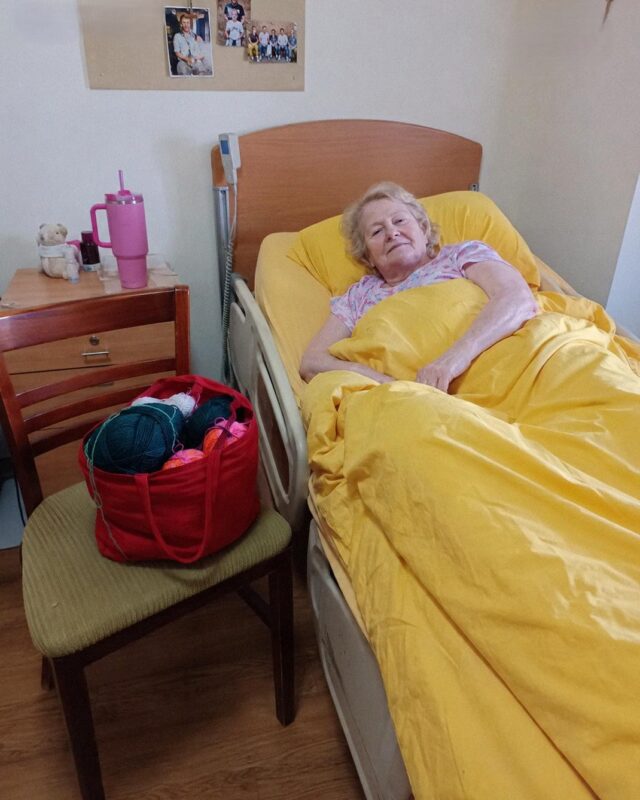
Then I noticed her knitting bag sitting in the corner.
“Open it.”
She didn’t move.
So I walked over and dumped the contents onto the bed.
Yarn spilled everywhere.
Knitting needles.
Half-finished scarves.
And underneath them, folders.
Bank statements.
Investment reports.
Deposit records.
A sealed envelope with my name written across the front.
I stared.
Every check I had given her had been deposited into a separate account.
None of it had been spent.
Most of it had been invested.
The balance had actually grown.
“What is this?”
Her voice broke.
“It was the only way I knew you’d keep coming.”
The room fell silent.
Then the words poured out of her.
After my father died, she had watched my visits grow shorter.
My calls became rushed.
My promises became constant.
Next week.
Soon.
When work settles down.
When things get easier.
She knew I loved her.
But she also felt herself slowly becoming less important.
“I was lonely,” she whispered through tears. “And I was ashamed of being lonely.”
“You could have told me.”
“I wanted you to want to come.”
That sentence shattered something inside me.
She wasn’t crying loudly.
Linda never cried loudly.
She cried the way some people apologize.
Quietly.
As though taking up space was already too much.
I opened the envelope with my name on it.
Inside was a handwritten letter.
Page after page of apologies.
She admitted everything.
She never considered me her stepdaughter.
Not once.
After my father died, she became terrified of being left behind—not abandoned all at once, but gradually forgotten.
She wrote:
“I told myself I was borrowing your attention and giving the money back later, but that doesn’t make it honest.”
At the bottom, one sentence appeared twice.
As though she had rewritten it until it sounded right.
“I didn’t want your money. I wanted your time.”
I sat down because my knees suddenly felt weak.
For several minutes neither of us spoke.
Finally I asked, “Were you ever going to tell me?”
“Yes.”
“When?”
She pointed weakly at the letter.
“Soon.”
“That’s not a date.”
“I know.”
I rubbed my face.
“This was cruel.”
“Yes.”
“It was selfish.”
“Yes.”
“It was also completely insane.”
A tiny broken laugh escaped her.
“Yes.”
Then I asked the question that mattered.
“Do you understand what this did to me financially?”
Her expression collapsed.
“I do now.”
“Why didn’t you before?”
“Because the alternative meant admitting I was hurting you.”
That answer landed harder than anything else.
Not because it excused her.
Because it sounded painfully true.
I looked at the account statements again.
The balance was actually larger than what I had paid.
Careful investments.
Patient planning.
Every dollar accounted for.
“So what now?” I asked.
She swallowed.
“Now I give it all back.”
I laughed bitterly.
“Money doesn’t fix this.”
“I know.”
And she did.
Because what hurt wasn’t the money.
It was the reason behind the lie.
I had been loving her in leftovers.
Phone calls from parking lots.
Rushed visits.
Promises for some future version of myself that would finally have time.
As if later was guaranteed.
Finally I said quietly, “You should have told me you were lonely.”
“I know.”
“What you did was wrong.”
“I know.”
“I’m not over it.”
“I know.”
“I might stay angry for a very long time.”
Her mouth trembled.
“I know.”
Then I looked at her and said the only thing that mattered.
“But you don’t get to talk like I’m not still your daughter.”
That broke her completely.
She covered her mouth and sobbed.
I crossed the room and sat beside her.
She looked at me as though she didn’t deserve that kindness.
Maybe she didn’t.
I was too exhausted to decide.
I took her hand.
“For the record,” I said softly, “you are my real mother. In every way that matters.”
We sat there together for two hours.
No excuses.
No transactions.
No envelopes.
Just me and my mom.
I don’t think love erases betrayal.
I don’t think good intentions make dishonesty acceptable.
They don’t.
But I know this.
She didn’t lie because she wanted my money.
She lied because she was terrified that one day I would stop showing up.
And she would have to admit she saw it happening before I did.