The third-quarter container freight rates from Savannah were up eleven percent, but my hand was on a document that did not belong in my office desk drawer. It was the original 2011 deed to my house on Alderwood Drive. I had brought it to work three years ago to scan it into our secure cloud backup, but I had left the physical copy tucked behind my old performance reviews.
“We need to re-route the dry goods through Baltimore,” Greg said, leaning against the grey fabric of my cubicle wall with a stack of shipping manifests.
I tapped my fingers on the laminate desktop in three quick taps, then three more.
“Baltimore adds four days to the cycle, Greg,” I said, keeping my voice measured. “We cannot afford that lag when the holiday shipments begin next month. Our regional warehouses are already operating at eighty-eight percent capacity.”
“The carrier is offering us a loyalty discount if we commit to ten containers,” Greg said, tapping his pencil against his thumb. “But we have to sign the contract by Friday.”
“If we don’t use Baltimore, we pay the premium rate in Newark,” he said, flipping to the next page of his printout. “That is a twelve thousand dollar difference on the autumn containers alone.”
“I will run the mileage comparison before lunch,” I said, sliding the heavy paper of the deed into a crisp yellow folder.
The deed was a single sheet of parchment, stamped by the county clerk, showing that Claire Bennett was the sole owner of the property. I had purchased the house three years before I met Mark, using the inheritance from my grandmother and every cent of my savings.
My father had lost our family home to a bank foreclosure when I was fourteen, a disaster that started with small, hidden debts and ended with moving trucks in the driveway. I had sworn never to let another person control my shelter, and keeping this document in my office was a physical reminder of that vow.
Greg glanced at the yellow folder as I tucked it into my leather work bag. “Are you taking the tax files home early?”
“I am just reorganizing some personal records,” I said, closing the drawer of my filing cabinet with a heavy metal click.
“Mark still in commercial real estate?” Greg asked, shifting his weight.
“Yes,” I said. “He is very busy.”
“My brother-in-law tried that in Cherry Hill,” Greg said, shaking his head. “Hard town to make a living in if you don’t own the agency. He spent three years chasing commissions that never materialized.”
“Mark has several active listings,” I said, keeping my tone neutral to hide the slight prick of defensive pride.
“Good for him,” Greg said. “Just tell him to watch out for the commercial vacancy rates on Route Seventy. They are taking a hit.”
I did not reply, leaving the silence between us until Greg took the hint and walked back toward his own desk.
At six-thirty that evening, the kitchen smelled of damp oak leaves from the open window near the sink. I sat at the table with a plate of chicken and rice, watching Mark navigate his fork around his plate without actually eating.
Between us, resting on the corner of the laminate counter, sat the envelope from the township. It was the property tax bill for four thousand two hundred dollars.
“They adjusted the municipal assessment,” I said, pointing toward the envelope with my fork.
Mark did not look at the counter. He rubbed the back of his neck, his fingers smoothing the collar of his blue dress shirt.
“They always do that in October,” he said, offering a quick, dry smile. “It is just their annual grab for lunch money.”
“It is four thousand two hundred dollars, Mark,” I said. “And the payment is due by the end of the week.”
“I will handle it,” he said, his voice light and dismissive. “One of my listings in Cherry Hill is about to close, and the commission will cover it three times over.”
I tapped my fingers on the wooden table in my usual pattern of three.
“Which listing?” I asked. “The medical offices near the highway?”
“No, a retail space on Haddonfield Road,” he said, turning his water glass in a slow circle. “A boutique clothing store is looking to expand. It is practically a done deal.”
“Have they submitted their financial disclosures?” I asked. “The last time you had a retail client on Haddonfield Road, the landlord backed out because their credit score was under six hundred.”
Mark rubbed his neck again, his eyes darting to the hallway. “They are backed by a national franchise, Claire. It is completely different.”
“The tax bill is addressed to me,” I said. “The house is in my name, so the payment needs to come from my account.”
“We are a team, Claire,” he said, finally looking up but focusing on the wall behind me. “My money is your money. I can just transfer the funds to you.”
He stood up, carrying his plate to the sink before he had finished his vegetables. The cold brass deadbolt on the back door rattled slightly as the autumn wind hit the porch.
“I noticed the gutters need cleaning,” Mark said from the sink, his back to me. “I can get a guy out here on Wednesday.”
“I already hired a service,” I said. “They are coming tomorrow morning.”
“You don’t need to spend your own money on that,” he said, turning the faucet on high to rinse his plate.
“It is my house, Mark,” I said. “I like to know exactly who is working on it.”
He turned off the water, but he did not face me. He kept his hands flat against the edge of the sink.
“Sometimes you make it sound like I am just a tenant here,” he said, his voice dropping.
“You know that is not what I mean,” I said. “I simply prefer to keep the administrative tasks under my own name.”
“Then let me pay the tax bill,” he said.
“The tax bill must be paid from the account linked to the deed,” I said. “We discussed this when we got married nine years ago.”
He walked out of the kitchen without answering, his footsteps heavy on the stairs.
At eight o’clock, I carried a basket of folded laundry into the living room. Mark was sitting on the sofa, his phone already pressed to his ear.
“We cannot do this right now,” he was saying, his voice dropping to a harsh whisper that carried across the hallway.
As soon as he saw me cross the threshold, his thumb swiped the screen, muting the line. He slid the phone face down onto the cushion next to his thigh.
“Was that your mother?” I asked, setting the laundry basket on the coffee table.
“Just a client,” Mark said, his smile returning too fast. “An old lady who wants to sell her condo but cannot decide on a price.”
“She calls you after eight o’clock?” I asked.
“The market does not sleep, Claire,” he said, rubbing his neck again. “Everything with my mother’s building is under control.”
I frowned, looking at him. “Why would your mother’s building not be under control?”
“I meant the client,” he said, his voice smooth as glass. “Her name is Mrs. Gable. She lives in the same complex as my mother, so I get them confused.”
“Is Diane still planning to renew her lease in November?” I asked.
“Of course,” Mark said, leaning back against the cushions. “Why wouldn’t she?”
“Her sister mentioned something about the landlord raising the rent,” I said. “She was worried Diane might have to look for a smaller place, and she wondered if we had any room here.”
Mark’s hand tightened on his phone. “My mother has plenty of savings,” he said, though he did not look me in the eye. “She has no intention of moving. Lisa is helping her look at some local options just in case, but it is purely theoretical.”
He stood up and picked up the laundry basket, offering to carry it upstairs.
“I can do it,” I said, reaching for the handle.
“Let me help,” he said, pulling the basket gently from my grip. “You work too hard, Claire.”
I let him take it, but I watched him as he walked up the stairs. His phone stayed in his pocket, silent.
At eleven o’clock, the bedroom was quiet, but the space beside me was empty. I walked to the window and looked down at the gravel driveway under the floodlight.
Mark was pacing near the front bumper of his sedan, his coat collar turned up against the cold. He held his phone tight to his ear, his free hand cutting the air in sharp, frustrated motions.
I slid the window up two inches, ignoring the draft that smelled of wet earth and rotting wood.
“You have until the first of the month, Lisa,” Mark was saying, his voice carrying clearly over the gravel. “I cannot just tell her no. She has nowhere else to go.”
There was a long silence while the person on the other end spoke.
“I am not asking you to pay her rent,” Mark snapped, his voice dropping even lower. “I am asking you to help me with the logistics. We need to clear out the spare room by next week, and I need you to transport the smaller boxes.”
He ended the call abruptly and stared down at the screen of his tablet, which was resting on the hood of his car. The blue light from the screen illuminated his face.
I closed the window quietly, my fingers tapping three times against the wooden sill.
I walked down the dark stairs to the kitchen, where Mark had left his tablet charging on the counter near the fifteen-dollar stainless steel tea kettle. He had forgotten to lock the screen.
I tapped the glass. A real estate listing was open, showing Diane’s apartment on Maple Avenue. Across the main photo, a bright red banner had been stamped.
The banner read: Rented.
I stared at the quiet screen of his tablet reflecting in the dark kitchen.
I stepped away from my desk at ten o’clock the next morning to stretch my legs. Under my left foot, the floorboard near the radiator gave a sharp, dry squeak. It was a loose tongue-and-groove plank I had meant to hammer down since we moved to Alderwood Drive.
On the floorboards next to the baseboard lay Mark’s heavy steel tape measure, the orange casing scratched from commercial construction sites. He had left it there after checking the room’s dimensions the night before, while I was downstairs finishing the supply chain forecasts.
I picked up the metal tool and set it on my desk. My fingers tapped the wooden surface in my usual rhythm, three quick strikes, then a pause, then three more.
The measurements of my study were exactly twelve feet by eleven feet. It was the smallest bedroom in the house, but it held my steel filing cabinet, my two monitors, and the yellow folder where I kept the house deed from 2011.
I sat back down and opened my email to check the quarterly shipping schedules for the Philadelphia port. A notification from the township utility department sat at the top of my inbox, marked as urgent.
Mark came through the side door at half past five, dropping his leather briefcase onto the hallway bench. He rubbed the back of his neck as he looked at the mail on the small console table.
“The municipal water office emailed again today,” I said, leaning against the doorframe of the study. “That is the third notice about the joint utility registration.”
“I must have missed the alert,” Mark said, not looking up from his phone. “Those township websites are always five years behind the times.”
“I printed the physical authorization form and left it on the kitchen counter last Tuesday,” I said. “It only needs your signature to add your name to the billing profile.”
“What are we doing for dinner tonight?” he asked, stepping past me into the kitchen. “I was thinking we could try that new noodle place by the highway.”
“We have leftovers from yesterday,” I said, following him. “Why haven’t you signed the form, Mark? It takes thirty seconds, and they will shut off the online portal access if we don’t return it by Friday.”
“I will handle it later, Claire,” he said, opening the refrigerator door and staring at the shelves. “I have a lot of listings closing this month, and paperwork is the last thing I want to look at when I get home.”
The doorbell did not ring, but the heavy thud of a parcel hitting the front porch drew me away from the kitchen sink at seven o’clock. Outside, a delivery driver in a brown uniform was already walking back to his truck.
On the top step sat a wide, flat cardboard box, the shipping label printed with Mark’s name in bold black ink. The packing slip showed the sender was an industrial supply warehouse in northern New Jersey.
“Did you order something from regional supply?” I asked, carrying the box into the kitchen where Mark was pouring a glass of water.
He set the glass down with a sharp click against the stone counter. He did not touch the box, but his eyes stayed on the taped seam.
“Just some office essentials,” he said.
I found the kitchen shears in the utility drawer and cut the heavy packing tape along the top flap. Inside were twelve industrial-sized rolls of heavy-duty brown packing tape, each wrapped in clear shrink-wrap.
“You ordered a dozen rolls of professional shipping tape?” I asked. “Your agency has a supply room in Cherry Hill for this kind of material.”
“It is just standard packing tape for a client, nothing to worry about,” Mark said, reaching into the box to pull one of the rolls out. “One of my retail accounts is consolidating their storage units down in Mount Laurel, and I offered to help them box up their old files.”
“Which account?” I asked.
“The medical group near the turnpike,” he said, turning his back to me to rinse his water glass. “It keeps the relationship warm for when their lease comes up next autumn.”
At nine o’clock, the wind from the north brought the smell of damp oak leaves through the kitchen screen. I stood by the back door, watching the yard light illuminate the gravel driveway.
Mark went out the back door carrying the empty shipping box, his shoulders hunched against the October chill. He did not see me standing near the pantry window.
He lifted the lid of the blue ceramic storage bin we used for outdoor seat cushions, then paused, looking toward the driveway. He walked instead to the recycling container at the edge of the gravel.
He folded the cardboard flat, pressing his weight into the seams until the box made a sharp cracking sound. He pushed it deep down beneath the empty plastic bottles.
I watched him stand there for a moment in the dark, his hands shoved deep into his pockets, looking toward the empty road.
The cardboard box sliding deep into the blue recycling bin.
The glass doors of the Cherry Hill Bank were heavy, cold against my palm at eleven o’clock the next morning. I had taken an early lunch hour from the supply office, driving past three miles of damp oak leaves lining the suburban roads to reach the brick branch on Route 70. The annual property tax bill for four thousand two hundred dollars had arrived in the mail yesterday, and the numbers did not match our joint account ledger.
The teller, a young woman with a neat silver name tag that read Sarah, looked up from her computer screen as I reached the counter. My fingers tapped the polished wood surface in three precise taps, then three more, before I flattened my hand to stop the movement.
“I need a printout of the current principal balance on my mortgage, please,” I said.
Sarah smiled, her fingers moving across the keyboard in a rapid, rhythmic sequence. “Certainly. I just need your state identification and the account number, or your social security number.”
I slid my driver’s license across the high counter, the plastic clicking against the wood. My eyes drifted to the small glass sign listing the current interest rates, though the numbers did not register. My focus remained entirely on the screen facing away from me.
“And is this account in your name only, Mrs. Bennett?” Sarah asked, her voice dropping to a professional, quiet register.
“Yes,” I said, keeping my voice measured and clear. “Only Claire Bennett. There should be no other names on the title or the loan.”
She clicked her mouse twice, then paused, her eyes scanning the database. The printer behind her began to hum, pulling a single sheet of paper through its rollers with a sharp, mechanical feed.
“Correct,” she said, sliding the warm paper toward me along with my license. “The current outstanding balance is one hundred and twelve thousand, four hundred and six dollars. You are the sole obligor and owner of record.”
The printed paper also listed the pending municipal escrow details. The property tax bill for four thousand two hundred dollars was marked as unpaid, waiting for the escrow transfer that should have occurred on the first of the month.
“Is the escrow account fully funded for the autumn tax cycle?” I asked.
Sarah looked at her screen again, her eyebrows knitting together. “The monthly tax portion of your payment has been received, but the automatic transfer is currently on hold pending a signature for the updated municipal account.”
I folded the paper in half, then in half again, pressing the crease flat with my thumbnail. It was the same administrative delay that had kept our utility accounts separate for nine years, a pattern of omissions that I had allowed myself to overlook for far too long.
“Is there a second name listed anywhere on the escrow authorization?” I asked.
“No, just yours,” she said. “We sent the authorization form to your home address on Alderwood Drive three weeks ago, but we haven’t received the signed copy back yet.”
“Thank you,” I said, placing the paper inside my zippered purse. “I will handle the signature myself.”
At one o’clock, I pulled into the gravel lot of the small coffee shop on the corner of Maple Avenue. Lisa Bennett was already sitting at a small metal table near the back window, her laptop open and her corporate ID badge dangling from a blue lanyard. She was forty-two, three years older than Mark, and she shared his narrow nose but none of his easy, deflected posture.
“You’re late,” Lisa said, checking her watch before I had even pulled out my chair. “I have a project sync with the regional team at two, and I still need to leverage some data before the call.”
“The traffic on Cooper Road was backed up,” I said, sitting down. I did not order a drink.
Lisa took a quick sip from a paper cup, her eyes scanning her laptop screen before returning to me. “I can only stay twenty minutes. Mark said you wanted to talk about Mom’s housing situation, but honestly, Claire, I don’t have the bandwidth for this.”
“She has to vacate her apartment by November first,” I said. “That is exactly three weeks away. We need to finalize the arrangements for her next location.”
“Well, that location cannot be my house,” Lisa said, her voice rising slightly as she checked her watch again. “My remote work schedule is incredibly demanding this quarter, and the regional directors expect me to be online and available at a moment’s notice.”
“You have a three-bedroom house, Lisa,” I said, keeping my tone level. “The spare room has been vacant since your roommate moved out last spring.”
“My office is my livelihood, Claire, so my spare room is completely off limits,” she said, her fingers tightening around her paper cup. “I have two monitors, a dedicated secure router, and all my filing cabinets in there. If I don’t have a quiet, dedicated space for client presentations, my productivity metrics will drop.”
I watched her face, searching for any sign of hesitation, but she met my gaze with a hard, defensive look. She spoke with the fast, clipped rhythm of someone who had rehearsed her arguments long before she arrived at the cafe.
“A single desk does not require an entire bedroom,” I said.
“In my position, it does,” she replied, leaning forward. “We have strict data privacy protocols. I cannot have anyone walking past my screen while I am reviewing quarterly numbers.”
“But surely Diane could use the room temporarily while we look for an assisted living facility,” I said.
“Absolutely not,” Lisa said. “Mom needs a lot of attention, and I simply cannot provide it while managing my department. Mark agrees with me on this.”
I paused, my fingers tapping three times against the edge of the metal table. “Mark told you that?”
“He understands the demands of my career,” Lisa said, gathering her keys from the table and closing her laptop with a sharp click. “He knows I cannot just shut down my operation for her. We have to look at other options.”
“What other options has Mark discussed with you?” I asked.
Lisa stood up, pulling her coat over her shoulders in a single, rushed movement. “He said he was handling it. Let me know what you two decide, but leave my spare room out of the conversation.”
She walked toward the exit, her boots clicking loudly on the tile floor. She did not look back.
The kitchen was quiet when I got home at half past five. Mark’s sedan was already in the driveway, parked at an angle that blocked the path to the garage.
When I walked into the living room at six o’clock, Mark was sitting on the sofa with a stack of papers in his lap. He looked up, his expression shifting quickly into a bright, easy smile that did not reach his eyes.
“Hey,” he said, standing up. “I was just looking over some of the commercial listings from this week. The market is finally picking up in Mount Laurel.”
“Did you speak to Lisa today?” I asked, setting my keys on the side table.
He rubbed the back of his neck, his fingers lingering on his collar. “Briefly. She called during my drive between properties. She is pretty stressed about her workload.”
He reached into his stack and pulled out a single sheet of paper, stepping toward me. “Actually, I wanted to show you this. It’s the commission statement from the office building I leased last month.”
I took the printed commission statement from his hand. The paper was clean, fresh from the laser printer in his study. The header read Bennett Commercial Realty, and the net commission listed near the bottom was nine thousand four hundred dollars.
“That is a good transaction, Mark,” I said, reading the details.
“See?” he said, gesturing with his hands. “We are doing great. I told you there was no need to worry about the household accounts. I am taking care of things.”
“This commission is from September,” I said, looking up from the page. “But the joint account still has not received the transfer for the property taxes.”
Mark laughed, a short, dismissive sound. “It takes a couple of weeks for the brokerage to clear the funds, Claire. You know how the accounting department is. It is all standard bureaucracy.”
He took the paper back from me, folding it and putting it back into his pocket. “Why don’t we go out for dinner tonight? We could try that new Italian place by the mall.”
“I would rather eat here,” I said. “We still need to talk about your mother’s lease ending.”
Mark’s smile faltered for a fraction of a second before he recovered his cheerful expression. “Everything with my mother’s building is under control, Claire. There is no need to spend our evening analyzing it.”
He turned and walked back toward his study, his footsteps light on the hardwood floor.
By half past eight, the house had grown cold. I sat at the kitchen table with a hot mug of herbal tea, the steam rising in thin, twisting lines. A small black notebook lay open in front of me, its pages lined and white.
I opened my phone and scrolled through the call logs from the past two weeks. I began to write down the dates and times of the calls Mark had received late in the evening, the ones he always stepped out onto the porch to answer.
October second, nine-fifteen PM.
October fifth, ten-forty PM.
October eighth, nine-thirty PM.
The list grew, each entry written in my precise, analytical hand. They were all calls from his mother’s number, always at hours when he claimed he was merely checking on her health.
The blue ceramic storage bin sat in the corner of the pantry, catching the low light from the stove. It was empty, a physical reminder of the small administrative details that had begun to accumulate in our house without my consent.
I tapped my pen against the table, three quick clicks, then paused. The dates did not align with a simple medical check-in. They were clustered around the days his mother’s landlord had issued the lease non-renewal notices.
I closed the notebook, the black cover snapping shut with a soft puff of air.
The neat columns of dates written in Claire’s black notebook.
I closed the leather cover and slid the notebook under a stack of supply invoices, trying to focus on the regional shipping delays on my computer screen. My fingers tapped the edge of the laminate desk in quick, sharp groups of three. The supply chain office was quiet, save for the hum of the overhead fluorescent lights. It was exactly four-fifteen in the afternoon, and the warehouse workers downstairs were already loading the final pallets of medical tubing for the evening transport.
At four-seventeen, my phone vibrated against the desk.
It was a text from Mark.
“Had to make a quick decision,” the message read. “My mother’s apartment transition got moved up. Lisa is driving her over with her initial things now. They should be there by five.”
I stared at the screen, my thumb hovering over his name. I tapped the call icon and held the phone to my ear, listening to the long, empty rings. It went straight to his voicemail.
I called a second time, but the result was the same.
“Hey, it is Mark,” his recorded voice said, breezy and light. “Leave a message and I will get right back to you.”
I did not leave a message. I dialed Lisa’s number instead.
The call rang twice before going to a busy signal.
I packed my laptop into my bag, took my car keys from the drawer, and walked out of the building. The autumn air outside the office was crisp, carrying the scent of damp leaves from the nearby park. I drove home with the radio off, my mind tracing the dates of those secretive evening phone calls I had written in my notebook just an hour before.
The drive back to Cherry Hill took twenty-two minutes, but I spent another thirty sitting at the kitchen table with my phone in my hand, waiting for a call that did not come. The kitchen was cold, the air carrying the faint scent of damp oak leaves from the yard outside. On the stove, the fifteen-dollar stainless steel tea kettle sat cold and dry, reflecting the gray light from the window.
I walked to the back door and touched the cold brass deadbolt, ensuring it was locked.
A pair of bright headlights swept across the glass of the kitchen window, cutting through the autumn dusk.
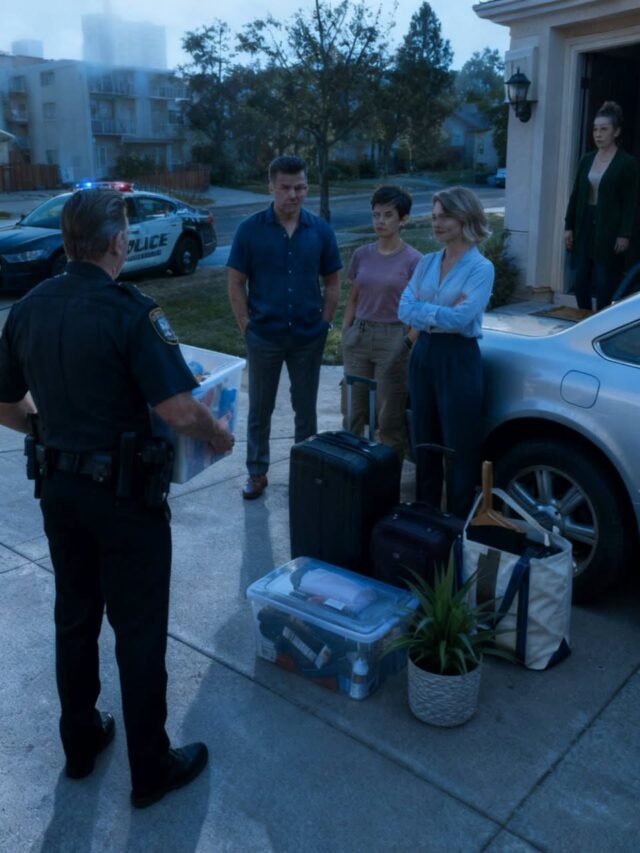
Lisa’s black SUV turned slowly onto the gravel, its tires crunching the loose stone before coming to a stop near the back porch. The rear cargo area was packed so high that the cardboard boxes pressed flat against the glass of the back window.
I did not go out to meet them yet. I stood by the window and watched Lisa open the driver’s side door, her movements fast and hurried.
She walked around to the passenger side and opened the door for their mother.
By the time I walked down the back steps, Diane was already out of the passenger seat. She stood in the gravel, holding a potted peace lily in both hands like a shield. She wore a heavy wool coat and her oversized designer sunglasses, despite the graying light of the late afternoon.
“Where is Mark?” I asked, stopping a few feet away from her.
Diane adjusted her sunglasses, pushing them up her nose with one gloved finger. “He is finishing up a meeting in Philadelphia, Claire. He told us to come ahead.”
“He did not tell me you were arriving today,” I said.
Lisa walked around to the back of the SUV, her boots clicking loudly against the gravel. She lifted the heavy rear hatch, revealing a wall of plastic bins and taped cardboard boxes. She checked her watch, her eyes darting toward the street.
“We had to vacate the apartment by five, Claire,” Lisa said, her voice tight and defensive. “The landlord had the cleaners waiting at the door. We did not have time to hold a committee meeting about it.”
“This is my home, Lisa,” I said, keeping my voice low and level. “We agreed to discuss this over the weekend.”
Diane took two steps toward the porch, her shoes crunching in the stone. “Which room is mine, Claire? I assume you have already cleared out the study for me.”
I looked at her, my fingers tapping against the seam of my coat pocket. “The study is my office. It has my tax files and my desk. We never agreed to clear it.”
“My son owns this house, and I have every right to step inside,” Diane said, her voice rising, loud and demanding.
I stood entirely still on the gravel. “Mark does not own this house, Diane.”
Diane laughed, a sharp, humorless sound that cut through the quiet neighborhood. “Of course he does. He showed me the listing nine years ago. Now let Lisa bring the blue bin inside.”
Lisa took another step up, the blue ceramic storage bin cradled against her chest, her face red from the effort.
“Set it down, Lisa,” I said, my voice steady, though my heart was hammering against my ribs. “If you try to push past me, I will call the police.”
Lisa stopped on the first step, her eyes wide as she looked up at me. She checked her watch again, then slowly lowered her arms.
The heavy blue storage bin rested on the bottom step of the porch.
Lisa raised her arm, holding her smartphone level with my chin. The glass screen showed my face, tight and pale, framed by the white painted trim of my own front door. Her thumb hovered over the red recording button, her manicured nail catching the dim autumn light.
“I am recording this, Claire,” Lisa said, her voice dropping into the flat, rehearsed tone she used for difficult clients. “For the record. You are actively denying our mother entry to her own family home.”
I tapped my fingers in three quick beats against the cold brass of the doorframe. One, two, three. The metal was cold enough to sting my skin, but I did not pull my hand back.
“This is not her home, Lisa,” I said, keeping my voice as level as her camera. “And it is not a family home. It is my house.”
Diane did not look at me. She was pressing her thumb hard against her own phone screen, her face flushed red beneath her large, dark sunglasses. She held the phone to her ear, listening to the rings before dropping it back to her chest with a sharp, impatient hiss.
“He is still not answering,” Diane said, her voice carrying across the yard. “His own mother. On moving day.”
“He is probably in a meeting with a client, Mom,” Lisa said, though she did not lower her phone. “But we do not need him to resolve this right now. Claire is being completely unreasonable.”
I looked down at the blue ceramic storage bin resting near Lisa’s leather boots. Through the semi-transparent lid, I could see the edge of a silver-plated vanity set and three thick photo albums bound in faded green leather. These were not emergency supplies. They were the permanent fixtures of a life being transplanted.
“You need to take that back to your car,” I said, pointing at the bin.
“We are not putting anything back,” Lisa said, stepping closer until the lens of her camera was inches from the screen door. “You cannot lock us out of a property my brother purchased.”
Across the street, the metal latch of Mr. Henderson’s mailbox clicked open with a sharp, metallic tang. He did not reach inside for his letters. He stood on the curb, his head turned toward our porch, his light blue jacket bright against his gray gravel driveway.
Further down the block, Mrs. Gable slowed her silver sedan to a crawl as she passed the house. Her brake lights flared red, reflecting in the puddles along the curb. She leaned forward over her steering wheel, her eyes locked on Lisa’s raised phone and the boxes stacked on my porch steps.
The damp autumn air smelled of rotting oak leaves from the gutters. The neighborhood was quiet enough that every word Lisa spoke seemed to echo off the brick fronts of the nearby houses. The silence between her statements felt heavy, waiting for me to make a scene.
“People are watching, Lisa,” I said, keeping my hands at my sides.
“Good,” Lisa said, her voice rising slightly. “Let them see how you treat your husband’s mother. Let them see you standing in the doorway like a guard dog.”
Diane adjusted her oversized sunglasses, pulling them down her nose to glare at me over the gold rims. She took a step toward the first wooden stair, her heavy heel clicking against the gray painted pine.
“I have a right to be here,” Diane said, her voice projecting toward the street. “My son assured me this was settled weeks ago.”
I stepped back into the hallway and closed the screen door, leaving the heavy wooden door open just enough to speak through the crack. The cold brass deadbolt felt solid under my fingers, a physical barrier between my home and their expectations.
The kitchen landline was sitting on the small walnut table by the stairs. I picked up the black receiver, the cord stretching as I pulled it into the hallway, and dialed the office number for Harold Jenkins.
The call went through on the second ring. Harold’s gravelly, slow voice answered, sounding exactly as it had for the fifteen years he had handled my family’s affairs in Cherry Hill.
“Claire,” Harold said, the sound of papers rustling in the background. “I was just finishing a brief. Is everything alright on Alderwood Drive?”
“Lisa and Diane are on my porch,” I said, watching them through the narrow window next to the door. “They have luggage. Diane is insisting she is moving in today.”
“Where is Mark?” Harold asked.
“He is not answering his phone,” I said. “He told them they could live here, Harold. But my name is the only one on the deed.”
“Yes, it is,” Harold said. “I drafted the transfer myself in 2011. Mark has no legal claim to that property, and neither does his mother.”
I carried the cordless handset back to the screen door, holding it close to my ear. Through the wire mesh, I could see Diane holding her phone again, her fingers tapping the glass with a frantic energy.
“Keep your position, Claire, and do not let them carry a single bag inside,” Harold said over the line, his voice deliberate and calm.
“They are threatening to call the police,” I whispered.
“Let them,” Harold said. “You are under no obligation to admit anyone who is not listed on the deed. If the police arrive, show them the title.”
Diane looked up from her phone, her eyes locked on mine through the screen door. She held the device to her ear again, but this time her expression was different, her jaw set in a hard, tight line.
“Yes, emergency,” Diane said, her voice loud enough to carry through the wood. “I need an officer at forty-two Alderwood Drive. I am seventy-four years old, and I am being locked out of my son’s house.”
She listened for a moment, nodding her head sharply as she paced the small space of the porch.
“Yes, my son Mark Bennett,” Diane said to the dispatcher. “He owns the property. His wife is refusing to let me inside with my belongings, and I have nowhere else to go.”
Lisa lowered her phone camera, a look of grim satisfaction settling over her face as she watched her mother speak. She crossed her arms, leaning her shoulder against the porch railing.
“They are sending someone,” Diane said, snapping her phone shut and looking directly at the screen door. “We will see what the authorities have to say about this.”
I held the landline receiver against my ear, hearing Harold’s quiet, steady breathing on the other end of the line.
“I am coming over, Claire,” Harold said.
“You do not have to do that, Harold,” I said. “It is late.”
“I am already putting my coat on,” Harold said. “Do not open that door until I get there.”
The line went dead with a soft click. I stood in the hallway, looking through the screen at my sister-in-law and my mother-in-law standing on the porch.
From three blocks away, a faint, rising wail cut through the quiet evening.
The distant sound of a siren turning onto Alderwood Drive.
The blue cruiser slowed as it reached the gravel, its tires crunching on the damp oak leaves that lined the curb.
Officer Ruiz got down from the driver’s seat, his black utility belt clicking as he adjusted his stance. He was a solid man with graying temples who looked like he had already worked twelve hours of a ten-hour shift.
Before the officer could walk toward the porch steps, the high-pitched whine of a small engine sounded from the corner of the block. Mark’s silver sedan rounded the curve too fast, swinging into the driveway and stopping less than two feet from the police car’s rear bumper.
The driver’s side door flung open, and Mark stepped out, his blue silk tie thrown over his shoulder from the breeze of his quick exit. He did not look at me. He looked straight at his mother, who was still holding her peace lily like a shield against her chest.
“Mom, stop talking,” Mark said, his voice a low, hurried whisper as he rushed across the gravel, his leather-soled shoes slipping slightly on the loose stones. “Just wait a second, please.”
Diane adjusted her oversized sunglasses, her fingers catching the gold trim on the frame despite the gray evening light that was settling over the yard. “I will not stop talking, Mark. This woman is standing on the porch trying to lock me out of your house.”
Mark rubbed the back of his neck, his palm making a dry scratching sound against his stiff white collar. “Claire, please. Let’s just step inside and clear this up before the whole street comes out to watch.”
“The officer is already here, Mark,” I said, keeping my hands flat against my sides, my fingers tapping in a quiet group of three against my wool coat.
“We don’t need the police for a family dinner,” Mark said, his voice cracking slightly as he looked toward the sidewalk.
Officer Ruiz walked up the three wooden steps of the porch, his heavy boots making the pine boards creak. He stood between us, his posture stiff, his eyes moving from Mark’s frantic expression to Diane’s rigid posture, and then finally to me.
“Whose vehicle is the silver sedan?” the officer asked, pointing a thumb back toward the driveway where Mark’s car sat idling, its exhaust forming a pale plume in the cold air.
“It’s mine, officer,” Mark said, taking a step closer to the bottom of the porch steps. “I live here. This is just a minor misunderstanding between my wife and my mother.”
“I need to see identification from everyone present,” Officer Ruiz said. He did not take his hands off his utility belt, his thumbs hooking into the thick leather near his holster.
I reached into my leather purse, pulled out my wallet, and extracted my driver’s license, holding it out. The plastic was cold against my fingertips as I handed it over.
Officer Ruiz took it, held it up to the porch light that had just flickered on, and then turned his head toward Mark. “Your turn, sir.”
Mark fumbled with his breast pocket, his fingers sliding twice before he pulled his leather wallet free. He handed his license over with a quick, tight nod, his eyes darting toward the blue ceramic storage bin resting on the bottom step of the porch.
“Is this your current address, sir?” the officer asked, looking down at Mark’s card and then comparing it to mine.
“Yes, of course,” Mark said, shifting his weight from one foot to the other. “We’ve lived here together since we bought the place in 2011. It’s our family home, and we’ve put a lot of work into it.”
“My son purchased this property nine years ago,” Diane said, her voice rising to its usual loud, formal pitch. “He has been an incredibly generous provider, and he made all the legal arrangements for me to move in today.”
Officer Ruiz did not look up from the cards, his face remaining entirely neutral under the brim of his hat. “Who is the primary owner of the residence?”
“It’s our house,” Mark said, his voice dropping an octave as he tried to catch my eye through the porch railing. “We are married, officer. Surely we don’t need to go through the deed paperwork on the driveway.”
“I need to establish who legally resides here and who has the authority to deny entry to guests,” Officer Ruiz said, writing a quick note on his small notepad.
“I am his mother, and my lease in Fort Lee ends on November first,” Diane said, her voice trembling slightly with indignation. “I have already handed over the keys to my landlord. My son made a commitment to me.”
Lisa checked her watch, her thumb tapping the glass face twice in rapid succession. She stepped off the gravel driveway and onto the grass of the front lawn, gesturing toward me with a slight wave of her hand.
“Claire, can we talk over here for a second?” Lisa asked, her voice fast, defensive, and filled with her usual corporate urgency. “Just you and me, without everyone standing around.”
“I am staying right here on the porch, Lisa,” I said, my voice measured and analytical.
“I can run down to the diner on Route 70 and grab us some takeout,” Lisa said, taking another step onto the damp grass. “We can sit down, align our schedules, and map out a transition plan that works for everyone involved.”
“There is no transition plan to map out,” I said.
“It is just a temporary arrangement until we find a permanent solution,” Lisa said, checking her watch again. “We just need to get her bags inside so I can head back to the office before my six o’clock call.”
I looked down at the blue ceramic storage bin sitting on the bottom step, its glossy glaze catching the yellow light from the porch lamp. “You told me your spare room was completely full, Lisa.”
“My office is my livelihood, Claire, so my spare room is completely off limits,” Lisa said, using the same defensive tone she had used at the coffee shop. “I have client files stored there that cannot be moved, and my remote work schedule is incredibly demanding.”
“We are not storing your files here, Lisa,” I said.
“We are talking about our mother’s safety,” Lisa said, her voice rising as she took another step closer to the porch. “We need to collaborate on this instead of shutting down the conversation.”
“I am not collaborating on a surprise move,” I said.
Lisa rubbed her forehead, her fingers catching the edge of her bangs. “No one is trying to surprise you, Claire. This is just a fast-moving logistics issue that we need to solve tonight.”
Diane turned her head toward the street, her large sunglasses reflecting the orange glow of the streetlamp that had just flickered on near our mailbox. “This neighborhood association has very strict rules about leaving luggage on the porch anyway. We need to get these things inside before someone complains.”
I looked at Mark, waiting to see if he would correct her, but he kept his eyes fixed on the gravel.
“Diane, there is no neighborhood association on Alderwood Drive,” I said.
“Of course there is,” Diane said, her voice sharp and demanding. “Mark told me all about the guidelines when he bought the place. He said they require the lawns to be edged weekly and that no commercial vehicles are allowed overnight.”
Mark rubbed the back of his neck again, his shoulders dropping as he looked down at his leather shoes. “Mom, please. Let’s not get into the details right now.”
“Why not?” Diane asked, looking genuinely confused. “You’ve always been so proud of this neighborhood. You promised me years ago that I would have the back bedroom overlooking the garden once I retired, and you said the association kept the whole block quiet.”
“Mark has been telling you a lot of things,” I said, my fingers tapping in another group of three against my side.
“He is my son,” Diane said, adjusting her sunglasses once more. “He bought this beautiful Cherry Hill home with his own money, and he has always promised me a place in it.”
“I think we need to look at the paperwork,” Officer Ruiz said, tapping his pen against his clipboard. “If there is a dispute over ownership, I cannot force anyone to leave or enter without documentation.”
“I have the documentation inside,” I said, looking directly at Mark, whose face had gone completely pale in the yellow porch light.
“Claire, don’t do this,” Mark whispered, his voice barely audible over the sound of a passing car on the main road. “We can handle this without making a scene.”
“The scene is already made, Mark,” I said, pointing toward the cruiser’s flashing blue lights that were casting long shadows across our neighbor’s driveway.
The damp smell of wet oak leaves seemed to grow stronger as the autumn dew started to settle on the grass around us.
Officer Ruiz looked at the two licenses in his hand and then back at Mark. “Sir, I asked you a direct question. Is your name on the property title?”
Mark did not answer the officer. Instead, he took a slow step up onto the first wooden step of the porch, narrowing the distance between us.
He reached his hand out, his fingers extended toward my shoulder in a soft, reassuring gesture that felt entirely empty.
“Let us just go inside and talk about this like a normal family, Claire,” he said.
My husband withdrew his fingers, his hand dropping slowly to his side as the cold autumn wind swept across the front yard. The damp scent of rotting oak leaves hung heavy over the driveway, settling into the fabric of my wool coat.
Officer Ruiz shifted his weight, his heavy black utility belt creaking with the movement. He looked directly at Mark, his expression flat and entirely unreadable under the brim of his cap.
“Mr. Bennett,” Officer Ruiz said, his voice dropping into a professional register that carried across the lawn. “I need a clear statement. Who holds the sole title to this property?”
Mark rubbed the back of his neck, his fingers pressing hard into his collar. He looked toward the front porch steps where Diane’s blue ceramic storage bin sat on the gravel, then back at the officer.
“It is a minor family misunderstanding, Officer,” Mark said, offering a light, quick laugh that did not reach his eyes. “We are just working out the transition details for my mother’s move.”
“That is not what I asked,” Officer Ruiz said. He hooked his thumbs into his utility belt and waited.
“My husband does not own this house,” I said, my voice measured and precise. “He is not on the deed, and he does not pay the mortgage.”
The silence that followed was broken only by the distant hum of traffic from the highway. Diane adjusted her oversized sunglasses, her fingers twitching against the plastic frame as she stared at her son.
“Mark?” Diane asked, her loud voice dropping into a rare, uncertain tone. “What is she talking about? You told me you bought this place when you closed that commercial listing in Cherry Hill.”
Mark did not look at his mother. He kept his eyes on the officer’s shoulder patch, his jaw tight.
“We can discuss the financial arrangements inside, Claire,” Mark muttered, his voice barely carrying past the hood of his sedan.
“There are no arrangements to discuss inside,” I said, tapping my fingers in a quick group of three against my leather purse. “The house is mine.”
Lisa stepped forward from the edge of the lawn, her flat designer shoes sinking slightly into the damp grass. She checked her watch with a sharp, defensive flick of her wrist.
“This is ridiculous,” Lisa said, her words coming in a fast, corporate-style rush. “We have a signed agreement. You cannot just back out on a whim, Claire.”
I turned my head slowly to look at my sister-in-law.
“What agreement, Lisa?” I asked.
“The storage delivery contract,” Lisa said, gesturing toward the blue ceramic bin near the steps. “We had to finalize the scheduling weeks ago. Mark signed the preliminary storage delivery receipt three weeks ago.”
A cold weight settled behind my eyes. Three weeks ago was the Tuesday before we had our first dinner argument about his mother’s housing.
“He signed it?” I asked, looking back at Mark.
“Of course he did,” Lisa said, her voice rising as she looked for support from her mother. “Mark told us the room was already cleared out weeks ago, Claire.”
Mark looked down at the gravel, his shoulders curving forward as if he were trying to shrink away from the light of the streetlamp.
“Mark,” I said, “the packing tape arrived on Tuesday.”
He did not answer me. He kept his hands deep in his pockets, his gaze fixed on a small yellow leaf near his shoe.
“You told me that tape was for a client,” I said, my voice steady but entirely devoid of warmth. “You told me it was just standard supply-chain paperwork.”
“I was trying to find the right time to bring it up,” Mark murmured.
Diane looked from Mark to Lisa, her brow furrowing deeply behind her dark lenses. She pointed a manicured finger at the blue storage bin.
“Lisa, what do you mean he signed it three weeks ago?” Diane asked. “You told me you were too busy with your corporate restructuring to help me with the packing.”
“I was busy,” Lisa said, her defensive tone sharpening. “But Mark said he had everything under control on Alderwood Drive. He said Claire had already agreed to let you have the study.”
“I never agreed to that,” I said. “I was never asked.”
Officer Ruiz pulled a small black notebook from his shirt pocket, though he did not write anything down yet.
“Is there a secondary lease agreement for the mother?” the officer asked, looking at Mark.
Mark shook his head once, a tiny, reluctant movement.
“No,” Mark said.
I walked away from the car and the gravel driveway, stepping around the corner of the garage into the side yard. The shadow of the brick chimney fell across the narrow grass path, hiding us from the neighbors’ view.
Lisa followed me, her heels clicking loudly on the concrete pavers that led to the green garden hose reel.
“Claire, be reasonable,” Lisa said, catching up to me under the oak branches. “We had to make a decision. Mom’s lease is up on the first of November, and the landlord already has a new tenant.”
“You have a spare room, Lisa,” I said, turning to face her.
“I told you, that is my home office,” she said, her fast-paced jargon returning like a shield. “I have global alignment calls at three in the morning. My workspace requires total isolation.”
“Your spare bedroom has been empty all month,” I said.
Lisa stopped, her hands dropping to her sides.
“What?” she asked.
“I stopped by your townhouse two weeks ago to drop off the packages that were misdelivered to our address,” I said. “The blinds were open, Lisa. There is nothing in that room but a twin mattress and a lamp.”
Lisa looked back toward the driveway, where Diane’s voice was getting louder again.
“I cannot live with her, Claire,” Lisa whispered, her corporate defense crumbling into a flat, dry confession. “She is demanding, she is loud, and she expects me to wait on her hand and foot.”
“So you let Mark lie to her,” I said.
“Mark said he had it handled,” Lisa said. “He told us he bought this place with his own commissions back in 2011. He said you were just the accountant who handled the utility bills.”
“I paid the down payment,” I said. “I pay the mortgage.”
Lisa looked down at her own shoes in the gravel, the silence between us stretching out into the dark.
Diane took off her oversized sunglasses and let them hang from the white plastic chain around her neck. She took two slow steps toward Lisa, her heels sinking into the damp earth beside the driveway.
“You told me your company required a permanent physical workstation,” Diane said, her voice rising above the idle rumble of the police cruiser.
Lisa did not look up from her sneakers. She shifted her heavy leather purse to her other shoulder, her fingers tightening on the strap until her knuckles turned white.
“It is a workspace, Mother,” Lisa said, checking her watch. “I have files in there.”
“Files do not take up an entire mattress, Lisa,” Diane said. “You let me pack my life into cardboard boxes because you did not want to share your hallway.”
Lisa looked toward the street where the neighbors were still standing.
“We are standing in the driveway, Mother,” Lisa said. “This is not the place to discuss my apartment.”
“I do not care where we are standing,” Diane said, her face flushing red under her makeup. “I want to know why you told me your landlord had a strict occupancy limit.”
Mark tried to step between them, raising his hands in a placating gesture.
“Let us all take a breath,” Mark said. “We can discuss this inside where it is warm.”
“We are not going inside,” I said.
My voice was quiet, but it stopped Mark mid-step. He looked at me, his hand still raised, his palm open.
“Claire, please,” Mark said, his voice dropping to a whisper. “The neighbors are watching.”
“Let them watch,” I said.
“It is a family matter,” Mark said, his fingers rubbing the back of his neck. “We can sit down in the kitchen and work out the details.”
“There are no details to work out,” I said. “This is my house, Mark. Your mother is not moving in.”
Diane turned her head toward me, her sunglasses swinging against her chest.
“My son bought this house,” Diane said, her voice rising. “He has paid the bills here for nine years.”
“He has not,” I said. “I paid the down payment, and I pay the mortgage every month from my own account.”
I walked back up to the second porch step, keeping my back to the heavy brass deadbolt of the front door.
Across the street, old Mr. Henderson stood near his mailbox, pretending to examine a flyer while keeping his eyes locked on our driveway. Two other neighbors had stopped near their driveways further down the block, their faces turned toward us.
Officer Ruiz did not look up from his small black notepad. He clicked his ballpoint pen twice, the sound sharp in the cool autumn air, and wrote down another line.
“Mrs. Bennett,” Ruiz said, looking up at me. “Do you have any documentation showing sole ownership of this property?”
“I do,” I said. “The deed is inside the house.”
He nodded once and looked back at Mark, who was still standing near the front bumper of his sedan.
“And you, sir?” Ruiz asked. “Is your name on the deed of record?”
Mark rubbed the back of his neck, his fingers pressing into his collar. He looked past the officer, his eyes scanning the windows of the house as if checking for an open latch.
“We can sort this out without digging through old paperwork,” Mark said, his voice returning to that smooth, professional tone he used on clients. “It is just a temporary family misunderstanding, Officer.”
“It is not a misunderstanding,” I said. “My husband has never been on the title.”
“Mark,” Diane said, her voice dropping its demanding tone. “Tell her she is wrong.”
Mark did not speak. He kept his eyes on the gravel, his chest rising and falling in quick, shallow breaths.
“He cannot tell me I am wrong,” I said. “Because he knows exactly whose name is on the deed.”
Officer Ruiz made another note on his clipboard, his pen scratching against the paper.
“If there is no joint ownership,” Ruiz said, “then the resident on the title has the sole right to determine who enters.”
“She is his wife,” Diane said, her voice cracking. “They are married.”
“That does not change the property title, ma’am,” Ruiz said.
“But my son pays the property taxes,” Diane insisted, pointing a finger at Mark. “He told me he paid four thousand two hundred dollars just last week.”
“The tax bill was in my name, Diane,” I said. “And the check came from my personal checking account.”
Lisa checked her watch again, her foot tapping against the gravel.
“We should just leave,” Lisa whispered to her mother. “This is getting ridiculous.”
“No,” Diane said. “I want to hear Mark say it.”
I walked down the steps and stopped three feet from Mark on the grass. The damp autumn air smelled of wet oak leaves, and my shoes were already cold.
“Mark,” I said. “You signed for the storage container three weeks ago.”
He looked at the mailbox, then at the police car, and finally at his sister. His left hand went into his pocket and jingled his keys.
“It was a preliminary hold, Claire,” he said. “Just to keep our options open in case things moved fast.”
“You told me last night that your mother’s housing search was purely theoretical,” I said. “You watched me make dinner while you already had a delivery date scheduled.”
He did not look at my face. He kept his eyes on his leather loafers, his jaw set in a tight, stubborn line.
“I was trying to protect you from the stress,” he whispered.
“You were protecting your own secret,” I said.
He did not deny it. He simply reached out a hand toward my shoulder, but I stepped back before his fingers could touch my coat.
“We can still fix this, Claire,” he said. “We can tell them it was a joint decision.”
“No,” I said. “I am done helping you hide.”
Diane took a step closer to the hood of Mark’s car, her hand resting on the cold metal.
“What storage container?” Diane asked. “What is she talking about, Mark?”
“Nothing, Mother,” Mark said, his voice cracking slightly. “Just some logistics.”
“He signed for the delivery of your blue ceramic storage bin, Diane,” I said. “Three weeks ago.”
Diane stared at her son, her mouth opening slightly.
“You told me the storage unit was full,” Diane said. “You told me we had to bring everything here directly.”
Mark did not answer. He turned his face toward the road, where a second police cruiser was slowing down as it passed the corner of Alderwood Drive.
“He lied to you about the storage,” I said. “Just like he lied to you about this house.”
“I was trying to help,” Mark muttered.
“You were trying to avoid paying for a second storage unit,” Lisa said, her voice sharp. “You told me you had plenty of room in the basement.”
“You told me the same thing, Lisa,” Diane said, turning her head slowly.
“I have a business to run,” Lisa said. “My spare room is my office.”
“We will see about that,” Diane said.
Diane reached into her large black bag and pulled out her phone. She tapped the screen with her long, French-tipped nail, her fingers moving with a slow, deliberate precision.
“I am calling Aunt Clara,” Diane said, looking directly at Lisa.
“Mother, do not do this,” Lisa said, her voice losing its defensive edge. “Clara has nothing to do with this.”
“Clara helped you pack your kitchen last month,” Diane said. “She knows exactly what you have in that apartment.”
“She is eighty-two years old, Mother,” Lisa said, checking her watch again. “She does not need to be dragged into your drama.”
“I am being dragged out of my home, Lisa,” Diane said. “I have a right to know who is lying to me.”
She hit the speaker button. The dial tone echoed off the brick face of the house, loud and metallic in the quiet evening.
“Hello?” a voice answered after two rings. It was Clara, Diane’s younger sister, speaking from her kitchen in Cherry Hill.
“Clara,” Diane said, holding the phone out like a small offering. “I am standing in Claire’s driveway. I need you to tell me exactly what is in Lisa’s second bedroom.”
There was a brief pause on the line, the sound of a television commercial playing in the background.
“What do you mean?” Clara asked. “The bedroom is empty, Diane. We went in there to measure for the new rug last Tuesday.”
“Is there a desk?” Diane asked. “Any computers or filing cabinets for her job?”
“No,” Clara said. “The room is completely bare. There is only a roll of bubble wrap and a folding chair in the corner.”
“You told me you had no space, Lisa, and now I hear this,” Diane said.
“Diane,” Clara’s voice continued over the speaker, flat and clear. “Lisa told me weeks ago she wasn’t going to let you move in because she didn’t want to deal with your clutter.”
The loud, flat voice of Diane’s sister crackled over the speakerphone.
Diane’s sister’s voice had barely faded from the speakerphone before the silence settled over the gravel driveway. Diane lowered her hand, her thumb sliding across the screen to end the call, but she did not put the device back into her purse. She stared at Lisa, who was still looking down at her own shoes in the gravel, her face pale under the amber streetlights.
I stepped back from the edge of the grass, turned my back on the flashing blue lights of the police cruiser, and walked toward the porch steps.
“Claire, wait,” Mark said, his voice dropping to a harsh, urgent whisper as he caught up with me at the screen door.
I did not slow down. I pulled the door open and stepped into the front hallway, where the air was cool and smelled of the damp oak leaves we had tracked inside. Mark followed me, closing the heavy wooden door behind him with a soft click that seemed too quiet for the noise outside.
“We can figure this out,” he whispered, his hand reaching toward my elbow before stopping short of making contact. “We don’t need to do this out there in front of Ruiz and the entire neighborhood.”
I kept walking down the narrow hallway, my hand sliding along the cool wood paneling. My fingers tapped the surface in groups of three. One, two, three. One, two, three.
“Let us just tell them we had a misunderstanding about the dates,” Mark said, his boots squeaking on the pine floorboards as he tried to keep pace with me. “I can tell my mother the room isn’t ready yet, and we can store her things for a few days while we work this out.”
I did not answer him, focusing on the dark wood of the study door at the end of the hall.
“Claire, please,” he said, stepping ahead of me to block the threshold of the study. “If you go in there and bring those papers out, there is no going back from this.”
“Step aside, Mark,” I said, my voice measured and quiet.
He rubbed the back of his neck, his shoulders slumping as he looked toward the front yard where Diane was starting to raise her voice again. He did not move, his eyes searching my face for some sign of hesitation or the familiar willingness to compromise that had kept us quiet for nine years.
“I am not going to let you hide behind my hard work anymore, Mark,” I said.
He let his hand fall to his side and stepped back, his boots making a dry, scraping sound on the floorboards as he yielded the doorway.
I walked into the small study and stood near the corner of the heavy oak desk. Under my feet, the loose floorboard near the window gave its familiar high squeak, the same one Mark had measured three weeks ago when he left his steel tape measure on the shelf. The room was cold, the radiator beneath the window giving only a faint, dry rattle as the autumn air seeped through the glass.
I opened the bottom drawer of the filing cabinet, where the tax papers and legal documents were organized by year in green hanging folders. My hand went straight to the yellow folder labeled 2011 Tax and Property.
Inside, the paper was crisp and dry, the original ink of the 2011 deed still dark and clear on the thick legal sheets. Beside the deed lay the printed real estate commission statement Mark had brought me three weeks ago to prove his summer earnings. I pulled both documents out, holding them under the yellow light of the desk lamp to verify the names.
The commission statement showed a net payout of only two thousand four hundred dollars, a fraction of what he had claimed during our dinners in the kitchen. He had lied about the money, just as he had lied about his mother’s lease, using the printed sheet as a prop to keep me from asking about our savings. I looked at the line items, the empty columns, and the small, neat font of the brokerage logo at the top.
I clutched the yellow folder against my ribs, the paper cool through my cotton shirt. Mark stood in the doorway of the study, his silhouette dark against the light of the hallway behind him.
“Is that the original deed?” he asked, his voice flat and strained.
“It is,” I said.
“You don’t have to show the officer,” he said, taking a half-step into the room. “We can tell him we need to look for it, and that we will bring it to the station tomorrow morning after we have had time to talk.”
“I have spent nine years letting you manage your family’s expectations,” I said, my fingers tapping the edge of the folder in groups of three.
“I did it for us,” he said, his hands clenching into fists in his pockets. “I wanted them to think I was taking care of you, that I was the one providing this life for us in Cherry Hill.”
“You did it for yourself,” I said, sliding the commission statement into the front pocket of the folder. “You let your mother believe I was a guest in my own home so you wouldn’t have to admit your commissions were failing.”
He looked down at the floorboards, his face shadow-striped by the window blinds.
“I saw the commission statement, Mark,” I said. “The one you left on the counter.”
“That was a different deal,” he said quickly, rubbing the back of his neck. “There was another closing last week, but the paperwork hasn’t cleared the main office yet.”
“I called the escrow agent yesterday,” I said.
He stopped talking, his mouth staying slightly open. He looked toward the small bookshelf where his old real estate textbooks sat in a neat row.
“You shouldn’t have done that,” he said. “That is my business.”
“It became my business when you invited your mother to live in my house without asking,” I said. “You let her think you paid for the whole property.”
“She needed to believe I was successful,” he said, his voice barely audible over the hum of the refrigerator in the kitchen. “After my father lost his firm, she couldn’t handle another failure.”
“So you let her believe I was just a tenant in your house,” I said.
“It wasn’t like that,” he said.
“It was exactly like that,” I said, tapping my fingers on the yellow cardstock. One, two, three. One, two, three.
I stepped past him into the hallway, the yellow folder heavy against my side. I stopped under the hallway light to flip open the second page of the mortgage documents, wanting to be absolutely sure of every line before I stepped back onto the porch.
My signature sat alone on the line marked Buyer, with the notary stamp from the Cherry Hill municipal office pressed firmly beside it. There was no second signature, no co-signer, and no mention of Mark Bennett anywhere on the three pages of the property title.
I remembered the day we bought the house, how he had complained of a sudden headache and waited in the car while I signed the papers in Harold Jenkins’ office. I had thought he was just stressed about his own work, but now I saw the truth of his absence. He had wanted to avoid seeing his name left off the deed, even then.
I also looked at the white utility form stapled to the back of the folder. It was the joint utility account registration I had asked him to sign three separate times this year, each one returned with an excuse about his busy schedule.
“Lisa is going to leave if we don’t go back out there,” Mark said, pointing toward the front door where the blue cruiser’s lights were still painting the walls in rhythmic flashes.
“Let her leave,” I said.
“My mother has nowhere to go tonight, Claire,” he said, his voice dropping to a plea. “Her apartment is already rented, and her lease expires on November first.”
“She can stay at Lisa’s empty house,” I said.
“Lisa won’t allow it because of her career,” he said.
“That is between your sister and your mother,” I said, closing the folder with a quiet snap.
“This is going to ruin everything we built,” Mark said.
“It is only going to reveal what was already true,” I said, walking past him toward the front door.
I pushed the screen door open and walked out onto the wooden porch. The air was colder now, carrying the sharp scent of damp oak leaves from the lawn where Officer Ruiz was still taking notes on his clipboard.
Diane was sitting on the edge of the blue ceramic storage bin, her oversized sunglasses pushed up onto her forehead as she watched the road. Lisa stood near the open trunk of her SUV, her phone still clutched in her hand, though the screen had finally gone dark.
“Did you find the documentation, ma’am?” Officer Ruiz asked, looking up from his clipboard as his boots crunched on the gravel.
“I did,” I said, holding the yellow folder out so the white label was visible under the porch light.
Mark came out behind me, stopping on the top step and crossing his arms over his chest to hide the slight rise and fall of his shoulders.
“Officer, we really don’t need to make a formal issue of this,” Mark said, his voice loud enough to carry to the sidewalk where two neighbors were pretending to check their mailboxes.
“I need to see the proof of residency, sir,” Officer Ruiz said, taking a step toward the porch stairs.
Lisa took a step forward too, her watch catching the amber light as she checked the time with a sharp, defensive jerk of her wrist.
“We are just trying to help our mother move into her new home,” Lisa said, her voice rising. “My brother paid for this place, and he has every right to invite her.”
“Let the officer look at the papers, Lisa,” I said.
Diane stood up from the blue bin, her hands resting on her hips as she glared at me with a cold, demanding look.
“I know what my son told me,” Diane said, her voice carrying across the quiet yard. “He bought this house in 2011, and no piece of paper is going to change that.”
I clutched the yellow paper folder firmly against my side.
The gravel under my shoes felt cold and loose as I walked down the three wooden steps of the front porch. The damp autumn air carried the sharp, heavy smell of wet oak leaves from the front lawn. Officer Ruiz stood beside the driver’s side door of his patrol car, his thumbs hooked in his utility belt, waiting. Mark took two quick steps toward me, his hand reaching out to block the yellow folder I held against my side.
“Claire, stop,” Mark said, his voice dropping to a harsh whisper that barely carried past the front bumper. “We don’t need to involve him in this. Let’s just go inside, make some tea, and talk about this like a normal family.”
I did not stop walking. I bypassed him entirely, leaving him standing near the front tire of his sedan. My fingers tapped twice in a group of three against the smooth plastic of the yellow folder before I held it out to the officer.
“This is the folder from my filing cabinet,” I said to Officer Ruiz. “It contains the original deed from October of 2011, when the property was purchased.”
Officer Ruiz took the folder with a nod, his movements slow and deliberate. He set it on the warm hood of the patrol car, the metal clinking against his belt buckle as he leaned forward. He flipped past a property tax bill for four thousand two hundred dollars and found the folded blue parchment of the deed.
Mark stood on the grass, his fingers rubbing the back of his neck as he watched the officer read. “It is a joint household, Officer. I pay half the mortgage every month, and we share all the household expenses.”
“That is a private financial arrangement,” Officer Ruiz said, his voice flat as he turned to the second page of the deed. “But according to this document, there is only one name on the title of this property.”
He looked up, his eyes moving from the paper to Mark’s face. “Mr. Bennett, can you confirm that your name does not appear anywhere on this deed?”
Mark did not look at the officer. He looked at the gravel, his jaw tight. “We’ve been married for nine years. I assumed my name was added when we did the refinancing three years ago.”
“You declined to participate in the joint utility registration three times this year,” I said, my voice steady. “And you know your name is not on the homeowner’s insurance policy either.”
Officer Ruiz flipped through the remaining sheets in the yellow folder, stopping at the white insurance declaration page. “The policy holder listed here is Claire Bennett. No other names are registered as co-insured.”
Diane adjusted her oversized sunglasses, pulling them down to look over the officer’s shoulder. The yellow light from the porch highlighted the deep lines around her mouth.
“What does that mean?” Diane asked, her formal, loud voice sounding suddenly brittle. “Mark, you told me you bought this house with your own commission money from the commercial listings.”
Mark rubbed his neck again, his eyes darting toward the street where two of our neighbors stood near their mailboxes, watching. “The market was different back then, Mom. We had to structure the loan this way for tax purposes.”
“You told me the neighborhood association had strict rules about family members moving in,” Diane said, her voice rising. “You said you had to get written approval from the board before I could bring my things.”
“There is no neighborhood association on Alderwood Drive,” I said. “He made that up to keep you from asking to move in years ago.”
Lisa walked over from her SUV, her heels clicking sharply on the asphalt at the edge of the driveway. She checked her watch, her face pale. “Mark, is this true? Did you lie to us about owning this place?”
Mark did not answer. He took a slow breath, his shoulders rising and falling under his light jacket. “We can discuss this inside, without the police officer standing on our driveway.”
“It is not your driveway, Mr. Bennett,” Officer Ruiz said, closing the folder and handing it back to me. “Legally, the homeowner determines who is permitted on the property.”
Diane took the folder from my hand, her fingers trembling slightly as she opened it herself. She stared at the typed name, Claire Bennett, printed in bold letters at the top of the deed.
“Nine years,” Diane whispered, her voice losing its demanding tone. “I spent nine years telling my friends about my son’s beautiful home in Cherry Hill. I told everyone how successful you were.”
“I am successful, Mom,” Mark said, his voice tight. “The house is just in Claire’s name. It doesn’t change anything.”
“It changes everything,” Lisa said, checking her watch again. “You told me you had no space for Mom because of Claire’s office, but you didn’t even have the right to offer her a room.”
“You had three weeks to tell them, Mark,” I said. “You signed that preliminary storage agreement for Diane’s belongings weeks ago, and you let them think it was my decision to lock them out.”
Diane turned to Lisa, her expression turning sharp. “You knew about the storage agreement?”
“Mark told me he was handling it,” Lisa said quickly, stepping back toward her SUV. “I didn’t know he was lying about the deed.”
Officer Ruiz turned toward Diane and Lisa, his flat, professional voice cutting through the argument. “Ma’am, since the homeowner has not authorized your residency here, you must remove the luggage from the property.”
Diane looked at the blue ceramic storage bin resting on the bottom step of the porch, then up at the dark windows of the kitchen where the fifteen-dollar stainless steel tea kettle sat on the stove.
“I have nowhere to go tonight,” Diane said, looking at me for the first time without her sunglasses. “My apartment lease expired today.”
“Lisa’s spare bedroom is empty,” I said. “Her sister-in-law confirmed it this afternoon.”
Lisa opened her mouth to argue, but Officer Ruiz stepped forward, his boots crunching on the gravel. “Let’s get these bags loaded back into the vehicle, ladies. We need to clear the driveway.”
Mark watched in silence as Lisa began picking up the smaller suitcases, her movements fast and defensive. He did not offer to help her.
The blue cruiser’s lights reflected on the quiet brick faces of Alderwood Drive.
Officer Ruiz stood near his open car door, his pen scratching against his notepad as he made a final entry. The silent blue flashes swept across the white siding of our home, illuminating the porch steps in steady, cold pulses. Diane remained standing near the front bumper of Lisa’s car, her fingers curled around the strap of her purse.
“I don’t understand how you could let this happen, Mark,” Diane said, her voice dropping its demanding pitch, sounding smaller than I had ever heard it. “You let me believe you bought this house. You let me tell everyone at the club that you had made it.”
“I did make it, Mom,” Mark said, though he kept his back to her, his gaze fixed on the dark grass near his feet. “We just did the mortgage this way. It’s a standard financial strategy.”
“It’s not a strategy,” Lisa said, lifting a heavy black suitcase and hoisting it into the back of her vehicle with a dull thud. “It’s a lie. You let me feel guilty for not taking her in, when you didn’t even have a home of your own to offer.”
“I pay the bills here,” Mark said, his voice rising slightly before he checked himself and looked at Officer Ruiz. “I contribute to this household every single month.”
“Paying utilities does not grant ownership status, sir,” Officer Ruiz said, closing his notepad with a snap. “Under New Jersey state law, the deed of record dictates who holds exclusive dominion over the residence.”
Diane walked slowly toward the passenger side of Lisa’s car, her movements stiff. She did not look at Mark as she passed him, nor did she look at me as I stood on the bottom step with the yellow folder in my hands.
“I need to sit down,” Diane said, her voice muffled as she opened the car door and slid into the front seat.
Lisa slammed the trunk closed, the latch clicking shut with a heavy metallic sound that seemed to end the discussion. She turned to me, her hand resting on the driver’s side door handle.
“I’ll take her to my house for tonight,” Lisa said, her fast, defensive tone replaced by a quiet fatigue. “But we are going to have to talk about how we handle her furniture tomorrow.”
“You can discuss that with Mark,” I said. “My position on the matter has not changed.”
Officer Ruiz walked back to the driver’s side of his cruiser, his utility belt clinking in the autumn quiet. He looked at me one last time, offering a brief, professional nod.
“Have a good evening, Mrs. Bennett,” he said. “Call us if there are any further disruptions.”
“Thank you, Officer,” I said.
The cruiser’s engine started with a low rumble, and the silent blue lights finally died, leaving the driveway in the sudden, deep gray of the October dusk. The red taillights of the patrol car swept down Alderwood Drive, casting long shadows across the dry lawns of our neighbors who were slowly retreating back inside their homes.
Mark stood near the edge of the gravel, his hands deep in his pockets, his posture slouched as the quiet settled over the street. Lisa’s SUV remained idling, the headlights cutting through the rising mist from the damp soil.
The blue cruiser’s lights reflected on the quiet brick faces of Alderwood Drive.
I guided Diane and Lisa inside, followed by Mark, who kept his eyes fixed on the linoleum floor. The kitchen felt larger now, cleared of the loud assumptions that had filled it only ten minutes ago.
I picked up the blue ceramic tea kettle from the counter and carried it to the sink. The faucet run was loud in the silence of the room, a steady rush of cold water filling the hollow metal.
Nobody spoke as the water rose inside the container. Mark stood by the refrigerator, his shoulder pressed against the door frame, his hand rubbing the back of his neck in slow, repetitive circles.
I set the kettle on the front burner of the stove and clicked the dial. The blue flame flared up with a small hiss, licking the edges of the metal.
The blue ceramic storage bin, which Lisa had left resting on the bottom step of the porch, sat just outside the back door where Officer Ruiz had made her leave it. It looked smaller out there in the twilight, a heavy, misplaced block of clay.
I took four ceramic mugs from the cabinet above the sink, placing them one by one on the wooden table. The clatter of each mug echoed off the cabinets.
I did not ask who wanted tea. I simply set the box of English Breakfast in the center of the table and waited.
Diane was the first to sit, her joints popping slightly as she lowered her weight into the oak chair. She adjusted her oversized sunglasses, sliding them down her nose, before realizing she was indoors and placing them in her lap.
Lisa sat next to her, her eyes scanning the room, her watch face catching the light from the stove. She looked at her phone, then placed it face down on the table.
Mark remained standing by the doorway, his keys jingling in his pocket as he shifted his weight. He looked at the hallway, then back at his mother.
“Sit down, Mark,” Diane said, her voice dropping its usual loud, demanding edge. It sounded dry, like paper scraping against paper.
Mark did not move immediately, but after a second prompt from his sister’s sharp glance, he pulled out the third chair. The legs of the wood scraped against the floor, a sound that made Lisa flinch.
I sat opposite Diane, my fingers tapping the edge of the table in groups of three. One, two, three. One, two, three.
“We need to talk about the house,” Diane said, looking down at the empty mug in front of her. Her fingers traced the rim, her nail clicking against the glaze.
I did not offer a transition or an opening. I waited for her to find the words she had spent nine years avoiding.
“I called the association last week,” Diane said, her voice barely above a whisper. “I told them my son bought a beautiful place on Alderwood Drive. I told them we would be moving some things in early.”
She looked up at me, her eyes watery behind her mascara. For the first time, she did not look past me or through me.
“I spent nine years believing something that wasn’t true because you never bothered to correct me,” Diane said, turning her head toward Mark. Her voice was not loud, but it held a weight that made Mark pull his chin back.
Mark rubbed the back of his neck again, his eyes darting to the window. “Mother, it wasn’t like that. I was trying to build a career, and the market was difficult.”
“You told me you bought it,” Diane interrupted, her hand coming down flat on the table, though not hard enough to rattle the mugs. “You sat in my apartment on East Maple and told me you had put down seventy-five thousand dollars of your own money.”
Mark looked at me, his eyes pleading for a distraction, some small domestic detail to break the focus. I sat still, my hands resting in my lap.
“I checked the registry last year, Mark,” Lisa said, her voice fast and defensive, her corporate jargon slipping away. “I thought there was a mistake when only Claire’s name came up on the tax records. But you said it was for tax shelter purposes.”
Mark did not answer her. He looked at the yellow folder that still sat on the counter, the original 2011 deed visible through the plastic sleeve.
The radiator in the study down the hall began to rattle, a low, metallic clink that carried through the open door. It was the same sound I had heard every autumn since I bought the house.
Above us, the floorboard in the study gave a familiar, light squeak as the house settled. I had meant to fix that board three years ago when we painted the room, but Mark had told me it wasn’t worth the trouble.
Now I knew why he hadn’t wanted me spending too much time in that corner of the house. It was right above the joist where he kept his old files, the ones he never wanted me to organize.
“I am sorry, Claire,” Lisa said suddenly, her watch catching the light again as she reached across the table. Her hand hovered for a second before she pulled it back.
I looked at her, my fingers stilling on my lap. “For what, Lisa?”
“For the phone,” Lisa said, her face reddening slightly under the kitchen lights. “For recording you on the porch. I was trying to secure a place for Mother because my own house is crowded, or at least I claimed it was.”
She did not mention the empty spare bedroom again, but the lie sat between us like a physical object. Diane looked at her daughter, her mouth a thin line.
“You have a whole room, Lisa,” Diane said, her tone cold. “Your aunt told me. You have an empty bed and a dresser that belonged to your father.”
“It’s my office, Mother,” Lisa said quickly, her fast speech returning. “The remote work requirements are very strict about dedicated space.”
“You work from a laptop at the kitchen island,” Diane said, turning her back on her daughter. “I have seen you.”
The stove clicked as the burner adjusted itself, the blue flame steady beneath the kettle. The water was beginning to warm, a low rumble starting in the base of the metal.
Diane looked back at me, her hands clasped together on the table. “Claire, I have been very difficult. I thought you were living off my son’s hard work, and I treated you like a guest in your own home.”
The apology was plain, free of the formal, demanding tone she usually used to command a room. It was the first time in nine years she had used my name without a sigh.
“Thank you, Diane,” I said, my voice measured. “I bought this house with the money my father left me after he lost his own business. I needed to know I had a roof over my head that no one could take away.”
Mark looked down at his knees, his hands flat on his thighs. “Claire, we can still figure this out. If we put the utilities in both names now, we can show the association that we are partners.”
“The utilities are staying in my name, Mark,” I said. “They have been in my name since 2011. There is nothing to figure out.”
The gap between what Mark wanted his mother to believe and the reality of the deed was finally closed, but the space it left was empty and cold. The dream of Sunday dinners and family holidays on Alderwood Drive was gone, replaced by the quiet kitchen and the four mugs that would go unused.
“You lied to me for nine years, Mark,” Diane said, her voice shaking slightly. “You let me think you were the one who succeeded.”
Mark did not answer. He stared at the blue ceramic storage bin visible through the window, its glaze dark under the outdoor light.
“We should go, Mother,” Lisa said, checking her watch again. “The traffic on the turnpike will be heavy by now.”
Diane did not move immediately. She looked around the kitchen, her eyes resting on the fifteen-dollar stainless steel tea kettle on the counter, then on the clean linoleum.
“I will be staying with Lisa tonight,” Diane said to Mark, her voice flat. “And we will discuss your father’s trust next week.”
Mark’s neck rubbed red from his own hand. “Mother, the trust is under control.”
“Is it?” Diane asked, her sunglasses sliding off her lap onto the floor with a soft plastic clatter. She did not pick them up.
Lisa reached down and retrieved the glasses, wiping them with her sleeve before putting them in her purse. She stood up, her chair scraping the floor again.
“Thank you for the tea, Claire,” Lisa said, though the kettle had not yet boiled.
“You are welcome,” I said.
Mark remained in his chair, his eyes fixed on the empty mug in front of him. He looked like a guest who had stayed too long and had forgotten where he left his coat.
I watched the steam begin to rise from the spout of the kettle, a thin white plume in the warm kitchen air. The silence returned, heavier now that the shouting had stopped.
The slow whistle of the blue tea kettle began to rise in the quiet kitchen.
The blue ceramic tea kettle sat on the cold stove burner, its whistle fading into a low, dry hiss before dying out completely.
Diane did not reach for her mug. She stood by the kitchen table, her large sunglasses pushed up onto her hair, staring down at the printed commission statement that lay open between them.
Lisa was already gathering her purse from the counter, her fingers tight around the leather strap, avoiding Mark with her face set in a hard, defensive line.
“We need to get the bags back to the car,” Lisa said.
Mark did not move from his spot near the refrigerator. He kept his hands deep in his pockets, his gaze fixed on the pattern of the linoleum floor.
“I will help you carry them,” Claire said.
She kept her voice steady, measured, and quiet. There was no need for volume now, as the numbers were verified and the nine-year lie lay exposed on the counter like an unpaid bill.
Diane did not look at her son as she turned toward the hallway. Her formal, loud posture had vanished, replaced by a stiff, silent retreat.
Claire followed them out to the porch, her shoes clicking on the hardwood. The damp autumn air smelled of wet oak leaves and cold gravel.
On the lower step, the blue ceramic storage bin sat exactly where Lisa had left it when she arrived.
Lisa picked up one side of the heavy plastic tub, and Diane took the other. They carried it down the steps together, their movements slow and awkward in the dim yellow light of the porch.
Mark remained inside the kitchen, his silhouette flat against the screen door.
Claire stood on the top step, her hands clasped in front of her. She tapped her fingers in groups of three against her wrist, counting the rhythm in her mind.
“Do you want the peace lily?” Claire asked, pointing to the plant on the gravel near the bottom step.
Lisa did not answer. She set her end of the storage bin down by the SUV hatch and picked up the plant, shoving it into the back cargo space next to the suitcases.
Diane climbed into the passenger seat without looking back at the house. She adjusted her sunglasses, pulling them down over her eyes even though the sun had set an hour ago.
Lisa closed the rear hatch with a sharp, metallic slam that echoed off the brick faces of the neighborhood.
She did not say goodbye to Claire or to her brother. She got into the driver’s seat, started the engine, and turned on the headlights.
The bright beams swept across the gravel driveway, illuminating the dry leaves trapped against the garage door.
Claire stood by the window as the taillights of Lisa’s car disappeared into the autumn dark.
She turned back to the kitchen, where the original deed lay flat on the clean counter.
Mark stood near the hallway, his face pale, waiting for an argument that Claire had no desire to start.
She did not raise her voice or call him names, refusing the small satisfaction of throwing his mistakes back at him.
She simply pointed to the single suitcase sitting by the front door.
“You should stay at your sister’s house tonight,” she said.
Mark looked at the dark leather suitcase resting by the front door. It was the same bag he had used for his commercial real estate conferences in Philadelphia, the one with the slightly frayed strap near the handle.
“Claire, be reasonable,” he said, his voice dropping into that quiet tone he used when negotiating with clients.
“We do not have to do this tonight. My mother is gone. Lisa is gone. We can just sit down and talk.”
“We have been talking for nine years, Mark,” Claire said. “But only one of us was telling the truth.”
He rubbed the back of his neck, his fingers pulling at his collar. He took a step toward the kitchen, but her quiet, steady posture stopped him.
“I was trying to protect her pride,” he said, pointing toward the driveway. “She needed to believe I was doing well. She needed to know her son could provide.”
“You provided a lie,” Claire said. “And you used my house to build it.”
“It is our home, Claire.”
“The deed has one name on it,” she said, her voice remaining perfectly level.
“It has always had one name. You refused the joint utility accounts three times because you did not want your name linked to any paper trail you could not control.”
Mark looked down at his shoes. The light from the hallway lamp cast a long, narrow shadow behind him, reaching all the way to the kitchen door.
“Lisa’s spare room is empty,” Claire added. “She admitted it. You knew it was empty when you signed that storage agreement three weeks ago.”
“I did what I had to do,” he muttered.
“So am I,” Claire said.
She walked past him into the kitchen, her movements deliberate and calm. She did not want to watch him pick up the bag, nor did she want to hear the sound of the zipper or the small rattle of the wheels against the floorboards.
She stood by the clean counter and picked up the yellow folder. Inside, the paper of the 2011 deed felt dry and familiar under her fingers.
In the hallway, the floorboard creaked. It was a heavy, slow sound, followed by the quiet rustle of fabric as Mark lifted the suitcase.
The front door opened, letting in a brief draft of cold autumn air that stirred the papers on the counter, and then closed behind him.
Claire stayed in the kitchen for a long time, listening to the silence that followed. Soon she heard the distant, muffled sound of his sedan starting up in the gravel driveway.
The headlights cut across the kitchen window, casting a brief, bright grid of light onto the refrigerator before sweeping away.
The engine noise faded down Alderwood Drive, turning the corner near the park until there was nothing left but the quiet hum of the refrigerator.
At ten o’clock, Claire walked through the dark living room and up the stairs. The house felt different now, lighter, as if a long-held breath had finally been released.
She entered the main bedroom and stood by the window, looking out at the empty gravel driveway. The space where his sedan had been parked for nine years was clear and open under the streetlights.
She closed the bedroom window, shutting out the cool breeze and the smell of damp oak leaves. She reached out and turned the heavy brass deadbolt on the bedroom door, feeling the click of the lock.
She sat on the edge of her bed, her bare feet touching the cold hardwood floor.
The fear of her father’s financial ruin, the old anxiety that had kept her fingers tapping in groups of three for years, did not come. In its place was only a deep, clean quiet.
She reached into her pocket and pulled out the cold brass key to her desk drawer.
She walked back down to the study one last time, the floorboards cool under her bare feet. She unlocked the drawer, took a deep breath, and set the key inside.
The cold brass key sliding into her desk drawer next to her deed